
English uses word order to tell the subject from the object. "The dog bit the man" and "The man bit the dog" describe different events, and the only signal is which noun comes before the verb. Most of the world's languages do not work this way.
Instead, they mark nouns (and the adjectives and determiners that accompany them) with inflectional endings that directly encode the role the noun plays in the sentence. This system is called grammatical case. In a case-rich language, word order becomes relatively free, because the role of each noun is marked on the noun itself.
This reference compares case systems across four languages that still use explicit case marking: Russian (six cases), German (four cases), Latin (six cases), and Arabic (three cases). It also touches on Finnish (fifteen cases) as an outlier, and describes how Japanese and Korean achieve similar ends with particles rather than inflectional endings.
The goal is to give a reader familiar with English a concrete understanding of how case works, what case endings look like across these languages, and how the same basic proposition - "I give a book to a friend" - is decomposed differently by each system.
Grammatical case is one of the features that most distinguishes case-rich languages from English. A learner of Russian, German, Latin, or Arabic who has not encountered case before typically finds the system bewildering at first. After months of study the paradigms settle into memory and the logic becomes clear, but the initial investment is substantial. Understanding what case is and why it exists - before starting to memorize specific paradigms - makes that investment much more productive.
What Is a Grammatical Case
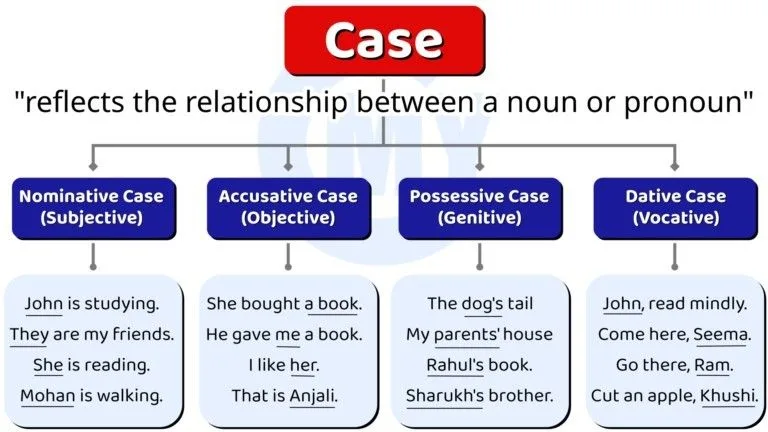
A grammatical case is a morphological marker on a noun, pronoun, adjective, or determiner that indicates the grammatical role of that noun in the sentence. "Subject," "direct object," "indirect object," "possessor," "location," and "instrument" are common roles that cases mark. The same underlying noun appears in different surface forms depending on its role.
In English, case has been nearly eliminated from nouns but survives in the pronoun system. Consider: "She gave her the book." The first pronoun "she" is nominative (subject). The second pronoun "her" is accusative (object). "The book" receives no case marking because English nouns do not inflect for case except in the possessive ("the book's cover"). The pronoun system preserves a three-way distinction: I/me/my, he/him/his, she/her/her, we/us/our, they/them/their, who/whom/whose.
This pronoun remnant is all that English preserves of what was, in Old English and in Proto-Indo-European, a full case system on every noun. Over the thousand years between Old English and modern English, the case endings eroded, and word order took over the grammatical signaling they once provided.
Languages preserve case systems of different sizes. Some languages use two cases (direct and oblique in some Romance remnants). Most case-marking Indo-European languages use four to eight. Finnish has fifteen. Hungarian has eighteen.
The Caucasian language Tsez has been analyzed with more than fifty cases, though most linguists consider some of these to be compound postpositional constructions. There is no upper bound on the number of cases a language can have, but the inventory tends to stabilize in any given language because new case distinctions are costly to learn and maintain.
English Case Remnants
Modern English pronouns preserve a three-way case distinction, but English nouns have essentially no case marking apart from the Saxon genitive (-'s). Consider the system:
Table 1: English Case Remnants in Pronouns
| Subject (nominative) | Object (accusative/dative) | Possessive (genitive) |
|---|---|---|
| I | me | my, mine |
| you | you | your, yours |
| he | him | his |
| she | her | her, hers |
| it | it | its |
| we | us | our, ours |
| they | them | their, theirs |
| who | whom | whose |
Notice that "you" and "it" have collapsed into a single form for subject and object; "him" and "them" are rare survivals of an originally distinct dative and accusative that merged centuries ago. "Whom" is the accusative of "who" and, while still correct in formal writing, is increasingly being replaced by "who" in speech.
Outside pronouns, the only English case marker on nouns is the possessive -'s, as in "John's book" or "the city's center." This is sometimes called the Saxon genitive. Some linguists argue it is no longer a case marker at all but a clitic, because it attaches to phrases rather than individual nouns ("the king of England's crown").
Russian: Six Cases
Russian has the most elaborate case system of the languages commonly studied by English speakers. All nouns, adjectives, pronouns, and determiners inflect for one of six cases, one of three genders (masculine, feminine, neuter), and one of two numbers (singular, plural).
Table 2: Russian Six Cases and Their Functions
| Case | Russian Name | Primary Function | Example Question |
|---|---|---|---|
| Nominative | именительный | Subject | Who? What? |
| Accusative | винительный | Direct object | Whom? What? |
| Genitive | родительный | Possession, negation, after some prepositions | Of whom? Of what? |
| Dative | дательный | Indirect object, recipient | To whom? To what? |
| Instrumental | творительный | Means, instrument, agent in passive | With whom? With what? |
| Prepositional | предложный | After certain prepositions (в, на, о) | About whom? In what? |
The Russian case system interacts with grammatical gender. A feminine noun ending in -а takes a different set of endings from a masculine noun ending in a consonant or from a neuter noun ending in -о. The full declension of a single noun produces 12 forms (6 cases x 2 numbers), and adjectives that modify the noun must agree in case, number, and gender, giving an even larger set of adjective forms per base word.
Table 3: Russian Declension of книга (book, feminine)
| Case | Singular | Plural |
|---|---|---|
| Nominative | книга | книги |
| Accusative | книгу | книги |
| Genitive | книги | книг |
| Dative | книге | книгам |
| Instrumental | книгой | книгами |
| Prepositional | (о) книге | (о) книгах |
A full treatment with examples and paradigms is in the Russian grammar cases complete guide. For how gender interacts with these cases, see the Russian gender nouns and adjectives agreement guide. To read the examples fluently, see the Russian Cyrillic alphabet complete guide.
German: Four Cases
German has four cases: nominative, accusative, dative, and genitive. This is a substantially reduced system compared to Russian. German also has three grammatical genders (masculine, feminine, neuter), and the case endings attach primarily to the definite article (der, die, das) rather than to the noun itself, except in the genitive and dative plural.
Table 4: German Case System and Primary Functions
| Case | German Name | Primary Function |
|---|---|---|
| Nominative | Nominativ | Subject |
| Accusative | Akkusativ | Direct object, after certain prepositions |
| Dative | Dativ | Indirect object, recipient, after certain prepositions |
| Genitive | Genitiv | Possession, after a few prepositions |
Table 5: German Definite Article Paradigm
| Case | Masculine | Feminine | Neuter | Plural |
|---|---|---|---|---|
| Nominative | der | die | das | die |
| Accusative | den | die | das | die |
| Dative | dem | der | dem | den |
| Genitive | des | der | des | der |
Only the masculine singular distinguishes nominative from accusative in the article (der vs. den). For feminine and neuter nouns, nominative and accusative articles are identical, and word order is usually what tells the reader which is which. The dative and genitive are fully distinct.
German also uses weak, mixed, and strong adjective endings depending on which determiner (if any) precedes the noun. This is considered one of the more difficult aspects of German grammar for learners.
Latin: Six Cases
Latin, though no longer a native spoken language, remains an important reference point because it is studied in the academic tradition, it is the ancestor of the Romance languages, and its case system is well documented. Latin has six cases and preserves them more consistently across noun classes than Russian does.
Table 6: Latin Six Cases
| Case | Latin Name | Primary Function |
|---|---|---|
| Nominative | nominativus | Subject |
| Accusative | accusativus | Direct object |
| Genitive | genitivus | Possession |
| Dative | dativus | Indirect object |
| Ablative | ablativus | Means, instrument, separation, agent |
| Vocative | vocativus | Direct address |
Note that Latin has a vocative case, used for directly addressing someone, and an ablative case, which covers a wide range of adverbial functions (means, manner, place from which, time when, and more). Russian has prepositional and instrumental cases that overlap somewhat with the Latin ablative, but the categories are not identical.
Table 7: Latin Declension of liber (book, masculine second declension)
| Case | Singular | Plural |
|---|---|---|
| Nominative | liber | libri |
| Accusative | librum | libros |
| Genitive | libri | librorum |
| Dative | libro | libris |
| Ablative | libro | libris |
| Vocative | liber | libri |
Latin had five major noun declensions, plus further subpatterns, and learners typically spend a significant portion of first-year Latin memorizing them. Nouns must also agree with their adjectives in case, number, and gender. This is one reason Romance languages simplified so dramatically after Latin: most daughter languages lost case on nouns entirely, preserving it only in pronouns (similar to English).
Arabic: Three Cases
Modern Standard Arabic has a three-case system: nominative (rafʿ), accusative (naṣb), and genitive (jarr). The case endings are short-vowel diacritics placed on the final consonant of the noun, and in ordinary running text these diacritics are omitted. Arabic cases thus exist in writing primarily in fully vocalized texts (the Quran, classical poetry, children's books) and in careful spoken recitation.
Table 8: Arabic Three Cases
| Case | Arabic Name | Diacritic Ending (indefinite) | Primary Function |
|---|---|---|---|
| Nominative | رَفْع (rafʿ) | -un | Subject |
| Accusative | نَصْب (naṣb) | -an | Direct object, predicate of kāna, adverbial |
| Genitive | جَرّ (jarr) | -in | Possession, object of preposition, second noun in a construct state |
Table 9: Arabic Case Endings on كتاب (book)
| Case | Indefinite | Definite | Transliteration |
|---|---|---|---|
| Nominative | كتابٌ | الكتابُ | kitābun / al-kitābu |
| Accusative | كتاباً | الكتابَ | kitāban / al-kitāba |
| Genitive | كتابٍ | الكتابِ | kitābin / al-kitābi |
The double diacritic (tanwīn) on the indefinite form is called nunation and is pronounced with a final -n sound that is not written as the letter nūn. Definite nouns (prefixed with the definite article al-) lose the final -n but keep the short vowel case ending.
In colloquial Arabic dialects (Egyptian, Levantine, Gulf, Moroccan, and so on), case endings are not pronounced at all. The dialects have shifted to word-order-based grammar, functionally similar to English. A learner who studies only Modern Standard Arabic encounters full cases; a learner of Egyptian Arabic does not. See the Arabic grammar rules complete beginners guide for the full framework.
Finnish: Fifteen Cases
Finnish is often mentioned as a case-rich language. It has fifteen cases, each with a fairly specific meaning, and most of them cover what English or German would handle with prepositions.
Table 10: The Fifteen Finnish Cases (Brief)
| Case | Example | Meaning |
|---|---|---|
| Nominative | talo | house (subject) |
| Genitive | talon | of a house |
| Accusative | talon | a house (object, sometimes) |
| Partitive | taloa | some of a house, indefinite object |
| Inessive | talossa | in a house |
| Elative | talosta | out of a house |
| Illative | taloon | into a house |
| Adessive | talolla | on a house |
| Ablative | talolta | from a house |
| Allative | talolle | to a house |
| Essive | talona | as a house |
| Translative | taloksi | (becoming) a house |
| Instructive | taloin | (with) houses (rare) |
| Abessive | talotta | without a house |
| Comitative | taloineen | with one's house |
Finnish is not a Indo-European language. It is Uralic. The case system is used primarily for what other languages handle with prepositions: "in the house," "from the house," "into the house," and so on are each a distinct case-marked form of the noun.
Japanese and Korean: Particles Instead of Case Endings
Japanese and Korean achieve the function of grammatical case through a different mechanism: post-positional particles. A particle is a small word that follows the noun and marks its role, rather than an inflectional ending fused onto the noun. Functionally the result is similar. Structurally it differs in that the noun itself does not change form.
Table 11: Japanese Core Grammatical Particles
| Particle | Rough Equivalent | Function |
|---|---|---|
| が (ga) | Nominative | Grammatical subject |
| を (wo) | Accusative | Direct object |
| に (ni) | Dative / Locative | Indirect object, destination, time |
| で (de) | Instrumental / Locative | Means, location of action |
| の (no) | Genitive | Possession, modification |
| へ (e) | Allative | Direction toward |
| から (kara) | Ablative | From |
| まで (made) | Terminative | Until, as far as |
| と (to) | Comitative | With, and |
| は (wa) | Topic marker | Marks topic (not case, but often confused for one) |
See the Japanese grammar particles complete guide for the full system, including the notoriously subtle は vs が distinction.
Korean works similarly, with particles like 이/가 (subject), 을/를 (object), 에 (location/goal), 에서 (location of action), 로/으로 (instrument/direction), and so on. The forms alternate depending on whether the noun ends in a vowel or a consonant.
Chinese has no inflectional case system and no particles that function as grammatical case markers. Chinese relies entirely on word order and, to a lesser extent, on particles that mark aspect and topic. See the Chinese grammar rules complete beginners guide for how Chinese handles grammatical relations without cases.
"I give a book to a friend" Across Languages
To make the comparison concrete, here is the same sentence rendered with case or particle markings explicit in each of the compared languages.
Table 12: "I give a book to a friend" Decomposed
| Language | Sentence | Case / Marker Analysis |
|---|---|---|
| English | I give a book to a friend. | Word order; "to" marks recipient |
| Russian | Я даю книгу другу. | книгу = accusative (direct object), другу = dative (recipient) |
| German | Ich gebe einem Freund ein Buch. | einem Freund = dative, ein Buch = accusative |
| Latin | Amico librum do. | amico = dative, librum = accusative, do = "I give" |
| Arabic (MSA) | أُعْطِي الكِتَابَ لِصَدِيقٍ | al-kitāba = accusative, li-ṣadīqin = preposition + genitive |
| Japanese | 私は友達に本をあげます (watashi wa tomodachi ni hon wo agemasu) | 友達に = particle ni (recipient), 本を = particle wo (object) |
| Mandarin | 我给朋友一本书 (wǒ gěi péngyou yī běn shū) | No case; word order; 给 = "give" |
Russian and German both use morphological case on both the object ("book") and the recipient ("friend"). Latin does the same. Arabic marks the object with accusative case and uses a preposition plus genitive for the recipient. Japanese marks both with particles. Chinese uses pure word order: subject + verb + recipient + object, with no inflection anywhere.
Summary Comparison Table
Table 13: Case Systems Across Major Languages
| Language | Number of Cases | Case Marking Location | Still Marked in Colloquial Use? |
|---|---|---|---|
| English | 2-3 (pronouns only) | Pronouns | Yes (me vs I, him vs he) |
| Russian | 6 | Noun, adjective, determiner, pronoun | Yes |
| German | 4 | Primarily article, also adjective | Yes |
| Latin | 6 | Noun, adjective, pronoun | N/A (no colloquial Latin today) |
| Greek (modern) | 4 | Noun, adjective, article, pronoun | Yes |
| Arabic (MSA) | 3 | Noun (short-vowel ending) | No (dialects drop case) |
| Finnish | 15 | Noun | Yes |
| Japanese | None (uses particles) | Separate particle words | Yes |
| Korean | None (uses particles) | Separate particle words | Yes |
| Mandarin | None | N/A | N/A |
FAQ
Q: Why did English lose its case system? A: Old English had a full four-case (or five-case) system similar to modern German's. Over centuries, contact with Old Norse and Norman French eroded the inflectional endings, and word order took over the grammatical signaling. By Chaucer's time, the system was already largely gone on nouns.
Q: Is grammatical case the same as "case" in writing style? A: No. In writing style, "case" refers to capitalization (uppercase vs. lowercase). In grammar, "case" refers to morphological role marking on nouns. The terms are unrelated despite the shared word.
Q: Do I need to memorize all Russian cases at once? A: No. Most textbooks introduce them gradually: nominative in week one, accusative and prepositional early on, then genitive, dative, and instrumental spread across the first year. The hardest part is learning to produce them automatically in speech, which takes longer than learning to recognize them in text.
Q: Why does German have both accusative and dative if they often look similar? A: They serve different grammatical functions (direct object vs. indirect object / certain prepositions). Some articles do look similar in some genders, but the full paradigm is distinct in the masculine singular (den vs. dem) and in many adjective forms.
Q: Are Japanese particles really "case" or something else? A: Linguists debate this. Particles are phonologically separate from the noun (unlike inflectional endings), but functionally they mark the same grammatical roles that morphological case marks in Russian or Latin. Most reference grammars of Japanese treat particles as a distinct category, not as case markers in the Indo-European sense.
Q: Do Arabic dialects really have no case system? A: Yes. Modern colloquial Arabic varieties (Egyptian, Levantine, Gulf, Maghrebi, and others) have lost the MSA case endings. A learner studying MSA will encounter the case system, but a learner who starts with a dialect will find grammar closer to English in this respect.
Q: What is the relationship between case and word order? A: There is an inverse trade-off. Languages with rich case marking tolerate freer word order, because the roles are signaled on the nouns themselves. Languages that have lost case (like English, Chinese) rely on word order to signal roles. Languages in between (like Spanish, which marks some direct objects with the preposition a) mix both strategies.
See Also
- Russian grammar cases complete guide
- Russian gender nouns and adjectives agreement guide
- Russian Cyrillic alphabet complete guide
- Russian verb aspects perfective imperfective guide
- Russian pronunciation and stress guide
- Arabic grammar rules complete beginners guide
- Arabic alphabet complete guide for beginners
- Arabic verb conjugation present and past tense guide
- Arabic pronunciation guide for English speakers
- Japanese grammar particles complete guide
- Japanese verb conjugation beginners guide
- Chinese grammar rules complete beginners guide
- Spanish grammar rules complete beginners guide
Frequently Asked Questions
Why did English lose its case system?
Old English had a full four-case (or five-case) system similar to modern German’s. Over centuries, contact with Old Norse and Norman French eroded the inflectional endings, and word order took over the grammatical signaling. By Chaucer’s time, the system was already largely gone on nouns.
Is grammatical case the same as 'case' in writing style?
No. In writing style, ‘case’ refers to capitalization. In grammar, ‘case’ refers to morphological role marking on nouns. The terms are unrelated despite the shared word.
Do I need to memorize all Russian cases at once?
No. Most textbooks introduce them gradually: nominative in week one, accusative and prepositional early on, then genitive, dative, and instrumental spread across the first year. The hardest part is learning to produce them automatically in speech.
Why does German have both accusative and dative if they often look similar?
They serve different grammatical functions (direct object vs. indirect object / certain prepositions). The full paradigm is distinct in the masculine singular (den vs. dem) and in many adjective forms.
Are Japanese particles really 'case' or something else?
Linguists debate this. Particles are phonologically separate from the noun (unlike inflectional endings), but functionally they mark the same grammatical roles that morphological case marks in Russian or Latin. Most reference grammars of Japanese treat particles as a distinct category.
Do Arabic dialects really have no case system?
Yes. Modern colloquial Arabic varieties (Egyptian, Levantine, Gulf, Maghrebi, and others) have lost the MSA case endings. A learner studying MSA will encounter the case system, but a learner who starts with a dialect will find grammar closer to English in this respect.
What is the relationship between case and word order?
There is an inverse trade-off. Languages with rich case marking tolerate freer word order, because the roles are signaled on the nouns themselves. Languages that have lost case (like English, Chinese) rely on word order to signal roles.