
Russian has three grammatical genders - masculine, feminine, and neuter - compared to the two-gender system of Spanish, French, and Italian. While the concept of noun gender may already be familiar to learners who have studied Romance languages, Russian gender operates with its own set of rules, a third gender category, and a direct connection to the case system that makes it central to all of Russian grammar. This guide explains Understanding Russian Gender with clear rules and worked examples.
Every noun in Russian has a fixed gender. Gender is not a choice - it is an inherent property of each word that must be learned alongside the word itself. Gender determines which adjective endings to use, which pronoun to use to replace a noun, and certain aspects of case declension. Without a solid grasp of gender, every sentence involving nouns and adjectives becomes uncertain.
The encouraging news is that Russian noun gender is largely predictable from the word's ending. There are clear patterns and relatively few exceptions compared to languages like German (which also has three genders but with far more exceptions). This guide covers how to identify the gender of any noun, the adjective ending system for each gender in the nominative case, how adjectives change across genders, and how to construct noun-adjective phrases with complete agreement.
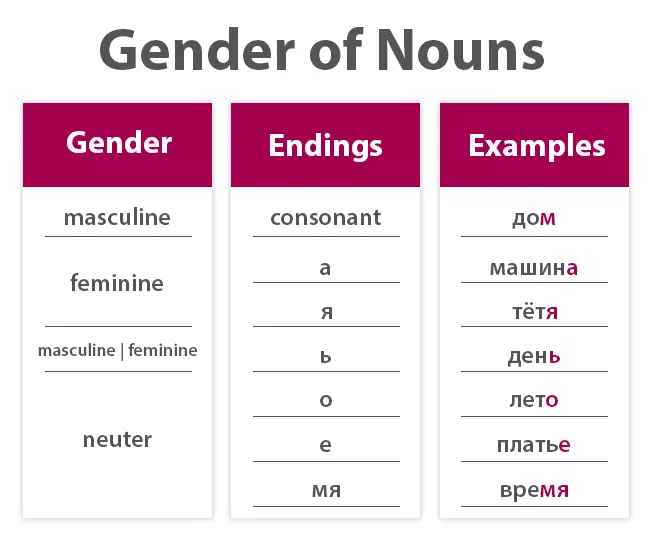
The Three Genders at a Glance
Masculine nouns are typically words that:
- End in a consonant: стол (stol) = table, банк (bank) = bank, город (gorod) = city, студент (student)
- End in -й: музей (muzey) = museum, трамвай (tramvay) = tram
- End in -ь (soft sign): словарь (slovar') = dictionary, рубль (rubl') = ruble
Feminine nouns are typically words that:
- End in -а: книга (kniga) = book, мама (mama) = mom, школа (shkola) = school
- End in -я: семья (sem'ya) = family, неделя (nedelya) = week, земля (zemlya) = earth
- End in -ь (soft sign): дверь (dver') = door, ночь (noch') = night, мать (mat') = mother
Neuter nouns are typically words that:
- End in -о: слово (slovo) = word, окно (okno) = window, молоко (moloko) = milk
- End in -е: море (more) = sea, поле (pole) = field, здание (zdaniye) = building
- End in -мя: время (vremya) = time, имя (imya) = name, знамя (znamya) = flag
Identifying Gender from Noun Endings
Table 1: Noun Gender - Ending Patterns
| Ending | Gender | Examples | Notes |
|---|---|---|---|
| Consonant | Masculine | стол, банк, год, нос | Very common masculine pattern |
| -й | Masculine | музей, трамвай, чай | |
| -ь (masc) | Masculine | словарь, рубль, июль | Must be memorized - soft sign is ambiguous |
| -а | Feminine | книга, мама, вода | Very common feminine pattern |
| -я | Feminine | семья, неделя, земля | |
| -ь (fem) | Feminine | дверь, ночь, мать | Must be memorized - soft sign is ambiguous |
| -о | Neuter | слово, окно, лицо | Very common neuter pattern |
| -е | Neuter | море, поле, здание | |
| -мя | Neuter | время, имя, знамя | Small group; special declension |
The Soft Sign Problem
The soft sign (-ь) is the main source of ambiguity in Russian noun gender. Both masculine and feminine nouns can end in a soft sign, and there is no purely visual way to tell them apart in the nominative case. You must learn the gender of soft-sign nouns individually.
Masculine soft-sign nouns (sample):
- словарь (slovar') = dictionary
- рубль (rubl') = ruble
- июль (iyul') = July
- гость (gost') = guest (m.)
- медведь (medved') = bear
Feminine soft-sign nouns (sample):
- дверь (dver') = door
- ночь (noch') = night
- мать (mat') = mother
- дочь (doch') = daughter
- тетрадь (tetrad') = notebook
- соль (sol') = salt
The practical approach: when you learn a new soft-sign noun, immediately mark its gender and memorize it as part of the word entry.
Natural Gender vs. Grammatical Gender
For nouns referring to people and animals, grammatical gender usually aligns with natural gender:
- мужчина (muzhchina) = man - grammatically feminine (ends in -а) but refers to a male
- папа (papa) = dad - grammatically feminine (ends in -а) but refers to a male
- врач (vrach) = doctor - grammatically masculine but can refer to a female doctor
- студент / студентка (student / studentka) - separate masculine and feminine forms
Words like "мужчина" (man) are grammatically feminine in their noun declension but take masculine agreement for pronouns and descriptive adjectives. These "natural gender" overrides are a small but important group.
Adjective Endings by Gender: Nominative Case
Russian adjectives change their ending to match the noun they describe in gender, number, and case. The nominative case (used for subjects) is the best place to start.
Table 2: Adjective Endings in the Nominative Case
| Gender | Hard Ending | Soft Ending | Example (noun + adj) | Translation |
|---|---|---|---|---|
| Masculine | -ый / -ой | -ий | новый стол / большой банк / синий карандаш | new table / large bank / blue pencil |
| Feminine | -ая | -яя | новая книга / большая школа / синяя ручка | new book / large school / blue pen |
| Neuter | -ое | -ее | новое слово / большое море / синее небо | new word / large sea / blue sky |
| Plural (all genders) | -ые | -ие | новые книги / синие карандаши | new books / blue pencils |
Hard vs. Soft Adjective Stems
Most adjectives follow the "hard" pattern (ending in -ый/-ая/-ое). Some adjectives - particularly those with stems ending in certain consonants or the adjective "синий" (blue) - follow the "soft" pattern (-ий/-яя/-ее).
Common hard adjectives:
- новый / новая / новое / новые (novy) = new
- старый / старая / старое / старые (stary) = old
- большой / большая / большое / большие (bolshoy) = big
- хороший / хорошая / хорошее / хорошие (khoroshy) = good (note: хороший follows soft pattern in some forms)
- красивый / красивая / красивое / красивые (krasivyy) = beautiful
- маленький / маленькая / маленькое / маленькие (malen'ky) = small
Common soft adjectives:
- синий / синяя / синее / синие (siniy) = blue
- последний / последняя / последнее / последние (posledniy) = last
- внешний / внешняя / внешнее / внешние (vneshniy) = external
- летний / летняя / летнее / летние (letniy) = summer (adj.)
Noun-Adjective Agreement in Practice
When an adjective modifies a noun, it must match in gender, number, AND case. For now, let us focus on the nominative case for all three genders.
Masculine examples:
- "Это новый стол." (Eto novy stol.) = This is a new table.
- "Это большой город." (Eto bolshoy gorod.) = This is a big city.
- "Это красивый музей." (Eto krasivyy muzey.) = This is a beautiful museum.
Feminine examples:
- "Это новая книга." (Eto novaya kniga.) = This is a new book.
- "Это большая школа." (Eto bolshaya shkola.) = This is a big school.
- "Это красивая улица." (Eto krasivaya ulitsa.) = This is a beautiful street.
Neuter examples:
- "Это новое слово." (Eto novoye slovo.) = This is a new word.
- "Это большое море." (Eto bolshoye more.) = This is a big sea.
- "Это красивое здание." (Eto krasivoye zdaniye.) = This is a beautiful building.
Plural examples (all genders):
- "Это новые книги." (Eto novyye knigi.) = These are new books.
- "Это большие города." (Eto bolshiye goroda.) = These are big cities.
- "Это красивые здания." (Eto krasivyye zdaniya.) = These are beautiful buildings.
Plural Formation of Nouns
Forming plurals in Russian also depends on gender and the final consonant of the stem.
Table 3: Plural Noun Endings
| Gender | Singular ending | Plural ending | Example |
|---|---|---|---|
| Masculine (consonant) | consonant | -ы or -и | стол - столы, банк - банки |
| Masculine (-й) | -й | -и | музей - музеи |
| Masculine (-ь) | -ь | -и | словарь - словари |
| Feminine (-а) | -а | -ы or -и | книга - книги, школа - школы |
| Feminine (-я) | -я | -и | семья - семьи, неделя - недели |
| Feminine (-ь) | -ь | -и | дверь - двери |
| Neuter (-о) | -о | -а | слово - слова, окно - окна |
| Neuter (-е) | -е | -я | море - моря, поле - поля |
The choice between -ы and -и in masculine and feminine plurals depends on the preceding consonant. After "soft consonants" (г, к, х, ж, ш, щ, ч), use -и. After hard consonants, use -ы.
Common irregulars in plural:
- друг (drug) - друзья (druz'ya) = friends
- брат (brat) - братья (brat'ya) = brothers
- дерево (derevo) - деревья (derev'ya) = trees
- человек (chelovek) - люди (lyudi) = people
- ребёнок (rebyonok) - дети (deti) = children
Adjective Agreement Across Cases
To show how adjective endings change to match both gender AND case, here is one adjective (новый = new) with one feminine noun (книга = book) across the six cases:
Table 4: Adjective-Noun Agreement - "New Book" Across Cases
| Case | Adjective | Noun | Full phrase | Translation |
|---|---|---|---|---|
| Nominative | новая | книга | новая книга | a new book (subject) |
| Accusative | новую | книгу | новую книгу | a new book (object) |
| Genitive | новой | книги | новой книги | of a new book |
| Dative | новой | книге | новой книге | to a new book |
| Instrumental | новой | книгой | новой книгой | with a new book |
| Prepositional | новой | книге | о новой книге | about a new book |
Note that Genitive, Dative, Instrumental, and Prepositional share the same feminine adjective ending (-ой). This is a useful simplification: feminine adjectives have three forms - -ая (nominative), -ую (accusative), and -ой (all other cases in singular).
Short and Long Adjective Forms
Russian has two adjective forms: long (full) and short. The long form is used attributively (before a noun: "the new book") and predicatively in most modern usage. The short form is used only predicatively (after a verb: "the book is new").
Short forms are created by removing the long ending and using:
- Masculine: bare stem (sometimes with -ен/-ён): новый - нов, красивый - красив
- Feminine: add -а: новая - нова, красивая - красива
- Neuter: add -о/-е: новое - ново, красивое - красиво
- Plural: add -ы/-и: новые - новы, красивые - красивы
Short forms in use:
- "Он умён." (On umen.) = He is intelligent. (short form, predicative)
- "Она умна." (Ona umna.) = She is intelligent.
- "Это важно." (Eto vazhno.) = This is important.
Short forms are less flexible than long forms - they cannot be used before a noun. For beginners, focus on long forms and note short forms when you encounter them in reading.
Possessive and Demonstrative Pronouns: Gender Agreement
Possessive and demonstrative pronouns also agree with the noun they modify in gender and number.
| Masculine | Feminine | Neuter | Plural | |
|---|---|---|---|---|
| my | мой (moy) | моя (moya) | моё (moyo) | мои (moi) |
| your (informal) | твой (tvoy) | твоя (tvoya) | твоё (tvoyo) | твои (tvoi) |
| his/its | его (yevo) | его (yevo) | его (yevo) | его (yevo) |
| her/its | её (yoyo) | её (yoyo) | её (yoyo) | её (yoyo) |
| this | этот (etot) | эта (eta) | это (eto) | эти (eti) |
| that | тот (tot) | та (ta) | то (to) | те (te) |
Examples:
- "Это мой словарь." (Eto moy slovar'.) = This is my dictionary. (masculine)
- "Это моя книга." (Eto moya kniga.) = This is my book. (feminine)
- "Это моё слово." (Eto moyo slovo.) = This is my word. (neuter)
- "Это мои книги." (Eto moi knigi.) = These are my books. (plural)
Common Mistakes
1. Assigning gender based on real-world meaning rather than ending "Папа" (dad) ends in -а which looks feminine, but the word takes masculine agreement for pronouns and adjectives because it refers to a male: "Мой папа" (my dad, masculine adjective) not "Моя папа."
2. Not distinguishing masculine and feminine soft-sign nouns Seeing -ь and guessing masculine. "Ночь" (night), "дочь" (daughter), "дверь" (door) are feminine. These must be memorized.
3. Using wrong adjective ending Saying "новый книга" instead of "новая книга." The adjective must match the noun's gender - книга is feminine, so the adjective takes the feminine ending.
4. Forgetting that plural adjectives have a single form for all genders "Новые книги, новые столы, новые слова" - plural adjective is the same regardless of whether the original noun was masculine, feminine, or neuter.
5. Confusing "его" used as possessive vs. as object pronoun "Его" means both "his/its" (possessive) and "him/it" (Accusative/Genitive of "он"). Context determines which is meant.
Quick Reference: Adjective Endings (Nominative)
| Masculine | Feminine | Neuter | Plural | |
|---|---|---|---|---|
| Hard | -ый / -ой | -ая | -ое | -ые |
| Soft | -ий | -яя | -ее | -ие |
Frequently Asked Questions
Q: How do I know whether a soft-sign noun is masculine or feminine? A: You must learn the gender with the word. Dictionaries always mark noun gender (m., f., n.). Make it a habit to note the gender every time you learn a new soft-sign noun.
Q: Do adjectives come before or after nouns in Russian? A: Russian adjectives typically come before the noun they modify, like English: "красивый город" (beautiful city). Adjectives after a verb are predicative: "Город красивый" (The city is beautiful).
Q: What is the difference between "большой" and "большое"? A: They are the masculine and neuter forms of the same adjective. "Большой" goes with masculine nouns (большой город = big city). "Большое" goes with neuter nouns (большое море = big sea). "Большая" goes with feminine nouns (большая школа = big school).
Q: Are there any nouns that change gender? A: A small group of nouns referring to people can apply to either male or female referents and take agreement based on natural gender. "Врач" (doctor) is grammatically masculine but when a female doctor is meant, verb predicates may agree in feminine. This is a nuanced area of Russian grammar.
Q: How does gender interact with the case system? A: Every case has different endings for masculine, feminine, and neuter nouns - and for their accompanying adjectives. Once you know a noun's gender, you can predict most of its case endings. This is why knowing gender is the foundation for learning cases.
Conclusion
Russian gender is the organizing principle behind noun declension, adjective agreement, pronoun selection, and much of the case system. The three-gender system is learnable precisely because noun gender is largely predictable from the ending - with soft-sign nouns as the main exception requiring individual memorization.
When learning any new Russian noun, always learn it with its gender and its basic case forms. This investment at the vocabulary-learning stage prevents endless confusion when constructing sentences.
The natural next step is integrating your knowledge of gender with the case system. "Russian Grammar Cases: Complete Guide for Beginners" shows how gender-specific endings appear in each of the six cases, and "Russian Verb Aspects: Perfective vs Imperfective Guide" rounds out the core structural features of the language.
Frequently Asked Questions
How do you identify a Russian noun's gender?
Most nouns ending in a consonant or -й are masculine. Most ending in -а or -я are feminine. Most ending in -о or -е are neuter. Soft-sign (-ь) nouns can be masculine or feminine and must be memorized individually.
What are the adjective endings for the three genders in nominative case?
Hard adjectives: masculine -ый/-ой, feminine -ая, neuter -ое, plural -ые. Soft adjectives: masculine -ий, feminine -яя, neuter -ее, plural -ие.
How do soft-sign nouns work for gender in Russian?
Soft-sign nouns (-ь) can be either masculine (slovar = dictionary) or feminine (dver = door). There is no visual rule to distinguish them - their gender must be learned individually with each word.
Do Russian plural adjectives change by gender?
No. In the plural, adjectives have one form for all genders: -ые (hard) or -ие (soft). ‘Novyye knigi, novyye stoly, novyye slova’ use the same plural adjective form regardless of noun gender.
What are the most common Russian irregular plural nouns?
Key irregulars: drug (friend) - druz’ya, brat (brother) - brat’ya, chelovek (person) - lyudi, rebyonok (child) - deti, derevo (tree) - derev’ya.