
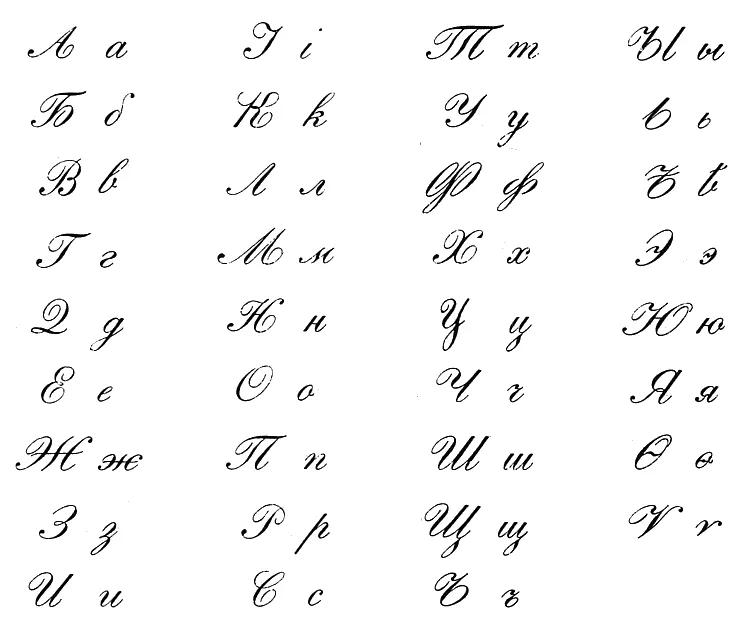
The modern Russian alphabet contains 33 letters: 10 vowels, 21 consonants, and 2 signs that carry no sound of their own but modify the letters around them. Developed from the Early Cyrillic script created in the 9th century and reformed most recently in 1918, it represents the phonology of spoken Russian far more directly than English orthography represents English.
This reference lays out every letter with its printed form, handwritten cursive form, name, Latin transliteration using the ALA-LC and scholarly systems, IPA value, and practical pronunciation notes. A dedicated section covers the so-called false friends - Cyrillic letters that share shapes with Latin letters but take entirely different sounds.
This page is built for readers who already know that Cyrillic exists and are ready to memorize it systematically. If you are just meeting Cyrillic for the first time, start with the Russian alphabet complete guide, then return here for the full phonetic reference. For word-stress and reduction patterns, which transform the way letters actually sound inside real Russian words, see the Russian pronunciation and stress guide.
Full Alphabet Chart
Table 1. The 33 letters of modern Russian in dictionary order.
| # | Upper | Lower | Name | Translit | IPA | English hint |
|---|---|---|---|---|---|---|
| 1 | А | а | а | a | /a/ | father |
| 2 | Б | б | бэ | b | /b/ | book |
| 3 | В | в | вэ | v | /v/ | voice |
| 4 | Г | г | гэ | g | /ɡ/ | go |
| 5 | Д | д | дэ | d | /d/ | dog |
| 6 | Е | е | е | e/ye | /je/ or /e/ | yes |
| 7 | Ё | ё | ё | yo | /jo/ | yogurt |
| 8 | Ж | ж | жэ | zh | /ʐ/ | meaSure |
| 9 | З | з | зэ | z | /z/ | zoo |
| 10 | И | и | и | i | /i/ | feet |
| 11 | Й | й | и краткое | y/j | /j/ | boy |
| 12 | К | к | ка | k | /k/ | key |
| 13 | Л | л | эль | l | /l/ | lamp |
| 14 | М | м | эм | m | /m/ | map |
| 15 | Н | н | эн | n | /n/ | note |
| 16 | О | о | о | o | /o/ | more (stressed) |
| 17 | П | п | пэ | p | /p/ | post |
| 18 | Р | р | эр | r | /r/ | rolled r |
| 19 | С | с | эс | s | /s/ | sun |
| 20 | Т | т | тэ | t | /t/ | top |
| 21 | У | у | у | u | /u/ | food |
| 22 | Ф | ф | эф | f | /f/ | fact |
| 23 | Х | х | ха | kh | /x/ | loch, Bach |
| 24 | Ц | ц | цэ | ts | /ts/ | cats |
| 25 | Ч | ч | че | ch | /tɕ/ | church |
| 26 | Ш | ш | ша | sh | /ʂ/ | ship |
| 27 | Щ | щ | ща | shch | /ɕː/ | fresh cheese |
| 28 | Ъ | ъ | твёрдый знак | '' | - | hard sign |
| 29 | Ы | ы | ы | y | /ɨ/ | no English match |
| 30 | Ь | ь | мягкий знак | ' | - | soft sign |
| 31 | Э | э | э | e | /ɛ/ | bet |
| 32 | Ю | ю | ю | yu | /ju/ | you |
| 33 | Я | я | я | ya | /ja/ | yard |
Memory aid: Russian has ten vowels in five pairs: А/Я, О/Ё, У/Ю, Э/Е, Ы/И. The first of each pair is "hard" (leaves the preceding consonant non-palatalized); the second is "soft" (palatalizes the preceding consonant or adds an initial /j/ after a vowel or at the start of a word).
Vowels in Detail
Russian vowels fall into two series. Hard-series vowels (а, о, у, э, ы) do not palatalize a preceding consonant. Soft-series vowels (я, ё, ю, е, и) do, and at the start of a word or after another vowel they carry an initial /j/ glide. This single distinction drives enormous amounts of Russian spelling and grammar.
- А а /a/ - "мама" (mama) mother. Unstressed А reduces toward /ɐ/ or /ə/.
- Я я /ja/ or /ʲa/ - "мясо" (myaso) meat; "яблоко" (yabloko) apple.
- О о /o/ only when stressed. "стол" (stol) table. Unstressed О reduces to /ɐ/ or /ə/ - this is the famous akanye.
- Ё ё /jo/ or /ʲo/ - always stressed. "ёлка" (yolka) fir tree; "мёд" (myod) honey. In everyday writing the two dots are often omitted, becoming a stumbling block for learners.
- У у /u/ - "утро" (utro) morning.
- Ю ю /ju/ or /ʲu/ - "юг" (yug) south.
- Э э /ɛ/ - rare letter, mostly in loanwords and demonstratives. "это" (eto) this.
- Е е /je/ or /ʲe/ - "лес" (les) forest; "ехать" (yekhat') to go by vehicle.
- Ы ы /ɨ/ - the most distinctive Russian vowel. Central, unrounded, pronounced with the tongue pulled back. "сын" (syn) son. Never occurs word-initially in native words.
- И и /i/ - "мир" (mir) world/peace.
For a full treatment of vowel reduction in unstressed syllables, see the Russian pronunciation and stress guide.
Consonants in Detail
Russian consonants come in paired hard/soft series. The same letter usually represents both, with softness signalled by the following vowel letter (or by the soft sign Ь).
Voicing pairs. Russian has six voiced/voiceless consonant pairs: Б/П, В/Ф, Г/К, Д/Т, Ж/Ш, З/С. At the end of a word or before a voiceless consonant, voiced consonants are devoiced: "хлеб" (khleb) bread is pronounced "khlep."
- Б/б /b/ - "брат" (brat) brother.
- В/в /v/ - "вода" (voda) water.
- Г/г /ɡ/ - "год" (god) year. In the genitive endings -ого/-его, Г is pronounced /v/: "его" sounds like "yevo."
- Д/д /d/ - "дом" (dom) house.
- Ж/ж /ʐ/ - retroflex, always hard. "жена" (zhena) wife.
- З/з /z/ - "зима" (zima) winter.
- Й/й /j/ - always a consonant; closes a diphthong. "чай" (chay) tea.
- К/к /k/ - "книга" (kniga) book.
- Л/л /l/ - a dark, velarized "l." Soft Л (ль) is closer to Italian gli. "лампа" (lampa) lamp.
- М/м /m/ - "мать" (mat') mother.
- Н/н /n/ - "нос" (nos) nose.
- П/п /p/ - unaspirated. "пять" (pyat') five.
- Р/р /r/ - trilled, like Spanish. "рука" (ruka) hand.
- С/с /s/ - "стол" (stol) table.
- Т/т /t/ - unaspirated. "там" (tam) there.
- Ф/ф /f/ - mostly in loanwords. "фильм" (fil'm) film.
- Х/х /x/ - voiceless velar fricative, as in Scottish "loch." "хлеб" (khleb) bread.
- Ц/ц /ts/ - always hard. "цирк" (tsirk) circus.
- Ч/ч /tɕ/ - always soft. "час" (chas) hour.
- Ш/ш /ʂ/ - always hard. "школа" (shkola) school.
- Щ/щ /ɕː/ - always soft, long. "щи" (shchi) cabbage soup.
The Two Signs: Ъ and Ь
Ь (мягкий знак, soft sign) marks palatalization of the preceding consonant. It never carries a sound of its own, but it can change the meaning of a word entirely:
- мать (mat') mother vs. мат (mat) checkmate
- угол (ugol) corner vs. уголь (ugol') coal
- брат (brat) brother vs. брать (brat') to take
Ъ (твёрдый знак, hard sign) is rare in modern Russian. It appears between a prefix ending in a consonant and a root beginning with а soft-series vowel, to prevent palatalization or a /j/ glide from incorrectly attaching: объявление (ob''yavlenie) announcement, подъезд (pod''yezd) entrance.
Key insight: Ь and Ъ are never letter-initial, never stressed, never pronounced in isolation. Think of them as punctuation for consonants.
False Friends: Letters Shared with Latin
The single biggest trap for English speakers is assuming a Cyrillic letter sounds like its Latin-shaped twin. It usually does not.
Table 2. Cyrillic letters that look like Latin letters.
| Cyrillic | Looks like | Actually is | Example |
|---|---|---|---|
| В | Latin V | /v/ | вода (voda) water |
| Н | Latin H | /n/ | нос (nos) nose |
| Р | Latin P | /r/ trilled | рука (ruka) hand |
| С | Latin C | /s/ | соль (sol') salt |
| У | Latin Y | /u/ | утро (utro) morning |
| Х | Latin X | /x/ (kh) | хлеб (khleb) bread |
| Ё | Latin E+dots | /jo/ | ёлка (yolka) fir |
| Я | Latin R backwards | /ja/ | яблоко (yabloko) apple |
| И | Latin N backwards | /i/ | имя (imya) name |
Letters that are actually identical in shape and close in sound: А, К, М, О, Т are the "safe set." Beginners should over-learn the false-friend list first and drill them until the Cyrillic reading overrides the Latin habit.
Printed vs Cursive
Russian cursive diverges sharply from print, especially for lowercase letters. Some examples that trip up learners:
- т in cursive looks like English "m"
- ш in cursive looks like English "w"
- д in cursive can look like "g" or "d" depending on handwriting school
- в in cursive resembles "B" with a loop
Learners who only read printed Russian will struggle with handwritten signs, menus, and notes. If your goal is passive reading only, skip cursive. If you plan to live in or travel through Russian-speaking regions, learn it.
Stress Marks
Dictionaries and teaching materials mark stressed syllables with an acute accent: мо́ре (more) sea. Russian text in the wild does not show stress. Because vowel quality depends on stress (especially for О, Е, Я), learning where the stress falls is effectively part of learning each word. See the Russian pronunciation and stress guide for reduction patterns, and the Russian grammar cases guide for how stress can shift across a paradigm.
Common Mistakes English Speakers Make
- Reading Р as /p/. The letter Р is /r/. The Russian /p/ is written П.
- Reading В as /b/. В is /v/. Russian /b/ is Б.
- Ignoring soft signs. Leaving out Ь in speech can turn "mother" into "checkmate."
- Forgetting final-consonant devoicing. "хлеб" reads as /xlʲep/, not /xlʲeb/.
- Pronouncing unstressed О as /o/. Unstressed О is /ɐ/ or /ə/. "Москва" sounds like "Maskva," not "Moskva."
- Treating Ы and И as the same sound. They are not. "мыло" (soap) and "мило" (cute) are different words.
- Confusing Ш and Щ. Ш is short and hard; Щ is long and soft. "наш" (our) vs "нащ" is not a real word but would be soft.
- Skipping cursive. Not a pronunciation error, but you will not read handwriting without it.
Quick Reference
| Group | Letters | Note |
|---|---|---|
| Identical look and sound | А, К, М, О, Т | Learn first |
| False friends | В, Н, Р, С, У, Х | Drill hardest |
| New shapes, familiar sounds | Б, Г, Д, З, И, Л, П, Ф, Ш, Э | Medium effort |
| New shapes, new sounds | Ж, Ц, Ч, Щ, Х, Ы | Most effort |
| Iotated vowels | Я, Е, Ё, Ю | Always palatalize or add /j/ |
| Signs | Ь, Ъ | No sound; modify neighbors |
FAQ
How many letters are in the Russian alphabet?
33 letters: 10 vowels, 21 consonants, and 2 signs (Ь and Ъ).
Why does Ё often appear written as Е?
In informal writing and most books, Ё's two dots are omitted; readers are expected to recognize the word. In children's books, dictionaries, and texts for foreign learners, Ё is written with dots. If you see "все" it could be "all" (vse) or "everyone" (vsyo, properly всё).
What's the difference between И and Й?
И is a vowel /i/. Й is a consonant /j/ that cannot appear alone as a syllable. Й typically ends a syllable: "мой" (moy) my.
Is Russian phonetic?
Mostly. Russian spelling is much more regular than English, but it is not strictly phonetic: unstressed vowel reduction, final-consonant devoicing, and the /v/-reading of Г in -ого/-его endings all mean pronunciation differs from spelling in predictable ways.
How long does memorizing the alphabet take?
Reading slowly: one to two weeks of daily 20-minute practice. Reading fluently: four to eight weeks.
Do Russians write in cursive every day?
Yes. Handwritten shopping lists, notes, personal letters, and school work use cursive.
Why are there two letters for the /i/-like sound (И, Ы)?
They are different phonemes. И is a front vowel /i/ that palatalizes preceding consonants; Ы is a central vowel /ɨ/ that does not.
See Also
- Russian alphabet Cyrillic complete guide
- Russian pronunciation and stress guide
- Russian grammar cases complete guide
- Russian six cases reference
- Russian gender of nouns and adjectives
- Russian verb aspects perfective vs imperfective
- Russian pronouns reference
- Russian numbers 1-100 with declension
Frequently Asked Questions
How many letters are in the Russian alphabet?
33 letters: 10 vowels, 21 consonants, and 2 signs (the soft sign Ь and the hard sign Ъ) that modify neighboring sounds without carrying a sound themselves.
Why does Ё often appear written as Е?
In everyday writing Ё is usually printed without its two dots; readers are expected to recognize the word. Children’s books, dictionaries, and texts for foreigners write it with dots.
What's the difference between И and Й?
И is the vowel /i/. Й is the consonant /j/, used to close diphthongs and never standing alone as a syllable.
Is Russian spelling phonetic?
Largely yes, but with predictable exceptions: unstressed vowel reduction, final-consonant devoicing, and the /v/ reading of Г in the genitive endings -ого/-его.
How long does it take to learn Cyrillic?
Most adult learners can read slowly within 1-2 weeks of daily practice and reach fluent reading in 4-8 weeks.
What is a false friend in Cyrillic?
A Cyrillic letter that shares a shape with a Latin letter but has a different sound. Examples: В=/v/, Н=/n/, Р=/r/, С=/s/, У=/u/, Х=/x/.
Why are there two letters for i-like sounds?
И /i/ and Ы /ɨ/ are genuinely different vowels. И palatalizes a preceding consonant; Ы does not. They distinguish pairs like мило (cute) vs мыло (soap).