
Russian Six Cases: Nominative, Accusative, Genitive, Dative, Instrumental, Prepositional Reference
Russian is a fusional, highly inflected language. Almost every noun, pronoun, adjective, and number changes its ending to signal its grammatical role in a sentence. There are six cases, and mastering them is the central task of intermediate Russian. This guide explains Russian Cases Explained with clear rules and worked examples.
Word order in Russian is famously free precisely because cases, not position, carry the grammatical load. "Brat vidit sestru" (the brother sees the sister) and "Sestru vidit brat" mean the same thing: the -у ending on сестру marks it as the direct object regardless of where it sits.
This reference lays out all six cases for the three genders in both singular and plural, explains the core semantic function of each case, gives the main prepositions that govern each, and provides memory devices. For background on gender itself - which drives the endings you see here - see the Russian gender of nouns and adjectives guide. For broader grammar orientation, start with the Russian grammar cases complete guide.
The Six Cases at a Glance
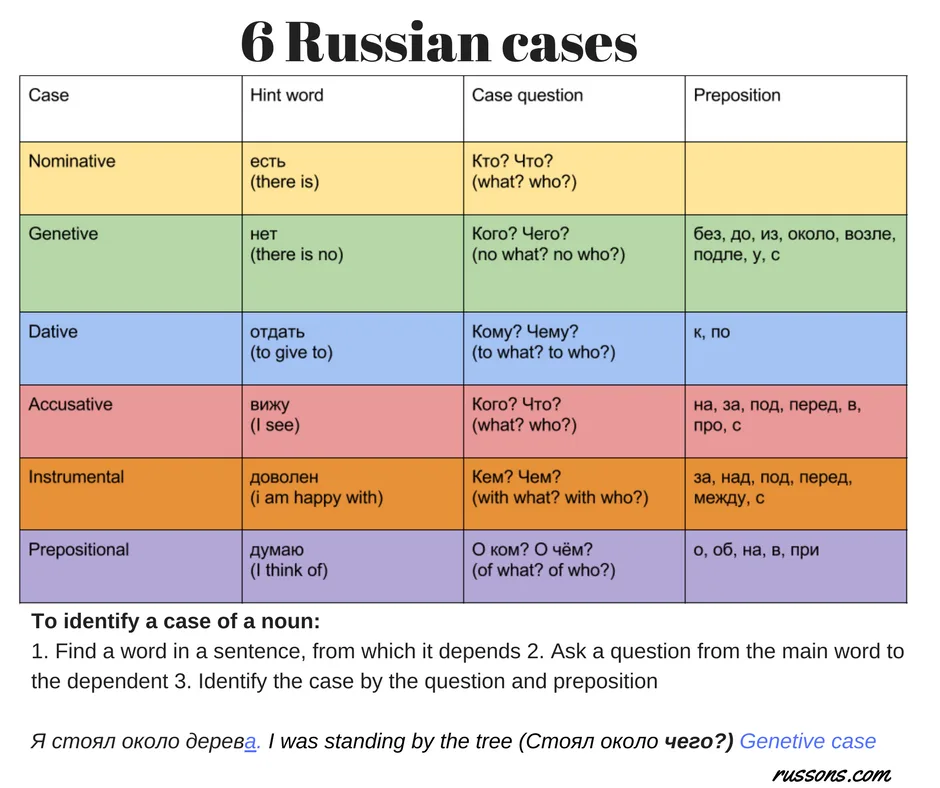
Table 1. The six cases, core functions, and typical question words.
| # | Case (Russian) | Abbrev | Core function | Question words |
|---|---|---|---|---|
| 1 | Nominative (именительный) | Nom | Subject; dictionary form | кто? что? (who? what?) |
| 2 | Genitive (родительный) | Gen | Possession, absence, of | кого? чего? |
| 3 | Dative (дательный) | Dat | Indirect object, recipient | кому? чему? |
| 4 | Accusative (винительный) | Acc | Direct object, destination | кого? что? |
| 5 | Instrumental (творительный) | Ins | Means, accompaniment | кем? чем? |
| 6 | Prepositional (предложный) | Pre | Location, topic (never alone) | о ком? о чём? где? |
Note: the traditional Russian teaching order is Nom, Gen, Dat, Acc, Ins, Pre. Most Western textbooks use the same order. The prepositional case never occurs without a preposition - hence its name.
Mnemonic (English): "Never Give Dad An Irish Pickle" - Nom, Gen, Dat, Acc, Ins, Pre.
Case-by-Case Reference
1. Nominative (именительный)
The dictionary-entry case. Used for:
- The subject of a sentence: Студент читает. (Studyent chitaet.) The student is reading.
- Naming: Это Москва. (Eto Moskva.) This is Moscow.
- The complement of "быть" in present tense (which is null): Он инженер. (On inzhener.) He is an engineer.
2. Genitive (родительный)
The workhorse case. Used for:
- Possession: книга брата (kniga brata) the brother's book.
- Absence or negation: У меня нет книги. (U menya net knigi.) I don't have a book.
- After numbers 2, 3, 4 (singular) and 5+ (plural): два студента, пять студентов.
- Quantities: чашка чая (chashka chaya) a cup of tea.
- After prepositions из, от, до, без, для, у, около, после, против, вместо.
3. Dative (дательный)
The "to" or "for" case. Used for:
- Indirect object: Я дал брату книгу. (Ya dal bratu knigu.) I gave my brother a book.
- Age: Мне двадцать лет. (Mne dvadtsat' let.) I am twenty years old.
- Impersonal constructions: Мне холодно. (Mne kholodno.) I am cold.
- After prepositions к, по.
- With verbs like помогать (to help), нравиться (to appeal to), звонить (to call).
4. Accusative (винительный)
The direct-object case. Used for:
- Direct object of a transitive verb: Я вижу дом. (Ya vizhu dom.) I see the house.
- Destination after в, на: Я иду в школу. (Ya idu v shkolu.) I'm going to school.
- Time expressions: в понедельник (v ponedel'nik) on Monday.
- After prepositions через, про, сквозь.
Key rule: For inanimate masculine nouns, accusative looks like nominative. For animate masculine nouns, accusative looks like genitive. This is the "animacy" distinction that English lacks.
5. Instrumental (творительный)
The "by means of" or "with" case. Used for:
- Tool or means: Я пишу ручкой. (Ya pishu ruchkoy.) I write with a pen.
- Accompaniment after с: с братом (s bratom) with my brother.
- Profession with быть, стать, работать: Он стал врачом. (On stal vrachom.) He became a doctor.
- After prepositions с, над, под, перед, за, между.
6. Prepositional (предложный)
Always used after a preposition. Main uses:
- Location after в, на: в доме (v dome) in the house; на столе (na stole) on the table.
- Topic after о/об: Мы говорим о Москве. (My govorim o Moskve.) We are talking about Moscow.
- After при.
Full Noun Declension Charts
Masculine nouns
Table 2. Masculine singular and plural endings. Example inanimate: стол (stol) table. Example animate: студент (studyent) student.
| Case | Sg inanimate | Sg animate | Pl inanimate | Pl animate |
|---|---|---|---|---|
| Nom | стол | студент | столы | студенты |
| Gen | стола | студента | столов | студентов |
| Dat | столу | студенту | столам | студентам |
| Acc | стол | студента | столы | студентов |
| Ins | столом | студентом | столами | студентами |
| Pre | (о) столе | (о) студенте | (о) столах | (о) студентах |
Feminine nouns
Table 3. Feminine endings for nouns in -а and -я. Example: книга (kniga) book; неделя (nedelya) week.
| Case | Sg книга | Sg неделя | Pl книги | Pl недели |
|---|---|---|---|---|
| Nom | книга | неделя | книги | недели |
| Gen | книги | недели | книг | недель |
| Dat | книге | неделе | книгам | неделям |
| Acc | книгу | неделю | книги | недели |
| Ins | книгой | неделей | книгами | неделями |
| Pre | (о) книге | (о) неделе | (о) книгах | (о) неделях |
Neuter nouns
Table 4. Neuter endings for nouns in -о and -е. Example: окно (okno) window; море (more) sea.
| Case | Sg окно | Sg море | Pl окна | Pl моря |
|---|---|---|---|---|
| Nom | окно | море | окна | моря |
| Gen | окна | моря | окон | морей |
| Dat | окну | морю | окнам | морям |
| Acc | окно | море | окна | моря |
| Ins | окном | морем | окнами | морями |
| Pre | (об) окне | (о) море | (об) окнах | (о) морях |
Soft-stem and Spelling-rule Variants
Two orthographic rules reshape endings:
Rule 1 (the 7-letter spelling rule). After Г, К, Х, Ж, Ч, Ш, Щ write И not Ы and А not Я. So "книга" becomes "книги" in nominative plural, not "книгы."
Rule 2 (the unstressed О rule). After Ж, Ч, Ш, Щ, Ц, write Е for unstressed /o/-ending positions. So instrumental of "муж" (husband) is "мужем," not "мужом."
These rules turn apparently irregular forms into predictable ones.
Adjective Agreement Across the Cases
Adjectives agree with their nouns in gender, number, and case. A sample "hard" adjective: новый (novyy) new.
Table 5. Adjective новый across singular cases.
| Case | Masculine | Feminine | Neuter |
|---|---|---|---|
| Nom | новый | новая | новое |
| Gen | нового | новой | нового |
| Dat | новому | новой | новому |
| Acc | новый/нового | новую | новое |
| Ins | новым | новой | новым |
| Pre | новом | новой | новом |
Plural for all genders:
| Case | Plural |
|---|---|
| Nom | новые |
| Gen | новых |
| Dat | новым |
| Acc | новые/новых |
| Ins | новыми |
| Pre | новых |
For deeper coverage of noun-adjective agreement, see the Russian gender guide.
Memory Mnemonics
- Ivan knows only pigs, cows, goats. I (именительный), K (not quite - use PVDRIP in another order if this one is awkward). Many learners make their own mnemonic.
- "Kto / chto" question trick. Before writing an ending, ask the question word: кто? (nom), кого? (gen/acc), кому? (dat), кем? (ins), о ком? (pre). The question word's ending matches noun endings rhythmically.
- Case meaning by preposition. Memorize prepositions with their cases, not just their meanings. "в" + accusative = motion into; "в" + prepositional = static in. The same preposition has different senses depending on case.
Common Mistakes Learners Make
- Treating the accusative as always equal to nominative. It is only for inanimate masculine and neuter singulars. Feminine singulars and animates have distinct forms.
- Forgetting the genitive after numbers. "два студента" (singular genitive), not "два студенты."
- Using nominative after prepositions. Every Russian preposition governs one or two cases; none takes nominative.
- Confusing "в + acc" (motion) with "в + pre" (location). "Я иду в школу" vs "Я в школе."
- Skipping the spelling rules. Writing "книгы" or "душой" (wrong) instead of "книги" and "душой" (correct - this one follows Rule 2 differently).
- Not learning the dative for indirect objects. English speakers tend to expect "to" + a noun; Russian uses a bare dative.
- Overlooking animate/inanimate. "Я вижу студента" not "Я вижу студент."
- Ignoring stress shift in declension. Some nouns change stress between cases (окно: sg окно́, pl о́кна).
Quick Reference: Which Preposition Takes Which Case?
Most prepositions govern one fixed case, so learning the preposition and its case together is more efficient than learning them separately. A few take two cases and switch meaning accordingly: v and na take the accusative for motion toward something and the prepositional for location. The table below lists the common ones.
| Preposition | Case | Meaning |
|---|---|---|
| у, от, из, до, без, для, около, после, против, возле | Gen | from, without, for, near |
| к, по | Dat | toward, along |
| в, на | Acc or Pre | into/onto (Acc) or in/on (Pre) |
| через, про, сквозь | Acc | through, about |
| с, над, под, перед, за, между | Ins | with, above, under |
| о, об, при | Pre | about, at |
FAQ
Why does Russian need six cases?
Because Russian marks grammatical role on the word itself rather than with fixed word order or many prepositions. This lets the speaker emphasize different elements by moving them without losing meaning. English has to keep the subject before the verb to show who is acting, but a Russian sentence stays unambiguous no matter how its parts are rearranged.
Does the accusative always equal the genitive for animates?
In the singular, only for masculine animates. Feminine singular animates have a distinct accusative in -u, so they do not follow the pattern. In the plural, the rule broadens and all animates of any gender use the genitive form for the accusative. The practical summary is that the rule is narrow in the singular and general in the plural.
What's the point of the prepositional case if it always needs a preposition?
The prepositional marks location (after v, na) and topic (after o). A separate case form prevents ambiguity with the accusative after the same prepositions, because v and na also take the accusative when they express motion toward something rather than position at it. The ending on the noun is what tells the listener which of the two meanings applies.
Is there a seventh case in Russian?
Historical Russian had a vocative for direct address, preserved today in fixed forms such as Bozhe (O God) and Gospodi (O Lord). Modern Russian has also developed a truncated new vocative, formed by dropping the final vowel, as in Mash for Masha. Neither is counted in the standard paradigm, which is taught and declined as six cases.
How do I learn all six cases quickly?
Learn one case per week and drill a single noun through all genders before moving on. Once those endings are automatic, add adjective agreement, then pronouns, then free prose. Working depth-first through one example at a time builds the pattern faster than memorizing a full grid of endings. See the Russian verb aspects guide for the other half of Russian grammar.
Do pronouns decline like nouns?
Pronouns follow similar patterns to nouns but carry more irregularities, so they cannot be learned purely by applying noun endings. Several of the most common change stem as well as ending, and some add an initial consonant after prepositions. They are best learned as their own tables. See the Russian pronouns reference.
Why do numbers trigger the genitive?
The pattern is a survival from older grammar. After 2, 3, and 4, Russian preserves what was historically a dual form, which now looks identical to the genitive singular. After 5 and above, the partitive genitive plural is used instead, expressing a quantity drawn from a larger group. See the Russian numbers with declension reference.
See Also
- Russian grammar cases complete guide
- Russian gender of nouns and adjectives
- Russian pronouns reference
- Russian numbers 1-100 with declension
- Russian verb aspects perfective vs imperfective
- Russian Cyrillic alphabet reference
- Russian pronunciation and stress guide
- Russian alphabet Cyrillic complete guide
Frequently Asked Questions
Why does Russian need six cases?
Russian marks grammatical role on the word itself rather than by fixed word order or by numerous prepositions. Cases allow flexible word order without losing meaning, so a sentence can be rearranged for emphasis while still showing clearly who is doing what to whom. English relies on position to carry that information, which is why English word order is comparatively rigid.
Does the accusative always equal the genitive for animates?
In the singular, only for masculine animate nouns. Feminine singular animate nouns have a distinct accusative ending in -u, so they do not follow the pattern. In the plural, the rule broadens: all animates across all genders take the genitive form as their accusative. The shortcut is that the animate-accusative rule is narrow in the singular and general in the plural.
What is the point of the prepositional case?
It always follows a preposition, which is what gives it its name, and it marks either location (after v and na) or topic (after o). Having a distinct form prevents confusion with the accusative, because the same prepositions v and na take the accusative when they express motion toward something rather than position at it. The case ending is what separates the two meanings.
Is there a seventh case?
Historical Russian had a vocative case for direct address, preserved today in fixed religious forms such as Bozhe and Gospodi. Modern Russian has also developed a colloquial new vocative, formed by dropping the final vowel, as in Mash for Masha. Neither is counted in the standard paradigm, which is taught and declined as six cases.
Why do numbers trigger the genitive?
The pattern is a survival from older grammar. After 2, 3, and 4, Russian preserves what was historically a dual form, which now looks identical to the genitive singular. After 5 and above, the partitive genitive plural is used instead, expressing a quantity taken from a larger group. This is why the noun ending changes as you count upward.
Do pronouns decline like nouns?
Pronouns follow similar patterns to nouns but carry more irregularities, so they cannot be learned purely by applying noun endings. Several of the most common pronouns change stem as well as ending, and some add an initial consonant after prepositions. They are best learned as their own set of tables rather than derived, so consult the Russian pronouns reference for the full paradigms.
What is the easiest way to start learning cases?
Pick one noun of each gender and drill it through all six cases in the singular, then repeat the same noun through the plural. Once those endings are automatic, add adjective agreement, then pronouns, then free prose. Working depth-first through one example of each gender builds the pattern faster than trying to memorize a full grid of endings at once.