
Arabic verb conjugation is one of the most systematic and elegant aspects of the language, and also one of the most challenging for learners coming from English. The system is built on a principle entirely absent from English: a three-consonant root is combined with specific vowel patterns and prefixes or suffixes to produce different grammatical forms. Once you understand this principle, you can conjugate any regular Arabic verb in any tense by applying the same patterns.
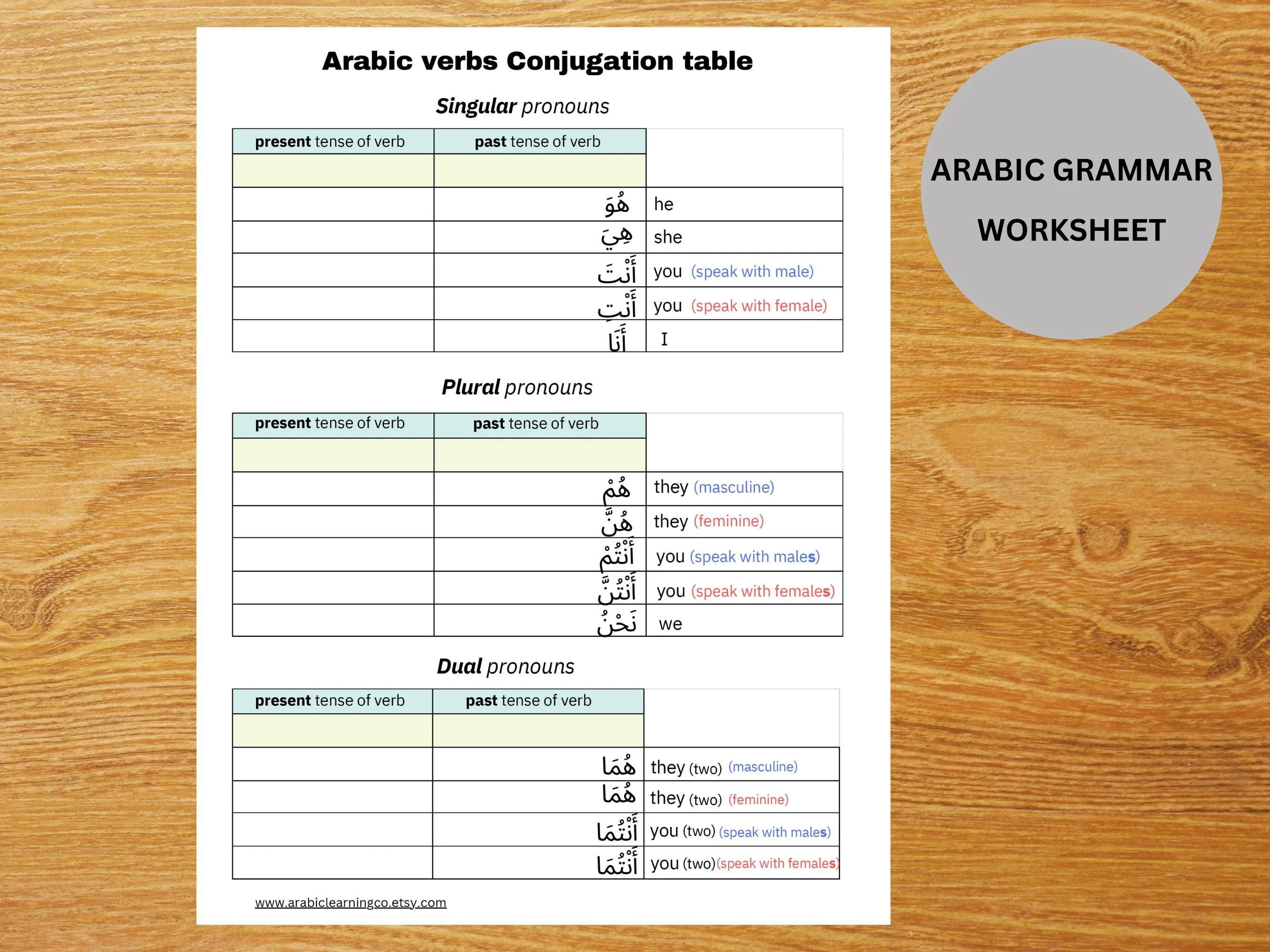
The challenge is the sheer number of forms. Arabic verbs conjugate for person (first, second, third), gender (masculine, feminine), and number (singular, dual, plural). This produces 13 distinct conjugated forms for each tense - 13 ways to say "write" or "go" or "eat" depending on who is doing it and how many of them there are. English has at most five distinct forms for any verb (write, writes, wrote, written, writing), and in practice uses far fewer.
The good news is that these 13 forms follow consistent patterns. Once you learn the pattern for the past tense and the pattern for the present tense (called mudari), you can apply them to any regular Arabic verb. Regular Arabic verbs are those whose three-letter root contains no weak letters (waw or ya) and no doubled consonant - these constitute the majority of common Arabic verbs.
This guide covers: how the root-and-pattern system works, the complete 13-form conjugation tables for past and present tense with example verb كَتَبَ (kataba - to write), how to form the present tense from the past, common irregular patterns, and over 30 example sentences.
The Root-and-Pattern System
Every Arabic verb is built from a three-consonant root. The root k-t-b carries the meaning of "writing." The root d-r-s carries the meaning of "studying." The root dh-h-b carries the meaning of "going."
A verb form is created by inserting specific vowels between these consonants, and by adding prefixes and suffixes. The past tense of the simplest verb type (Form I) uses the pattern CaCaCa for third-person masculine singular:
- ك-ت-ب + a-a-a pattern = كَتَبَ (kataba) - he wrote
- د-ر-س + a-a-a pattern = دَرَسَ (darasa) - he studied
- ذ-هـ-ب + a-a-a pattern = ذَهَبَ (dhahaba) - he went
- جَ-لَ-س + a-a-a pattern = جَلَسَ (jalasa) - he sat
- خَ-رَ-جَ + a-a-a pattern = خَرَجَ (kharaja) - he left
However, not all Form I verbs use an a-a-a pattern throughout. The middle vowel varies and is a property of the individual verb that must be memorized:
- CaCaBa: كَتَبَ (kataba) - he wrote (middle vowel a)
- CaCiBa: شَرِبَ (shariba) - he drank (middle vowel i)
- CaCuBa: كَبُرَ (kabura) - he grew big (middle vowel u)
The past tense first and second person forms do not vary in the middle vowel - that variation only appears in third person. The middle vowel is therefore a lexical property of each verb.
The 13 Forms of Arabic Verb Conjugation
Arabic verbs conjugate for three persons, two genders, and three numbers (singular, dual, plural). This creates 13 distinct forms because the first person has no gender distinction (there is no "I" masculine vs. "I" feminine in Arabic - unlike third and second person), and first person plural also has no gender distinction.
The 13 forms are:
- Third person masculine singular (he)
- Third person feminine singular (she)
- Third person masculine dual (they two, masc.)
- Third person feminine dual (they two, fem.)
- Third person masculine plural (they, masc.)
- Third person feminine plural (they, fem.)
- Second person masculine singular (you, masc.)
- Second person feminine singular (you, fem.)
- Second person dual (you two)
- Second person masculine plural (you all, masc.)
- Second person feminine plural (you all, fem.)
- First person singular (I)
- First person plural (we)
Past Tense (Al-Madi): Complete Conjugation Table
The past tense in Arabic is formed by adding suffixes to the past tense stem. The stem for Form I is typically CaCaC (the first three root consonants with a-a vowels, dropping the final -a of the base form).
Example verb: كَتَبَ (kataba) - to write (root: ك-ت-ب)
| Person | Gender | Number | Arabic | Transliteration | English |
|---|---|---|---|---|---|
| 3rd | Masc. | Singular | كَتَبَ | kataba | he wrote |
| 3rd | Fem. | Singular | كَتَبَتْ | katabat | she wrote |
| 3rd | Masc. | Dual | كَتَبَا | kataabaa | they two wrote (m) |
| 3rd | Fem. | Dual | كَتَبَتَا | katabataa | they two wrote (f) |
| 3rd | Masc. | Plural | كَتَبُوا | katabuu | they wrote (m) |
| 3rd | Fem. | Plural | كَتَبْنَ | katabna | they wrote (f) |
| 2nd | Masc. | Singular | كَتَبْتَ | katabta | you wrote (m) |
| 2nd | Fem. | Singular | كَتَبْتِ | katabti | you wrote (f) |
| 2nd | - | Dual | كَتَبْتُمَا | katabtumaa | you two wrote |
| 2nd | Masc. | Plural | كَتَبْتُمْ | katabtum | you all wrote (m) |
| 2nd | Fem. | Plural | كَتَبْتُنَّ | katabtunna | you all wrote (f) |
| 1st | - | Singular | كَتَبْتُ | katabtu | I wrote |
| 1st | - | Plural | كَتَبْنَا | katabnaa | we wrote |
Learning tip: Learn the past tense suffixes independently of any specific verb: -a, -at, -aa, -ataa, -uu, -na, -ta, -ti, -tumaa, -tum, -tunna, -tu, -naa. These same suffixes attach to the past stem of every regular Arabic verb. Memorizing the suffix table once gives you the past tense of all regular verbs.
Present Tense (Al-Mudari): Complete Conjugation Table
The present tense in Arabic is formed with both prefixes and suffixes. Each person takes a specific prefix (indicating person), and number/gender markers appear as suffixes. The present tense stem also uses a different vowel pattern from the past.
For Form I verbs, the present tense uses the pattern yaCCuCu, yaCCiCu, or yaCCaCu, depending on the individual verb. The verb كَتَبَ uses the pattern yaktubu (u-vowel on the last root consonant).
| Person | Gender | Number | Arabic | Transliteration | English |
|---|---|---|---|---|---|
| 3rd | Masc. | Singular | يَكْتُبُ | yaktubu | he writes |
| 3rd | Fem. | Singular | تَكْتُبُ | taktubu | she writes |
| 3rd | Masc. | Dual | يَكْتُبَانِ | yaktubaan | they two write (m) |
| 3rd | Fem. | Dual | تَكْتُبَانِ | taktubaan | they two write (f) |
| 3rd | Masc. | Plural | يَكْتُبُونَ | yaktubuun | they write (m) |
| 3rd | Fem. | Plural | يَكْتُبْنَ | yaktubna | they write (f) |
| 2nd | Masc. | Singular | تَكْتُبُ | taktubu | you write (m) |
| 2nd | Fem. | Singular | تَكْتُبِينَ | taktubiin | you write (f) |
| 2nd | - | Dual | تَكْتُبَانِ | taktubaan | you two write |
| 2nd | Masc. | Plural | تَكْتُبُونَ | taktubuun | you all write (m) |
| 2nd | Fem. | Plural | تَكْتُبْنَ | taktubna | you all write (f) |
| 1st | - | Singular | أَكْتُبُ | aktubu | I write |
| 1st | - | Plural | نَكْتُبُ | naktubu | we write |
The present tense prefixes are: ya- (3rd masc. sg), ta- (3rd fem. sg / 2nd masc. sg / 2nd fem. sg), ya- (3rd masc. dual), ta- (3rd fem. dual / 2nd dual), ya- (3rd masc. pl), ya- (3rd fem. pl), ta- (2nd masc. pl), ta- (2nd fem. pl), a- (1st sg), na- (1st pl).
A Second Verb: شَرِبَ (shariba) - to drink
To demonstrate that the pattern applies to any root, here is the past and present conjugation for شَرِبَ. Note the middle vowel of the past is i (not a), and the present tense pattern uses a (yakhraba type) - these are properties of this specific verb.
| Form | Past | Present |
|---|---|---|
| He | شَرِبَ (shariba) | يَشْرَبُ (yashrabu) |
| She | شَرِبَتْ (sharibat) | تَشْرَبُ (tashrabu) |
| They (m. pl) | شَرِبُوا (sharibuu) | يَشْرَبُونَ (yashrbuun) |
| You (m. sg) | شَرِبْتَ (sharibta) | تَشْرَبُ (tashrabu) |
| I | شَرِبْتُ (sharibtu) | أَشْرَبُ (ashrabu) |
| We | شَرِبْنَا (sharibnaa) | نَشْرَبُ (nashrabu) |
Common Irregular Verb Patterns
While Form I regular verbs follow the patterns above, several types of irregular (or "weak") verbs deviate due to weak letters (و waw or ي ya) in the root.
Hollow Verbs (Middle Weak Letter)
The root contains waw or ya as the middle consonant. In past tense, the middle weak letter changes:
- قَالَ (qaala) - he said (root: q-w-l, the waw becomes aa in past)
- بَاعَ (baaa) - he sold (root: b-y-a, the ya becomes aa)
- كَانَ (kaana) - he was (root: k-w-n)
Present tense: the middle letter returns in modified form:
- يَقُولُ (yaquulu) - he says
- يَبِيعُ (yabiiu) - he sells
- يَكُونُ (yakuunu) - he is/becomes
Defective Verbs (Final Weak Letter)
The root ends in waw or ya. Conjugation produces predictable alternations:
- دَعَا (daaa) - he called/invited (root: d-a-w)
- مَشَى (mashaa) - he walked (root: m-sh-y)
Example Sentences: Past and Present Tense
| Arabic | Transliteration | English |
|---|---|---|
| كَتَبْتُ رِسَالَةً | katabtu risaalatan | I wrote a letter. |
| هُوَ يَكْتُبُ الدَّرْسَ | huwa yaktubu ad-darsa | He writes/is writing the lesson. |
| شَرِبَتْ قَهْوَةً | sharibat qahwatan | She drank (a) coffee. |
| نَحْنُ نَشْرَبُ الْمَاءَ | nahnu nashrabu al-maa'a | We drink the water. |
| ذَهَبَ الطُّلَّابُ إِلَى الْمَدْرَسَةِ | dhahaba at-tullaab ilaa al-madrasa | The students went to the school. |
| هَلْ قَرَأْتَ الْكِتَابَ؟ | hal qara'ta al-kitaab? | Did you read the book? |
| أَنَا أَدْرُسُ الْعَرَبِيَّةَ | anaa adrusu al-arabiyyata | I study Arabic. |
| هِيَ تُعَلِّمُ فِي الْمَدْرَسَةِ | hiya tu'allimu fii al-madrasa | She teaches at the school. |
| أَكَلْنَا فِي الْمَطْعَمِ | akalnaa fii al-mat'am | We ate at the restaurant. |
| يَسْكُنُ فِي بَيْرُوت | yaskunu fii bayrut | He lives in Beirut. |
| سَمِعْتُ الْأَغْنِيَةَ | samitu al-ughniyata | I heard the song. |
| تَفْهَمُ الدَّرْسَ | tafhamu ad-darsa | She understands the lesson. |
| كَانَ الطَّقْسُ جَمِيلاً | kaana at-taqs jamiilan | The weather was beautiful. |
| يَقُولُ الْحَقِيقَةَ | yaquulu al-haqiiqa | He tells the truth. |
| سَافَرَ إِلَى مِصْرَ | saafara ilaa misr | He traveled to Egypt. |
Negation in Past and Present Tense
Past tense negation: Use لَمْ (lam) + present tense verb (in jussive mood, which removes final vowel):
- لَمْ يَكْتُبْ (lam yaktub) - he did not write
- لَمْ أَذْهَبْ (lam adhhab) - I did not go
Alternatively, مَا (maa) + past tense verb (more common in spoken Arabic):
- مَا كَتَبَ (maa kataba) - he did not write
Present tense negation: Use لَا (laa) + present tense verb:
- لَا يَكْتُبُ (laa yaktubu) - he does not write
- لَا أَفْهَمُ (laa afhamu) - I do not understand
Negation examples:
| Arabic | Transliteration | English |
|---|---|---|
| لَمْ أَكْتُبِ الرِّسَالَةَ | lam aktubi ar-risaala | I did not write the letter. |
| لَا أَشْرَبُ الْقَهْوَةَ | laa ashrabu al-qahwa | I do not drink coffee. |
| لَمْ يَذْهَبِ الطَّالِبُ | lam yadhhabi at-taalib | The student did not go. |
| هِيَ لَا تَفْهَمُ | hiya laa tafhamu | She does not understand. |
Common Mistakes in Verb Conjugation
Using the wrong gender form for second person. In Arabic, "you (masculine)" and "you (feminine)" are different forms. Using كَتَبْتَ (katabta - you masc. wrote) to address a woman, when كَتَبْتِ (katabti - you fem. wrote) is required, is a common and noticeable error.
Forgetting the present tense prefix. The present tense requires a prefix (ya-, ta-, a-, na-) as well as any suffixes. Omitting the prefix produces an incomplete form.
Confusing the present tense with the past. The past tense for "he wrote" is كَتَبَ; the present is يَكْتُبُ. These look different, but in unvowelized text they can appear confusingly similar. The ya- prefix on the present tense is the key distinguishing marker.
Assuming Form I is the only verb form. Arabic has ten standard derived verb forms (awzaan), each with its own meaning modification: Form II intensifies or causes, Form III creates reciprocal/opposition, Form IV causes/makes happen, etc. All use the same 13 conjugation forms but different stems. Encountering a verb from Form II or III and trying to apply Form I conjugation patterns will not work correctly.
Quick Reference: Past and Present Tense Suffixes and Prefixes
Past tense suffixes (for root katab-):
- He: -a; She: -at; They two m/f: -aa/-ataa; They m: -uu; They f: -na
- You m.sg: -ta; You f.sg: -ti; You two: -tumaa; You m.pl: -tum; You f.pl: -tunna
- I: -tu; We: -naa
Present tense (person markers - prefix + root + suffix):
- He: ya-; She/You m.sg: ta-; I: a-; We: na-
- Additional suffixes for dual (-aan) and plural (-uun/-na) attach after the root vowel
Frequently Asked Questions
Why does Arabic have so many verb forms? Arabic distinguishes gender and number in every person, which English does not. "You (masc. singular) wrote" and "you (fem. singular) wrote" are genuinely different social and grammatical realities in Arabic-speaking contexts. The 13 forms reflect the full range of who can perform an action.
Is the dual form used in everyday speech? The dual form appears regularly in Modern Standard Arabic writing and in formal speech. In some spoken dialects, the dual is less consistently used and plural forms substitute for it. For reading and formal Arabic, the dual forms should be learned.
What is the jussive mood used for? The jussive (majzuum) form of the present tense is used after لَمْ (lam - did not) for past negation, after لِ (li - in order to) for purpose clauses, and in conditional sentences. It is formed by removing the final vowel from the present tense.
How do I learn which vowel pattern a verb uses in the present tense? The present tense pattern (a, i, or u on the last root consonant) is a lexical property of each verb and must be memorized. Most dictionaries list it alongside the verb. Common high-frequency verbs are worth memorizing individually; patterns will start to feel familiar with practice.
Are Arabic verb tenses really just past and present? Arabic has two main tenses. The present tense (mudari) covers both present and future meaning, with context distinguishing them. Some grammarians recognize a future marker سَوْفَ (sawfa) or سَ (sa-) that attaches to present tense verbs to clarify future meaning. There is no separate future conjugation pattern.
Conclusion and Next Steps
Arabic verb conjugation follows a logical and consistent system. The 13 forms of past and present tense, once memorized as patterns, give you access to the full tense-and-person system of Arabic. The challenge is memorization volume - 13 forms per tense per verb - but the regularity means each new verb requires only learning the root and its present tense vowel pattern, not entirely new forms.
After mastering basic conjugation, progress to:
- The ten Arabic verb forms (Form I through Form X) and their semantic patterns
- The imperative mood for commands
- The passive voice (mabniyy lil-majhuul) which uses different vowel patterns
- The perfect aspect vs. imperfect aspect distinction in more nuanced usage
- Conditional sentences using verb sequences
Every regular Arabic verb you encounter - and there are thousands - can be conjugated correctly once you have internalized the patterns in this guide.
Frequently Asked Questions
Why does Arabic have so many verb forms?
Arabic distinguishes gender and number in every person, which English does not. You (masculine singular) and you (feminine singular) are genuinely different grammatical realities. The 13 forms reflect the full range of who can perform an action.
Is the dual form used in everyday speech?
The dual form appears regularly in Modern Standard Arabic writing and formal speech. In some spoken dialects, plural forms substitute for the dual. For reading and formal Arabic, dual forms should be learned.
How do I learn which vowel pattern a verb uses in the present tense?
The present tense pattern is a lexical property of each verb and must be memorized. Most dictionaries list it alongside the verb. Common high-frequency verbs are worth memorizing individually.
What is the jussive mood used for?
The jussive form is used after lam for past negation, after li for purpose clauses, and in conditional sentences. It is formed by removing the final vowel from the present tense form.
Does Arabic have a separate future tense?
Arabic has two main tenses: past and present (which covers both present and future meaning). The future marker sawfa or sa- attaches to present tense verbs to clarify future meaning, but there is no separate future conjugation pattern.