
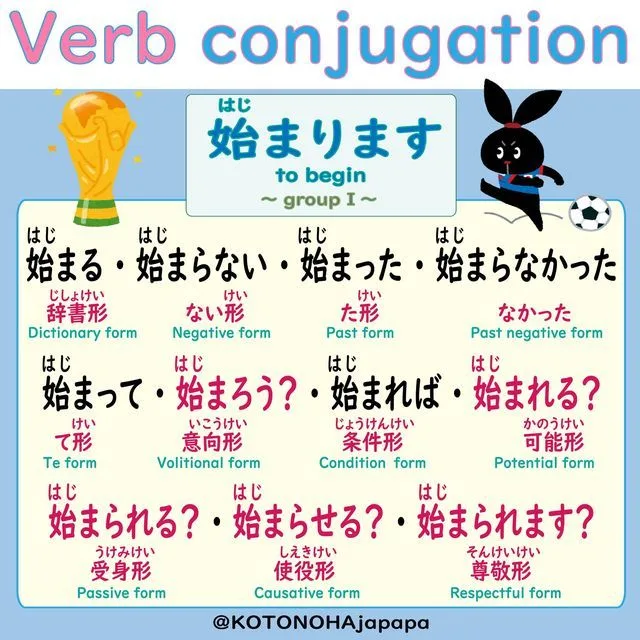
Japanese verb conjugation is simultaneously more systematic and more different from English than most learners expect. Unlike English, which changes verbs based on person and number ("I walk, he walks, they walk"), Japanese verbs do not change based on who performs the action.
There is no difference between "I eat," "you eat," and "he eats" in Japanese - the verb form is identical. Instead, Japanese verbs conjugate to express politeness level, tense, positive or negative meaning, and a range of grammatical connections to other verbs and clauses.
The good news is that Japanese verb conjugation is highly regular once you understand the three verb groups. The vast majority of Japanese verbs follow one of two predictable patterns, and there are only two genuinely irregular verbs in the entire language. This regularity means that once you learn the conjugation rules for each group, you can apply them to hundreds of new verbs automatically.
Every Japanese verb in its dictionary form (the form used in dictionaries and in plain-speech sentences) ends in a u-sound syllable. This is the fundamental characteristic of Japanese verbs. Specifically, the final syllable must be one of: u, ku, gu, su, tsu, nu, bu, mu, or ru. This fact is the basis for identifying verb groups and predicting conjugation patterns.
This guide covers the three verb groups, all core tenses and polarities in both polite and plain forms, the te-form and its many uses, and provides complete conjugation tables with hiragana, romaji, and English for all major verb forms.
The Three Verb Groups
Japanese verbs divide into three groups based on how they conjugate. Identifying the group is the first step before any conjugation.
Group 1: U-verbs (Godan Verbs)
U-verbs end in any u-sound syllable except -ru. They can end in: -u, -ku, -gu, -su, -tsu, -nu, -bu, -mu. They can also end in -ru if the vowel before -ru is NOT an i or e sound (though there are exceptions - see below).
When the verb stem is isolated (by removing the final -u sound), what remains is the stem that changes its final vowel across conjugations. This is the "five-step" (godan) change that gives these verbs their Japanese grammatical name.
Common U-verbs:
- かく (kaku) - to write
- いく (iku) - to go
- のむ (nomu) - to drink
- はなす (hanasu) - to speak
- まつ (matsu) - to wait
- あそぶ (asobu) - to play
- よむ (yomu) - to read
- かう (kau) - to buy
- おる (oru) - to fold (note: ends in -ru but vowel before is "o," not "i" or "e")
Group 2: RU-verbs (Ichidan Verbs)
RU-verbs end specifically in -ru, and the vowel immediately before -ru is always either i or e. These verbs conjugate by simply removing -ru and adding the appropriate ending. Because they only change this single final element, they are called ichidan (one-step) verbs.
Common RU-verbs:
- たべる (taberu) - to eat (vowel before ru: "e")
- みる (miru) - to see/watch (vowel before ru: "i")
- おきる (okiru) - to wake up (vowel before ru: "i")
- ねる (neru) - to sleep (vowel before ru: "e")
- でる (deru) - to leave/exit (vowel before ru: "e")
- おしえる (oshieru) - to teach (vowel before ru: "e")
- いれる (ireru) - to put in (vowel before ru: "e")
- きる (kiru) - to wear (vowel before ru: "i") - NOTE: this is a trap verb (see below)
Group 3: Irregular Verbs
Only two verbs in Japanese are truly irregular: する (suru - to do) and くる (kuru - to come). Every other verb is Group 1 or Group 2. Learn these two specially.
Learning tip: The most common error is mis-grouping verbs. A verb ending in -iru or -eru is usually (but not always) a Group 2 RU-verb. However, some -iru/-eru-ending verbs are actually Group 1 and conjugate accordingly. These must be memorized individually. Key exceptions: かえる (kaeru - to return home) is Group 1, not Group 2. はいる (hairu - to enter) is Group 1. きる (kiru - to cut) is Group 1, while きる (kiru - to wear) is Group 2.
Polite Form (Masu Form) Conjugation Table
The polite form uses the -masu ending and is appropriate for most situations: speaking with strangers, in formal contexts, with older people, in professional settings. For beginners, using the polite form exclusively is recommended.
To form the polite stem (the part before -masu), different rules apply by group.
Group 2 RU-verbs: Remove -ru, add -masu.
- たべる - stem: たべ - polite: たべます
Group 1 U-verbs: Change the final u-row vowel to the i-row equivalent, then add -masu.
- かく (ku) - stem: かき (ki) - polite: かきます
- のむ (mu) - stem: のみ (mi) - polite: のみます
- はなす (su) - stem: はなし (shi) - polite: はなします
- まつ (tsu) - stem: まち (chi) - polite: まちます
- かう (u) - stem: かい (i) - polite: かいます
Complete Conjugation Table: Four Core Forms in Polite Style
| Verb | Dictionary | Present/Future + | Present/Future - | Past + | Past - |
|---|---|---|---|---|---|
| to eat | たべる | たべます | たべません | たべました | たべませんでした |
| taberu | tabemasu | tabemasen | tabemashita | tabemasen deshita | |
| to drink | のむ | のみます | のみません | のみました | のみませんでした |
| nomu | nomimasu | nomimasen | nomimashita | nomimasen deshita | |
| to go | いく | いきます | いきません | いきました | いきませんでした |
| iku | ikimasu | ikimasen | ikimashita | ikimasen deshita | |
| to read | よむ | よみます | よみません | よみました | よみませんでした |
| yomu | yomimasu | yomimasen | yomimashita | yomimasen deshita | |
| to write | かく | かきます | かきません | かきました | かきませんでした |
| kaku | kakimasu | kakimasen | kakimashita | kakimasen deshita | |
| to speak | はなす | はなします | はなしません | はなしました | はなしませんでした |
| hanasu | hanashimasu | hanashimasen | hanashimashita | hanashimasen deshita | |
| to see | みる | みます | みません | みました | みませんでした |
| miru | mimasu | mimasen | mimashita | mimasen deshita | |
| to do | する | します | しません | しました | しませんでした |
| suru | shimasu | shimasen | shimashita | shimasen deshita | |
| to come | くる | きます | きません | きました | きませんでした |
| kuru | kimasu | kimasen | kimashita | kimasen deshita |
Plain Form (Dictionary Form) Conjugation
The plain form is used in casual speech among friends and family, in written narrative, and as the base for many grammatical constructions. Learners often encounter it in manga, novels, and movies before formal study.
Plain Form Rules
Plain present positive: Simply the dictionary form. Plain present negative: Group 2 - remove ru, add ない. Group 1 - change u-vowel to a-vowel, add ない. Irregular: しない (shinai), こない (konai). Plain past positive: Group 2 - remove ru, add た. Group 1 - follows sound change rules (below). Plain past negative: Plain present negative form minus い, add かった.
Group 1 Plain Past: Sound Change Rules
The plain past of Group 1 verbs involves sound changes that reduce the harshness of consonant clusters:
| Verb ending | Past ending | Example |
|---|---|---|
| -ku | -ita | かく - かいた (kaita) |
| -gu | -ida | およぐ - およいだ (oyoida) |
| -su | -shita | はなす - はなした (hanashita) |
| -tsu, -u, -ru | -tta | まつ - まった (matta); かう - かった (katta); おる - おった (otta) |
| -nu, -bu, -mu | -nda | のむ - のんだ (nonda); あそぶ - あそんだ (asonda) |
Exception: いく (iku - to go) is irregular in the past - it becomes いった (itta), not いいた.
Complete Plain Form Table
| Verb | Pres. + | Pres. - | Past + | Past - |
|---|---|---|---|---|
| to eat (taberu) | たべる | たべない | たべた | たべなかった |
| to drink (nomu) | のむ | のまない | のんだ | のまなかった |
| to go (iku) | いく | いかない | いった | いかなかった |
| to read (yomu) | よむ | よまない | よんだ | よまなかった |
| to write (kaku) | かく | かかない | かいた | かかなかった |
| to speak (hanasu) | はなす | はなさない | はなした | はなさなかった |
| to see (miru) | みる | みない | みた | みなかった |
| to do (suru) | する | しない | した | しなかった |
| to come (kuru) | くる | こない | きた | こなかった |
The Te-Form: The Most Useful Verb Form
The te-form is arguably the most important verb form after the basic masu and plain forms. It is used to:
- Connect verbs in sequence (first X, then Y)
- Form the present progressive (verb te-form + います)
- Make requests (verb te-form + ください)
- Express permission (verb te-form + もいいです)
- Express prohibition (verb te-form + はいけません)
- Connect to other grammatical structures
Forming the Te-Form
Group 2 RU-verbs: Remove -ru, add -te.
- たべる - たべて (tabete)
- みる - みて (mite)
Group 1 U-verbs: Follow the same sound change rules as plain past, but use -te/-de instead of -ta/-da.
| Verb ending | Te-form ending | Example |
|---|---|---|
| -ku | -ite | かく - かいて (kaite) |
| -gu | -ide | およぐ - およいで (oyoide) |
| -su | -shite | はなす - はなして (hanashite) |
| -tsu, -u, -ru | -tte | まつ - まって (matte); かう - かって (katte) |
| -nu, -bu, -mu | -nde | のむ - のんで (nonde); あそぶ - あそんで (asonde) |
Irregular: する - して (shite); くる - きて (kite)
Te-Form in Use: Example Sentences
- たべて ください - Tabete kudasai - Please eat.
- みず を のんで ください - Mizu wo nonde kudasai - Please drink water.
- てを あらって います - Te wo aratte imasu - I am washing my hands. (progressive)
- としょかんに いって、ほんを よみました - Toshokan ni itte, hon wo yomimashita - I went to the library and read a book. (sequence)
- ここに すわっても いいですか - Koko ni suwatte mo ii desu ka - May I sit here?
- はしって はいけません - Hashitte wa ikemasen - You must not run.
- にほんご を べんきょうして います - Nihongo wo benkyou shite imasu - I am studying Japanese.
Useful Verb Conjugation Patterns Beyond the Basics
Volitional Form ("Let's" / "I will")
Polite: Replace -masu with -mashou.
- いきましょう (ikimashou) - Let's go.
- たべましょう (tabemashou) - Let's eat.
Plain: Group 2 - remove ru, add you. Group 1 - change u-vowel to o-vowel, add u.
- たべよう (tabeyou) - (I'll / let's) eat.
- いこう (ikou) - (I'll / let's) go.
Potential Form ("Can do")
Group 2: Remove ru, add られる.
- たべられる (taberareru) - can eat.
Group 1: Change u-vowel to e-vowel, add る.
- かける (kakeru) - can write (from かく).
- のめる (nomeru) - can drink (from のむ).
Irregular: できる (dekiru) - can do (for する); こられる (korareru) - can come (for くる).
Example sentences with potential form:
- にほんごが はなせます - Nihongo ga hanasemasu - I can speak Japanese.
- からいものが たべられません - Karai mono ga taberaremasen - I cannot eat spicy food.
- きょうは こられますか - Kyou wa koraremasu ka - Can you come today?
30+ Example Sentences: All Forms
| Sentence | Romaji | English |
|---|---|---|
| まいにち にほんごを べんきょうします | Mainichi Nihongo wo benkyou shimasu | I study Japanese every day. |
| きのう えいがを みました | Kinou eiga wo mimashita | I watched a movie yesterday. |
| あした がっこうに いきません | Ashita gakkou ni ikimasen | I will not go to school tomorrow. |
| ともだちと ごはんを たべました | Tomodachi to gohan wo tabemashita | I ate a meal with a friend. |
| もう おきましたか | Mou okimashita ka | Did you already wake up? |
| まだ ねていません | Mada nete imasen | I haven't slept yet. |
| でんしゃで かいしゃに いきます | Densha de kaisha ni ikimasu | I go to the company by train. |
| にほんごが すこし はなせます | Nihongo ga sukoshi hanasemasu | I can speak a little Japanese. |
| てを あらって ください | Te wo aratte kudasai | Please wash your hands. |
| ここで しゃしんを とっても いいですか | Koko de shashin wo totte mo ii desu ka | May I take a photo here? |
| からいものは たべられません | Karai mono wa taberaremasen | I cannot eat spicy things. |
| いっしょに いきましょう | Issho ni ikimashou | Let's go together. |
| むずかしくて わかりませんでした | Muzukashikute wakarimasen deshita | It was difficult and I didn't understand. |
| はやく きて ください | Hayaku kite kudasai | Please come quickly. |
| まいあさ ろくじに おきます | Maiasa roku-ji ni okimasu | I wake up at 6 o'clock every morning. |
Learning tip: Learn verbs in conjugated sentences, not in isolation. When you encounter a new verb, immediately practice it in at least four sentences: present positive, present negative, past positive, past negative. This four-sentence drill cements the conjugation pattern for each new verb far faster than memorizing conjugation tables in the abstract.
Common Mistakes in Verb Conjugation
Misidentifying Group 1 vs Group 2. Verbs ending in -iru or -eru are often Group 2, but not always. はいる (hairu - to enter), かえる (kaeru - to return), きる (kiru - to cut), はしる (hashiru - to run) are all Group 1 despite ending in -iru/-eru. They must be memorized.
Forgetting the exception for いく. The verb いく (iku - to go) forms its te-form and plain past as いって (itte) and いった (itta), not いいて and いいた. This is the one exception to the -ku/-ite rule.
Confusing polite past and polite negative. たべました (tabemashita) is "ate" (past positive). たべません (tabemasen) is "do not eat" (present negative). The endings are different: -mashita vs -masen.
Using dictionary form when polite form is required. In formal or semi-formal situations, using the plain dictionary form instead of the -masu form sounds abrupt or rude. Beginners should default to -masu form with anyone except close friends.
Quick Reference: Verb Conjugation Summary
| Form | Group 2 (RU) | Group 1 (U) example: nomu |
|---|---|---|
| Dictionary | taberu | nomu |
| Polite + | tabemasu | nomimasu |
| Polite - | tabemasen | nomimasen |
| Polite past + | tabemashita | nomimashita |
| Polite past - | tabemasen deshita | nomimasen deshita |
| Plain - | tabenai | nomanai |
| Plain past + | tabeta | nonda |
| Plain past - | tabenakatta | nomanakatta |
| Te-form | tabete | nonde |
Frequently Asked Questions
Do Japanese verbs change based on who is doing the action? No. Japanese verbs do not conjugate for person or number. The same verb form is used whether the subject is I, you, he, she, we, or they. Context or pronouns identify the actor.
What is the difference between plain form and polite form? Politeness level. The plain form is used with close friends, family, and in written narrative. The polite (-masu) form is used with strangers, in formal situations, and as the default register for learners. Both forms express the same information; only the social register differs.
How many verb tenses does Japanese have? Japanese has two basic tenses: non-past (present and future combined) and past. There is no separate future tense - context and time words clarify when future actions occur. This is simpler than many European languages.
What does the te-form do exactly? The te-form is a connector form, not a tense. It connects a verb to the next grammatical element: another verb, a permission structure, a request, or a prohibition. It also forms the progressive tense when followed by います (imasu).
Are there verbs that are always polite in meaning? No. All verbs can be used in both polite and plain forms. The meaning stays the same; only the register changes. Some verbs have honorific equivalents (e.g., いらっしゃる for いる/いく/くる), but these are a separate category for advanced study.
Conclusion and Next Steps
Japanese verb conjugation is one of the most rewarding aspects of the language to study because its regularity means that effort compounds. Every new conjugation pattern you internalize applies immediately to all new verbs of that group. Unlike English, which has dozens of irregular verb forms, Japanese irregular verbs number exactly two.
After mastering the forms in this guide, advance to:
- Conditional forms (ば-form and たら-form) for "if/when" sentences
- Causative form (させる) for "make someone do"
- Passive form (られる) for "is done to"
- Causative-passive for "is made to do"
- Verb-form connections: V-te + いる (progressive/resultant state), V-te + もらう (receive the action), V-て + あげる (do for someone)
Each of these builds directly on the foundation established by mastering the basic conjugation patterns described in this guide.
Frequently Asked Questions
Do Japanese verbs change based on who is doing the action?
No. Japanese verbs do not conjugate for person or number. The same verb form is used whether the subject is I, you, he, she, we, or they. Context or pronouns identify the actor.
What is the difference between plain form and polite form?
Politeness level. The plain form is used with close friends, family, and in written narrative. The polite masu form is used with strangers and in formal situations. Both forms express the same information; only the social register differs.
How many verb tenses does Japanese have?
Japanese has two basic tenses: non-past (present and future combined) and past. There is no separate future tense - context and time words clarify when future actions occur.
What does the te-form do exactly?
The te-form is a connector form. It connects a verb to the next grammatical element: another verb, a permission structure, a request, or a prohibition. It also forms the progressive tense when followed by imasu.
How do I identify if a verb is Group 1 or Group 2?
Group 2 RU-verbs end in -iru or -eru. Group 1 U-verbs end in any other u-sound syllable. However, some verbs ending in -iru or -eru are actually Group 1 (like hairu, kaeru, kiru-to-cut) and must be memorized individually.