
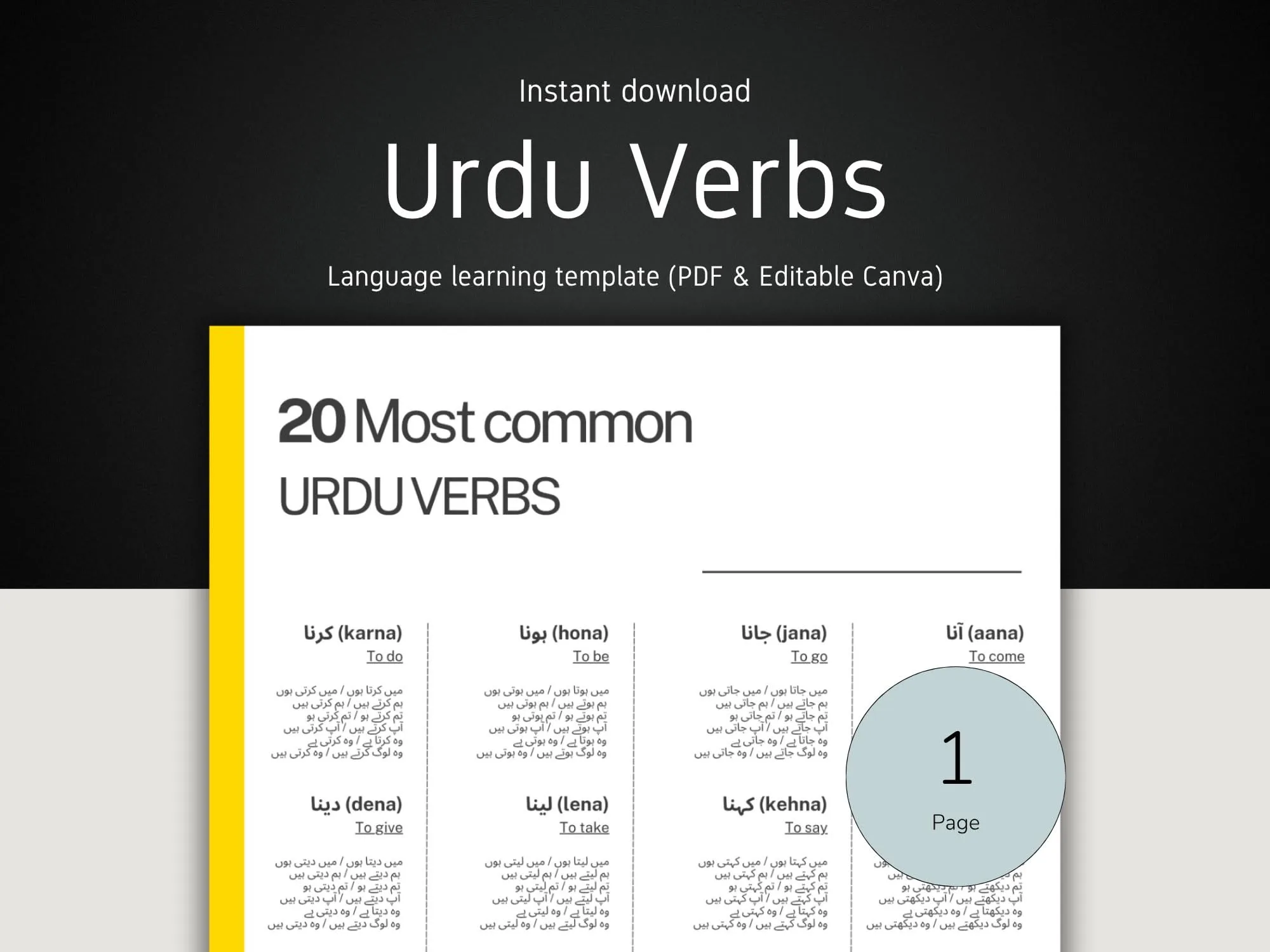
Urdu verbs combine tense, aspect, mood, gender, number, and person into a rich but systematic morphology. The core insight for learners is that Urdu does not conjugate verbs the way Latin or French do with dozens of unique forms. This reference explains Urdu Verb Conjugation with clear rules and worked examples.
Instead, Urdu builds complex verb forms by combining a small set of participles (habitual, progressive, perfect) with the auxiliary هونا (hona, "to be") in various tenses. Once you master the three core participles and the auxiliary, the entire tense and aspect system opens up.
This reference covers verb stem formation, the three participles, the auxiliary verb, present/past/future tenses, imperative, subjunctive, the progressive construction with raha, perfect forms with chuka, passive voice with jaana, causatives, and gender/number agreement. Together with Urdu Grammar: Cases, Gender, and the Ergative, this gives you the machinery to produce almost any sentence. For pronouns see Urdu Pronouns and Levels of Respect.
The Verb Infinitive and Stem
Urdu verb infinitives end in -na (نا in script): کرنا karna (to do), جانا jaana (to go), لکھنا likhna (to write), بولنا bolna (to speak), آنا aana (to come), پڑھنا paRhna (to read), سونا sona (to sleep).
The stem is the infinitive minus -na:
- کرنا karna -> stem کر kar
- جانا jaana -> stem جا ja
- لکھنا likhna -> stem لکھ likh
- پڑھنا paRhna -> stem پڑھ paRh
The stem is the base used to build all tense and aspect forms. It is also the imperative singular (tu form).
The Three Core Participles
Urdu verb conjugation revolves around three participles, each agreeing in gender and number with the subject (or patient in ergative clauses).
Habitual Participle
Used for habitual, general, or customary actions. Formed: stem + ta/ti/te.
| Subject | Ending | Example (karna) |
|---|---|---|
| Masc. sg. | -ta | کرتا karta |
| Masc. pl. | -te | کرتے karte |
| Fem. sg. | -ti | کرتی karti |
| Fem. pl. | -ti + n | کرتی karti (same as fem. sg. in most dialects) |
Perfective (Past) Participle
Used for completed actions. Formed: stem + a/i/e (with euphonic insertion for stems ending in vowels).
| Subject | Ending | Example (karna) | Example (jaana) |
|---|---|---|---|
| Masc. sg. | -a | کیا kiya | گیا gaya |
| Masc. pl. | -e | کیے kiye | گئے gaye |
| Fem. sg. | -i | کی ki | گئی gai |
| Fem. pl. | -in | کیں kin | گئیں gain |
Several verbs have irregular perfective participles:
- کرنا karna -> کیا kiya (not "kara")
- جانا jaana -> گیا gaya
- ہونا hona -> ہوا hua
- لینا lena -> لیا liya
- دینا dena -> دیا diya
- پینا peena -> پیا piya
Progressive Marker: Raha
The progressive is formed not by a participle of the main verb but by stem + raha/rahi/rahe, which is the perfective of رہنا (rehna, "to stay"):
| Subject | Ending |
|---|---|
| Masc. sg. | رہا raha |
| Masc. pl. | رہے rahe |
| Fem. sg. | رہی rahi |
| Fem. pl. | رہی rahi (with verb plural if needed) |
The Auxiliary Verb Hona
Most tenses combine a participle with a form of ہونا (hona, "to be"). The auxiliary carries person and tense; the participle carries aspect and gender/number agreement.
Present Tense of Hona
| Person | Form | Script |
|---|---|---|
| mein (I) | hoon | ہوں |
| tu (you intimate) | hai | ہے |
| tum (you familiar) | ho | ہو |
| aap (you respectful) | hain | ہیں |
| yeh/woh (he/she/it near/far) | hai | ہے |
| yeh/woh (they near/far) | hain | ہیں |
| hum (we) | hain | ہیں |
Past Tense of Hona
| Person | Masculine | Feminine |
|---|---|---|
| mein | tha ہوں نہیں، میں تھا | thi تھی |
| tu | tha تھا | thi تھی |
| tum | the تھے | thin تھیں |
| aap | the تھے | thin تھیں |
| yeh/woh sg. | tha تھا | thi تھی |
| yeh/woh pl. | the تھے | thin تھیں |
| hum | the تھے | thin تھیں |
Future Tense of Hona
Future of hona uses stem + ga/gi/ge suffix combined with subjunctive forms. See future tense below.
Present Tenses
Present Habitual
Pattern: subject + habitual participle + present auxiliary.
English "I write (habitually), I often write."
| Person | Urdu | Roman | English |
|---|---|---|---|
| mein | میں لکھتا ہوں | mein likhta hoon | I write (m.) |
| mein | میں لکھتی ہوں | mein likhti hoon | I write (f.) |
| tu | تو لکھتا ہے | tu likhta hai | you write (m., intimate) |
| tum | تم لکھتے ہو | tum likhte ho | you write (m., familiar) |
| aap | آپ لکھتے ہیں | aap likhte hain | you write (m., respectful) |
| woh sg. | وہ لکھتا ہے | woh likhta hai | he writes |
| woh sg. f. | وہ لکھتی ہے | woh likhti hai | she writes |
| hum | ہم لکھتے ہیں | hum likhte hain | we write |
| woh pl. | وہ لکھتے ہیں | woh likhte hain | they write (m.) |
Present Progressive
Pattern: subject + stem + raha/rahi/rahe + present auxiliary.
English "I am writing (right now)."
| Person | Urdu | Roman | English |
|---|---|---|---|
| mein | میں لکھ رہا ہوں | mein likh raha hoon | I am writing (m.) |
| mein | میں لکھ رہی ہوں | mein likh rahi hoon | I am writing (f.) |
| tum | تم لکھ رہے ہو | tum likh rahe ho | you are writing (m., familiar) |
| aap | آپ لکھ رہے ہیں | aap likh rahe hain | you are writing (respectful) |
| woh sg. | وہ لکھ رہا ہے | woh likh raha hai | he is writing |
Past Tenses
Past Simple (Perfective)
Pattern: subject (with ne if transitive) + stem + a/i/e/in (perfective participle).
English "I wrote, I did."
For intransitive verbs:
- میں گیا (mein gaya, "I went" m.)
- میں گئی (mein gai, "I went" f.)
- ہم گئے (hum gaye, "we went")
For transitive verbs, the agent takes ne and the verb agrees with the patient:
- میں نے کتاب لکھی (mein ne kitaab likhi, "I wrote the book" - agrees with feminine kitaab)
- میں نے خط لکھا (mein ne khat likha, "I wrote the letter" - agrees with masculine khat)
- لڑکے نے خط لکھے (larke ne khat likhe, "the boy wrote the letters" - masculine plural)
See the ergative construction in Urdu Grammar: Cases, Gender, and the Ergative for full explanation.
Past Imperfect (Habitual)
Pattern: subject + habitual participle + past auxiliary (tha/thi/the/thin).
English "I used to write, I would write."
- میں لکھتا تھا (mein likhta tha, "I used to write" m.)
- وہ روز لکھتی تھی (woh roz likhti thi, "she used to write daily")
- ہم سکول جاتے تھے (hum school jaate the, "we used to go to school")
Past Progressive
Pattern: subject + stem + raha/rahi/rahe + past auxiliary.
English "I was writing."
- میں لکھ رہا تھا (mein likh raha tha, "I was writing" m.)
- وہ آ رہی تھی (woh aa rahi thi, "she was coming")
Past Perfect
Pattern: subject (with ne if transitive) + perfective participle + past auxiliary.
English "I had written, I had gone."
- میں جا چکا تھا (mein ja chuka tha, "I had already gone" m.)
- اس نے کتاب پڑھی تھی (us ne kitaab paRhi thi, "he had read the book")
Future Tense
The future uses the subjunctive stem plus -ga/-gi/-ge for gender/number agreement.
The subjunctive stem is the verb stem plus vowel endings (oon, e, en, o, ein) for person.
| Person | Subjunctive | Future suffix | Full future |
|---|---|---|---|
| mein (m.) | likhoon | ga | likhoon ga |
| mein (f.) | likhoon | gi | likhoon gi |
| tu | likhe | ga/gi | likhe ga / likhe gi |
| tum | likho | ge | likho ge |
| aap | likhein | ge/gi | likhein ge / likhein gi |
| woh sg. | likhe | ga/gi | likhe ga / likhe gi |
| hum | likhein | ge/gi | likhein ge / likhein gi |
| woh pl. | likhein | ge/gi | likhein ge / likhein gi |
Examples:
- میں کل آؤں گا (mein kal aaoon ga, "I will come tomorrow" m.)
- وہ لکھے گی (woh likhe gi, "she will write")
- ہم جائیں گے (hum jaaein ge, "we will go")
Imperative and Subjunctive
Imperative
Three levels corresponding to the three second-person pronouns:
| Pronoun | Imperative form | Example (karna) |
|---|---|---|
| tu (intimate) | stem | کر (kar, "do!") |
| tum (familiar) | stem + o | کرو (karo, "do!") |
| aap (respectful) | stem + iye | کیجیے (kijiye, "please do") |
Irregular polite forms include: دیجیے (dijiye, from dena "to give"), لیجیے (lijiye, from lena "to take"), پیجیے (pijiye, from peena "to drink"), کیجیے (kijiye, from karna "to do").
Subjunctive
Used for wishes, possibilities, dependent clauses after ke, and polite suggestions. Forms are the same as the future stem without the -ga/-gi/-ge suffix:
- میں جاؤں (mein jaaoon, "that I may go" / "should I go")
- کیا میں آؤں؟ (kya mein aaoon?, "should I come?")
- وہ چاہتا ہے کہ میں لکھوں (woh chahta hai ke mein likhoon, "he wants me to write")
Perfect Aspects with Chuka
The perfective participle combined with chuka/chuki/chuke (from chukna, "to finish") gives a "have already done" meaning.
| Tense | Construction | Example | Meaning |
|---|---|---|---|
| Present perfect | chuka/chuki/chuke hoon/hai/hain | میں کھا چکا ہوں mein kha chuka hoon | I have already eaten |
| Past perfect | chuka/chuki/chuke tha/thi/the | وہ جا چکی تھی woh ja chuki thi | she had already gone |
| Future perfect | chuka/chuki/chuke hoon ga | میں پڑھ چکا ہوں گا mein paRh chuka hoon ga | I will have already read |
Note: chuka is always used without ne even with transitive verbs - this aspect has its own syntax.
Passive Voice
Passive is formed with the perfective participle + جانا (jaana, "to go") conjugated for tense.
- کتاب لکھی جاتی ہے (kitaab likhi jaati hai, "the book is written")
- کتاب لکھی گئی (kitaab likhi gai, "the book was written")
- کتاب لکھی جائے گی (kitaab likhi jaayegi, "the book will be written")
The participle agrees with the grammatical subject, which is now the patient.
Causatives
Urdu has regular causative morphology: insert -aa- for one-step causative (make someone do X) and -waa- for two-step causative (have someone make someone do X).
| Base | 1st causative | 2nd causative |
|---|---|---|
| کرنا karna (do) | کرانا karana (get done) | کروانا karwana (have done) |
| لکھنا likhna (write) | لکھانا likhana (teach to write) | لکھوانا likhwana (have X write) |
| پڑھنا paRhna (read) | پڑھانا paRhana (teach) | پڑھوانا paRhwana (have X teach) |
| کھانا khana (eat) | کھلانا khilana (feed) | کھلوانا khilwana (have X feed) |
The causative agent (the one who is caused to do) takes se; the causer is the subject.
Gender and Number Agreement Summary
In every tense, the verb (or its participle) must agree with one noun - which one depends on the construction:
| Construction | Verb agrees with |
|---|---|
| Intransitive any tense | Subject |
| Transitive non-past | Subject |
| Transitive past with ne | Object (patient) |
| Transitive past with ko-marked object | Defaults to masculine singular |
| Passive | Patient (new subject) |
Complete Conjugation Table: Likhna ("to Write")
| Tense | 1sg m. | 1sg f. | 3sg m. | 3sg f. | 3pl m. |
|---|---|---|---|---|---|
| Present habitual | likhta hoon | likhti hoon | likhta hai | likhti hai | likhte hain |
| Present progressive | likh raha hoon | likh rahi hoon | likh raha hai | likh rahi hai | likh rahe hain |
| Past simple (with ne) | ne likha | ne likha/likhi* | ne likha | ne likha/likhi* | ne likha/likhi* |
| Past habitual | likhta tha | likhti thi | likhta tha | likhti thi | likhte the |
| Past progressive | likh raha tha | likh rahi thi | likh raha tha | likh rahi thi | likh rahe the |
| Past perfect | likh chuka tha | likh chuki thi | likh chuka tha | likh chuki thi | likh chuke the |
| Future | likhoon ga | likhoon gi | likhe ga | likhe gi | likhein ge |
| Present perfect | likh chuka hoon | likh chuki hoon | likh chuka hai | likh chuki hai | likh chuke hain |
*With ne, the verb agrees with the object, not the subject. So "mein ne kitaab likhi" (fem. kitaab) vs "mein ne khat likha" (masc. khat).
Common Mistakes
Using stem instead of participle. Learners sometimes say "mein likh hoon" instead of "mein likhta hoon" for "I write." The habitual form needs the -ta/-ti/-te ending.
Forgetting gender agreement on verbs. A female speaker saying "mein ja raha hoon" instead of "mein ja rahi hoon" sounds wrong. Progressive participles, habitual participles, and perfective participles all agree with the subject's gender.
Confusing present progressive with present habitual. "I write" (habitual) = mein likhta hoon. "I am writing" (right now) = mein likh raha hoon. English "I write" is often habitual and maps to the first form.
Not using ne in past transitive clauses. This is the most common error for English speakers. See Urdu Grammar: Cases, Gender, and the Ergative.
Confusing imperative and infinitive. "Come" (imperative) = aao (to tum). "To come" = aana. They differ in ending.
Wrong pronoun-verb level matching. Using tum commands with aap pronouns or vice versa signals wrong formality. Match level throughout the conversation.
Treating chuka like a past tense. Chuka is perfect aspect (already done), not past. "I have already eaten" = mein kha chuka hoon; "I ate" = mein ne khaya.
Quick Reference
- Infinitive: stem + na
- Habitual: stem + ta/ti/te (agrees with subject)
- Perfective: stem + a/i/e/in (agrees with subject in intransitive, patient in ergative)
- Progressive: stem + raha/rahi/rahe
- Perfect: perfective + chuka/chuki/chuke
- Auxiliary: hona - hoon, hai, hain, ho (pres); tha, thi, the, thin (past)
- Future: subjunctive + ga/gi/ge
- Imperative: stem (tu), stem + o (tum), stem + iye (aap)
- Passive: perfective + jaana conjugated
- Causative: stem + -aa- (first) or -waa- (second)
Frequently Asked Questions
How many tenses does Urdu have? Urdu has roughly ten regularly used tense-aspect combinations: present habitual, present progressive, present perfect, past simple (perfective), past habitual, past progressive, past perfect, future, future progressive, and future perfect. Plus subjunctive, imperative, and passive transformations of each.
Is ne required in all past tenses? No. ne is only required with past tense (perfective) of transitive verbs. Past habitual, past progressive, and past perfect continuous do not use ne. "mein likhta tha" and "mein likh raha tha" use the subject in direct case with no ne.
Do Urdu verbs conjugate for person? Partially. The auxiliary hona conjugates for person (hoon, hai, ho, hain). The main verb's participle agrees for gender and number but not person. So "I write" and "he writes" have the same participle (likhta) but different auxiliaries (hoon vs hai).
How do I form negative verbs? Place nahi (not) before the verb for declarative negation: mein nahi likhta (I don't write). For prohibitions, use mat before the imperative: mat jaao (don't go). For subjunctive negation, use na: na aaye to behtar (better if he doesn't come).
What is the difference between chuka and liya? chuka marks perfect aspect (already done, completed state). liya is a compound verb formant with lena (to take), adding a nuance of completion-for-oneself: mein ne khaya (I ate) vs mein ne kha liya (I ate it up, ate it for myself). Both convey completeness but with different nuances.
Are there irregular verbs? Yes but not many. The main ones are karna (perfective kiya, not "kara"), jaana (gaya), hona (hua), lena (liya), dena (diya), peena (piya). Learn these six and the rest are regular.
How do I say "can" and "must"? "Can" uses sakna after the verb stem: mein kar sakta hoon (I can do). "Must" uses chahiye after the oblique infinitive: mujhe jaana chahiye (I must go/I should go). "Have to" uses paRna: mujhe jaana paRega (I have to go).
See Also
- Urdu Grammar: Cases, Gender, and the Ergative
- Urdu Pronouns and Levels of Respect
- Urdu Alphabet and Nasta'liq Script: Complete Guide
- Urdu Conversations: Daily Phrases and Register
- Urdu vs Hindi: Same Language, Different Scripts
- Verb Tense Systems Compared Across Languages
- Arabic Verb Conjugation: Present and Past Tense Guide
- Grammatical Cases Comparison Reference
Frequently Asked Questions
How many tenses does Urdu have?
Urdu has roughly ten regularly used tense aspect combinations: present habitual, present progressive, present perfect, past simple, past habitual, past progressive, past perfect, future, future progressive, and future perfect, plus subjunctive, imperative, and passive transformations.
Is ne required in all past tenses?
No. ne is only required with past tense perfective of transitive verbs. Past habitual, past progressive, and past perfect continuous do not use ne.
Do Urdu verbs conjugate for person?
Partially. The auxiliary hona conjugates for person. The main verb participle agrees for gender and number but not person. So I write and he writes have the same participle likhta but different auxiliaries hoon vs hai.
How do I form negative verbs?
Place nahi before the verb for declarative negation. For prohibitions use mat before the imperative. For subjunctive negation use na.
What is the difference between chuka and liya?
chuka marks perfect aspect (already done). liya is a compound verb formant with lena (to take), adding a nuance of completion for oneself. mein ne khaya is I ate; mein ne kha liya is I ate it up.
Are there irregular verbs in Urdu?
Yes but not many. The main ones are karna (kiya), jaana (gaya), hona (hua), lena (liya), dena (diya), and peena (piya). Learn these six and the rest are regular.
How do I say can and must in Urdu?
Can uses sakna after the verb stem: mein kar sakta hoon. Must or should uses chahiye after the oblique infinitive: mujhe jaana chahiye. Have to uses paRna: mujhe jaana paRega.