
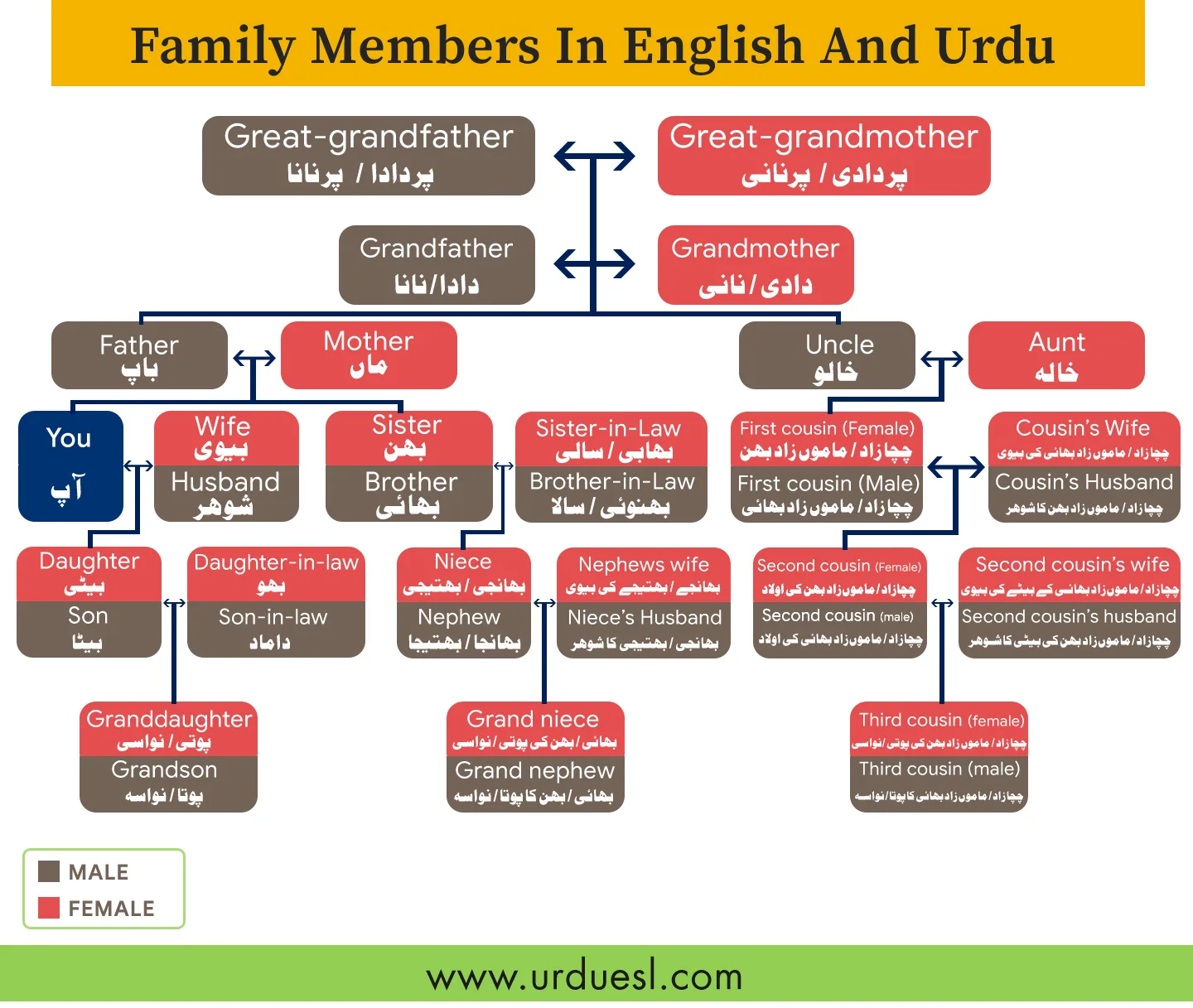
Urdu family vocabulary is one of the most precise and demanding kinship systems any learner can encounter.
Where English collapses paternal and maternal relations into shared terms (grandfather, grandmother, uncle, aunt, cousin), Urdu insists on tracking exactly which side of the family the relative comes from, distinguishing father's mother (dadi) from mother's mother (nani), father's brother (chacha) from mother's brother (mamoo), and naming each cousin by the specific aunt or uncle through whom the relationship runs.
This precision reflects the centrality of extended family in South Asian Muslim culture, where weddings, funerals, festivals, and everyday hospitality assemble dozens of relatives whose individual roles must be linguistically marked.
This reference catalogues more than one hundred Urdu kinship terms organised by direction (paternal, maternal, in-law) and generation (grandparents, parents, siblings, children, cousins, nieces and nephews). Each entry appears in Urdu script (Perso-Arabic, written right to left), Roman Urdu transliteration as used in Pakistani text messaging, and English explanation. Where Pakistani and Indian Urdu, or specifically Muslim and Hindu kinship usage, diverge, brief notes flag the differences.
Urdu kinship terminology draws principally from three layers. Native Indo-Aryan kinship (bhai, behen, beta, beti) provides the basic generational and sibling vocabulary. Persian and Arabic loanwords (walid, walida, abbu, ammi, jaan) supply the elevated and affectionate registers.
Hindi-Sanskrit equivalents (pita, mata, putra) exist in Urdu's understanding but are mostly avoided by Muslim speakers in favour of Persian-Arabic alternatives. The full kinship vocabulary, with its directional precision and register layering, is a defining feature of Urdu and Hindi alike.
For background on Urdu's historical sociolinguistics, see Urdu in Pakistan, India and the Diaspora. For loanword origins, see Urdu Persian and Arabic Loanwords. For pronoun and respect rules in family contexts, see Urdu Pronouns and Levels of Respect.
Parents (Maa-Baap)
The first family relationships any learner must master are the parents. Urdu offers multiple registers for father and mother, ranging from formal (walid, walida) to affectionate household (abbu, ammi) to childlike (papa, mama).
| Urdu | Roman Urdu | English | Register |
|---|---|---|---|
| باپ | Baap | Father (generic, somewhat blunt) | Neutral |
| ابو / ابا | Abbu / Abba | Dad, Father (intimate household) | Affectionate |
| والد | Walid | Father (formal, written) | Formal |
| پاپا | Papa | Papa (loanword, modern urban) | Casual modern |
| ماں | Maa | Mother (generic) | Neutral |
| امی / اماں | Ammi / Amma | Mom, Mother (intimate) | Affectionate |
| والدہ | Walida | Mother (formal, written) | Formal |
| ماما | Mama | Mama (loanword, modern urban) | Casual modern |
| ماں باپ | Maa-baap | Parents | Generic |
| والدین | Waalidain | Parents (formal) | Formal |
The difference between abbu and walid is a matter of intimacy and register. A son or daughter speaking to or about their own father uses abbu in nearly every household setting; walid appears in formal writing, official documents, biography, and occasionally in elevated speech. Calling one's father walid in casual conversation reads as stiff or affected. The pair walid sahib (والد صاحب) and walida sahiba (والدہ صاحبہ) is used when speaking about someone else's parents respectfully.
"The asymmetry between paternal and maternal terms in Urdu reflects an underlying patrilineal logic. The father's family (abbu's parents, abbu's siblings) is dada/dadi/chacha/phupphi territory, the mother's family (ammi's parents, ammi's siblings) is nana/nani/mamoo/khaala territory, and the two are kept lexically separate at every step. This precision lets a sentence with no other context (Mera mamoo aaya) tell you instantly which side of the family is involved."
Grandparents (Dada/Dadi vs Nana/Nani)
The paternal-maternal split begins immediately at the grandparent level. Dada and dadi are paternal grandparents (father's parents); nana and nani are maternal grandparents (mother's parents). This four-way distinction is absolute and never collapsed.
| Urdu | Roman Urdu | English |
|---|---|---|
| دادا | Dada | Paternal grandfather (father's father) |
| دادی | Dadi | Paternal grandmother (father's mother) |
| نانا | Nana | Maternal grandfather (mother's father) |
| نانی | Nani | Maternal grandmother (mother's mother) |
| دادا ابو | Dada Abbu | Affectionate for paternal grandfather |
| نانا ابو | Nana Abbu | Affectionate for maternal grandfather |
| دادی اماں | Dadi Amma | Affectionate for paternal grandmother |
| نانی اماں | Nani Amma | Affectionate for maternal grandmother |
| پر دادا | Par dada | Paternal great-grandfather |
| پر دادی | Par dadi | Paternal great-grandmother |
| پر نانا | Par nana | Maternal great-grandfather |
| پر نانی | Par nani | Maternal great-grandmother |
Pakistani and Indian children grow up calling their grandparents by these specific terms, and the affection structure is woven into nursery rhymes, lullabies, and family folklore. The phrase Nani ke ghar (نانی کے گھر, "at maternal grandmother's house") evokes summer holidays for an entire South Asian generation; Dadi ki kahaani (the story dadi tells) is a literary trope. The distinction is not merely lexical; it sorts the cultural geography of childhood.
Siblings (Bhai, Behen)
Siblings are linguistically simpler than collaterals: bhai (brother) and behen (sister) cover the basic distinction without paternal-maternal complication, since siblings share parents.
| Urdu | Roman Urdu | English |
|---|---|---|
| بھائی | Bhai | Brother |
| بہن | Behen | Sister |
| بڑا بھائی | Bara bhai | Older brother |
| چھوٹا بھائی | Chhota bhai | Younger brother |
| بڑی بہن | Bari behen | Older sister |
| چھوٹی بہن | Chhoti behen | Younger sister |
| بھائی جان | Bhai jaan | Dear brother (term of address) |
| باجی | Baji | Older sister (term of address, Pakistani) |
| آپا | Aapa | Older sister (term of address, traditional) |
| دیدی | Didi | Older sister (Indian Urdu, Hindi-influenced) |
Modes of address among siblings reveal class and regional variation. In urban Pakistani usage, baji is the default address for an older sister; aapa is more traditional and carries an old-Lucknowi or family-formal tone. Indian Urdu speakers often use didi (Hindi-derived) where Pakistani Urdu uses baji. Younger siblings have no formal address term; they are called by name.
"Bhai (brother) extends well beyond literal siblings in Urdu. A male shop-owner addressed as bhai, a male stranger addressed as bhai sahib, a male rickshaw driver as rickshaw wale bhai - this is honorific brotherhood, marking respect and harmlessness. The female equivalent baji or behen-ji performs the same fictive-kinship politeness."
Paternal Uncles and Aunts (Chacha, Taya, Phupphi)
The father's siblings are named with three-way precision: father's older brother (taya) versus father's younger brother (chacha) versus father's sister (phupphi). The age distinction between taya and chacha is critical and reflects traditional joint-family hierarchy.
| Urdu | Roman Urdu | English |
|---|---|---|
| چچا | Chacha | Father's younger brother |
| چچی | Chachi | Wife of father's younger brother |
| تایا | Taya | Father's older brother |
| تائی | Tayi | Wife of father's older brother |
| پھپھی / پھپو | Phupphi / Phupho | Father's sister |
| پھوپا | Phupha | Husband of father's sister |
In a traditional Punjabi or Pashtun joint family, the taya assumes near-paternal authority over the entire extended household, and his wife the tayi often runs the kitchen for multiple sub-families sharing one home. The chacha is closer to a friend or peer-uncle, often only a few years older than his nephews. The distinction shapes family power structures in ways modern urban Pakistanis only partially preserve.
Maternal Uncles and Aunts (Mamoo, Khaala)
The mother's siblings get their own pair: mother's brother (mamoo) and mother's sister (khaala). Notice that the older-younger distinction is less rigorously lexicalised on the maternal side; in most usage, all of the mother's brothers are mamoo regardless of birth order.
| Urdu | Roman Urdu | English |
|---|---|---|
| ماموں | Mamoo / Maamu | Mother's brother |
| ممانی | Mumaani | Wife of mother's brother |
| خالہ | Khaala | Mother's sister |
| خالو | Khaaloo | Husband of mother's sister |
The relationship between a person and their mamoo (maternal uncle) is culturally charged. In Punjabi and Pashtun tradition, the mamoo plays an honorific role at his nieces' and nephews' weddings, often providing significant gifts (mamoo ka phera) and walking the bride down.
A loving mamoo is a stock figure in Pakistani family TV dramas; a feuding one a tragic one. The word mamoo also functions slangily in some Indian usage as "fool" or "victim" but this is absent from polite Pakistani Urdu.
Cousins (Specific by Aunt/Uncle)
Here Urdu's precision peaks. There is no single word for "cousin"; instead, every cousin is named by the specific aunt or uncle through whom the relationship runs. The cousin's gender is also marked.
| Urdu | Roman Urdu | English |
|---|---|---|
| چچا زاد بھائی | Chacha-zaad bhai | Father's younger brother's son |
| چچا زاد بہن | Chacha-zaad behen | Father's younger brother's daughter |
| تایا زاد بھائی | Taya-zaad bhai | Father's older brother's son |
| تایا زاد بہن | Taya-zaad behen | Father's older brother's daughter |
| پھپھی زاد بھائی | Phupphi-zaad bhai | Father's sister's son |
| پھپھی زاد بہن | Phupphi-zaad behen | Father's sister's daughter |
| ماموں زاد بھائی | Mamoo-zaad bhai | Mother's brother's son |
| ماموں زاد بہن | Mamoo-zaad behen | Mother's brother's daughter |
| خالہ زاد بھائی | Khaala-zaad bhai | Mother's sister's son |
| خالہ زاد بہن | Khaala-zaad behen | Mother's sister's daughter |
The compound suffix -zaad (زاد, "born of") attaches to the relevant uncle/aunt term to derive the cousin term. Chacha-zaad bhai is literally "born of chacha brother" - the son of one's father's younger brother. This pattern is fully productive: any kinship base plus -zaad plus bhai/behen yields the appropriate cousin term.
| Cultural Context | Significance |
|---|---|
| Cousin marriage | Common in Pakistan; mamoo-zaad and chacha-zaad pairings frequent |
| Inheritance | Patrilineal cousins carry the family name; matrilineal do not |
| Wedding rituals | Each cousin category has its own role |
| Daily address | Cousins often addressed as bhai or behen, dropping the -zaad in casual speech |
"Cousin marriage, particularly the marriage of mamoo-zaad and khaala-zaad cousins to the same protagonist's brother or sister, is a stock plot device of Pakistani drama. Real-world cousin marriage rates in Pakistan are among the highest in the world (around 60 per cent in some regions), shaped by inheritance protection, dowry economics, and religious-cultural sanction. The kinship vocabulary's precision is partly a reflection of marriage politics."
Spouse and Children
| Urdu | Roman Urdu | English |
|---|---|---|
| شوہر | Shauhar | Husband |
| میاں | Miyaan | Husband (familiar) |
| خاوند | Khaawand | Husband (older usage) |
| بیوی | Biwi | Wife |
| اہلیہ | Ahliya | Wife (formal) |
| بیگم | Begum | Wife (formal/respectful) |
| بیٹا | Beta | Son |
| بیٹی | Beti | Daughter |
| اولاد | Aulad | Offspring, children |
| بچہ | Bachcha | Child |
| بچی | Bachchi | Female child |
| بچے | Bachche | Children |
| پوتا | Pota | Son's son (paternal grandson) |
| پوتی | Poti | Son's daughter (paternal granddaughter) |
| نواسا | Nawaasa | Daughter's son (maternal grandson) |
| نواسی | Nawaasi | Daughter's daughter (maternal granddaughter) |
Even at the grandchild level the paternal-maternal split persists: pota and poti are the son's children (carry the family name); nawaasa and nawaasi are the daughter's children (carry her husband's name). A grandfather in old-Lucknowi tradition would refer to grandchildren by these specific terms in conversation, leaving no ambiguity about which child of his is the child's parent.
In-Laws (Sas, Susar, Nand, Devar, Saala, Saali)
In-laws receive their own dense vocabulary, with separate terms for the husband's relatives versus the wife's relatives, and for each specific position. Pakistani family politics flow through these terms.
| Urdu | Roman Urdu | English |
|---|---|---|
| ساس | Saas | Mother-in-law (husband or wife's mother) |
| سسر | Susar | Father-in-law |
| سسرال | Sasural | In-laws' household |
| نند | Nand | Husband's sister (sister-in-law from H side) |
| دیور | Devar | Husband's younger brother |
| جیٹھ | Jeth | Husband's older brother |
| جیٹھانی | Jethaani | Wife of husband's older brother |
| دیورانی | Devarani | Wife of husband's younger brother |
| سالا | Saala | Wife's brother (from H perspective) |
| سالی | Saali | Wife's sister (from H perspective) |
| بہنوئی | Bahnoyi | Sister's husband |
| داماد | Damaad | Daughter's husband (son-in-law) |
| بہو | Bahu | Son's wife (daughter-in-law) |
| سمدھی | Samdhi | Co-father-in-law (your child's spouse's father) |
| سمدھن | Samdhan | Co-mother-in-law |
The relationship between a Pakistani daughter-in-law (bahu) and her mother-in-law (saas) is a classic site of family tension, the saas-bahu dynamic, dramatised endlessly in Pakistani television. A new bahu enters her sasural and must negotiate with her saas, her nand (sister-in-law from husband's side, often the most resented relative), and her devarani or jethaani (her sisters-in-law via her husband's brothers). This is a real social structure with real linguistic weight.
| Tension Pair | Cultural Note |
|---|---|
| Saas-bahu | Mother-in-law and daughter-in-law: the canonical drama relationship |
| Nand-bhabi | Sister-in-law and brother's wife: often competitive |
| Saali-jiju | Wife's sister and sister's husband: stock joking-relationship in films |
| Saala-jija | Wife's brother and sister's husband: friendly teasing |
The word saala literally meaning wife's brother has acquired a vulgar slang use as a mild insult in Hindi-Urdu (similar to "bastard" in mildness). Foreigners should be aware: even calling a friend saala in jest can land badly with the wrong audience.
Affectionate Modifiers (Jaan, Pyaare, Sahib)
Urdu kinship terms accept a layer of affectionate or respectful modifiers. The most common are jaan (life, dear), pyaare (beloved), sahib (sir), and aziz (precious).
| Modifier | Roman | Usage Example |
|---|---|---|
| جان | Jaan | Bhai jaan, abbu jaan, ammi jaan |
| پیارے | Pyaare | Pyaare beta, pyaari beti |
| صاحب | Sahib | Walid sahib, abbu sahib |
| صاحبہ | Sahiba | Walida sahiba, ammi sahiba |
| عزیز | Aziz | Aziz bhai, aziz dosti |
| ملکہ | Malika | Pet name for queen-like daughter |
A letter to one's mother in Urdu often opens with Pyaari ammi jaan (پیاری امی جان, "dear beloved mother"), stacking three affectionate modifiers. A formal letter to one's father might open with Mohtaram walid sahib (محترم والد صاحب, "respected father sir"), shifting the entire register upward.
Islamic Family Culture
Urdu kinship vocabulary maps onto Islamic family law and culture, which prescribes specific obligations, inheritance shares, and prohibited-degrees-of-marriage. Mahram (محرم) refers to relatives in prohibited-marriage degrees (parents, siblings, children, grandparents, grandchildren, paternal and maternal uncles and aunts, nieces and nephews); ghair-mahram (غیر محرم) are non-prohibited and therefore eligible for marriage (cousins, in-laws beyond certain limits).
| Concept | Urdu | English |
|---|---|---|
| محرم | Mahram | Prohibited-degree relative |
| غیر محرم | Ghair-mahram | Non-prohibited (marriageable) |
| رشتہ | Rishta | Relationship, marriage proposal |
| رشتہ دار | Rishtedaar | Relative |
| خاندان | Khaandaan | Extended family, lineage |
| نسل | Nasl | Generation, descent line |
| ورثہ | Wirsa | Inheritance |
| وارث | Waaris | Heir |
| نکاح | Nikah | Islamic marriage contract |
| جہیز | Jahez | Dowry |
| مہر | Mehr | Bride-gift in Islamic marriage |
"Islamic family practice and Urdu kinship terminology together produce a household where every relative is named, located, and obligated. A wedding announcement enumerates the bride's father, paternal and maternal grandfathers, brothers, paternal uncles, and maternal uncles by full name, locating her in a six-dimensional kinship grid before the ceremony begins. This is not bureaucratic excess; it is the cultural logic that the names track."
Common Mistakes
Using English uncle/aunt for any relative: Modern urban Pakistanis sometimes default to "uncle" and "aunty" for any older relative, papering over the chacha/taya/mamoo/khaaloo distinction. This is acceptable casual speech but loses the relational precision Urdu enforces. In family-formal contexts, use the specific terms.
Confusing dada and nana: Dada is paternal grandfather (father's father), nana is maternal grandfather (mother's father). Switching them in conversation immediately marks you as either a learner or someone outside the family who has lost track of the relationships.
Forgetting the -zaad cousin construction: Saying "my cousin" in Urdu without specifying via which uncle/aunt sounds odd. Use chacha-zaad bhai or mamoo-zaad behen with full directional precision.
Mixing Hindi pita with Urdu walid: Hindi-Urdu speakers often understand both, but pita and mata (Sanskrit-Hindi) sound religiously Hindu in formal Urdu. Pakistani Muslim contexts default to walid and walida or abbu and ammi.
Calling a sister-in-law saali: In Pakistani usage saali (wife's sister) is grammatically correct but, in casual speech, has accumulated a vulgar slang use. Use behen or behan-noyi or family-name with respect.
Mis-applying age-marked uncle terms: Taya is older brother of one's father; chacha is younger brother. Pakistani families take this seriously. Calling your taya as chacha can be received as insult to seniority.
Quick Reference Card
| Relative | Urdu Term |
|---|---|
| Father | Abbu / Walid |
| Mother | Ammi / Walida |
| Older brother | Bara bhai |
| Younger sister | Chhoti behen |
| Father's father | Dada |
| Mother's father | Nana |
| Father's mother | Dadi |
| Mother's mother | Nani |
| Father's older brother | Taya |
| Father's younger brother | Chacha |
| Mother's brother | Mamoo |
| Father's sister | Phupphi |
| Mother's sister | Khaala |
| Husband | Shauhar / Miyaan |
| Wife | Biwi / Begum |
| Son | Beta |
| Daughter | Beti |
| Mother-in-law | Saas |
| Father-in-law | Susar |
| Daughter-in-law | Bahu |
| Son-in-law | Damaad |
Frequently Asked Questions
Why does Urdu distinguish paternal and maternal grandparents? Because the underlying kinship system is patrilineal, with property, family name, and household-residence flowing through the father's line. The dada/nana distinction lets a sentence with no other context tell you whether the relative shares your family name or not. English collapses this because Anglo-Saxon kinship is bilateral and largely indifferent to the line.
Is cousin marriage really common in Pakistan? Yes. Cousin marriage rates in Pakistan are among the highest in the world, around 50 to 60 per cent in some regions and demographics. The preferred match is often a mamoo-zaad cousin (mother's brother's child) or chacha-zaad cousin (father's younger brother's child). Inheritance protection, dowry economics, and religious sanction reinforce the practice.
What is the difference between abbu and walid? Both mean father. Abbu (also abba) is the affectionate household term used by sons and daughters to and about their own father. Walid is formal and written, used in documents, biographies, formal speech, or when speaking respectfully of someone else's father (walid sahib).
What does -zaad mean in cousin terms? The Persian-origin suffix -zaad means "born of" or "child of". Chacha-zaad bhai is "the son born of chacha", that is, the son of one's father's younger brother. The pattern is fully productive across all uncle/aunt terms.
How should I address my Pakistani friend's mother? Aunty is acceptable in modern urban Pakistani usage, especially among younger people. More respectful is khaala (literally maternal aunt, used with friends' mothers as fictive kinship) or aap with appropriate honorifics. Avoid using the friend's mother's first name; that is too casual.
What is sasural? Sasural is the household of one's in-laws, specifically the household where one's spouse grew up. A bride moving to her sasural is a major life transition in Pakistani culture, marked by ceremony (rukhsati). The word evokes the new home, the new family, and the new social position simultaneously.
Why are there so many in-law terms? Because traditional Pakistani households are joint families where a married couple lives with the husband's parents and often his brothers and their wives. Every relative in this dense household has a specific position with specific obligations and rivalries, and the language tracks them all. Nuclear family migration to cities is slowly eroding the relevance of some terms but they remain culturally alive.
See Also
- Urdu Common Phrases and Daily Conversation Reference
- Urdu Pronouns and Levels of Respect
- Urdu Persian and Arabic Loanwords
- Urdu in Pakistan, India and the Diaspora
- Urdu vs Hindi: Same Language, Different Scripts
- Urdu Grammar: Cases, Gender and Ergative
- Urdu Conversations and Daily Phrases by Register
Author: Kalenux Team
Frequently Asked Questions
Why does Urdu distinguish paternal and maternal grandparents?
The underlying kinship system is patrilineal, with property and family name flowing through the father’s line. The dada/nana distinction tracks whether a relative shares your family name. English collapses this because Anglo-Saxon kinship is bilateral.
Is cousin marriage really common in Pakistan?
Yes, around 50 to 60 per cent in some regions. Preferred matches are often mamoo-zaad or chacha-zaad cousins. Inheritance protection, dowry economics, and religious sanction reinforce the practice.
What is the difference between abbu and walid?
Both mean father. Abbu is affectionate household term. Walid is formal and written, used in documents, biographies, or when speaking respectfully of someone else’s father.
What does -zaad mean in cousin terms?
The Persian-origin suffix means born of. Chacha-zaad bhai is the son of one’s father’s younger brother. The pattern is fully productive across all uncle and aunt terms.
How should I address my Pakistani friend's mother?
Aunty is acceptable in urban Pakistani usage. More respectful is khaala used as fictive kinship. Avoid using the mother’s first name.
What is sasural?
The household of one’s in-laws, specifically where one’s spouse grew up. A bride moving to her sasural is a major life transition marked by ceremony (rukhsati).
Why are there so many in-law terms?
Traditional Pakistani households are joint families where a married couple lives with the husband’s parents and often his brothers’ families. Every relative has a specific position with specific obligations, and the language tracks them all.