
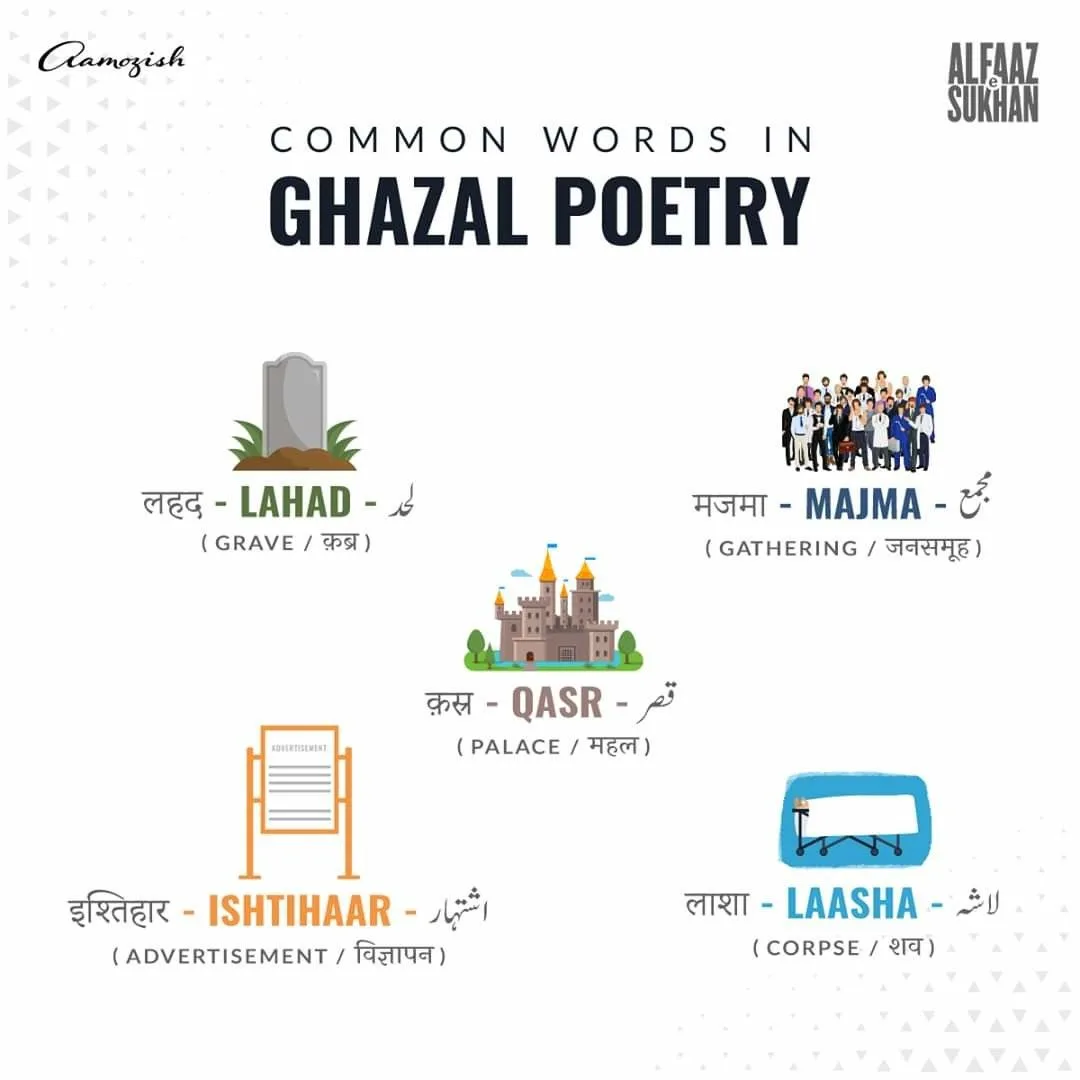
The vocabulary of Urdu poetry, especially the ghazal tradition that has dominated South Asian literary expression for nearly four centuries, is a curated lexicon of perhaps 300 to 500 words that recur across the work of Mir Taqi Mir, Ghalib, Iqbal, Faiz, Faraz, and a hundred lesser masters. To read Urdu poetry without this vocabulary is to read it through a fog.
Words like dil (heart), jaan (life), ishq (passion), gham (sorrow), khwab (dream), wafa (loyalty), jafa (cruelty), and mehbooba (beloved) carry not just meaning but accumulated symbolic weight: a poet writing dil invokes every preceding poet's dil, and the listener hears the chord of all those uses sounding together. Master this 100+ word essential vocabulary and you unlock the gates of one of the world's great literary traditions.
This reference catalogues 100+ Urdu poetry vocabulary words organised by theme: heart and love, beloved and lover, separation and union, time and longing, beauty and pain, mystic and divine. Each entry appears in Urdu script (Perso-Arabic, written right to left), Roman Urdu transliteration, and English explanation, with brief notes on origin (Persian, Arabic, or native Indic) and the conventional poetic resonances that the word carries beyond its dictionary meaning.
Urdu poetry's vocabulary is overwhelmingly Persian and Arabic in origin. The ghazal as a form was imported from Persian in the early Mughal period, and its central vocabulary comes from Persian (gul, bulbul, saaqi, mai-khana) and Arabic (ishq, mohabbat, hijr, wisaal).
Native Indic words appear but are subordinate; high Urdu poetry favours the Persian-Arabic register. For learners with even a Hindi background, the poetic vocabulary will feel foreign in ways everyday Urdu does not. Memorisation is required.
For the broader poetry tradition, see Urdu Poetry: Ghazal and Shayari Vocabulary. For background on Persian and Arabic loanwords that fill this lexicon, see Urdu Persian and Arabic Loanwords. For the script and pronunciation, see the Urdu Alphabet and Nasta'liq Script Complete Guide.
The Heart (Dil) and Soul (Jaan)
The dil and jaan are the inner geography of Urdu poetry. Dil is the metaphorical seat of love, suffering, longing, and consciousness. Jaan is life itself, often used as a term of endearment for the beloved.
| Urdu | Roman Urdu | English | Origin |
|---|---|---|---|
| دل | Dil | Heart | Persian |
| جان | Jaan | Life, soul, beloved | Persian |
| روح | Rooh | Soul, spirit | Arabic |
| سینہ | Seena | Chest, breast | Persian |
| نظر | Nazar | Gaze, sight | Arabic |
| نگاہ | Nigaah | Glance, look | Persian |
| دیدہ | Deeda | Eye (poetic) | Persian |
| چشم | Chashm | Eye | Persian |
| لب | Lab | Lip | Persian |
| زلف | Zulf | Lock of hair, tresses | Persian |
| رخ | Rukh | Cheek, face | Persian |
| رخسار | Rukhsaar | Cheek (poetic) | Persian |
| قد | Qad | Stature, height | Arabic |
| جگر | Jigar | Liver, beloved | Persian |
The substitution of jigar for dil in romantic vocabulary is a Pakistani convention: jigar-jaan (liver-life) and dil-jigar pairings are common. The lover's gaze (nigaah, deeda) and the beloved's tresses (zulf) are fixed images recurring across thousands of couplets.
"When Mir Taqi Mir writes Dil hi to hai na sang-o-khisht (it is just a heart, not stone or brick), the dil he names is doing six things at once: it is the speaker's chest, his metaphor for sentiment, the conventional poetic lover's heart that breaks under love's weight, the locus where memory of the beloved resides, the muscle that physically aches from yearning, and the rhetorical fulcrum of the couplet. This compression of meanings is what reading ghazal vocabulary feels like."
Love (Mohabbat, Ishq, Pyaar)
Urdu poetry has at least three words for love, each occupying a different register and intensity.
| Urdu | Roman Urdu | English | Connotation |
|---|---|---|---|
| محبت | Mohabbat | Love | General, dignified |
| عشق | Ishq | Passion, intense love | Overwhelming, often divine |
| پیار | Pyaar | Love (everyday) | Casual, household |
| الفت | Ulfat | Affection | Gentle, friendship-tinged |
| چاہت | Chaahat | Wish, longing | Yearning |
| مودت | Mawaddat | Affection | Formal Arabic |
| لگاوٹ | Lagaawat | Attachment | Pakistani Urdu |
| دیوانگی | Deewaangi | Madness (of love) | Madman's passion |
| جنون | Junoon | Madness, frenzy | Absolute possession |
Ishq is the king of these terms. Sufi-influenced Urdu poetry distinguishes ishq-e-haqeeqi (true love, divine love) from ishq-e-majaazi (apparent love, human love), with the human variant understood as a path to the divine. The Persian word ishq carries this weight in every couplet that uses it.
| Compound | Meaning |
|---|---|
| عشق حقیقی | Ishq-e-haqeeqi: divine love |
| عشق مجازی | Ishq-e-majaazi: human/apparent love |
| محبوب حقیقی | Mehboob-e-haqeeqi: God, the True Beloved |
The Beloved (Mehboob, Yaar, Sanam)
The beloved appears in Urdu poetry under many names, each bringing its own emotional colour. The conventional beloved is gender-ambiguous (the same words can apply to a young man, a young woman, or God), and the ghazal tradition exploits this ambiguity systematically.
| Urdu | Roman Urdu | English |
|---|---|---|
| محبوب | Mehboob | Beloved (m or f) |
| محبوبہ | Mehbooba | Beloved (f-marked) |
| یار | Yaar | Friend, beloved |
| ساجن | Saajan | Beloved (Hindi-Urdu) |
| پیا | Piya | Beloved (Hindi-Urdu) |
| سنم | Sanam | Idol, beloved |
| نگار | Nigaar | Beloved (literary) |
| دلربا | Dilruba | Heart-stealer |
| دلدار | Dildaar | Heart-keeper |
| دل نواز | Dilnawaaz | Heart-comforter |
| پری | Pari | Fairy, beautiful one |
| حسینہ | Haseena | Beautiful one (f) |
| ماہ رو | Maah-roo | Moon-faced |
| سیمتن | Seemtan | Silver-bodied |
| نازنین | Naazneen | Delicate one |
| دلنشین | Dilnasheen | Heart-settling |
The pari and ma-roo categories collect Persian beauty-words that compare the beloved to a fairy, the moon, or other classical beauty-symbols. A Pakistani wedding-night ghazal might call the bride pari paikar (fairy-shaped) or ma-roo (moon-faced) without sounding archaic; this vocabulary is alive in song lyrics.
The Lover (Aashiq, Deewana)
| Urdu | Roman Urdu | English |
|---|---|---|
| عاشق | Aashiq | Lover (one who loves) |
| دیوانہ | Deewana | Madman, mad lover |
| مجنوں | Majnoon | Madman (refers to Majnu) |
| پاگل | Paagal | Madman (everyday) |
| فقیر | Faqeer | Mendicant, ascetic lover |
| ملنگ | Malang | Wandering Sufi/lover |
| غم خوار | Gham-khwaar | Sorrow-eater |
| جان نثار | Jaan-nisaar | One who sacrifices life |
| غریب | Ghareeb | Poor (of the lover) |
| مجبور | Majboor | Helpless, compelled |
| تنہا | Tanha | Lonely |
The conventional Urdu lover is mad (deewana, majnoon) - the Layla and Majnoon legend supplies the archetype - poor (faqeer), wandering, sleepless, and willing to give up his life (jaan-nisaar) for a glance from the beloved. The vocabulary maintains this stock figure even as individual poets add personality.
Separation and Union (Hijr, Wisaal)
The central dramatic axis of the ghazal is the separation of lover from beloved. Hijr (separation) and wisaal (union) are not events; they are states of being that the poet inhabits and writes from. Urdu poetry is dramatically more about hijr than wisaal.
| Urdu | Roman Urdu | English |
|---|---|---|
| ہجر | Hijr | Separation |
| فراق | Firaaq | Separation, distance |
| جدائی | Judaai | Separation (Indic register) |
| دوری | Doori | Distance |
| وصال | Wisaal | Union |
| ملاقات | Mulaqaat | Meeting |
| ملن | Milan | Meeting (Hindi-Urdu) |
| دیدار | Deedaar | Sight (of the beloved) |
| یاد | Yaad | Memory |
| یادگار | Yaadgaar | Memorial, keepsake |
| انتظار | Intezaar | Wait, expectation |
| فریاد | Faryaad | Lament, plea |
| نالہ | Naala | Wail, lament |
| آہ | Aah | Sigh |
"The hijr-wisaal axis structures Urdu poetry the way comedy and tragedy structure Greek drama. Most ghazals dwell in hijr; the rare wisaal couplet flashes brilliantly precisely because it interrupts the prevailing separation. Faiz Ahmed Faiz's progressive poetry, even when about politics or revolution, retains this hijr-wisaal grammar by treating freedom or justice as the absent beloved."
Sorrow and Pain (Gham, Dard)
| Urdu | Roman Urdu | English |
|---|---|---|
| غم | Gham | Sorrow, grief |
| دکھ | Dukh | Sadness, sorrow |
| رنج | Ranj | Distress |
| مصیبت | Museebat | Calamity |
| درد | Dard | Pain |
| الم | Alam | Sorrow (formal) |
| غمزدہ | Gham-zada | Sorrow-stricken |
| دلگیر | Dil-geer | Heart-grieved |
| ٹوٹا ہوا | Toota hua | Broken |
| زخم | Zakhm | Wound |
| داغ | Daagh | Stain, scar |
| تڑپ | Tarap | Anguish |
| بے چینی | Bechaini | Restlessness |
| اضطراب | Iztaraab | Agitation |
The lover's sorrow is not weakness but virtue in the ghazal economy. To suffer is to prove genuine love. The wound (zakhm) and the scar (daagh) are badges. A poet who has not earned his daaghs cannot speak credibly of ishq.
Time and Longing
| Urdu | Roman Urdu | English |
|---|---|---|
| رات | Raat | Night (time of yearning) |
| شب | Shab | Night (poetic) |
| سحر | Sahar | Dawn |
| صبح | Subh | Morning |
| شام | Shaam | Evening |
| دور | Daur | Era, age |
| زمانہ | Zamaana | Time, era |
| لمحہ | Lamha | Moment |
| پل | Pal | Instant |
| عمر | Umr | Lifetime, age |
| حیات | Hayaat | Life (Arabic) |
| موت | Maut | Death |
| فنا | Fana | Annihilation, mystic dissolution |
| بقا | Baqa | Subsistence, eternal life |
| ابد | Abad | Eternity |
Fana and baqa are technical Sufi terms. Fana is the annihilation of the self in the divine beloved; baqa is the subsisting union beyond annihilation. Ghalib uses these terms with full theological awareness; modern poets sometimes use them more loosely.
Beauty Vocabulary
| Urdu | Roman Urdu | English |
|---|---|---|
| حسن | Husn | Beauty |
| جمال | Jamaal | Beauty (radiant) |
| جلوہ | Jalwa | Manifestation, splendour |
| نور | Noor | Light, radiance |
| روشنی | Roshni | Light |
| چمک | Chamak | Glimmer, flash |
| رنگ | Rang | Colour |
| خوشبو | Khushboo | Fragrance |
| شباب | Shabaab | Youth, prime |
| نازو ادا | Naaz-o-ada | Coquetry and gesture |
| ادا | Ada | Style, mannerism |
| غمزہ | Ghamza | Coquettish glance |
| اشارہ | Ishaara | Hint, signal |
| تبسم | Tabassum | Smile |
| لطف | Lutf | Pleasure, grace |
Wine, Tavern, and Mystic Imagery
The Persian-Sufi heritage gives Urdu poetry a wine-and-tavern vocabulary that signals mystic experience even when the literal subject is human love. The pious reader and the libertine reader interpret these words differently, and the poet exploits the ambiguity.
| Urdu | Roman Urdu | English |
|---|---|---|
| مے | Mai | Wine (poetic) |
| شراب | Sharaab | Wine (everyday) |
| ساقی | Saaqi | Wine-pourer (often divine) |
| مے کدہ | Mai-kada | Tavern (mystic centre) |
| مے خانہ | Mai-khaana | Tavern |
| پیمانہ | Paimaana | Cup, goblet |
| جام | Jaam | Cup |
| بادہ | Baada | Wine |
| مست | Mast | Drunken, intoxicated |
| مستی | Masti | Intoxication |
| سرور | Suroor | Ecstasy |
| ہوش | Hosh | Sobriety, consciousness |
| بے ہوش | Behosh | Unconscious |
The Saaqi is often God or the spiritual master, the wine the divine love that intoxicates the seeker, the tavern the gathering of mystics. A pious reading does not deny the imagery; it spiritualises it. A worldly reading enjoys the libertine surface.
Loyalty and Cruelty (Wafa, Jafa)
| Urdu | Roman Urdu | English |
|---|---|---|
| وفا | Wafa | Loyalty, faithfulness |
| جفا | Jafa | Cruelty, infidelity |
| بے وفا | Bewafa | Unfaithful |
| سچا | Saccha | Truthful |
| جھوٹا | Jhoota | False |
| اعتبار | Aitbaar | Trust |
| یقین | Yaqeen | Certainty |
| دھوکہ | Dhoka | Deception |
| فریب | Fareb | Deception |
| ستم | Sitam | Cruelty, oppression |
| ظلم | Zulm | Tyranny |
| رحم | Reham | Mercy |
The wafa-jafa pair structures romantic dynamics. The lover offers wafa (loyalty unto death); the beloved frequently performs jafa (cruelty, indifference). The lover's complaint is the conventional middle ground: bewafa kyon ho? (why are you faithless?). Faiz inverted this pair to political use, making wafa loyalty to revolution and jafa state oppression.
Dream, Vision, and Hope
| Urdu | Roman Urdu | English |
|---|---|---|
| خواب | Khwab | Dream |
| تعبیر | Taabeer | Interpretation (of dream) |
| خیال | Khayaal | Thought, imagination |
| تصور | Tasawwur | Imagination, conception |
| امید | Umeed | Hope |
| آرزو | Aarzoo | Wish, desire |
| تمنا | Tamanna | Wish, longing |
| خواہش | Khwaahish | Wish |
| منزل | Manzil | Destination |
| منزل مقصود | Manzil-e-maqsood | Goal, destination |
| سفر | Safar | Journey |
| راستہ | Raasta | Path |
| ٹھکانا | Thikaana | Abode, refuge |
"The phrase Manzil-e-maqsood (the destination of one's seeking) is one of those Urdu compounds that resists clean translation. It is more than goal, more than destination, more than aspiration. It is the place the soul is journeying to, both literal and spiritual, the end of the long quest. Iqbal uses it as a key term in Asraar-e-Khudi; Faiz translates it into political quest; everyday Pakistani usage retains the spiritual undertone."
Sky, Fate, and the World
| Urdu | Roman Urdu | English |
|---|---|---|
| آسمان | Aasmaan | Sky |
| فلک | Falak | Heaven, sky (poetic) |
| سپہر | Sipehr | Sphere, sky |
| تقدیر | Taqdeer | Destiny, fate |
| قسمت | Qismat | Fortune, fate |
| نصیب | Naseeb | Fate, lot |
| قضا | Qaza | Decreed fate |
| دنیا | Dunya | World |
| جہاں | Jahaan | World (poetic) |
| عالم | Aalam | Universe, state |
| کائنات | Kainaat | Universe, cosmos |
Falak is poetic sky, the heavens that are the cause of the lover's misfortunes (the cruel falak whose stars decree separation). Taqdeer (Arabic, divinely ordained), qismat (Arabic, lot), naseeb (Arabic, share) are stacked vocabulary for fate; poets use them with subtle distinctions.
Common Mistakes
Reading dil as just "heart" anatomically: In poetry, dil is the metaphorical heart, the seat of feeling, the locus of love. Translating as "heart" loses the cultural weight. Sometimes "soul" or "feeling-self" captures it better.
Confusing ishq, mohabbat, and pyaar levels: Ishq is intense, often mystical-allegorical. Mohabbat is dignified general love. Pyaar is everyday, household. A Pakistani father saying he has pyaar for his daughter is normal; saying ishq would be wrong.
Mistaking saaqi as a literal bartender: The saaqi is the wine-pourer in the tavern but in mystic poetry is God, the master, the divine cup-bearer. Reading purely literally misses the layer.
Treating wafa and jafa as gender-neutral: In conventional ghazal, the male lover offers wafa and the female (or divine, or male) beloved performs jafa. Reversing the pattern is rare and signals modernist or feminist intervention.
Mis-pronouncing Persian phonemes: The letters khe (خ) and ghain (غ) require proper guttural articulation, distinct from English k and g. Mispronouncing khwab as "kwab" loses the sound and reveals non-fluency.
Ignoring the gender ambiguity of Mehboob: The beloved in Urdu ghazal is often grammatically masculine, even when the poet is male. This is a stylistic-cultural-mystic feature, not a literal gender. Translation should preserve the ambiguity.
Quick Reference Card
| English | Urdu Poetic Term |
|---|---|
| Heart | Dil |
| Soul, life | Jaan |
| Love (intense) | Ishq |
| Love (general) | Mohabbat |
| Beloved | Mehboob / Yaar / Sanam |
| Lover | Aashiq / Deewana |
| Separation | Hijr / Firaaq |
| Union | Wisaal |
| Sorrow | Gham |
| Pain | Dard |
| Memory | Yaad |
| Loyalty | Wafa |
| Cruelty | Jafa |
| Wine | Mai |
| Tavern | Mai-khaana |
| Cup-bearer | Saaqi |
| Dream | Khwab |
| Hope | Umeed |
| Eye | Chashm / Aankh |
| Tresses | Zulf |
| Night | Shab / Raat |
| Dawn | Sahar |
| Sky/heaven | Falak |
| Destiny | Taqdeer / Qismat |
Frequently Asked Questions
Why is Urdu poetry vocabulary so Persian and Arabic? Because the ghazal as a form was imported from Persian in the early Mughal period, and the established literary vocabulary of love, beauty, and mystic experience was already Persian. Urdu poets adopted the Persian framework wholesale rather than developing native Indic alternatives. Native Hindi poetry (the bhakti and rekhta traditions) developed parallel vocabulary, but ghazal stayed Persianate.
What is the difference between mohabbat and ishq? Mohabbat is general dignified love, applicable to family, friends, country. Ishq is intense romantic or mystic passion, often overwhelming and self-destructive. A father has mohabbat for his children; a Sufi has ishq for God. The two are not interchangeable.
Is the saaqi in Urdu poetry literal or mystic? Both, simultaneously. The Sufi-inflected ghazal exploits the ambiguity systematically. A pious reading sees the saaqi as the divine cup-bearer pouring spiritual wine; a worldly reading sees an actual tavern wine-pourer. Skilled poets keep both readings open.
Who are some essential Urdu poets to read? Mir Taqi Mir (18th c, melancholy ghazal master), Mirza Ghalib (19th c, the canonical figure), Allama Iqbal (early 20th c, philosophical poet), Faiz Ahmed Faiz (mid-20th c, progressive-revolutionary), Ahmed Faraz (late-20th c, popular ghazal). Reading even one of each opens the tradition.
Is poetic Urdu the same as everyday Urdu? No. Poetic Urdu uses an intentionally elevated register saturated with Persian-Arabic vocabulary that everyday speech avoids. A Pakistani who can speak fluent Urdu may struggle to fully parse a Ghalib couplet without notes; the gap is similar to a modern English speaker reading Shakespeare.
Why is the beloved often grammatically male in Urdu poetry? Persian grammatical convention treated the beloved as masculine even when the poet was a male writer with a female beloved, because Persian grammar is gender-neutral and Urdu inherited the convention. This also dovetailed with the Sufi convention where the divine beloved is grammatically masculine. The ambiguity is a feature, not a bug; it lets human and divine love overlap.
What is the difference between hijr and judaai? Both mean separation. Hijr is the formal Persian-Arabic word, dominant in classical ghazal. Judaai is Indic-register, common in Hindi-Urdu film songs and Bollywood lyrics. Modern poets use both depending on the desired register.
See Also
- Urdu Poetry: Ghazal and Shayari Vocabulary
- Urdu Persian and Arabic Loanwords
- Urdu Alphabet and Nasta'liq Script Complete Guide
- Urdu Common Phrases and Daily Conversation Reference
- Urdu vs Hindi: Same Language, Different Scripts
- Urdu in Pakistan, India and the Diaspora
- Urdu Conversations and Daily Phrases by Register
Author: Kalenux Team
Frequently Asked Questions
Why is Urdu poetry vocabulary so Persian and Arabic?
The ghazal as a form was imported from Persian in the early Mughal period. The established literary vocabulary of love and beauty was already Persian. Urdu poets adopted the framework wholesale rather than developing native Indic alternatives.
What is the difference between mohabbat and ishq?
Mohabbat is general dignified love. Ishq is intense romantic or mystic passion, often overwhelming. A father has mohabbat for his children; a Sufi has ishq for God.
Is the saaqi in Urdu poetry literal or mystic?
Both simultaneously. Sufi-inflected ghazal exploits the ambiguity. A pious reading sees the divine cup-bearer; a worldly reading sees an actual tavern wine-pourer.
Who are some essential Urdu poets to read?
Mir Taqi Mir, Mirza Ghalib, Allama Iqbal, Faiz Ahmed Faiz, and Ahmed Faraz. Reading even one of each opens the tradition.
Is poetic Urdu the same as everyday Urdu?
No. Poetic Urdu uses an intentionally elevated register saturated with Persian-Arabic vocabulary. The gap is similar to modern English readers approaching Shakespeare.
Why is the beloved often grammatically male in Urdu poetry?
Persian grammatical convention treated the beloved as masculine. Urdu inherited the convention. This dovetailed with Sufi convention where the divine beloved is grammatically masculine. The ambiguity lets human and divine love overlap.
What is the difference between hijr and judaai?
Both mean separation. Hijr is formal Persian-Arabic, dominant in classical ghazal. Judaai is Indic-register, common in Bollywood lyrics. Modern poets use both.