
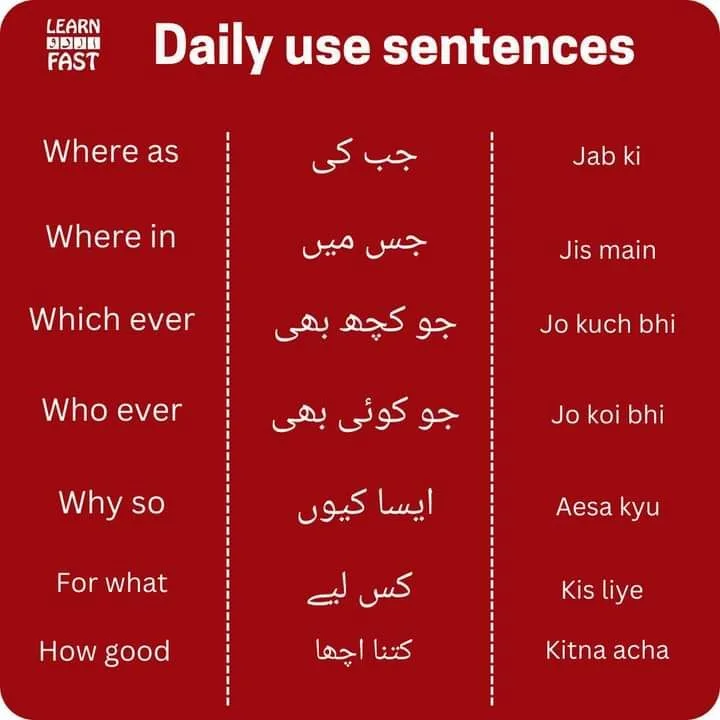
Urdu (اردو, urdu) is the national language of Pakistan and one of the twenty-two scheduled languages of India, spoken by more than 230 million people worldwide when native and second-language speakers are combined. For travellers, expatriates, diaspora learners, and heritage speakers, a working repertoire of everyday phrases opens doors that grammar tables alone cannot.
Unlike textbook drills, living Urdu is textured by register, religion, region, and the constant negotiation between Pakistani and Indian usage. A single greeting like Assalam alaikum (السلام علیکم) signals not just hello but a shared Islamicate cultural world, while Namaste (نمسکار) in the Hindi-speaking north of India signals the opposite orientation.
This reference collects more than one hundred high-frequency Urdu phrases organised by situation: greetings, introductions, courtesy, shopping, transportation, dining, emergencies, and small talk. Each phrase appears in Urdu script (Perso-Arabic, written right to left), Roman Urdu transliteration (the informal Latin orthography used in SMS, WhatsApp, and social media across Pakistan), and English gloss.
Where Pakistani and Indian Urdu diverge, both variants are given. The aim is not to replace a textbook but to function as a durable desk reference that a working learner can consult during real interactions.
Urdu shares its colloquial core with Hindi (the two are often described as registers of a single Hindustani language), so many of these phrases will sound immediately familiar to Hindi speakers, differing mainly in written script and in the proportion of Persian-Arabic versus Sanskrit vocabulary.
At the formal end, Urdu leans heavily on Persian and Arabic loans (Shukriya, Mehrabani, Khuda hafiz); at the informal end, everyday conversation uses the same Hindustani base as Bollywood dialogue. Learners should expect to recognise both layers.
For background on the script, pronunciation, and writing system used throughout this guide, see the Urdu Alphabet and Nasta'liq Script Complete Guide. For the broader sociolinguistic picture, consult Urdu vs Hindi: Same Language, Different Scripts and Urdu in Pakistan, India and the Diaspora.
Greetings and Salutations
Urdu greetings carry strong cultural and religious weight. The default Pakistani greeting is Assalam alaikum (السلام علیکم, "peace be upon you"), an Arabic-origin Islamic salutation answered with Wa alaikum assalam (وعلیکم السلام, "and peace be upon you too").
This exchange is universal in Pakistan across age, class, and setting, and common among Indian Muslims. Hindus and Sikhs in India more often use Namaste (نمستے) or Sat Sri Akal (ست سری اکال) respectively, and Urdu speakers across communities freely use neutral greetings like Adaab (آداب, a respectful courtesy greeting with no religious content) in mixed company.
| Urdu | Roman Urdu | English | Context |
|---|---|---|---|
| السلام علیکم | Assalam alaikum | Peace be upon you | Default Pakistani/Muslim greeting |
| وعلیکم السلام | Wa alaikum assalam | And peace upon you too | Response to above |
| آداب | Adaab | Respectful greeting | Neutral, secular, formal |
| نمستے | Namaste | Greetings (Hindu) | Common in Indian Urdu contexts |
| خدا حافظ | Khuda hafiz | God protect you (goodbye) | Standard Pakistani farewell |
| اللہ حافظ | Allah hafiz | God protect you (goodbye) | More Islamically marked, modern |
| پھر ملیں گے | Phir milenge | See you again | Casual farewell |
| شب بخیر | Shab bakhair | Good night | Persian-origin, formal |
| صبح بخیر | Subh bakhair | Good morning | Persian-origin, formal |
| کیسے ہیں آپ؟ | Kaise hain aap? | How are you? (formal) | aap = formal "you" |
| کیسے ہو؟ | Kaise ho? | How are you? (informal) | tum = informal "you" |
| میں ٹھیک ہوں | Main theek hoon | I am fine | Standard reply |
| الحمد للہ | Alhamdulillah | Praise be to God (I am well) | Muslim idiomatic reply |
"In Pakistan, exchanging Assalam alaikum is not optional politeness but a near-obligatory social ritual. Walking into a shop or office without it marks the speaker as rude, and even children are drilled in the full response Wa alaikum assalam wa rahmatullahi wa barakatuhu."
The Pakistani versus Indian distinction in farewells is notable. Khuda hafiz (Persian, "may God protect") was universal in Urdu until the late twentieth century, when Islamist movements in Pakistan popularised Allah hafiz (Arabic "Allah" replacing Persian "Khuda") as ideologically purer. Older Pakistanis still say Khuda hafiz; younger religious Pakistanis often prefer Allah hafiz; Indian Urdu speakers retain Khuda hafiz without controversy.
Introductions and Small Talk
Introducing oneself in Urdu uses the verb hona (ہونا, "to be") and a possessive or naming construction. The phrase mera naam ... hai (میرا نام ... ہے, "my name is ...") is foundational and gender-invariable.
| Urdu | Roman Urdu | English |
|---|---|---|
| میرا نام احمد ہے | Mera naam Ahmad hai | My name is Ahmad |
| آپ کا نام کیا ہے؟ | Aap ka naam kya hai? | What is your name? |
| خوشی ہوئی آپ سے مل کر | Khushi hui aap se mil kar | Pleased to meet you |
| میں پاکستان سے ہوں | Main Pakistan se hoon | I am from Pakistan |
| آپ کہاں سے ہیں؟ | Aap kahan se hain? | Where are you from? |
| میں انگریز ہوں | Main Angrez hoon | I am English (male) |
| میں انگریز ہوں | Main Angrez hoon | I am English (invariable) |
| میں اردو سیکھ رہا ہوں | Main Urdu seekh raha hoon | I am learning Urdu (m) |
| میں اردو سیکھ رہی ہوں | Main Urdu seekh rahi hoon | I am learning Urdu (f) |
| آپ کیا کرتے ہیں؟ | Aap kya karte hain? | What do you do? |
| میں طالب علم ہوں | Main taalib-e-ilm hoon | I am a student |
| میں استاد ہوں | Main ustaad hoon | I am a teacher |
Note the gender agreement on verb participles: raha hoon for a male speaker, rahi hoon for a female speaker. This is a general feature of Urdu grammar covered in Urdu Grammar: Cases, Gender and Ergative and Urdu Verb Conjugation: Tense and Aspect.
Courtesy, Gratitude and Apology
Urdu has several ways to say thank you, each with different register weight. Shukriya (شکریہ) is the all-purpose default, borrowed from Arabic. Mehrabani (مہربانی, "kindness") is warmer, often paired with shukriya. Bahut shukriya (بہت شکریہ) is "thank you very much".
| Urdu | Roman Urdu | English | Register |
|---|---|---|---|
| شکریہ | Shukriya | Thank you | Neutral default |
| بہت شکریہ | Bahut shukriya | Thank you very much | Emphatic |
| مہربانی | Mehrabani | Kindness, thanks | Warm, heartfelt |
| نوازش | Nawaazish | (Your) favour, thanks | Formal, literary |
| کوئی بات نہیں | Koi baat nahin | You are welcome (it is nothing) | Standard reply |
| خوش آمدید | Khush aamdeed | Welcome | Greeting to a guest |
| معاف کیجیے | Maaf kijiye | Forgive me, excuse me | Formal apology |
| معذرت | Maazarat | Apology, sorry | Neutral, short |
| افسوس ہے | Afsos hai | I am sorry (regret) | For condolences |
| جی ہاں | Ji haan | Yes (respectful) | "ji" = honorific particle |
| جی نہیں | Ji nahin | No (respectful) | Polite refusal |
| ہاں | Haan | Yes | Casual |
| نہیں | Nahin | No | Casual |
| برائے کرم | Baraa-e-karam | Please (by favour) | Formal, Persian |
| پلیز | Please | Please (English loan) | Casual, ubiquitous |
"The honorific particle ji (جی) attaches to names and to yes/no to mark respect: Ahmad ji, ji haan, ji nahin. A Pakistani executive saying ji nahin sahib ("no, sir") to a superior is not merely refusing but performing deference; dropping the ji would be curt."
Numbers, Quantities and Shopping
Urdu numbers are notoriously irregular up to 100 because each tens-plus-units combination (21, 22, 23 ...) has its own word rather than a compound. For a complete treatment see Urdu Numbers and Counting 1 to 1000. The core shopping vocabulary below assumes you can count at least 1 to 20.
| Urdu | Roman Urdu | English |
|---|---|---|
| کتنے کا ہے؟ | Kitne ka hai? | How much is it? (m object) |
| کتنی کی ہے؟ | Kitni ki hai? | How much is it? (f object) |
| یہ کتنے کا ہے؟ | Yeh kitne ka hai? | How much is this? |
| بہت مہنگا ہے | Bahut mahanga hai | It is very expensive |
| سستا کر دیں | Sasta kar dein | Make it cheaper, lower the price |
| آخری قیمت کیا ہے؟ | Aakhri qeemat kya hai? | What is the final price? |
| تھوڑا کم کر دیں | Thoda kam kar dein | Reduce it a bit |
| میں لے لوں گا | Main le loonga | I will take it (m) |
| میں لے لوں گی | Main le loongi | I will take it (f) |
| پیسے کہاں دوں؟ | Paise kahan doon? | Where do I pay? |
| رسید دے دیں | Raseed de dein | Give me a receipt |
| مجھے یہ چاہیے | Mujhe yeh chahiye | I want this |
| مجھے وہ چاہیے | Mujhe woh chahiye | I want that |
| اور کچھ؟ | Aur kuch? | Anything else? |
| بس، اتنا کافی ہے | Bas, itna kaafi hai | That is enough |
Bargaining is expected in most bazaars in Pakistan and India (Anarkali in Lahore, Empress Market in Karachi, Chandni Chowk in Delhi, Zainab Market in Karachi). Starting offers of 30 to 50 per cent of the asking price for tourist-visible goods is normal. Fixed-price shops (most modern malls and international brands) do not bargain.
Transportation: Rickshaw, Bus, Taxi, Ride-Hailing
Pakistan and India have overlapping transport vocabularies drawn from English, Persian, and regional languages. Auto-rickshaws (آٹو رکشا) dominate short-distance travel in most cities, buses (بس) handle medium distances, and ride-hailing apps (Careem in Pakistan, Uber and Ola in India) increasingly replace street taxis.
| Urdu | Roman Urdu | English |
|---|---|---|
| رکشا والے بھائی | Rickshaw wale bhai | Brother rickshaw driver (address) |
| مینار پاکستان جانا ہے | Minar-e-Pakistan jaana hai | I need to go to Minar-e-Pakistan |
| کتنے پیسے لو گے؟ | Kitne paise lo ge? | How much will you charge? |
| میٹر چلاؤ | Meter chalao | Turn on the meter |
| یہاں رک جاؤ | Yahan ruk jao | Stop here |
| تھوڑا آگے | Thoda aage | A bit forward |
| بائیں طرف | Baayen taraf | To the left |
| دائیں طرف | Daayen taraf | To the right |
| سیدھا جاؤ | Seedha jao | Go straight |
| اسٹیشن کہاں ہے؟ | Station kahan hai? | Where is the station? |
| بس اڈا کہاں ہے؟ | Bus adda kahan hai? | Where is the bus stand? |
| ٹکٹ کتنے کا ہے؟ | Ticket kitne ka hai? | How much is the ticket? |
| کیا یہ بس کراچی جاتی ہے؟ | Kya yeh bus Karachi jaati hai? | Does this bus go to Karachi? |
"Urdu uses the verb jaana (to go) in second- and third-person constructions like jaana hai (literally 'going is'). This is an impersonal obligation construction meaning 'I need/have to go' and is ubiquitous in transport requests. The subject is implied, not stated."
Restaurant and Food
Pakistani and Indian cuisine intersect heavily in the Urdu-speaking belt. For a dedicated vocabulary list see Urdu Food Vocabulary and Cuisine Reference. The phrases below cover ordering, complimenting, and paying.
| Urdu | Roman Urdu | English |
|---|---|---|
| میں آرڈر دینا چاہتا ہوں | Main order dena chahta hoon | I want to place an order (m) |
| مینو دیں | Menu dein | Give me the menu |
| آپ کی سپیشلٹی کیا ہے؟ | Aap ki speciality kya hai? | What is your speciality? |
| یہ تیز ہے؟ | Yeh tez hai? | Is this spicy? |
| کم مصالحہ دار | Kam masaala daar | Less spicy |
| ایک چائے اور لے آئیں | Ek chai aur le aayen | Bring one more tea |
| پانی دیں | Paani dein | Give me water |
| بہت لذیذ تھا | Bahut lazeez tha | It was very delicious |
| بل لے آئیں | Bill le aayen | Bring the bill |
| کارڈ چلتا ہے؟ | Card chalta hai? | Does card work here? |
| نقد میں دیں گے | Naqd mein dein ge | We will pay in cash |
Emergencies, Health, Directions
Certain phrases you should know before you need them. Pakistani emergency services: Rescue 1122 (fire, ambulance, disasters nationwide), 15 (police), 1166 (Edhi ambulance). Indian: 112 (unified), 102 (ambulance), 100 (police historically).
| Urdu | Roman Urdu | English |
|---|---|---|
| مدد کریں! | Madad karein! | Help! |
| ایمبولینس بلائیں | Ambulance bulaaein | Call an ambulance |
| پولیس کو بلائیں | Police ko bulaaein | Call the police |
| مجھے ڈاکٹر چاہیے | Mujhe doctor chahiye | I need a doctor |
| میرا دل گھبرا رہا ہے | Mera dil ghabra raha hai | My heart is uneasy (I feel faint) |
| درد ہو رہا ہے | Dard ho raha hai | I am in pain |
| میں کھو گیا ہوں | Main kho gaya hoon | I am lost (m) |
| میں کھو گئی ہوں | Main kho gayi hoon | I am lost (f) |
| آپ کا فون استعمال کر سکتا ہوں؟ | Aap ka phone istemaal kar sakta hoon? | May I use your phone? |
| میرا پاسپورٹ گم ہو گیا | Mera passport gum ho gaya | I lost my passport |
| قریب ترین ہسپتال کہاں ہے؟ | Qareeb tareen hospital kahan hai? | Where is the nearest hospital? |
Pakistani vs Indian Urdu: Phrase-Level Differences
While core grammar and most vocabulary are identical, the two national varieties diverge in everyday lexical choices, greeting rituals, and loanword preferences. Pakistani Urdu absorbs more Persian, Arabic, and Punjabi influence; Indian Urdu (as spoken by Muslims in Lucknow, Delhi, Hyderabad) preserves older Persianate high register but in daily speech overlaps with Hindi.
| Meaning | Pakistani Urdu | Indian Urdu | Note |
|---|---|---|---|
| Goodbye | Khuda hafiz / Allah hafiz | Khuda hafiz | Allah hafiz rare in India |
| Thank you | Shukriya / Mehrabani | Shukriya / Dhanyavaad | Dhanyavaad is Sanskrit, used by Hindus |
| Yes (respectful) | Ji haan | Ji haan / Ji | Same core |
| Bread | Roti / Naan / Chapati | Roti / Chapati | Naan more common in PK |
| Tea | Chai | Chai | Identical |
| Water | Paani | Paani / Jal | Jal is Sanskritic, not used by Muslims |
| Train | Train / Rail | Rail / Train | Same |
| Police station | Thaana | Thaana | Same |
| Excuse me | Maaf kijiye / Excuse me | Excuse me / Maaf kijiye | English loan dominant in both |
"Bollywood films, which circulate freely across the Pakistan-India border despite political tensions, have homogenised colloquial Urdu-Hindi to a remarkable degree. A Lahore teenager and a Mumbai teenager speak, in casual register, nearly the same language and understand each other without effort."
Register and Respect: tu, tum, aap
Urdu's three-way "you" distinction shapes every phrase above. The full treatment is in Urdu Pronouns and Levels of Respect, but a working summary:
- tu (تو): intimate singular, used with God in prayer, with very close family, with young children, or as insult
- tum (تم): informal, used with friends, siblings, younger relatives, equals in casual settings
- aap (آپ): formal, respectful, used with elders, strangers, superiors, in shops, with anyone in a first meeting
A safe rule for foreign learners: use aap with everyone until invited to use tum. Using tu with a stranger will be received as rude or aggressive.
Common Mistakes
Forgetting gender agreement: Main theek hoon is invariable for "I am fine", but Main ja raha hoon versus Main ja rahi hoon splits by speaker gender. Female learners often over-apply the male form because they learn from male instructors.
Overusing Namaste in Pakistan: Namaste is culturally Hindu and is not used in Pakistan outside religious-minority contexts. Default to Assalam alaikum or Adaab.
Confusing kya and kaise: kya (what) and kaise (how) are both question words but not interchangeable. Aap kaise hain (how are you) versus Aap kya kar rahe hain (what are you doing).
Dropping the honorific ji: Addressing elders without ji (Ahmad bhai versus Ahmad ji) is casual to the point of disrespect in formal settings.
Mis-spelling Shukriya: Common Roman Urdu spellings include shukriya, shukria, shukrya. All are readable but shukriya is the standard.
Saying Allah hafiz in India to Hindus: The Islamicised farewell can read as communally marked. Khuda hafiz or a neutral Phir milenge is safer.
Quick Reference Card
| Need | Phrase |
|---|---|
| Hello | Assalam alaikum / Adaab |
| Goodbye | Khuda hafiz |
| Yes | Ji haan |
| No | Ji nahin |
| Please | Baraa-e-karam / Please |
| Thank you | Shukriya |
| Sorry | Maaf kijiye |
| How much? | Kitne ka hai? |
| Where? | Kahan hai? |
| I do not understand | Mujhe samajh nahin aaya |
| Do you speak English? | Aap angrezi bolte hain? |
| Help! | Madad karein! |
Frequently Asked Questions
How many Urdu phrases do I need to travel in Pakistan? A functional tourist survives on roughly fifty phrases: greetings, numbers one to twenty, directions, shopping, restaurant basics, and emergencies. The hundred-phrase set in this reference will carry you through most non-specialist interactions.
Is Urdu more formal than Hindi? In written and elevated spoken registers, yes, because Urdu draws heavily on Persian and Arabic vocabulary that Hindi replaces with Sanskrit equivalents. In casual speech the two are nearly identical. A Bollywood dialogue and a Pakistani drama share 80 to 90 per cent of their everyday vocabulary.
Should I learn the Urdu script or can I use Roman Urdu? Roman Urdu is ubiquitous in SMS, WhatsApp, and Pakistani social media and can get you through casual communication. Anything formal, literary, or printed is in Perso-Arabic script. If you plan to read signs, menus, newspapers, or poetry, learn the script.
Do Pakistanis understand Hindi? Almost universally, thanks to Bollywood saturation. Pakistani Urdu speakers watch Hindi films and Indian television fluently. The reverse is also true: Indian Urdu speakers understand Pakistani dramas without difficulty.
When should I use Allah hafiz versus Khuda hafiz? Both mean "may God protect you" as a farewell. Khuda hafiz is older, Persian-origin, and culturally inclusive. Allah hafiz is newer, Arabic-inflected, and marks the speaker as more religiously observant in a Pakistani context. In India, Khuda hafiz remains standard.
Is it rude to bargain at Pakistani bazaars? No, bargaining is expected at traditional markets and the starting price assumes negotiation. Not bargaining marks you as naive and you will pay significantly more than locals. Modern malls and chain stores are fixed-price.
What is the difference between Shukriya and Mehrabani? Both mean thank you. Shukriya is Arabic-origin and neutral. Mehrabani (literally "kindness") is Persian-origin, warmer, and often paired as "Mehrabani, bahut shukriya" for emphatic gratitude.
See Also
- Urdu Alphabet and Nasta'liq Script Complete Guide
- Urdu vs Hindi: Same Language, Different Scripts
- Urdu Pronouns and Levels of Respect
- Urdu Numbers and Counting 1 to 1000
- Urdu Conversations and Daily Phrases by Register
- Urdu in Pakistan, India and the Diaspora
- Urdu Persian and Arabic Loanwords
Author: Kalenux Team
Frequently Asked Questions
How many Urdu phrases do I need to travel in Pakistan?
A functional tourist survives on roughly fifty phrases: greetings, numbers one to twenty, directions, shopping, restaurant basics, and emergencies. The hundred-phrase set in this reference will carry you through most non-specialist interactions.
Is Urdu more formal than Hindi?
In written and elevated spoken registers, yes, because Urdu draws heavily on Persian and Arabic vocabulary that Hindi replaces with Sanskrit equivalents. In casual speech the two are nearly identical.
Should I learn the Urdu script or can I use Roman Urdu?
Roman Urdu is ubiquitous in SMS, WhatsApp, and Pakistani social media. Anything formal, literary, or printed is in Perso-Arabic script. To read signs, menus, and newspapers, learn the script.
Do Pakistanis understand Hindi?
Almost universally, thanks to Bollywood saturation. Pakistani Urdu speakers watch Hindi films and Indian television fluently, and Indian Urdu speakers understand Pakistani dramas without difficulty.
When should I use Allah hafiz versus Khuda hafiz?
Both mean may God protect you. Khuda hafiz is older, Persian-origin, and culturally inclusive. Allah hafiz is newer, Arabic-inflected, and marks the speaker as more religiously observant. In India Khuda hafiz remains standard.
Is it rude to bargain at Pakistani bazaars?
No, bargaining is expected at traditional markets and the starting price assumes negotiation. Not bargaining marks you as naive. Modern malls and chain stores are fixed-price.
What is the difference between Shukriya and Mehrabani?
Both mean thank you. Shukriya is Arabic-origin and neutral. Mehrabani is Persian-origin, literally kindness, warmer, and often paired as Mehrabani bahut shukriya for emphatic gratitude.