
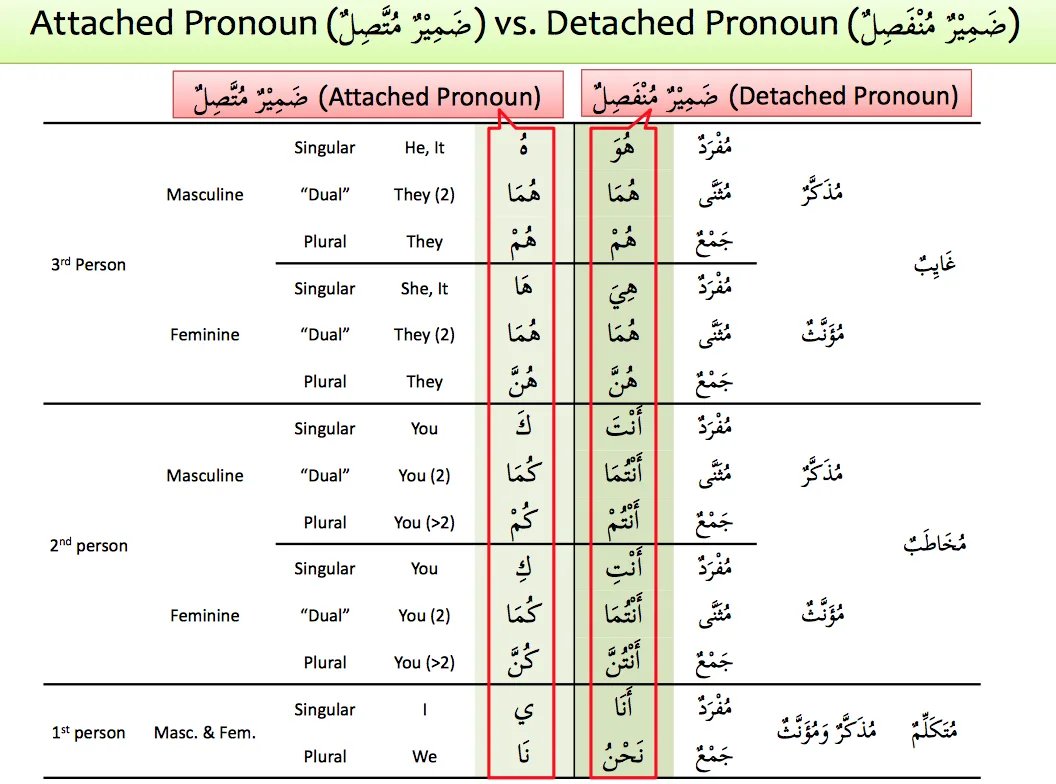
Urdu, like French with tu/vous or Spanish with tu/usted, distinguishes levels of formality in second-person pronouns. But Urdu goes further than most European languages: it has three distinct levels of "you," each with its own verb agreement pattern, its own possessive adjectives, and its own social register.
Choosing the wrong level can feel insulting (too familiar) or distant (too formal) or simply odd (mismatched with context). Mastering the three levels is one of the most important social-linguistic skills for a learner of Urdu.
This reference covers all personal pronouns (first, second, third), the three levels of second-person address (tu, tum, aap), demonstrative vs distance-marked third person (yeh, woh), possessive forms, oblique forms used before postpositions, reflexive pronouns, and complete usage guidelines with cultural notes.
For the verb forms that go with each pronoun, see Urdu Verb Conjugation: Tense and Aspect Reference. For how these fit into broader grammar, see Urdu Grammar: Cases, Gender, and the Ergative.
Complete Pronoun Chart
| Person | Direct (nom.) | Oblique | Possessive | Meaning |
|---|---|---|---|---|
| 1st sg. | میں mein | مجھ mujh | میرا/میری/میرے mera/meri/mere | I / my |
| 1st pl. | ہم hum | ہم hum | ہمارا/ہماری/ہمارے hamara/hamari/hamare | we / our |
| 2nd intimate sg. | تو tu | تجھ tujh | تیرا/تیری/تیرے tera/teri/tere | you / your (intimate) |
| 2nd familiar pl. | تم tum | تم tum | تمہارا/تمہاری/تمہارے tumhara/tumhari/tumhare | you / your (familiar) |
| 2nd respectful | آپ aap | آپ aap | آپ کا/کی/کے aap ka/ki/ke | you / your (respectful) |
| 3rd near sg. | یہ yeh | اس is | اس کا/کی/کے is ka/ki/ke | this / he / she / it |
| 3rd near pl. | یہ yeh | ان in | ان کا/کی/کے in ka/ki/ke | these / they |
| 3rd far sg. | وہ woh | اس us | اس کا/کی/کے us ka/ki/ke | that / he / she / it |
| 3rd far pl. | وہ woh | ان un | ان کا/کی/کے un ka/ki/ke | those / they |
The oblique forms appear before postpositions. The possessives agree in gender and number with the possessed noun, not the possessor.
First Person: Mein and Hum
میں (mein) means "I." Its oblique stem is mujh, used with postpositions:
- مجھ کو / مجھے mujh ko / mujhe (to me, me - dative/accusative)
- مجھ سے mujh se (from me, with me - instrumental)
- میرے ساتھ mere saath (with me - accompaniment, uses possessive)
- میرے پاس mere paas (near me, I have)
Possessives mera/meri/mere agree with the possessed noun:
- میرا گھر mera ghar (my house - masculine)
- میری کتاب meri kitaab (my book - feminine)
- میرے دوست mere dost (my friends - masculine plural)
ہم (hum) means "we." Its oblique form is also hum. Possessives hamara/hamari/hamare.
Note: some Urdu speakers (particularly in older and more formal usage, and in Bollywood dialogues) use hum to mean "I" in a royal or affected style. This is a stylistic choice that can sound grand, pompous, or informal depending on context.
Examples
- میں آ رہا ہوں۔ mein aa raha hoon. (I am coming. - m.)
- مجھے پانی چاہیے۔ mujhe paani chahiye. (I need water.)
- میری کتاب کہاں ہے؟ meri kitaab kahaan hai? (Where is my book?)
- ہم کل جائیں گے۔ hum kal jaaein ge. (We will go tomorrow.)
- ہمارا گھر یہاں ہے۔ hamara ghar yahan hai. (Our house is here.)
Second Person: Three Levels of "You"
This is the core social-linguistic distinction every Urdu learner must master.
Tu (تو) - Intimate
Uses: addressing God in prayer, young children, very close family members (in some families), lovers in poetry, animals, oneself in soliloquy, insulting an enemy.
Do NOT use tu with: strangers, acquaintances, older people, shop staff, taxi drivers, any professional relationship. To use tu incorrectly is either grossly impolite or wildly overly-intimate.
Verb forms with tu: singular direct forms with -ta/-ti + hai.
- تو کیا کرتا ہے؟ tu kya karta hai? ("What do you do?" - m., extremely informal/intimate)
Possessives tera/teri/tere.
Tum (تم) - Familiar
Uses: friends of same age or younger, siblings, colleagues of similar status, children (for teachers/elders), close friends regardless of status.
Verb forms with tum: plural forms even though tum is grammatically singular in modern use. Uses -te/-ti + ho.
- تم کیا کرتے ہو؟ tum kya karte ho? ("What do you do?" - m.)
- تم کیا کرتی ہو؟ tum kya karti ho? (f.)
Possessives tumhara/tumhari/tumhare.
Aap (آپ) - Respectful
Uses: strangers, elders, seniors, customers, superiors at work, teachers, in-laws, any professional or formal context. Safest default when unsure.
Verb forms with aap: plural with -te/-ti + hain.
- آپ کیا کرتے ہیں؟ aap kya karte hain? ("What do you do?" - m., polite)
- آپ کیا کرتی ہیں؟ aap kya karti hain? (f., polite)
Possessives aap ka/aap ki/aap ke.
Comparison Table
| Question | tu (intimate) | tum (familiar) | aap (respectful) |
|---|---|---|---|
| What is your name? | تیرا نام کیا ہے؟ tera naam kya hai? | تمہارا نام کیا ہے؟ tumhara naam kya hai? | آپ کا نام کیا ہے؟ aap ka naam kya hai? |
| How are you? | تو کیسا ہے؟ tu kaisa hai? | تم کیسے ہو؟ tum kaise ho? | آپ کیسے ہیں؟ aap kaise hain? |
| Where are you going? | تو کہاں جا رہا ہے؟ tu kahaan ja raha hai? | تم کہاں جا رہے ہو؟ tum kahaan ja rahe ho? | آپ کہاں جا رہے ہیں؟ aap kahaan ja rahe hain? |
| Come here. | تو آ۔ tu aa. (or just "aa!") | تم آؤ۔ tum aao. | آپ آئیے۔ aap aaiye. |
| Don't do that. | مت کر۔ mat kar. | مت کرو۔ mat karo. | مت کیجیے۔ mat kijiye. |
Cultural Notes on Respect Levels
The default is aap in virtually all adult interactions with people you do not know intimately. Children learn tum quite early with friends and family. tu is marked - it signals either extreme closeness (lovers, family, prayer) or contempt (insulting an enemy). Learners should rarely if ever use tu; if unsure, always use aap.
Moving from aap to tum with someone is a social milestone signalling friendship. It can be done by mutual consent or initiated by the older/higher-status person. Once the relationship moves to tum, moving back to aap signals emotional distance, anger, or formality.
Some families use tu among parents and children, others use tum, others use aap from children to parents. Regional and class variation is significant. When in doubt in a family, observe what others use.
Third Person: Yeh and Woh
Urdu does not distinguish he/she/it at the pronoun level. The same pronoun covers all three English meanings; context disambiguates. What Urdu does distinguish is proximity: near (yeh) vs far (woh).
یہ (yeh) = this / these / he/she/it (near, visible, recently mentioned)
وہ (woh) = that / those / he/she/it (far, absent, previously mentioned)
In speech, yeh is often used when the referent is present or salient; woh when the referent is absent or being introduced from memory.
| Direct | Oblique sg. | Oblique pl. | Possessive |
|---|---|---|---|
| یہ yeh (this, near) | اس is | ان in | اس کا/کی/کے is ka/ki/ke (sg.) ان کا/کی/کے in ka/ki/ke (pl.) |
| وہ woh (that, far) | اس us | ان un | اس کا/کی/کے us ka/ki/ke (sg.) ان کا/کی/کے un ka/ki/ke (pl.) |
Note: the written forms of is/us and in/un are identical in Urdu script (اس for both singular oblique; ان for both plural oblique). Context determines whether the referent is near (is/in) or far (us/un) and speakers pronounce them subtly differently.
Examples
- یہ میرا بھائی ہے۔ yeh mera bhai hai. (This is my brother. - pointing/introducing)
- وہ میرا دوست ہے۔ woh mera dost hai. (That/He is my friend. - absent or distant)
- اس کی کتاب کہاں ہے؟ is/us ki kitaab kahaan hai? (Where is his/her book? - this person's / that person's)
- ان سے پوچھو۔ in/un se poocho. (Ask them. - these/those)
Third Person Honorific Plural
When referring to a person one respects in third person, Urdu often uses plural forms even for a single person, similar to how aap is plural-concordant for a single addressee.
- میرے والد صاحب آ رہے ہیں۔ mere walid sahab aa rahe hain. ("My father is coming" - plural agreement as respect)
- استاد محترم تشریف لائے۔ ustad muhtaram tashreef laaye. ("The respected teacher arrived" - plural verb laaye is used for a single respected person)
Oblique Forms and Postpositions
Every pronoun takes an oblique form before any postposition. The table consolidates them:
| Pronoun | Direct | Oblique | With ne | With ko | With se |
|---|---|---|---|---|---|
| I | mein | mujh | mein ne | mujh ko / mujhe | mujh se |
| we | hum | hum | hum ne | hum ko / hamein | hum se |
| you (intimate) | tu | tujh | tu ne | tujh ko / tujhe | tujh se |
| you (familiar) | tum | tum | tum ne | tum ko / tumhein | tum se |
| you (respectful) | aap | aap | aap ne | aap ko | aap se |
| this/he/she (near) | yeh | is | is ne | is ko / ise | is se |
| these/they (near) | yeh | in | inhon ne | in ko / inhein | in se |
| that/he/she (far) | woh | us | us ne | us ko / use | us se |
| those/they (far) | woh | un | unhon ne | un ko / unhein | un se |
Contracted dative/accusative forms (mujhe, tumhein, use, unhein) are more common in speech than the full ko forms (mujh ko, tum ko, us ko, un ko). Both are correct.
Note the special ergative forms "inhon ne" and "unhon ne" for third-person plurals before ne. These are irregular and must be memorised.
Possessive Pronouns and Agreement
Possessives agree with the possessed noun in gender and number, using the same ka/ki/ke pattern as the genitive postposition.
| Person | Masc. sg. | Masc. pl. obl. | Fem. |
|---|---|---|---|
| my | mera | mere | meri |
| our | hamara | hamare | hamari |
| your (intimate) | tera | tere | teri |
| your (familiar) | tumhara | tumhare | tumhari |
| your (respectful) | aap ka | aap ke | aap ki |
| his/her (near) | is ka | is ke | is ki |
| their (near) | in ka | in ke | in ki |
| his/her (far) | us ka | us ke | us ki |
| their (far) | un ka | un ke | un ki |
Examples with agreement:
- میرا بیٹا mera beTa (my son - masc. sg.)
- میری بیٹی meri beTi (my daughter - fem. sg.)
- میرے بیٹے mere beTe (my sons - masc. pl.)
- میری بیٹیاں meri beTiyaan (my daughters - fem. pl.)
Reflexive Pronoun: Apna
اپنا apna (reflexive, "own") is used when the possessor is the same as the subject of the clause. It replaces the personal possessive in this case and agrees with the possessed noun.
- میں اپنی کتاب پڑھ رہا ہوں۔ mein apni kitaab paRh raha hoon. (I am reading my own book.)
- وہ اپنے دوست کے ساتھ آیا۔ woh apne dost ke saath aaya. (He came with his own friend.)
- تم اپنا کام کرو۔ tum apna kaam karo. (Mind your own business / Do your own work.)
Compare non-reflexive:
- میں اس کی کتاب پڑھ رہا ہوں۔ mein us ki kitaab paRh raha hoon. (I am reading his [someone else's] book.)
The contrast mein ... meri vs mein ... apni is important. Using meri (non-reflexive possessive) for one's own is mildly wrong and signals poor command of the language, although everyday speech sometimes blurs the distinction.
Self-reflexive: Apne Aap
اپنے آپ apne aap = "oneself" as emphatic reflexive:
- وہ اپنے آپ آیا۔ woh apne aap aaya. (He came by himself / on his own.)
- میں نے اپنے آپ سے کہا۔ mein ne apne aap se kaha. (I said to myself.)
Polite Third Person: Sahab, Sahiba, and Honorifics
Urdu culture uses honorifics extensively when referring to or addressing others in third person.
- صاحب sahab (sir, for men, added to name): علی صاحب Ali sahab
- صاحبہ sahiba (madam, for women): فاطمہ صاحبہ Fatima sahiba
- جناب janab (sir, polite direct address)
- محترم/محترمہ muhtaram/muhtarama (respected, m./f.)
- بیگم begum (for married/older women)
Using aap with the name and adding sahab/sahiba is the safest respectful default:
- آپ علی صاحب ہیں؟ aap Ali sahab hain? (Are you Mr. Ali?)
Complete Dialogue Example
Meeting at a shop (formal, stranger):
- شاپ کیپر: آپ کو کیا چاہیے؟ (shopkeeper: aap ko kya chahiye? - "What do you need, sir?")
- گاہک: مجھے یہ کتاب چاہیے۔ (customer: mujhe yeh kitaab chahiye. - "I need this book.")
- شاپ کیپر: اس کی قیمت پانچ سو روپے ہے۔ (shopkeeper: is ki qeemat paanch sau rupay hai. - "Its price is 500 rupees.")
Between close friends:
- تم کہاں ہو؟ میں تمہارا انتظار کر رہا ہوں۔ (tum kahaan ho? mein tumhara intezaar kar raha hoon. - "Where are you? I'm waiting for you.")
Between lovers or in poetry:
- تو میرا سب کچھ ہے۔ (tu mera sab kuch hai. - "You are my everything." - poetic, tu.)
Common Mistakes
Using tu with strangers or elders. This is the most socially damaging error. Always use aap with anyone you do not know well, and switch to tum only when reciprocal and appropriate.
Mixing respect levels mid-conversation. Once you choose aap with someone, stay with aap throughout. Switching to tum mid-conversation can signal irritation or inappropriate familiarity.
Using mera for reflexive contexts. "I am reading my book" with mein as subject requires apni, not meri. Reflexive apna is mandatory when possessor = subject.
Wrong gender agreement on possessives. "My sister" is meri behen (f.), not mera behen. Possessives agree with possessed, not possessor.
Confusing plural verb with plural pronoun. aap is grammatically plural (takes hain), but it can refer to a single person. Verb agreement goes with the pronoun, not the real-world number.
Forgetting irregular ergative forms. "They did" is unhon ne kiya, not "un ne kiya." This applies to plural 3rd person pronouns with ne.
Using woh for "it" in a confusing context. Urdu does not grammaticalise "it." If the referent is unclear, use yeh/woh with a disambiguating noun or skip the pronoun.
Quick Reference
- Three levels of "you": tu (intimate), tum (familiar), aap (respectful)
- Default for strangers: always aap
- No he/she distinction: yeh (near) and woh (far) cover both
- Possessives agree with the possessed noun, not the possessor
- Reflexive apna: when possessor = subject, use apna/apni/apne, not personal possessive
- Irregular ergatives: inhon ne, unhon ne for plurals
- Oblique before postpositions: mujh, tujh, is, us, in, un (not direct forms)
- Contracted datives: mujhe, tumhein, use, unhein
Frequently Asked Questions
Which level of "you" should I use with a stranger? Always aap. This is the only safe choice for strangers, elders, service staff, and any formal or unknown context. You can relax to tum later if the relationship develops, but starting with aap is never wrong.
Can I use tu with my spouse or partner? It varies by family and generation. Some couples use tu as a sign of deep intimacy; others use tum throughout married life; some even use aap with each other as a sign of respect. Observe what the person and their family use. If in doubt, use tum.
Why does aap take plural verbs even for one person? This is a politeness strategy common across Indo-Iranian languages. Plural marking signals respect by rhetorically treating the addressee as multiple. Many languages do this (French vous, German Sie when capitalised). Urdu grammaticalises it fully with aap.
Does Urdu really not distinguish he and she? At the pronoun level, no. Both yeh and woh cover "he," "she," and "it." Gender is conveyed through verb agreement (the verb form shows gender of the subject) and through context. If you want to specify, you say yeh larka (this boy) or yeh larki (this girl).
What is the difference between apna and mera? apna is reflexive and used when the possessor is the subject of the clause. mera is a personal possessive referring specifically to the first-person singular. mein apni kitaab paRhta hoon (I read my own book) vs uski kitaab mein paRhta hoon (I read his/her book). Using mera when apna is required is an error.
How do I say "everyone" and "no one"? sab = all/everyone, har koi = everyone, koi nahi = no one, kisi ne nahi = no one (as ergative), kuch nahi = nothing. These are not pronouns in the strict sense but indefinites.
Are the intimate and plural really the same word (tu vs tum)? Historically, tum was the plural of tu. Over time tum softened into a familiar singular, while tu became restricted to intimate/religious/poetic/insulting uses. Today both are used, but tu is rare in polite speech.
See Also
- Urdu Verb Conjugation: Tense and Aspect Reference
- Urdu Grammar: Cases, Gender, and the Ergative
- Urdu Conversations: Daily Phrases and Register
- Urdu Alphabet and Nasta'liq Script: Complete Guide
- Urdu vs Hindi: Same Language, Different Scripts
- Urdu in Pakistan, India, and the Diaspora
- Arabic Pronouns: Attached and Detached Complete Reference
- Grammatical Cases Comparison Reference
Frequently Asked Questions
Which level of you should I use with a stranger?
Always aap. This is the only safe choice for strangers, elders, service staff, and any formal context. You can relax to tum later if the relationship develops, but starting with aap is never wrong.
Can I use tu with my spouse or partner?
It varies by family and generation. Some couples use tu as deep intimacy; others use tum throughout; some use aap as respect. Observe what the person and their family use. If in doubt, use tum.
Why does aap take plural verbs even for one person?
This is a politeness strategy where plural marking signals respect. Many languages do this, like French vous. Urdu grammaticalises it fully with aap.
Does Urdu really not distinguish he and she?
At the pronoun level, no. Both yeh and woh cover he, she, and it. Gender is conveyed through verb agreement, and context disambiguates. If you want to specify you say yeh larka (this boy) or yeh larki (this girl).
What is the difference between apna and mera?
apna is reflexive and used when the possessor is the subject of the clause. mera is a personal possessive. mein apni kitaab paRhta hoon (I read my own book) vs mein us ki kitaab paRhta hoon (I read his book).
How do I say everyone and no one?
sab means all or everyone. har koi means everyone. koi nahi means no one. kuch nahi means nothing. These are indefinites rather than strict pronouns.
Are the intimate and plural really the same word tu vs tum?
Historically tum was the plural of tu. Over time tum softened into a familiar singular while tu became restricted to intimate, religious, poetic, or insulting uses. Today both exist but tu is rare in polite speech.