
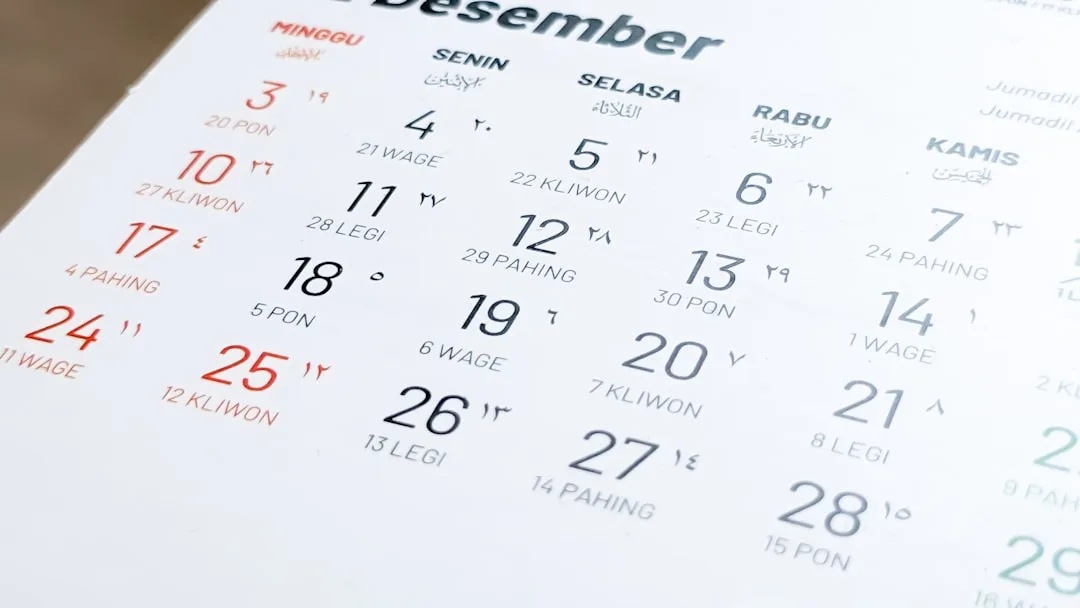
Urdu time vocabulary maps onto two parallel calendar systems and a distinctive grammar of relative time. Pakistanis and Indian Urdu speakers operate fluently in both the Gregorian solar calendar (used for civic life, work schedules, and international communication) and the Islamic Hijri lunar calendar (used for religious observances, Ramadan, Eid, Muharram processions, and Hajj scheduling). This Urdu Days reference collects the forms, examples, and usage notes in one place.
This dual-calendar competence shapes how Urdu names months, expresses dates, and structures time itself. Add the Persian-origin names of the days of the week, the lunar-month asymmetries, and the famous double-duty word kal (which means both yesterday and tomorrow depending on tense context), and time in Urdu becomes one of the more conceptually demanding vocabulary domains for learners.
This reference catalogues the full Urdu time-expression vocabulary: days of the week, months in both calendars, telling time, relative-time adverbs (today, yesterday, tomorrow, day before, day after), seasons, parts of the day, and idiomatic time expressions. Each entry appears in Urdu script (Perso-Arabic, written right to left), Roman Urdu transliteration, and English explanation. Where Pakistani and Indian Urdu diverge in calendar usage or month naming, brief notes flag the differences.
The Hijri calendar is not a curiosity. It governs Ramadan (when work hours shift, restaurants close during daylight, and the daily rhythm of Muslim Pakistan transforms), Eid ul-Fitr and Eid ul-Adha (the two major festivals, both lunar-dated), Muharram (especially the first ten days, marked by Shia mourning), and Hajj (the pilgrimage to Mecca in Zilhaj). A learner who cannot say Ramazan or Eid in Urdu cannot follow the rhythm of Pakistani life.
For background on the script, see the Urdu Alphabet and Nasta'liq Script Complete Guide. For numerical foundation needed to express dates and times, see Urdu Numbers and Counting 1 to 1000. For Persian-origin vocabulary patterns, see Urdu Persian and Arabic Loanwords.
Days of the Week
The Urdu names of the seven days of the week are nearly all Persian in origin, with the exception of Friday (Jumma), which comes from Arabic and reflects Friday's status as the Muslim holy day. Saturday (Hafta) is also Arabic-origin, meaning literally "the seventh". The Persian names use an ordinal-day system (Yak-shamba "first day" through Panj-shamba "fifth day", though shortened forms dominate in modern usage).
| Urdu | Roman Urdu | English | Origin |
|---|---|---|---|
| پیر / سوموار | Peer / Somvar | Monday | Persian/Sanskrit |
| منگل | Mangal | Tuesday | Sanskrit |
| بدھ | Budh | Wednesday | Sanskrit |
| جمعرات | Jumeraat | Thursday | Persian (literally Jumma's eve) |
| جمعہ | Jumma / Jumaa | Friday | Arabic (gathering) |
| ہفتہ | Hafta | Saturday | Arabic (seventh) |
| اتوار | Itvar | Sunday | Persian (one-day) |
Pakistan officially observes a Saturday-Sunday weekend, with Friday a regular working day featuring an extended Jumma prayer break (typically 12:30 to 14:30 in summer). Some Islamic-conservative-leaning institutions or government departments still observe Friday-Saturday weekends or Friday-only short hours. The phrase Jumma ki namaz (Friday prayer) is the structural fact that bends Pakistani Friday afternoons.
"The double name for Monday (peer or somvar) is a marker of register. Peer is the Persian-origin formal Pakistani Urdu form; somvar is Sanskrit-origin, used by Hindi speakers and Indian Urdu in casual register. Pakistani Urdu speakers will say peer in formal speech and writing but use somvar interchangeably in casual conversation."
Hijri Calendar Months (Islamic Lunar)
The Hijri calendar has twelve lunar months totalling approximately 354 days, which means Hijri dates drift by about eleven days per year against the Gregorian calendar. Ramadan moves through every season over a 33-year cycle. The names below are Arabic-origin and used identically across the Muslim world.
| Urdu | Roman Urdu | English | Significance |
|---|---|---|---|
| محرم | Muharram | Muharram (1st month) | Mourning, especially Shia 1-10 |
| صفر | Safar | Safar (2nd month) | Generally non-significant |
| ربیع الاول | Rabi-ul-Awwal | Rabi-ul-Awwal (3rd) | Birth of Prophet (12th day) |
| ربیع الثانی | Rabi-us-Saani | Rabi-us-Saani (4th) | Generally non-significant |
| جمادی الاول | Jamaadi-ul-Awwal | Jamaadi-ul-Awwal (5th) | Generally non-significant |
| جمادی الثانی | Jamaadi-us-Saani | Jamaadi-us-Saani (6th) | Generally non-significant |
| رجب | Rajab | Rajab (7th) | Pre-Islamic sacred month |
| شعبان | Shaaban | Shaaban (8th) | Lailat al-Bara'a in middle |
| رمضان | Ramazaan | Ramadan (9th) | Month of fasting |
| شوال | Shawwal | Shawwal (10th) | Eid ul-Fitr on 1st |
| ذی القعد | Zil-Qadah | Dhu al-Qadah (11th) | Sacred month, pre-Hajj |
| ذی الحج | Zil-Hijj | Dhu al-Hijjah (12th) | Hajj and Eid ul-Adha (10th) |
The Pakistani spelling Ramazaan (with a z) reflects local pronunciation of the Arabic letter dad in this word. The Arabic pronunciation Ramadan (with a d) is also used, especially in formal religious context. Both spellings are correct; Pakistani news headlines use Ramazaan, religious texts often use Ramadan.
| Festival | Date | Description |
|---|---|---|
| Eid ul-Fitr | 1 Shawwal | End of Ramadan fasting, three-day celebration |
| Eid ul-Adha | 10 Zil-Hijj | Festival of Sacrifice, follows Hajj |
| Muharram (Ashura) | 10 Muharram | Mourning of Karbala (Shia) |
| Mawlid an-Nabi | 12 Rabi-ul-Awwal | Birth of the Prophet Muhammad |
| Shab-e-Barat | 15 Shaaban | Night of Forgiveness |
| Shab-e-Mi'raj | 27 Rajab | Night of Ascension |
"Ramazaan transforms Pakistani daily rhythm. Restaurants and cafes close during daylight hours; office hours shift forward; the call for sehri at 4am and iftar at sunset structure entire weeks. The month rotates through the Gregorian calendar, so a Ramazaan in summer (long fasting hours, intense heat) and a Ramazaan in winter (short days, mild weather) are radically different experiences."
Gregorian Calendar Months
The Gregorian months in Urdu are direct phonetic adaptations of English month names. Pakistani official documents, civic life, school calendars, and modern business all run on the Gregorian system. The Hijri dates appear on government letterheads and religious documents alongside Gregorian.
| Urdu | Roman Urdu | English |
|---|---|---|
| جنوری | January | January |
| فروری | February | February |
| مارچ | March | March |
| اپریل | April | April |
| مئی | May | May |
| جون | June | June |
| جولائی | July | July |
| اگست | August | August |
| ستمبر | September | September |
| اکتوبر | October | October |
| نومبر | November | November |
| دسمبر | December | December |
Some traditional Pakistani household calendars also display the Vikram Samvat (Hindu solar) months and the Bengali calendar months, but these are not used in Pakistani Urdu daily life. Indian Urdu speakers, particularly those of Bengali, Marathi, or Tamil heritage, may know their respective regional calendar names but use Gregorian for general Urdu communication.
Telling Time
Urdu telling-time expressions combine number with the word baje (بجے, "o'clock") for hour and an optional minute or fraction expression. The basic pattern is teen baje (3 o'clock), saade teen baje (3:30, literally "three and a half o'clock"), paune chaar baje (3:45, "less-quarter four o'clock"), sawa teen baje (3:15, "and-quarter three o'clock"). The fraction-vocabulary is a distinctive feature.
| Urdu | Roman Urdu | English |
|---|---|---|
| ایک بجے | Ek baje | One o'clock |
| دو بجے | Do baje | Two o'clock |
| تین بجے | Teen baje | Three o'clock |
| سوا تین بجے | Sawa teen baje | Quarter past three (3:15) |
| ساڑھے تین بجے | Saade teen baje | Half past three (3:30) |
| پونے چار بجے | Paune chaar baje | Quarter to four (3:45) |
| ڈیڑھ بجے | Dedh baje | One-thirty (1:30, irregular form) |
| ڈھائی بجے | Dhaai baje | Two-thirty (2:30, irregular form) |
| منٹ | Minute | Minute |
| گھنٹہ | Ghanta | Hour |
| سیکنڈ | Second | Second |
| صبح | Subh | Morning |
| دوپہر | Dopahar | Afternoon, midday |
| شام | Shaam | Evening |
| رات | Raat | Night |
| صبح آٹھ بجے | Subh aath baje | Eight in the morning |
| رات نو بجے | Raat nau baje | Nine at night |
The irregular forms dedh (1:30) and dhaai (2:30) deserve special note: they replace what would otherwise be saade ek and saade do. From three o'clock onward, the regular saade pattern works (saade teen, saade chaar), but 1:30 and 2:30 use these special words. This is a learner trip-point.
| Time Concept | Urdu Phrase |
|---|---|
| What time is it? | Kya baja hai? |
| It is three o'clock | Teen baje hain |
| At three thirty | Saade teen baje |
| In the morning | Subh ko |
| In the evening | Shaam ko |
| At night | Raat ko |
| Now | Abhi |
| Soon | Jaldi |
| Later | Baad mein |
| On time | Waqt par |
| Late | Der se |
Aaj, Kal, Parson: The Tricky Relative-Time Triangle
Here Urdu surprises beginners. The word kal (کل) means BOTH yesterday AND tomorrow. The disambiguation comes entirely from the verb tense: kal main aaya tha (yesterday I came, past tense) versus kal main aaoon ga (tomorrow I will come, future tense). The same logic extends to parson (پرسوں), which means BOTH "day before yesterday" AND "day after tomorrow" depending on tense.
| Urdu | Roman Urdu | Past Sense | Future Sense |
|---|---|---|---|
| آج | Aaj | Today | Today |
| کل | Kal | Yesterday (past) | Tomorrow (future) |
| پرسوں | Parson | Day before yesterday | Day after tomorrow |
| نرسوں | Narson | Three days ago | Three days from now |
| ابھی | Abhi | Just now | Right now |
| پہلے | Pehle | Earlier, before | First, beforehand |
| بعد میں | Baad mein | Later (after) | Later (will be) |
| اس ہفتے | Is hafte | This week | This week |
| اگلے ہفتے | Agle hafte | (n/a) | Next week |
| پچھلے ہفتے | Pichhle hafte | Last week | (n/a) |
| اس مہینے | Is mahine | This month | This month |
| اگلے مہینے | Agle mahine | (n/a) | Next month |
| پچھلے مہینے | Pichhle mahine | Last month | (n/a) |
| اس سال | Is saal | This year | This year |
"Kal-yesterday and kal-tomorrow share a single word in Urdu, Hindi, and Punjabi. This is not lazy ambiguity but a deep cultural orientation: the day adjacent to today, in either direction, occupies the same structural position. The tense disambiguates without losing the underlying conceptual symmetry. Beginners struggle until they internalise that you simply listen for the verb tense to know which kal is meant."
This double-duty kal extends idiomatically. The phrase Kal kya hua? (literally "what happened kal?") is unambiguously past because hua is past. Kal kya ho ga? (what will happen kal?) is unambiguously future. A speaker constructing the present-relevant past pluperfect (kal main aaya tha, "I had come yesterday") makes past explicit; the future-marker ga makes future explicit. Native speakers process this without conscious effort.
Parts of the Day
| Urdu | Roman Urdu | English | Approximate Hours |
|---|---|---|---|
| صبح | Subh | Morning | 5am to 11am |
| دوپہر | Dopahar | Midday, afternoon | 12pm to 3pm |
| سہ پہر | Seh pahar | Late afternoon | 3pm to 5pm |
| شام | Shaam | Evening | 5pm to 8pm |
| رات | Raat | Night | 8pm to 4am |
| فجر | Fajr | Dawn (pre-sunrise prayer) | Before sunrise |
| ظہر | Zuhr | Noon prayer | After zenith |
| عصر | Asr | Late afternoon prayer | Mid-afternoon |
| مغرب | Maghrib | Sunset prayer | Just after sunset |
| عشا | Isha | Night prayer | After full darkness |
| سحر | Sahar | Pre-dawn | Before fajr |
| دو پہر کا کھانا | Dopahar ka khana | Lunch (literally midday meal) | Dopahar period |
The five Islamic prayer times (fajr, zuhr, asr, maghrib, isha) function as time markers in everyday Pakistani conversation. A speaker arranging a meeting may say Maghrib ke baad milein (let us meet after maghrib) instead of giving a clock time, because maghrib varies seasonally and the meeting time tracks sunset. This is real, common usage.
Seasons (Mausam)
Pakistan has four named seasons that align with North Indian climatic divisions: garmi (summer), barsaat (monsoon), sardi (winter), and bahaar (spring). Some traditions add a fifth, khareef or paat-jhar (autumn), though autumn is short and weakly marked in the Punjabi-Sindhi plains.
| Urdu | Roman Urdu | English |
|---|---|---|
| موسم | Mausam | Season, weather |
| موسم گرما | Mausam-e-garma | Summer season |
| گرمیاں | Garmiyaan | Summers (colloquial) |
| گرمی | Garmi | Heat, summer |
| موسم سرما | Mausam-e-sarma | Winter season |
| سردیاں | Sardiyaan | Winters (colloquial) |
| سردی | Sardi | Cold, winter |
| برسات | Barsaat | Monsoon season |
| ساون | Saawan | Monsoon (literary, romantic) |
| بہار | Bahaar | Spring |
| خزاں | Khazaan | Autumn |
| پت جھڑ | Pat jhar | Leaves-falling, autumn |
Pakistani seasonal experience varies dramatically by region. Karachi is hot or warm year-round with mild winter; Lahore has searing 45-degree summers and cool winter; Islamabad has four full distinct seasons; the Northern Areas have long snowy winters and brief summers. The vocabulary above describes the four-season Punjab-Sindh model that anchors literary Urdu.
Idiomatic Time Expressions
| Urdu | Roman Urdu | English |
|---|---|---|
| کبھی نہیں | Kabhi nahin | Never |
| ہمیشہ | Hamesha | Always |
| اکثر | Aksar | Often |
| کبھی کبھی | Kabhi kabhi | Sometimes |
| روز / روزانہ | Roz / Roozana | Daily |
| ہفتہ وار | Hafta-waar | Weekly |
| ماہانہ | Maahaana | Monthly |
| سالانہ | Saalaana | Yearly, annual |
| ابھی | Abhi | Just now, right now |
| فوراً | Fauran | Immediately |
| جلدی | Jaldi | Quickly, soon |
| دیر سے | Der se | Late |
| وقت پر | Waqt par | On time |
| پل بھر میں | Pal bhar mein | In a moment |
| دن بھر | Din bhar | All day |
| رات بھر | Raat bhar | All night |
| ہمیشہ کے لیے | Hamesha ke liye | Forever |
"The Urdu phrase waqt par (on time) carries a cultural irony: Pakistani standard time runs often to its own rhythm, and waqt par as a strict commitment is more associated with formal-business than social settings. A casual dinner invitation for nau baje (nine o'clock) typically begins materialising at ten, and arriving exactly at nine marks you as either a foreigner or an unusually punctilious host."
Common Mistakes
Treating kal as only meaning yesterday OR tomorrow: Both meanings are correct and active. The verb tense disambiguates. Listen to the verb to know which kal is meant.
Forgetting dedh and dhaai for 1:30 and 2:30: These are special irregular forms. Saying saade ek and saade do for 1:30 and 2:30 marks the speaker as a learner; native speakers always say dedh baje and dhaai baje.
Mixing Hijri and Gregorian months in dating: 15 Ramazan and 15 January are different kinds of dates. Pakistani official documents specify which calendar; informal Urdu writing may rely on context. Religious dates default to Hijri; civic dates to Gregorian.
Using Sanskrit somvar with Persian peer interchangeably in formal text: Both mean Monday but they sit at different register levels. Pakistani Urdu newspapers default to peer; Indian Urdu and Hindi-influenced Pakistani youth speech often uses somvar.
Misusing baje for the hour: Baje is the verb-form "is/are striking" used for clock hours. Saying ek ghante (one hour, duration) is different from ek baje (at one o'clock). Confusing duration with clock time misroutes meaning.
Ignoring prayer times as social time-markers: When a Pakistani host says baad-e-maghrib (after maghrib), they mean after sunset prayer, which varies seasonally. Don't ask for a clock time; just check sunset for that day.
Quick Reference Card
| Concept | Urdu |
|---|---|
| Today | Aaj |
| Yesterday | Kal (with past verb) |
| Tomorrow | Kal (with future verb) |
| Day before yesterday | Parson |
| Now | Abhi |
| Morning | Subh |
| Evening | Shaam |
| Night | Raat |
| What time is it? | Kya baja hai? |
| Three o'clock | Teen baje |
| Half past three | Saade teen baje |
| Monday | Peer / Somvar |
| Friday | Jumma |
| Sunday | Itvar |
| Ramadan | Ramazaan |
| Eid | Eid |
| Summer | Garmi |
| Winter | Sardi |
Frequently Asked Questions
Why does kal mean both yesterday and tomorrow? Because Urdu (and Hindi, Punjabi, and other related languages) conceives of "the day adjacent to today" as a single positional concept with directionality supplied by the verb tense. Kal main gaya (past, yesterday I went) and kal main jaaoonga (future, tomorrow I will go) use the same kal because the day-adjacent-to-today is symmetrical; the verb tells you which side.
Do Pakistanis use Hijri or Gregorian dates day to day? Both. Civic life (school, work, business, news) runs on Gregorian. Religious life (Ramadan, Eid, Muharram, Mawlid) runs on Hijri. A Pakistani might say their daughter's wedding is on 15 January but their iftar is on 15 Ramazan, switching calendars between sentences without confusion.
How do I say AM and PM in Urdu? Urdu uses descriptive parts-of-day: subh (morning), dopahar (midday), shaam (evening), raat (night). For AM/PM precision in formal writing, English am/pm or 24-hour notation is used. In speech, subh aath baje (8 in the morning) and raat aath baje (8 at night) disambiguate naturally.
Is the Pakistani weekend Friday-Saturday or Saturday-Sunday? Saturday-Sunday since 1997. Earlier, Friday-Saturday was tested under Islamic-conservative rationale but reverted because of international business friction. Friday remains an extended-prayer-break working day, with longer Jumma break around midday.
What is the difference between Ramazan and Ramadan? Same month, different transliteration. Ramazan reflects Pakistani-Indian pronunciation of the Arabic letter dad in this word. Ramadan reflects the Arabic-original pronunciation. Pakistani Urdu uses Ramazan in everyday writing; religious-classical contexts use Ramadan. Both are correct.
Why are Friday prayers so important? Jumma (Friday) is the Muslim community-prayer day. Jumma ki namaz (Friday prayer) is congregational, includes a sermon (khutba), and is obligatory for adult Muslim men in most schools. The 12:30 to 14:30 Friday window in Pakistani offices is reserved for this. Restaurants, schools, and businesses often pause.
What is dedh and why does it not follow the pattern? Dedh (1:30) and dhaai (2:30) are Sanskrit-derived irregular forms preserved from Old Indo-Aryan. They predate the saade ("and a half") system and never got regularised. From three onward, saade teen and saade chaar follow the regular pattern. This is one of those frozen irregularities that a language preserves because it is too common to standardise away.
See Also
- Urdu Numbers and Counting 1 to 1000
- Urdu Common Phrases and Daily Conversation Reference
- Urdu Persian and Arabic Loanwords
- Urdu Alphabet and Nasta'liq Script Complete Guide
- Urdu Verb Conjugation: Tense and Aspect
- Urdu Conversations and Daily Phrases by Register
- Urdu in Pakistan, India and the Diaspora
Author: Kalenux Team
Frequently Asked Questions
Why does kal mean both yesterday and tomorrow?
Urdu conceives the day adjacent to today as a single positional concept with directionality from the verb tense. Kal main gaya (past) means yesterday; kal main jaaoonga (future) means tomorrow. The verb disambiguates.
Do Pakistanis use Hijri or Gregorian dates day to day?
Both. Civic life runs on Gregorian. Religious life like Ramadan, Eid, Muharram, and Mawlid runs on Hijri. Pakistanis switch calendars between sentences without confusion.
How do I say AM and PM in Urdu?
Urdu uses parts-of-day: subh (morning), dopahar (midday), shaam (evening), raat (night). Subh aath baje and raat aath baje disambiguate. Formal writing may use English am/pm.
Is the Pakistani weekend Friday-Saturday or Saturday-Sunday?
Saturday-Sunday since 1997. Friday remains an extended-prayer-break working day with longer Jumma break around midday.
What is the difference between Ramazan and Ramadan?
Same month, different transliteration. Ramazan reflects Pakistani-Indian pronunciation of the Arabic dad. Ramadan reflects Arabic original. Pakistani Urdu uses Ramazan everyday; classical contexts use Ramadan.
Why are Friday prayers so important?
Jumma is the Muslim community-prayer day. Friday prayer is congregational, includes a sermon, and is obligatory for adult Muslim men. The 12:30 to 14:30 Friday window in Pakistani offices is reserved for this.
What is dedh and why does it not follow the pattern?
Dedh (1:30) and dhaai (2:30) are Sanskrit-derived irregular forms preserved from Old Indo-Aryan. They predate the saade system. From three onward saade teen follows the regular pattern.