
Urdu numerals look at first like a simple problem: recognise the digit shapes, learn the number words, memorise a few multiplication patterns, and you are done. But Urdu numbers are among the hardest memorisation tasks in the whole language. Unlike English (where 24 is a transparent compound of "twenty" + "four"), almost every Urdu number from 1 to 99 has an idiosyncratic, non-compositional form.
Twenty-four is chauwis, but you would not derive it cleanly from bees (twenty) and chaar (four). Each number in the teens, twenties, thirties, and so on up to 99 has its own learned form. This makes counting in Urdu a substantial memorisation project but unlocks essential vocabulary for shopping, telling time, ages, addresses, phone numbers, and dates.
Above 99, the system becomes more regular but introduces the distinctive South Asian grouping by lakh (one hundred thousand) and crore (ten million), which replaces the Western thousand/million structure and affects how Urdu (and Hindi) speakers think about large quantities.
This reference covers Urdu numeral digits (۰۱۲۳۴۵۶۷۸۹), cardinal numbers 0-100, the teen and tens patterns, hundreds and thousands, the lakh/crore system, ordinals (first, second, third), fractions, multiplicatives, and common counting expressions. For other vocabulary, see Urdu Persian and Arabic Loanwords Vocabulary. For grammatical context, see Urdu Grammar: Cases, Gender, and the Ergative.
The Urdu Numeral Digits
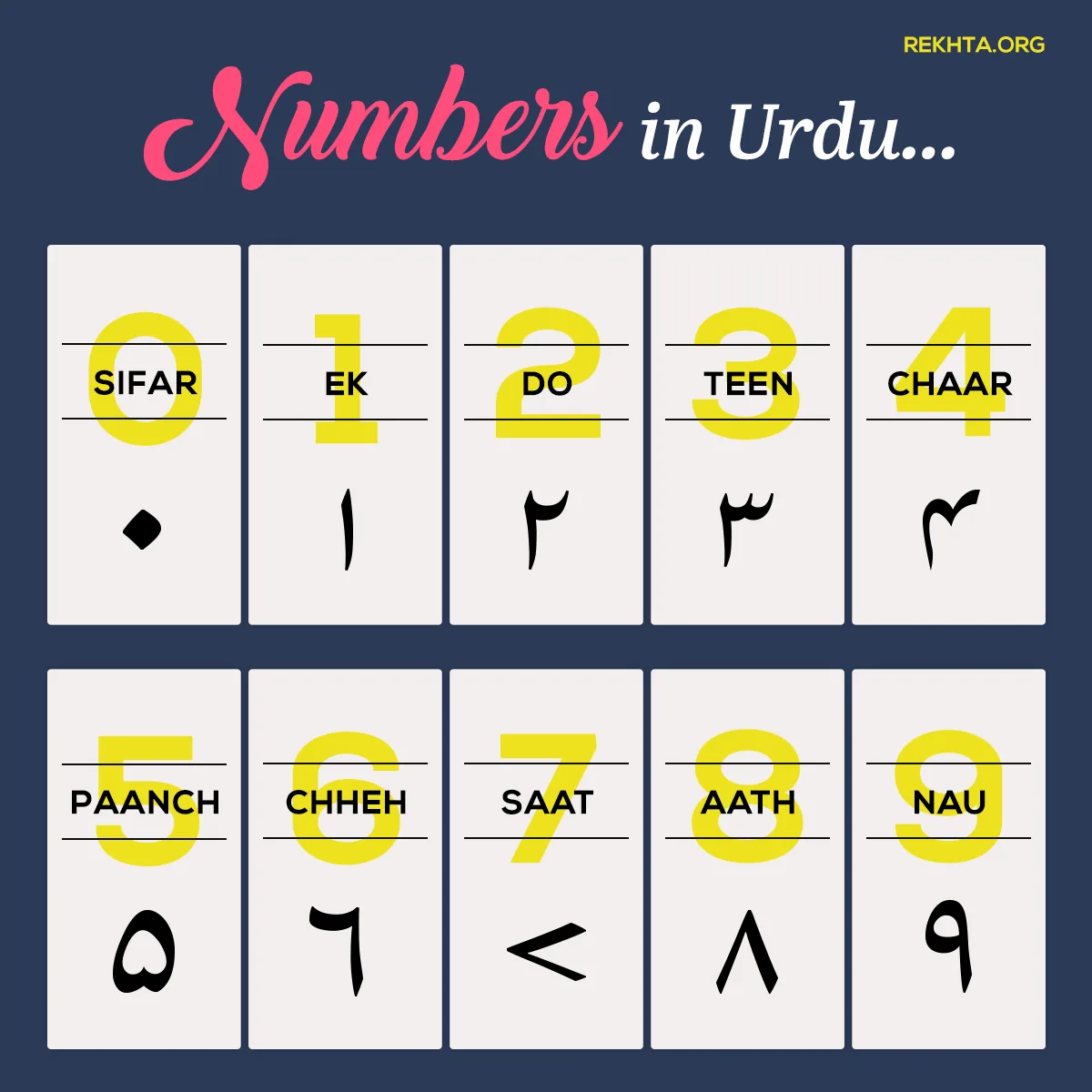
Urdu uses the Perso-Arabic numeral shapes for 0-9. Though the underlying system is decimal (positional, base 10), the digit shapes differ from the "Western" Arabic numerals familiar in English.
| Value | Urdu numeral | Name in Urdu |
|---|---|---|
| 0 | ۰ | صفر (sifar) |
| 1 | ۱ | ایک (aik or ek) |
| 2 | ۲ | دو (do) |
| 3 | ۳ | تین (teen) |
| 4 | ۴ | چار (chaar) |
| 5 | ۵ | پانچ (paanch) |
| 6 | ۶ | چھ (chhe) |
| 7 | ۷ | سات (saat) |
| 8 | ۸ | آٹھ (aaTh) |
| 9 | ۹ | نو (nau) |
Note that some shapes differ slightly from those used in most Arab countries: Urdu ۴ (four) is drawn differently from Arabic ٤, and Urdu ۶ (six) differs from Arabic ٦. Urdu and Persian share the same digit shapes.
Multi-digit numbers are written in the same order as in English (highest place-value leftmost), even though the surrounding text is right-to-left. So the year 2024 in Urdu is ۲۰۲۴, read from left to right within the number.
Urdu publications often use Western digits (0-9) for phone numbers, prices, and dates because digital typography handles them more easily. A literate Urdu reader is fluent in both digit systems.
Numbers 1-10
| Digit | Urdu | Roman | Pronunciation note |
|---|---|---|---|
| 1 | ایک | aik (ek) | "aik" in formal Urdu, "ek" common in speech |
| 2 | دو | do | "do" as in "dough" |
| 3 | تین | teen | long ee |
| 4 | چار | chaar | long aa |
| 5 | پانچ | paanch | long aa, final ch as in "church" |
| 6 | چھ | chhe | aspirated "chh" |
| 7 | سات | saat | long aa |
| 8 | آٹھ | aaTh | long aa, retroflex aspirated Th |
| 9 | نو | nau | "now" like English "now" |
| 10 | دس | das | "dus" with short "u" sound |
Numbers 11-20
This is where idiosyncrasy begins. Each number has to be memorised.
| Digit | Urdu | Roman |
|---|---|---|
| 11 | گیارہ | gyarah |
| 12 | بارہ | baarah |
| 13 | تیرہ | terah |
| 14 | چودہ | chaudah |
| 15 | پندرہ | pandrah |
| 16 | سولہ | solah |
| 17 | سترہ | satrah |
| 18 | اٹھارہ | aTharah |
| 19 | انیس | unnees |
| 20 | بیس | bees |
Numbers 21-30
The teens merge into the twenties: note the pattern "ik-" or "-ees" at the end but each number is still irregular.
| Digit | Urdu | Roman |
|---|---|---|
| 21 | اکیس | ikkees |
| 22 | بائیس | baais |
| 23 | تئیس | teis |
| 24 | چوبیس | chaubees |
| 25 | پچیس | pachchees |
| 26 | چھبیس | chhabbees |
| 27 | ستائیس | sattais |
| 28 | اٹھائیس | aTThais |
| 29 | انتیس | unatis |
| 30 | تیس | tees |
Numbers 31-40
| Digit | Urdu | Roman |
|---|---|---|
| 31 | اکتیس | ikatis |
| 32 | بتیس | battees |
| 33 | تینتیس | teintees |
| 34 | چونتیس | chauntees |
| 35 | پینتیس | paintees |
| 36 | چھتیس | chhattees |
| 37 | سینتیس | saintees |
| 38 | اڑتیس | aRtees |
| 39 | انتالیس | unataalees |
| 40 | چالیس | chaalees |
Numbers 41-50
| Digit | Urdu | Roman |
|---|---|---|
| 41 | اکتالیس | iktaalees |
| 42 | بیالیس | bayalees |
| 43 | تینتالیس | taintaalees |
| 44 | چوالیس | chawalees |
| 45 | پینتالیس | paintaalees |
| 46 | چھیالیس | chhiyalees |
| 47 | سینتالیس | saintaalees |
| 48 | اڑتالیس | aRtaalees |
| 49 | انچاس | unchaas |
| 50 | پچاس | pachaas |
Numbers 51-60
| Digit | Urdu | Roman |
|---|---|---|
| 51 | اکیاون | ikyawan |
| 52 | باون | bawan |
| 53 | ترپن | tirpan |
| 54 | چون | chauwan |
| 55 | پچپن | pachpan |
| 56 | چھپن | chhappan |
| 57 | ستاون | sattawan |
| 58 | اٹھاون | aTThawan |
| 59 | انسٹھ | unsaTh |
| 60 | ساٹھ | saaTh |
Numbers 61-70
| Digit | Urdu | Roman |
|---|---|---|
| 61 | اکسٹھ | iksaTh |
| 62 | باسٹھ | baasaTh |
| 63 | ترسٹھ | tirsaTh |
| 64 | چوسٹھ | chausaTh |
| 65 | پینسٹھ | painsaTh |
| 66 | چھیاسٹھ | chhiyasaTh |
| 67 | سڑسٹھ | saRsaTh |
| 68 | اڑسٹھ | aRsaTh |
| 69 | انہتر | unhattar |
| 70 | ستر | sattar |
Numbers 71-80
| Digit | Urdu | Roman |
|---|---|---|
| 71 | اکہتر | ikahattar |
| 72 | بہتر | bahattar |
| 73 | تہتر | tihattar |
| 74 | چوہتر | chauhattar |
| 75 | پچہتر | pichhattar |
| 76 | چھہتر | chhihattar |
| 77 | ستہتر | satahattar |
| 78 | اٹھہتر | aThhattar |
| 79 | اناسی | unaasi |
| 80 | اسی | assi |
Numbers 81-90
| Digit | Urdu | Roman |
|---|---|---|
| 81 | اکیاسی | ikyaasi |
| 82 | بیاسی | bayaasi |
| 83 | تراسی | tiraasi |
| 84 | چوراسی | chauraasi |
| 85 | پچاسی | pachaasi |
| 86 | چھیاسی | chhiyaasi |
| 87 | ستاسی | sataasi |
| 88 | اٹھاسی | aThaasi |
| 89 | نواسی | nawaasi |
| 90 | نوے | nawway |
Numbers 91-100
| Digit | Urdu | Roman |
|---|---|---|
| 91 | اکیانوے | ikyaanway |
| 92 | بانوے | baanway |
| 93 | ترانوے | tiraanway |
| 94 | چورانوے | chauraanway |
| 95 | پچانوے | pachaanway |
| 96 | چھیانوے | chhiyaanway |
| 97 | ستانوے | sataanway |
| 98 | اٹھانوے | aThaanway |
| 99 | ننانوے | ninyaanway |
| 100 | سو | sau |
Hundreds and Thousands
Once you reach 100 (سو sau), the system becomes predictable.
| Number | Urdu | Roman |
|---|---|---|
| 100 | سو | sau |
| 200 | دو سو | do sau |
| 300 | تین سو | teen sau |
| 500 | پانچ سو | paanch sau |
| 1,000 | ہزار | hazaar |
| 2,000 | دو ہزار | do hazaar |
| 10,000 | دس ہزار | das hazaar |
| 100,000 | لاکھ | laakh |
| 1,000,000 | دس لاکھ | das laakh (ten lakh) |
| 10,000,000 | کروڑ | karoR |
| 100,000,000 | دس کروڑ | das karoR |
| 1,000,000,000 | ارب | arab |
| 1,000,000,000,000 | کھرب | kharab |
Combining: say the biggest units first.
- 125 = ایک سو پچیس (aik sau pachchees)
- 1,500 = ڈیڑھ ہزار (DeRh hazaar, "one-and-a-half thousand") or ایک ہزار پانچ سو (aik hazaar paanch sau)
- 2,500 = ڈھائی ہزار (Dhai hazaar, "two-and-a-half thousand") or دو ہزار پانچ سو
- 12,345 = بارہ ہزار تین سو پینتالیس (baarah hazaar teen sau paintaalees)
The Lakh-Crore System
Urdu and Hindi use a grouping system based on lakh (100,000) and crore (10,000,000). In numerical notation, digits are separated with commas at these positions:
- 1,00,000 = one lakh = 100,000
- 10,00,000 = ten lakh = 1,000,000 (one million)
- 1,00,00,000 = one crore = 10,000,000 (ten million)
- 10,00,00,000 = ten crore = 100,000,000
- 1,00,00,00,000 = one arab = 1,000,000,000 (one billion)
Journalism and finance in Pakistan and India use lakh/crore, not million/billion. Saying "ten lakh rupees" is natural; "one million rupees" sounds foreign.
Fractions: the Half-System
Urdu has special half-and-quarter forms that are ubiquitous in counting:
| Term | Script | Meaning |
|---|---|---|
| aadha | آدھا | half |
| paun | پاؤ | quarter |
| DeRh | ڈیڑھ | one and a half |
| Dhai | ڈھائی | two and a half |
| sawa | سوا | one and a quarter (e.g., sawa 1 = 1.25) |
| paune | پونے | minus a quarter (e.g., paune 2 = 1.75) |
| saaRhe | ساڑھے | and a half (from 3 onwards, e.g., saaRhe 3 = 3.5) |
These are used for money, time, weight:
- DeRh sau = 150 (one and a half hundred)
- Dhai sau = 250
- saaRhe teen = 3.5
- sawa paanch = 5.25
- paune chhe = 5.75
Ordinals: First, Second, Third
Ordinals for 1-6 are irregular, Persian-derived. From 7 onwards, the regular pattern is cardinal + -vaan.
| English | Urdu | Roman |
|---|---|---|
| first | پہلا / اول | pehla / awwal |
| second | دوسرا / ثانی | doosra / saani |
| third | تیسرا | teesra |
| fourth | چوتھا | chautha |
| fifth | پانچواں | paanchwaan |
| sixth | چھٹا | chhaTa |
| seventh | ساتواں | saatwaan |
| eighth | آٹھواں | aaThwaan |
| ninth | نواں | nawwan |
| tenth | دسواں | daswan |
| twentieth | بیسواں | beeswan |
| hundredth | سواں | sauwan |
Ordinals agree with the noun they modify in gender and number (pehla larka, pehli larki, pehle larke).
Counting Time and Money
Time
- ایک بجا ہے۔ aik baja hai. (It's one o'clock.)
- دو بج کر بیس منٹ ہیں۔ do baj kar bees minaT hain. (It's twenty past two.)
- ساڑھے تین بجے ہیں۔ saaRhe teen baje hain. (It's half past three.)
- پونے پانچ بجے۔ paune paanch baje. (Quarter to five.)
- سوا چھ بجے۔ sawa chhe baje. (Quarter past six.)
Money (Pakistani Rupees or Indian Rupees)
- ایک روپیہ aik rupaiya (one rupee)
- پانچ روپے paanch rupay (five rupees)
- سو روپے sau rupay (100 rupees)
- پانچ ہزار روپے paanch hazaar rupay (5,000 rupees)
- ایک لاکھ روپے aik laakh rupay (100,000 rupees)
Age
- آپ کی عمر کتنی ہے؟ aap ki umar kitni hai? (How old are you?)
- میری عمر پچیس سال ہے۔ meri umar pachchees saal hai. (I am 25.)
Counting objects
- تین کتابیں teen kitaabein (three books)
- پانچ لڑکے paanch larke (five boys)
- دس روپے das rupay (ten rupees)
Note that some nouns take plural forms with numbers while others do not. Nouns referring to inanimate mass items like din (day), saal (year), rupaya (rupee) often stay singular in the plural construction: paanch saal (five years), not paanch saalein.
Common Mistakes
Trying to construct teens compositionally. Learners say "bees-char" for 24, but the correct form is chaubees. Each number must be memorised.
Confusing lakh and million. One lakh is 100,000, not one million. One crore is ten million, not one million. Mistranslating "ten lakh" as "ten million" will be off by a factor of 10.
Forgetting fraction words in daily speech. "DeRh ghanTa" (1.5 hours) is idiomatic; "aik aur aadha ghanTa" sounds foreign. Learn sawa, paune, saaRhe, DeRh, Dhai and use them.
Gender-agreement errors on ordinals. "pehla larki" is wrong; it must be pehli larki (feminine).
Reading Urdu digits right to left. Multi-digit numbers are read left to right even in right-to-left Urdu text. 2024 is still twenty twenty-four, not forty-two zero-two.
Mixing Western and Urdu digits inconsistently. Within a single document, pick one digit system and stick with it. Modern Pakistani newspapers often use Western digits for numbers and Urdu for everything else.
Using English ordinal suffixes like "th". Urdu ordinals have their own suffixes; do not graft "th" onto cardinal numbers.
Quick Reference
- Digits: ۰۱۲۳۴۵۶۷۸۹
- 0-10: sifar, aik, do, teen, chaar, paanch, chhe, saat, aaTh, nau, das
- Multiples of 10: das, bees, tees, chaalees, pachaas, saaTh, sattar, assi, nawway, sau
- Hundreds: sau (100), hazaar (1,000), laakh (100,000), karoR (10,000,000)
- Each number 11-99 is irregular: memorise by tens
- Fractions: aadha, paun, DeRh, Dhai, sawa, paune, saaRhe
- Ordinals: pehla, doosra, teesra, chautha, paanchwaan, ... (from 7 onwards add -vaan)
- Indian/Pakistani number system uses lakh and crore, not million and billion
Frequently Asked Questions
Why is every number from 11 to 99 irregular? Urdu numbers descend from Sanskrit via Prakrit, which had regular number formation that underwent centuries of phonetic erosion. What were once transparent compounds like "twenty-and-four" became contracted irregular forms. This is similar to how English "fourteen" and "forty" are worn-down compounds of "four + ten."
Do I have to memorise all 99 numbers or can I just use them compositionally? You have to memorise them. No Urdu speaker will understand "bees-chaar" for 24. The good news is that most daily interactions use a subset (prices, ages, dates, phone numbers), so you can prioritise the most used numbers.
What is the difference between aik and ek? They are the same word. "aik" is the formal pronunciation (closer to the written form ایک). "ek" is the more common colloquial pronunciation, especially in India. Both are correct in Urdu.
How do I say big numbers like one million? Use the lakh-crore system. One million = das laakh (ten lakh). Ten million = aik karoR. One hundred million = das karoR. One billion = aik arab. Financial and news media in Pakistan and India use this system almost exclusively.
How do I tell time in Urdu? Use "X bajna" for "o'clock": aik baja (one o'clock), do baje (two o'clock). For half past, use saaRhe X. For quarter past, sawa X. For quarter to, paune X. For minutes: do baj kar bees minaT (two o'clock and twenty minutes, i.e., 2:20).
Why are Urdu digits different from Arabic digits? They are actually the same underlying system (Eastern Arabic-Indic digits) with minor shape variations. Urdu shares shapes with Persian, while Modern Standard Arabic uses slightly different shapes for 4, 5, and 6. Both are descendants of the Brahmi-Gupta digits that also gave rise to "Western" Arabic numerals 0-9.
What are the fractions sawa, paune, saaRhe?
- sawa X = X + 1/4 (sawa 4 = 4.25)
- paune X = X - 1/4 (paune 4 = 3.75)
- saaRhe X = X + 1/2 (saaRhe 4 = 4.5, from 3 onwards)
- DeRh = 1.5 (special)
- Dhai = 2.5 (special)
Use these for time, money, and weights.
See Also
- Urdu Grammar: Cases, Gender, and the Ergative
- Urdu Conversations: Daily Phrases and Register
- Urdu Alphabet and Nasta'liq Script: Complete Guide
- Urdu Persian and Arabic Loanwords Vocabulary
- Urdu vs Hindi: Same Language, Different Scripts
- Arabic Numbers System Guide: Modern Standard
- Writing Systems and Alphabets Comparison
- Urdu in Pakistan, India, and the Diaspora
Frequently Asked Questions
Why is every number from 11 to 99 irregular?
Urdu numbers descend from Sanskrit via Prakrit, which had regular number formation that underwent centuries of phonetic erosion. Transparent compounds like twenty and four became contracted irregular forms, similar to how English fourteen and forty are worn down compounds.
Do I have to memorise all 99 numbers or can I use them compositionally?
You have to memorise them. No Urdu speaker will understand bees chaar for 24. The good news is that daily interactions use a subset, so prioritise the most used numbers like prices, ages, and dates.
What is the difference between aik and ek?
They are the same word. aik is the formal pronunciation closer to the written form. ek is the common colloquial pronunciation, especially in India. Both are correct in Urdu.
How do I say big numbers like one million?
Use the lakh crore system. One million is das laakh (ten lakh). Ten million is aik karoR. One hundred million is das karoR. One billion is aik arab. Financial and news media in Pakistan and India use this system.
How do I tell time in Urdu?
Use X bajna for o clock: aik baja, do baje. For half past, use saaRhe X. For quarter past, sawa X. For quarter to, paune X. For minutes: do baj kar bees minaT means 2:20.
Why are Urdu digits different from Arabic digits?
They are the same underlying system with minor shape variations. Urdu shares shapes with Persian, while Modern Standard Arabic uses slightly different shapes for 4, 5, and 6. Both descend from the Brahmi Gupta digits that also gave rise to Western numerals.
What are sawa, paune, and saaRhe?
sawa X means X plus a quarter. paune X means X minus a quarter. saaRhe X means X and a half (from 3 onwards). Special forms DeRh is 1.5 and Dhai is 2.5. Use these for time, money, and weight.