
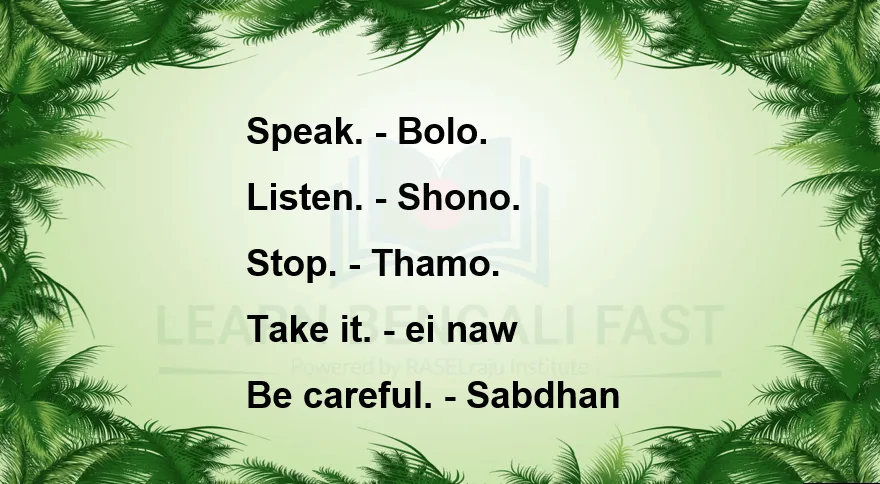
Bengali, known to its speakers as বাংলা Bangla, is the sixth most spoken language in the world with roughly 270 million speakers across Bangladesh and the Indian state of West Bengal.
A learner who controls a few hundred everyday phrases can navigate markets in Dhaka, catch a metro in Kolkata, negotiate a rickshaw fare in Sylhet, and hold simple social conversations with Bengalis of any region. This reference assembles more than a hundred of the most useful expressions, organized by the situations where a traveler, student, or expatriate most often needs them.
What follows is not a phrasebook for memorization but a structured survey of living Bengali. Each phrase appears in Bengali script (বাংলা হরফ Bangla hôroph), in a transliteration that reflects modern pronunciation, and in English translation.
Where a phrase differs in form between Hindu and Muslim speakers, between West Bengal and Bangladesh, or between respect levels, those variations are marked. The goal is usable fluency, not encyclopedic completeness; the phrases have been chosen because they recur in real spoken encounters rather than because they appear in grammar drills.
Before diving into the phrases, a note on register. Bengali has three politeness levels encoded in pronouns and verb endings: তুই tui (intimate), তুমি tumi (familiar), and আপনি apni (respectful). Learners should default to আপনি apni with strangers, elders, and service workers; the phrases below are given in this respectful register unless otherwise noted. For deeper treatment of this system, see the Bengali Honorifics reference.
Greetings and Opening Exchanges
Bengali greetings are marked by the religious background of the speaker. Hindus and secular Bengalis commonly use নমস্কার Nomoshkar, while Muslims use আসসালামু আলাইকুম Assalamu Alaikum. In mixed company, the time-of-day greetings are safely neutral.
| Bengali | Transliteration | English |
|---|---|---|
| নমস্কার | Nomoshkar | Greetings (Hindu) |
| সালাম / আসসালামু আলাইকুম | Salam / Assalamu Alaikum | Peace (Muslim) |
| ওয়ালাইকুম আসসালাম | Walaikum Assalam | And peace upon you (reply) |
| শুভ সকাল | Shubho shôkal | Good morning |
| শুভ দুপুর | Shubho dupur | Good afternoon |
| শুভ সন্ধ্যা | Shubho shondhya | Good evening |
| শুভ রাত্রি | Shubho ratri | Good night |
| হ্যালো | Hêlo | Hello (casual, from English) |
| বিদায় | Biday | Farewell |
| আবার দেখা হবে | Abar dêkha hôbe | We will meet again |
| পরে কথা হবে | Pore kotha hôbe | We will talk later |
After greeting, the next move is almost always an inquiry after health or situation. The formal respectful phrase is কেমন আছেন Kêmon achhen, while intimates use কেমন আছ Kêmon achho or কি খবর Ki khobor.
Bengali culture places high value on the inquiry itself, not on the detailed answer. Replying ভালো আছি, আপনি কেমন আছেন? Bhalo achhi, apni kêmon achhen? (I am well, how are you?) returns the question and is the expected courtesy.
Essential Politeness Formulas
Politeness in Bengali is marked through both pronouns and specific formulas. Learners should overuse these rather than underuse them; a slightly stilted learner who over-thanks and over-apologizes is perceived as courteous, not awkward.
| Bengali | Transliteration | English |
|---|---|---|
| ধন্যবাদ | Dhônnobad | Thank you |
| অনেক ধন্যবাদ | Ônek dhônnobad | Many thanks |
| ধন্যবাদ আপনাকে | Dhônnobad apnake | Thank you to you |
| দয়া করে | Dôya kôre | Please (literally, showing mercy) |
| মেহেরবানি করে | Meherbani kôre | Please (Bangladesh variant) |
| অনুগ্রহ করে | Onugroho kôre | Kindly (formal) |
| দুঃখিত | Duhkhito | Sorry |
| মাফ করবেন | Maph kôrben | Please pardon me |
| ক্ষমা করবেন | Khôma kôrben | Please forgive me |
| সমস্যা নেই | Shômossha nei | No problem |
| কিছু মনে করবেন না | Kichhu mône kôrben na | Do not take it personally |
| স্বাগতম | Shagôtom | Welcome |
A peculiarity of Bengali is that ধন্যবাদ Dhônnobad is used more sparingly than the English "thank you." In informal family settings, thanking someone for small favors can sound coldly formal. Reserve ধন্যবাদ for service encounters, substantive favors, and formal occasions. Within families, a smile or an acknowledging nod often serves where an English speaker would say "thanks."
Self Introduction and Getting Acquainted
Introducing oneself in Bengali follows predictable patterns. The verb হওয়া hôwa (to be) is implied in the present tense, so simple identity statements are verbless.
| Bengali | Transliteration | English |
|---|---|---|
| আমার নাম ... | Amar nam ... | My name is ... |
| আপনার নাম কি? | Apnar nam ki? | What is your name? |
| আমি ... থেকে এসেছি | Ami ... theke eshechhi | I have come from ... |
| আপনি কোথা থেকে? | Apni kotha theke? | Where are you from? |
| আমি ... তে থাকি | Ami ... te thaki | I live in ... |
| আমি ইংরেজি | Ami ingreji | I am English |
| আমি আমেরিকান | Ami amêrikan | I am American |
| আমি ছাত্র / ছাত্রী | Ami chhatro / chhatri | I am a male/female student |
| আমি শিক্ষক | Ami shikkhok | I am a teacher |
| পরিচিত হয়ে ভালো লাগল | Pôrichito hôye bhalo laglo | Pleased to meet you |
| আপনার সাথে দেখা হয়ে খুশি হলাম | Apnar shathe dêkha hôye khushi hôlam | Happy to have met you |
Bengalis often ask about one's family (পরিবার pôribar) very early in a conversation, sometimes within the first minute of meeting. Questions about parents, siblings, marriage, and children are not intrusive but are considered warm interest.
Asking for Information and Directions
Navigation in Bengali-speaking regions relies heavily on asking locals. Street signs are inconsistent, and even where GPS functions, local knowledge outperforms maps for lane-level accuracy.
| Bengali | Transliteration | English |
|---|---|---|
| এটা কোথায়? | ÊTa kothay? | Where is this? |
| ... কোথায়? | ... kothay? | Where is ... ? |
| কিভাবে যাব? | Kibhabe jabo? | How do I go? |
| কতদূর? | Kôtodur? | How far? |
| ডান দিকে | Dan dike | To the right |
| বাম দিকে | Bam dike | To the left |
| সোজা যান | Shoja jan | Go straight |
| এখানে | Êkhane | Here |
| ওখানে | Okhane | There |
| সামনে | Shamne | Ahead |
| পিছনে | Pichhone | Behind |
| কাছে | Kachhe | Near |
| দূরে | Dure | Far |
| স্টেশন কোথায়? | Steshon kothay? | Where is the station? |
| বাথরুম কোথায়? | Bathrum kothay? | Where is the bathroom? |
| থামুন | Thamun | Stop |
When asking directions from a stranger, open with দয়া করে Dôya kôre (please) or মাফ করবেন Maph kôrben (excuse me): দয়া করে বলবেন, পোস্ট অফিস কোথায়? Dôya kôre bôlben, post office kothay? (Please tell me, where is the post office?). The polite opener signals that you are making a request and invites cooperation.
Shopping and Bargaining
Bargaining is standard in Bengali markets outside of fixed-price chain stores. The rhythm of negotiation is part of the social fabric, and shopkeepers expect buyers to push back on the first quoted price. Knowing the right phrases signals that you are not a complete novice and invites a more reasonable opening offer.
| Bengali | Transliteration | English |
|---|---|---|
| এটার দাম কত? | ÊTar dam kôto? | How much is this? |
| কত টাকা? | Kôto Taka? | How many taka/rupees? |
| অনেক বেশি | Ônek beshi | Too much |
| কমান | Kôman | Reduce |
| কমাবেন না? | Kômaben na? | Won't you reduce? |
| সস্তা করুন | Shosta korun | Make it cheaper |
| শেষ দাম কত? | Shesh dam kôto? | What is the final price? |
| আমি নেব | Ami nebo | I will take it |
| আমি নেব না | Ami nebo na | I will not take it |
| দেখাবেন? | Dêkhaben? | Will you show me? |
| অন্য রঙ আছে? | Onno rong achhe? | Do you have another color? |
| ছোট / বড় সাইজ | ChhoTo / bôRo saiz | Small / large size |
| টাকা খুচরো আছে? | Taka khuchro achhe? | Do you have change? |
| রসিদ দিন | Rôshid din | Give me a receipt |
The standard rule of Bengali bazaar negotiation: offer around half the first quote, then meet somewhere between. Walking away almost always brings the price down. Seasoned shoppers say দেখি, দেখি Dêkhi, dêkhi (let me see, let me see) as they move slowly away.
Food and Dining
Bengali food culture is elaborate and deserves its own reference (Bengali Food Vocabulary). The phrases below are the minimum for ordering, complimenting, and requesting in a restaurant or home.
| Bengali | Transliteration | English |
|---|---|---|
| আমার ক্ষুধা পেয়েছে | Amar khudha peyechhe | I am hungry |
| আমার তৃষ্ণা পেয়েছে | Amar trishna peyechhe | I am thirsty |
| মেনু দেখাবেন? | Menu dêkhaben? | May I see the menu? |
| এটা কি? | ÊTa ki? | What is this? |
| একটু পানি / জল | Êktu pani / jôl | A little water (Bangladesh / West Bengal) |
| ঝাল কম | Jhal kôm | Less spicy |
| ঝাল বেশি | Jhal beshi | More spicy |
| খাবার খুব ভালো | Khabar khub bhalo | The food is very good |
| পেট ভরে গেছে | PêT bhôre gêchhe | I am full |
| বিল দিন | Bil din | Bring the bill |
| কত হলো? | Kôto hôlo? | How much is it? |
| আমি নিরামিষ | Ami niramish | I am vegetarian |
| মাংস নেই | Mangsho nei | No meat |
The word for water is one of the clearest dialect markers. West Bengal says জল jôl, Bangladesh says পানি pani. Both are universally understood, but using the local form signals cultural fluency.
Time and Numbers in Conversation
Time references are unavoidable in daily speech. See also the Bengali Days, Months, and Time reference for the full system.
| Bengali | Transliteration | English |
|---|---|---|
| এখন কটা বাজে? | Êkhon kôTa baje? | What time is it now? |
| আজ | Aj | Today |
| কাল | Kal | Yesterday / tomorrow (context) |
| পরশু | Pôrshu | Day after tomorrow / day before yesterday |
| এখন | Êkhon | Now |
| পরে | Pôre | Later |
| আগে | Age | Before |
| দেরি | Deri | Late |
| তাড়াতাড়ি | TaRataRi | Quickly |
| আস্তে | Aste | Slowly |
| সকাল | Shôkal | Morning |
| দুপুর | Dupur | Noon |
| বিকাল | Bikal | Afternoon |
| সন্ধ্যা | Shondhya | Evening |
| রাত | Rat | Night |
Note that কাল kal is one of Bengali's notable ambiguities: it means both "yesterday" and "tomorrow." Context, tense, and accompanying words resolve the ambiguity. গতকাল gôtokal (past kal) unambiguously means yesterday; আগামীকাল agamikal (coming kal) unambiguously means tomorrow.
Emergencies and Help
No traveler or expatriate wants to need these phrases, but every learner should memorize them. Bengali has a robust vocabulary for distress that follows predictable patterns.
| Bengali | Transliteration | English |
|---|---|---|
| সাহায্য করুন! | Shahajjo korun! | Help! |
| বাঁচান! | Banchan! | Save me! |
| চোর! | Chor! | Thief! |
| ডাক্তার ডাকুন | DakTar dakun | Call a doctor |
| পুলিশ ডাকুন | Pulish dakun | Call the police |
| অ্যাম্বুলেন্স ডাকুন | Ambulens dakun | Call an ambulance |
| আমি হারিয়ে গেছি | Ami hariye gêchhi | I am lost |
| আমার পাসপোর্ট হারিয়ে গেছে | Amar pasport hariye gêchhe | I have lost my passport |
| আমার খারাপ লাগছে | Amar kharap lagchhe | I feel unwell |
| হাসপাতাল কোথায়? | Hashpatal kothay? | Where is the hospital? |
| আগুন! | Agun! | Fire! |
| বিপদ | Bipôd | Danger |
| সাবধান | Shabdhan | Careful / watch out |
For medical emergencies in particular, the full Bengali Body Parts and Medical Vocabulary reference covers symptoms and pharmacy exchanges in more detail.
Feelings and Reactions
Expressing emotion in Bengali draws on a lexicon that often has no exact English counterpart. The construction উচ্চ আবেগ ucho abeg (high emotion) is frequent in cinema and song, and everyday conversation admits more overt feeling-talk than English does.
| Bengali | Transliteration | English |
|---|---|---|
| আমি খুশি | Ami khushi | I am happy |
| আমি দুঃখিত | Ami duhkhito | I am sad / sorry |
| আমি ক্লান্ত | Ami klanto | I am tired |
| আমি রেগে আছি | Ami rege achhi | I am angry |
| ভয় পাচ্ছি | Bhôy pachhi | I am afraid |
| দারুণ! | Darun! | Great! |
| চমৎকার | Chômôtkar | Wonderful |
| অবাক | Obak | Surprised |
| পছন্দ হয়েছে | Pôchhondo hôyechhe | I like it |
| পছন্দ হয়নি | Pôchhondo hôyni | I did not like it |
Bengalis often repeat an adjective for emphasis: ভালো ভালো bhalo bhalo (very good), সুন্দর সুন্দর shundor shundor (beautiful, beautiful). This is called reduplication and is grammatically productive.
Closing a Conversation
Exiting a Bengali interaction requires almost as much formula as opening one. Abruptly walking away without the closing phrases feels rude.
| Bengali | Transliteration | English |
|---|---|---|
| আচ্ছা, যাই তাহলে | Achchha, jai tahôle | Alright, I am going then |
| আবার আসবেন | Abar ashben | Do come again |
| ভালো থাকবেন | Bhalo thakben | Take care (literally, stay well) |
| খোদা হাফেজ | Khôda hafez | God protect you (Muslim farewell) |
| নমস্কার | Nomoshkar | Greetings (also used for farewell) |
| বিদায় | Biday | Goodbye |
| দেখা হবে | Dêkha hôbe | We will meet |
The phrase ভালো থাকবেন Bhalo thakben is probably the most common general farewell across both regions and both major religions. It is safe in any context and conveys genuine care.
Common Mistakes English Speakers Make
Using the wrong greeting for the religious context. নমস্কার Nomoshkar and আসসালামু আলাইকুম Assalamu Alaikum are not interchangeable in the minds of speakers. In religiously mixed company, the neutral time-of-day greetings are safer. In Bangladesh, defaulting to the Muslim greeting is standard; in West Bengal, Nomoshkar is standard.
Over-thanking close contacts. Saying ধন্যবাদ dhônnobad every time a family member passes the salt sounds cold and distancing in Bengali. Save thanks for service encounters and significant favors; in close relationships, a smile, nod, or affectionate gesture replaces the English habit.
Confusing পানি pani and জল jôl. Using পানি pani in Kolkata marks you as Bangladeshi (or culturally ignorant of West Bengal norms); using জল jôl in Dhaka marks you as Indian. Both are mutually comprehensible, but using the local form is appreciated.
Misunderstanding কাল kal. The word means both "yesterday" and "tomorrow." Confusion is common among learners who assume a single meaning. Tense, context, and the disambiguating prefixes গত gôto or আগামী agami resolve the ambiguity.
Forgetting to use respect endings. Phrases like বলবেন bôlben (please say, respectful) and করবেন kôrben (please do, respectful) must match the আপনি apni pronoun level. Saying আপনি বলো apni bolo (mixing respectful pronoun and familiar verb) is jarring and ungrammatical.
Translating too literally. The English "I am going" is not ami jachhi unless you are actually in motion; Bengali reserves the present continuous for current action. To announce plans to leave, use আমি এবার যাই ami êbar jai (I will go now) or আমি চলি ami choli (I am off).
Saying just "yes" or "no." Bengali typically uses হ্যাঁ hêng or না na with an echoing verb: হ্যাঁ, আছে hêng, achhe (yes, there is) or না, নেই na, nei (no, there is not). Bare "yes" and "no" without echo can sound curt.
Quick Reference
The absolute minimum vocabulary for survival Bengali: greetings (নমস্কার nomoshkar or আসসালামু আলাইকুম assalamu alaikum), thanks (ধন্যবাদ dhônnobad), please (দয়া করে dôya kôre), sorry (দুঃখিত duhkhito), yes and no (হ্যাঁ hêng, না na), where (কোথায় kothay), how much (কত kôto), help (সাহায্য করুন shahajjo korun), and the farewell ভালো থাকবেন bhalo thakben.
With these alone, a traveler can survive a short visit. Layering in the shopping, dining, and emergency phrases above expands to genuine functional capability.
Always default to আপনি apni with strangers and elders. Use জল jôl in West Bengal, পানি pani in Bangladesh. Expect to bargain in markets. Open requests with দয়া করে dôya kôre. Close conversations with ভালো থাকবেন bhalo thakben. Echo verbs when answering yes or no. Reduplicate adjectives for emphasis.
Frequently Asked Questions
How many phrases do I need to function as a tourist in Bengali-speaking areas?
Roughly 150 to 200 well-chosen phrases will cover perhaps 80 percent of tourist encounters. The phrases in this reference, together with the numbers 1 to 100 and basic food and direction vocabulary, constitute a working survival kit for travel in Dhaka, Kolkata, Sylhet, and Chittagong.
Should I learn Bangladeshi or West Bengali Bengali?
The standard written language is essentially unified, and both varieties are mutually intelligible. Dhaka-accented standard Bengali and Kolkata-accented standard Bengali differ mainly in a handful of vocabulary items (পানি pani vs জল jôl, লবণ lôbon vs নুন nun) and in intonation. Either variety will serve you in both regions.
Is it rude to speak English in Kolkata or Dhaka?
Not at all. English is widely spoken in educated urban circles in both cities, and many educated Bengalis are more comfortable in English than in written Bengali. Attempting Bengali is always appreciated but is never strictly required for survival.
How do Bengalis feel about foreigners attempting their language?
Extremely positively. Bengali is a language with strong cultural pride, and native speakers routinely delight in foreigners who make the effort to learn even basic phrases. Expect enthusiastic help, frequent laughter at pronunciation attempts, and invitations to tea.
Are there taboo phrases or expressions to avoid?
Avoid the pronoun তুই tui with anyone you do not know very well; it implies either deep intimacy or deliberate insult. Avoid discussing Partition history with strong political framing unless you know your audience. Jokes about regional differences can be sensitive.
What is the most useful single phrase?
Probably ভালো থাকবেন Bhalo thakben (take care). It is appropriate in any farewell, conveys genuine warmth, and is recognized in both West Bengal and Bangladesh across religious lines. Pair it with a nod or a smile and you have a universally graceful exit.
How do I address strangers on the street?
For men, ভাই bhai (brother) or দাদা dada (elder brother, West Bengal) or ভাইয়া bhaiya (elder brother, Bangladesh) are warm and respectful. For women, আপা apa (elder sister, Bangladesh) or দিদি didi (elder sister, West Bengal). For elderly strangers, চাচা chacha or কাকা kaka for men, চাচী chachi or কাকিমা kakima for women. Never address a stranger as তুই tui.
See Also
- Bengali Script and Alphabet Complete Guide
- Bengali Pronunciation and Phonology Reference
- Bengali Honorifics: Three Levels of Politeness
- Bengali Pronouns, Three Levels, and Demonstratives
- Bengali Food Vocabulary and Cuisine Reference
- Bengali Travel Phrases and Tourist Guide
- Bengali Dialects: Bangladesh vs West Bengal
- Language Difficulty for English Speakers Reference
Author: Kalenux Team
Frequently Asked Questions
How many phrases do I need to function as a tourist in Bengali-speaking areas?
Roughly 150 to 200 well-chosen phrases will cover perhaps 80 percent of tourist encounters. Combined with numbers 1 to 100 and basic food and direction vocabulary, a compact survival kit is sufficient for travel in Dhaka, Kolkata, Sylhet, and Chittagong.
Should I learn Bangladeshi or West Bengali Bengali?
The standard written language is essentially unified, and both varieties are mutually intelligible. Dhaka-accented and Kolkata-accented standard Bengali differ mainly in a handful of vocabulary items and in intonation. Either variety will serve you in both regions.
Is it rude to speak English in Kolkata or Dhaka?
Not at all. English is widely spoken in educated urban circles in both cities. Attempting Bengali is always appreciated but is never strictly required for survival. Many educated Bengalis are more comfortable in English than in written Bengali.
What is the most useful single phrase?
ভালো থাকবেন Bhalo thakben (take care). It is appropriate in any farewell, conveys genuine warmth, and is recognized in both West Bengal and Bangladesh across religious lines. It is a universally graceful exit line.
How do I address strangers on the street?
For men, ভাই bhai (brother) or দাদা dada (West Bengal) or ভাইয়া bhaiya (Bangladesh) are warm and respectful. For women, আপা apa (Bangladesh) or দিদি didi (West Bengal). Never address a stranger as তুই tui.
Why do Bengalis use কাল kal for both yesterday and tomorrow?
The word কাল kal inherits a Sanskrit root meaning ‘time’ more than a specific direction. Context, tense, and the disambiguating prefixes গত gôto (past) and আগামী agami (coming) resolve which is meant.
What is the difference between জল jôl and পানি pani?
Both mean water. জল jôl is standard in West Bengal and has Sanskrit origin. পানি pani is standard in Bangladesh; both পানি pani and জল jôl trace back to Sanskrit roots, with pani considered by linguists to be the older, original Bengali form. Both are universally understood, but using the local form signals cultural fluency.