
Pronouns are the most frequent small-word category in any language, and Ukrainian is no exception. A Ukrainian sentence often begins with a personal pronoun (я, ти, він, вона, ми, ви, вони), points to an object with a demonstrative (цей, той), marks possession with a possessive (мій, твій, наш), or refers back to the subject with the reflexive себе.
Because Ukrainian is a pro-drop language (the subject pronoun can be omitted when verb endings make the person clear), pronoun usage is partly stylistic and partly obligatory. Knowing when to include a pronoun, which case to use, and which form to choose are essential skills for natural-sounding Ukrainian.
This reference presents the full inventory of Ukrainian pronouns, organized by functional type: personal, possessive, reflexive, demonstrative, interrogative, relative, and indefinite. Each type is presented with complete declension tables across all seven cases.
Personal pronouns have fused (highly irregular) paradigms that reflect ancient Indo-European roots; possessives and demonstratives decline like adjectives. We flag the points where Ukrainian differs from Russian, because Russian speakers often transfer forms that are nearly right but off by a letter or a sound.
Ukrainian pronouns interact with the rest of the grammar: they agree with verbs (through person and gender marking in the past tense), they govern case on what follows, and they take case from prepositions and verbs. Mastering pronouns is a compact but important project; the rewards are immediate because pronouns appear in nearly every sentence.
Personal Pronouns
Table 1: Ukrainian personal pronouns (nominative)
| Person | Singular | Plural |
|---|---|---|
| 1st | я (I) | ми (we) |
| 2nd | ти (you, informal) | ви (you, plural or polite) |
| 3rd masc. | він (he) | вони (they) |
| 3rd fem. | вона (she) | вони |
| 3rd neut. | воно (it) | вони |
Ukrainian, like Russian, uses the 2nd person plural (ви) as a polite form when addressing one person formally. Ви is capitalized in formal writing (letters, documents) when addressing a single respected individual, though this is a stylistic convention.
Table 2: Full declension of personal pronouns (singular)
| Case | я | ти | він | вона | воно |
|---|---|---|---|---|---|
| Nominative | я | ти | він | вона | воно |
| Genitive | мене | тебе | його / нього | її / неї | його / нього |
| Dative | мені | тобі | йому / ньому | їй / ній | йому / ньому |
| Accusative | мене | тебе | його / нього | її / неї | його / нього |
| Instrumental | мною | тобою | ним | нею | ним |
| Locative | (на) мені | (на) тобі | (на) ньому | (на) ній | (на) ньому |
Table 3: Full declension of personal pronouns (plural)
| Case | ми | ви | вони |
|---|---|---|---|
| Nominative | ми | ви | вони |
| Genitive | нас | вас | їх / них |
| Dative | нам | вам | їм / ним |
| Accusative | нас | вас | їх / них |
| Instrumental | нами | вами | ними |
| Locative | (на) нас | (на) вас | (на) них |
The 3rd-person pronouns have two forms: одне (him/her/them) and друге (нього/неї/них). The forms starting with н- are used after prepositions. Without a preposition, use його, її, їх. With a preposition, use нього, неї, них. Example: Я бачу його (I see him) vs Я думаю про нього (I think about him).
Examples:
- Я люблю тебе. (Ya liubliu tebe.) = I love you.
- Вона дала мені книгу. (Vona dala meni knyhu.) = She gave me a book.
- Ми говоримо з ним. (My hovorymo z nym.) = We are talking with him.
- Вони живуть біля нас. (Vony zhyvut bilia nas.) = They live near us.
Possessive Pronouns
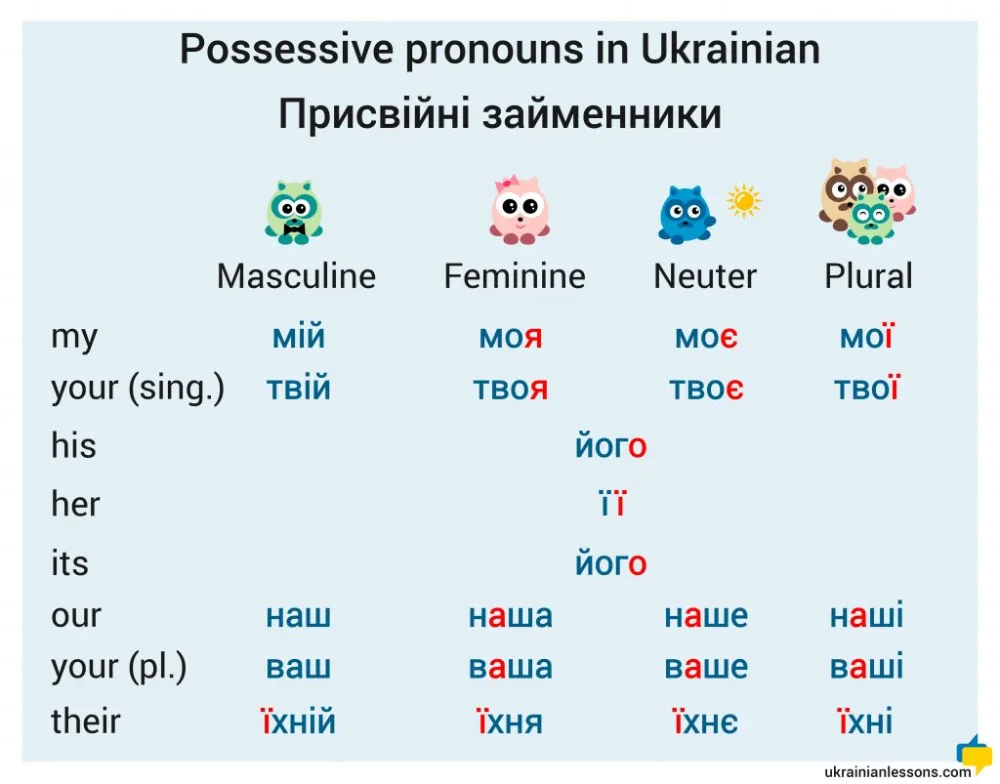
Table 4: Ukrainian possessive pronouns (nominative)
| Possessor | Masculine | Feminine | Neuter | Plural |
|---|---|---|---|---|
| 1sg. (my) | мій | моя | моє | мої |
| 2sg. (your, informal) | твій | твоя | твоє | твої |
| 1pl. (our) | наш | наша | наше | наші |
| 2pl. (your, formal/plural) | ваш | ваша | ваше | ваші |
| reflexive (one's own) | свій | своя | своє | свої |
For third-person possession, Ukrainian uses the genitive of the personal pronoun, which is uninflected:
- його (his, its - m./n.) - does not change for gender/case of the possessed noun
- її (her) - invariant
- їх (their) - invariant
Examples: його книга (his book), її брат (her brother), їхній дім (their house - alternative form that does decline: їхній, їхня, їхнє, їхні).
Table 5: Declension of мій (my, masc.)
| Case | Masculine | Feminine | Neuter | Plural |
|---|---|---|---|---|
| Nom. | мій | моя | моє | мої |
| Gen. | мого | моєї | мого | моїх |
| Dat. | моєму | моїй | моєму | моїм |
| Acc. | мій / мого | мою | моє | мої / моїх |
| Instr. | моїм | моєю | моїм | моїми |
| Loc. | (на) моєму | (на) моїй | (на) моєму | (на) моїх |
Examples:
- Мій друг живе в Києві. (Miy druh zhyve v Kyievi.) = My friend lives in Kyiv.
- Я бачу твою сестру. (Ya bachu tvoyu sestru.) = I see your sister.
- Це наша машина. (Tse nasha mashyna.) = This is our car.
- Вона любить своє місто. (Vona liubyt svoye misto.) = She loves her (own) city.
The Reflexive Possessive свій
The reflexive possessive свій / своя / своє / свої refers back to the subject of the clause. It means "one's own" and does not specify person. It is a critical feature of Slavic grammar; misusing it is a common mistake.
- Я читаю свою книгу. = I am reading my own book.
- Ти читаєш свою книгу. = You are reading your own book.
- Він читає свою книгу. = He is reading his own book.
- Він читає його книгу. = He is reading his (someone else's) book.
The last example changes meaning: його книга refers to someone other than the subject of the clause.
Reflexive Pronoun себе
Ukrainian has a single reflexive pronoun себе, equivalent to English "oneself." It has no nominative (reflexives by definition refer to an already-existing subject) and is invariant for person, gender, and number.
Table 6: Declension of себе
| Case | Form |
|---|---|
| Nominative | (none) |
| Genitive | себе |
| Dative | собі |
| Accusative | себе |
| Instrumental | собою |
| Locative | (на) собі |
Examples:
- Я питаю себе. (Ya pytaiu sebe.) = I ask myself.
- Він купив собі книгу. (Vin kupyv sobi knyhu.) = He bought himself a book.
- Ми говорили про себе. (My hovoryly pro sebe.) = We talked about ourselves.
- Вона задоволена собою. (Vona zadovolena soboiu.) = She is pleased with herself.
Demonstrative Pronouns
Ukrainian has two principal demonstratives: цей (this, near the speaker) and той (that, far from the speaker).
Table 7: Nominative forms of demonstratives
| Masculine | Feminine | Neuter | Plural | |
|---|---|---|---|---|
| this | цей | ця | це | ці |
| that | той | та | те | ті |
Table 8: Declension of цей (this, masc.)
| Case | Masc. | Fem. | Neut. | Plural |
|---|---|---|---|---|
| Nom. | цей | ця | це | ці |
| Gen. | цього | цієї | цього | цих |
| Dat. | цьому | цій | цьому | цим |
| Acc. | цей / цього | цю | це | ці / цих |
| Instr. | цим | цією | цим | цими |
| Loc. | (на) цьому | (на) цій | (на) цьому | (на) цих |
The neuter form це is also used as a demonstrative particle meaning "this is" or "it is": Це книга (This is a book), Це правда (This is true).
Examples:
- Цей дім гарний. (Tsey dim harnyi.) = This house is nice.
- Я хочу ту книгу. (Ya khochu tu knyhu.) = I want that book.
- Це моя сестра. (Tse moia sestra.) = This is my sister.
Interrogative Pronouns
Table 9: Interrogative pronouns
| Meaning | Ukrainian | Notes |
|---|---|---|
| who | хто | animate, for persons |
| what | що | inanimate |
| which (of many) | котрий | chooses among several |
| which kind | який | asks about quality |
| whose | чий | asks about possession |
| how many | скільки | invariant; governs gen. pl. |
Table 10: Declension of хто and що
| Case | хто | що |
|---|---|---|
| Nom. | хто | що |
| Gen. | кого | чого |
| Dat. | кому | чому |
| Acc. | кого | що |
| Instr. | ким | чим |
| Loc. | (на) кому | (на) чому |
Examples:
- Хто це? = Who is this?
- Що ти робиш? = What are you doing?
- Чия це книга? = Whose book is this?
- Якою мовою ти говориш? = Which language do you speak? (instrumental after говорити)
Relative and Indefinite Pronouns
Ukrainian forms relative pronouns primarily from interrogatives: який, яка, яке, які (who/which) is the most common relativizer, declining like an adjective.
- Книга, яку я читаю = The book that I am reading.
- Чоловік, який живе тут = The man who lives here.
Indefinite pronouns are formed with prefixes and suffixes:
- хтось (someone), щось (something) - unspecified
- хто-небудь (anyone), що-небудь (anything) - any one at all
- ніхто (no one), ніщо (nothing) - negative
Ukrainian uses double negation: Ніхто не приходив = "No one came" (literally: no one didn't come).
Common Mistakes (especially for Russian speakers learning Ukrainian)
1. Using Russian personal pronoun forms. Russian я, ты, он, она, мы, вы, они. Ukrainian я, ти, він, вона, ми, ви, вони. Note ти (not ты) and він (not он).
2. Copying Russian genitive мене as Russian меня. Ukrainian is мене, with clear /ɛ/; Russian has меня with /ɪa/.
3. Forgetting the н- forms after prepositions. Ukrainian has him/his = його без preposition, but нього after preposition: про нього (about him), not *про його.
4. Using Russian possessive ending. Russian моего, моему (with -ого, -ому as two syllables). Ukrainian мого, моєму - different spelling and pronunciation; -го in modern Ukrainian is a single syllable where Russian has two.
5. Confusing свій with his/her/its. Russian uses свой similarly. Ukrainian свій refers to the subject's own; його, її refer to someone else's. This distinction is critical.
6. Using Russian этот/тот. Ukrainian is цей / той (not этот / тот). The root is different in цей.
7. Using Russian double-negation patterns. Ukrainian and Russian both use double negation, but the particles are different. Ukrainian: Ніхто не приходив. Russian: Никто не приходил. Note ні- not ни-.
8. Mistranslating "who" in relative clauses. In English, "the person who" uses "who." In Ukrainian, it is usually який (agreeing with the antecedent), not хто: людина, яка працює (the person who works), not *людина, хто працює.
9. Overusing subject pronouns. Ukrainian is pro-drop. Читаю книгу (I read a book) is complete; Я читаю книгу adds emphasis or contrast. Russian speakers trained on textbooks often overuse subject pronouns.
10. Dropping pronouns incorrectly. While pro-drop is possible, it requires that the verb form make person clear. In past-tense contexts, pronouns must often be retained because the past tense marks only gender, not person.
Quick Reference
Table 11: Personal pronoun quick chart
| English | Ukrainian |
|---|---|
| I | я |
| you (informal) | ти |
| you (formal/plural) | ви |
| he | він |
| she | вона |
| it | воно |
| we | ми |
| they | вони |
| me (obj.) | мене |
| you (obj.) | тебе |
| him (obj.) | його / нього |
| her (obj.) | її / неї |
| us (obj.) | нас |
| them (obj.) | їх / них |
| myself | себе / собі |
Table 12: Possessives quick chart
| masc. | fem. | neut. | pl. | |
|---|---|---|---|---|
| my | мій | моя | моє | мої |
| your (sg.) | твій | твоя | твоє | твої |
| his/its | його | його | його | його |
| her | її | її | її | її |
| our | наш | наша | наше | наші |
| your (pl.) | ваш | ваша | ваше | ваші |
| their | їх / їхній | їх / їхня | їх / їхнє | їх / їхні |
| one's own | свій | своя | своє | свої |
FAQ
When should I use ти vs ви?
Use ти with close friends, family, children, pets, God (in prayer), and informal peers. Use ви with strangers, people older than you, people in positions of authority, and anyone you have not been invited to call by ти. Plural ви always addresses multiple people, formally or informally.
Why are there two forms for third-person pronouns (його / нього)?
The н-forms (нього, неї, них) are used after prepositions; the plain forms (його, її, їх) are used without prepositions. This distribution is historical: the н- developed from the final n of certain prepositions and attached to the pronoun.
How is свій different from мій?
Мій is always "my," regardless of the subject of the clause. Свій is "one's own," and refers back to the subject. In a sentence "Ivan reads his book," if the book is Ivan's, use Іван читає свою книгу. If the book is someone else's, use Іван читає його книгу.
Can I omit subject pronouns in Ukrainian?
Yes. Ukrainian is a pro-drop language. Читаю (I read) is complete without я. But in the past tense, pronouns are usually retained because the past only marks gender, not person. Subject pronouns also return for emphasis or contrast.
How do I say "themselves" in Ukrainian?
The reflexive себе / собі / собою is invariant for person and number. So "They bought themselves a car" is Вони купили собі машину, same собі as "I bought myself a car" = Я купив собі машину.
Do demonstratives decline?
Yes. Цей / ця / це / ці and той / та / те / ті decline through all seven cases. They agree with the noun in gender, number, and case: з цим другом (with this friend, instrumental masc. sg.), у тій кімнаті (in that room, locative fem. sg.).
What is "their" in Ukrainian?
Two options: їх (invariant, borrowed from the genitive of вони) or їхній/їхня/їхнє/їхні (fully declined). Їхній is more characteristically Ukrainian and is preferred in careful writing. Їх is common in speech.
See Also
- Ukrainian Seven Cases Declension Reference
- Ukrainian Adjectives Agreement and Declension
- Ukrainian Verb Conjugation and Aspect System
- Ukrainian Alphabet: Differences from Russian
- Ukrainian Greetings and Phrases
- Russian Pronouns Reference
- Russian Gender, Nouns, Adjectives Agreement
- Grammatical Cases Comparison
Frequently Asked Questions
When should I use ти vs ви?
Use ти with close friends, family, children, pets, and informal peers. Use ви with strangers, older people, authority figures, and anyone you have not been invited to address informally. Plural ви always addresses multiple people.
Why are there two forms for third-person pronouns (його / нього)?
The н-forms (нього, неї, них) are used after prepositions; the plain forms (його, її, їх) are used without prepositions. This distribution is historical: the н- developed from the final n of certain prepositions.
How is свій different from мій?
Мій is always ‘my.’ Свій is ‘one’s own,’ referring back to the subject. In ‘Ivan reads his book,’ if the book is Ivan’s, use Іван читає свою книгу. If someone else’s, use Іван читає його книгу.
Can I omit subject pronouns in Ukrainian?
Yes. Ukrainian is pro-drop. Читаю (I read) is complete without я. In the past tense, pronouns are usually retained because the past marks gender, not person. Subject pronouns return for emphasis or contrast.
How do I say themselves in Ukrainian?
The reflexive себе / собі / собою is invariant for person and number. So ‘They bought themselves a car’ is Вони купили собі машину, same собі as ‘I bought myself a car.’
Do demonstratives decline?
Yes. Цей/ця/це/ці and той/та/те/ті decline through all seven cases. They agree with the noun in gender, number, and case: з цим другом (with this friend, instrumental masc. sg.).
What is their in Ukrainian?
Two options: їх (invariant, from genitive of вони) or їхній/їхня/їхнє/їхні (fully declined). Їхній is more characteristically Ukrainian and preferred in careful writing. Їх is common in speech.