
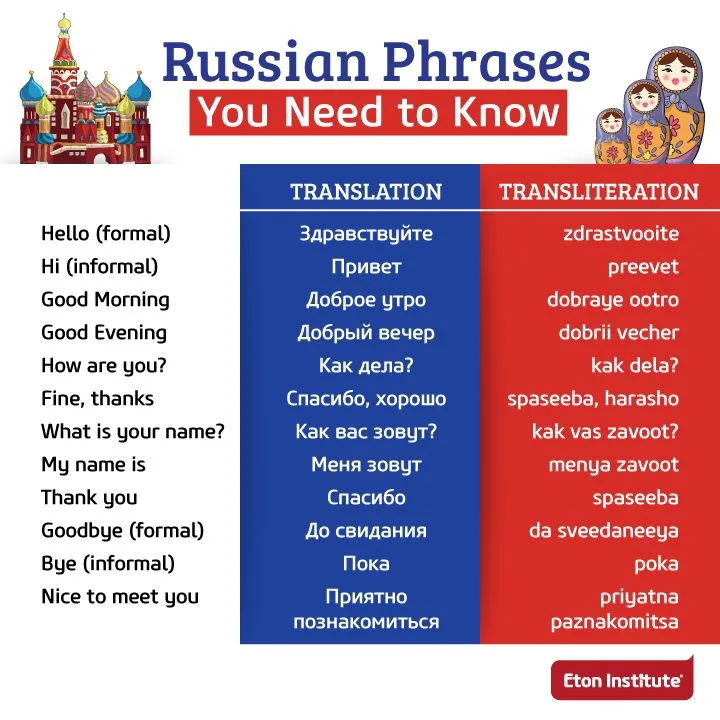
Learning Russian vocabulary and grammar in isolation produces a reader, not a speaker. To actually function in Russian - to greet a neighbor, order a coffee, apologize for bumping into someone on the Moscow metro, ask where the nearest pharmacy is - a learner needs a stock of ready-made phrases that can be produced without conscious assembly.
Russian, perhaps more than English, relies on fixed expressions whose literal components are less important than the social situation they cover. A Russian speaker does not translate "how are you" word by word; they say Как дела? because that is what one says.
This reference presents more than one hundred of the most essential Russian phrases for daily conversation, organized by situation. Every entry gives the Cyrillic form, a simple transliteration, and an English equivalent (not a literal translation).
Cultural notes flag traps that pure grammar study cannot catch: when ты versus вы matters, why Russians rarely say "please" the way English speakers do, and why извините is not quite "excuse me." For the grammar underlying these phrases, see the Russian grammar cases complete guide and the Russian pronouns reference. For the alphabet behind the Cyrillic, see the Russian alphabet Cyrillic complete guide.
Greetings and Farewells
Russian greetings are strongly marked for formality. The difference between Привет and Здравствуйте is not a stylistic preference but a social signal: using the wrong register can come across as rude or oddly distant.
Table 1. Greetings by time and formality.
| Russian | Transliteration | English | Register |
|---|---|---|---|
| Здравствуйте | Zdravstvuyte | Hello | Formal / plural |
| Здравствуй | Zdravstvuy | Hello | Informal singular |
| Привет | Privet | Hi | Informal |
| Доброе утро | Dobroye utro | Good morning | Neutral |
| Добрый день | Dobryy den | Good afternoon | Neutral |
| Добрый вечер | Dobryy vecher | Good evening | Neutral |
| Доброй ночи | Dobroy nochi | Good night | Neutral |
| Алло | Allo | Hello (on phone) | Neutral |
| Слушаю | Slushayu | Speaking (on phone) | Neutral |
Table 2. Farewells.
| Russian | Transliteration | English |
|---|---|---|
| До свидания | Do svidaniya | Goodbye |
| Пока | Poka | Bye |
| До завтра | Do zavtra | See you tomorrow |
| До встречи | Do vstrechi | Until we meet again |
| Счастливо | Schastlivo | All the best |
| Удачи | Udachi | Good luck |
| Всего хорошего | Vsego khoroshego | All the best |
| Спокойной ночи | Spokoynoy nochi | Sleep well |
Cultural note. Russians do not typically say hello repeatedly throughout the day to the same person. A single Здравствуйте in the morning usually covers every subsequent encounter until evening. Saying it twice can sound like you forgot you had already seen someone.
How Are You and Small Talk
English speakers often stumble here because Как дела? is not the automatic throwaway that "How are you?" is in North America. In Russia it is sincere - a real answer is expected, even if brief.
Table 3. Asking and answering about well-being.
| Russian | Transliteration | English |
|---|---|---|
| Как дела? | Kak dela? | How are things? |
| Как ты? | Kak ty? | How are you? (informal) |
| Как вы? | Kak vy? | How are you? (formal/plural) |
| Как жизнь? | Kak zhizn? | How is life? |
| Что нового? | Chto novogo? | What is new? |
| Хорошо, спасибо | Khorosho, spasibo | Fine, thank you |
| Нормально | Normalno | OK |
| Отлично | Otlichno | Excellent |
| Неплохо | Neplokho | Not bad |
| Так себе | Tak sebe | So-so |
| Плохо | Plokho | Bad |
| Всё в порядке | Vso v poryadke | Everything is fine |
Reciprocating is standard: А у вас? (And you?) or informal А у тебя?
Politeness: Please, Thank You, Sorry
Russian politeness phrases are compact and very frequently used. One apparent peculiarity: пожалуйста does double duty as "please" and as "you are welcome."
Table 4. Core politeness formulas.
| Russian | Transliteration | English |
|---|---|---|
| Пожалуйста | Pozhaluysta | Please / You are welcome |
| Спасибо | Spasibo | Thank you |
| Большое спасибо | Bolshoye spasibo | Thank you very much |
| Спасибо огромное | Spasibo ogromnoye | Thanks a lot |
| Не за что | Ne za chto | You are welcome (it was nothing) |
| Извините | Izvinite | Excuse me / Sorry (formal) |
| Прости | Prosti | Sorry (informal singular) |
| Простите | Prostite | Sorry (formal/plural) |
| Будьте добры | Budte dobry | Be so kind |
| Будьте любезны | Budte lyubezny | Be so kind (more formal) |
| Разрешите | Razreshite | Allow me / May I |
Common mistake. English speakers tend to say пожалуйста every time they would say "please" in English. Russians use it, but are less insistent about it: a direct imperative like Дайте меню (Give me the menu) is not rude if said with a polite tone, though adding пожалуйста is always safe.
Yes, No, and Basic Responses
Table 5. Affirmations, negations, hedges.
| Russian | Transliteration | English |
|---|---|---|
| Да | Da | Yes |
| Нет | Net | No |
| Конечно | Konechno | Of course |
| Разумеется | Razumeyetsya | Naturally |
| Не знаю | Ne znayu | I do not know |
| Может быть | Mozhet byt | Maybe |
| Наверное | Navernoye | Probably |
| Возможно | Vozmozhno | Possibly |
| Точно | Tochno | Exactly |
| Согласен / Согласна | Soglasen / Soglasna | I agree (m / f) |
| Не согласен / Не согласна | Ne soglasen / Ne soglasna | I disagree (m / f) |
| Правда? | Pravda? | Really? |
| Неужели? | Neuzheli? | Really?! (stronger) |
Introducing Yourself
Table 6. Getting to know someone.
| Russian | Transliteration | English |
|---|---|---|
| Как вас зовут? | Kak vas zovut? | What is your name? (formal) |
| Как тебя зовут? | Kak tebya zovut? | What is your name? (informal) |
| Меня зовут... | Menya zovut... | My name is... |
| Очень приятно | Ochen priyatno | Nice to meet you |
| Откуда вы? | Otkuda vy? | Where are you from? |
| Я из Америки | Ya iz Ameriki | I am from America |
| Я англичанин / англичанка | Ya anglichanin / anglichanka | I am English (m / f) |
| Сколько вам лет? | Skolko vam let? | How old are you? |
| Мне двадцать лет | Mne dvadtsat let | I am twenty years old |
| Я студент / студентка | Ya student / studentka | I am a student (m / f) |
| Я работаю... | Ya rabotayu... | I work... |
| Я говорю по-русски немного | Ya govoryu po-russki nemnogo | I speak a little Russian |
Age in Russian takes the dative: Мне тридцать лет literally reads "To me thirty years." For numbers, see the Russian numbers 1 to 100 reference.
Asking for Help and Directions
Table 7. Asking where and how.
| Russian | Transliteration | English |
|---|---|---|
| Где...? | Gde...? | Where is...? |
| Где здесь туалет? | Gde zdes tualet? | Where is the bathroom? |
| Где метро? | Gde metro? | Where is the metro? |
| Как пройти к...? | Kak proyti k...? | How do I get to...? |
| Это далеко? | Eto daleko? | Is it far? |
| Налево | Nalevo | To the left |
| Направо | Napravo | To the right |
| Прямо | Pryamo | Straight ahead |
| Назад | Nazad | Back |
| Рядом | Ryadom | Nearby |
| Напротив | Naprotiv | Opposite |
| Между | Mezhdu | Between |
| На углу | Na uglu | On the corner |
| Покажите на карте | Pokazhite na karte | Show me on the map |
| Я заблудился / заблудилась | Ya zabludilsya / zabludilas | I am lost (m / f) |
| Помогите, пожалуйста | Pomogite, pozhaluysta | Please help |
At a Restaurant or Cafe
Table 8. Restaurant phrases.
| Russian | Transliteration | English |
|---|---|---|
| Столик на двоих, пожалуйста | Stolik na dvoikh, pozhaluysta | A table for two, please |
| Меню, пожалуйста | Menyu, pozhaluysta | Menu, please |
| Что вы посоветуете? | Chto vy posovetuyete? | What would you recommend? |
| Я буду... | Ya budu... | I will have... |
| Без сахара | Bez sakhara | Without sugar |
| Без льда | Bez lda | Without ice |
| Острое / не острое | Ostroye / ne ostroye | Spicy / not spicy |
| Счёт, пожалуйста | Schot, pozhaluysta | The check, please |
| Можно расплатиться картой? | Mozhno rasplatitsya kartoy? | May I pay by card? |
| Где можно помыть руки? | Gde mozhno pomyt ruki? | Where can I wash my hands? |
| Это очень вкусно | Eto ochen vkusno | This is very tasty |
| Приятного аппетита | Priyatnogo appetita | Bon appetit |
Memory tip. Приятного аппетита is said by Russians before meals very routinely, to strangers and colleagues alike. Unlike the French formula it replaces, it is not considered slightly dated; it is simply expected.
Shopping and Money
Table 9. In the shop.
| Russian | Transliteration | English |
|---|---|---|
| Сколько стоит? | Skolko stoit? | How much does it cost? |
| Сколько это стоит? | Skolko eto stoit? | How much is this? |
| Это дорого | Eto dorogo | That is expensive |
| Это дёшево | Eto dyoshevo | That is cheap |
| Есть скидка? | Est skidka? | Is there a discount? |
| Можно примерить? | Mozhno primerit? | May I try it on? |
| Какой размер? | Kakoy razmer? | What size? |
| У вас есть...? | U vas est...? | Do you have...? |
| Дайте, пожалуйста, ... | Dayte, pozhaluysta, ... | Please give me... |
| Я возьму это | Ya vozmu eto | I will take this |
| Только посмотрю | Tolko posmotryu | I am just looking |
| Оплата наличными или картой? | Oplata nalichnymi ili kartoy? | Cash or card? |
| Дайте чек, пожалуйста | Dayte chek, pozhaluysta | Please give me a receipt |
Emergencies and Health
Table 10. Emergency phrases.
| Russian | Transliteration | English |
|---|---|---|
| Помогите! | Pomogite! | Help! |
| Вызовите скорую! | Vyzovite skoruyu! | Call an ambulance! |
| Вызовите полицию! | Vyzovite politsiyu! | Call the police! |
| Пожар! | Pozhar! | Fire! |
| Мне плохо | Mne plokho | I feel ill |
| У меня болит... | U menya bolit... | My ... hurts |
| У меня болит голова | U menya bolit golova | My head hurts |
| У меня температура | U menya temperatura | I have a fever |
| Я потерял документы | Ya poteryal dokumenty | I lost my documents |
| У меня украли кошелёк | U menya ukrali koshelyok | My wallet was stolen |
| Где ближайшая аптека? | Gde blizhayshaya apteka? | Where is the nearest pharmacy? |
| Где ближайшая больница? | Gde blizhayshaya bolnitsa? | Where is the nearest hospital? |
Communication and Language Problems
Table 11. Navigating a language barrier.
| Russian | Transliteration | English |
|---|---|---|
| Вы говорите по-английски? | Vy govorite po-angliyski? | Do you speak English? |
| Я не понимаю | Ya ne ponimayu | I do not understand |
| Повторите, пожалуйста | Povtorite, pozhaluysta | Please repeat |
| Говорите медленнее | Govorite medlenneye | Speak more slowly |
| Как это по-русски? | Kak eto po-russki? | How do you say this in Russian? |
| Что это значит? | Chto eto znachit? | What does this mean? |
| Напишите, пожалуйста | Napishite, pozhaluysta | Please write it down |
| Я плохо говорю по-русски | Ya plokho govoryu po-russki | I speak Russian badly |
| Я изучаю русский | Ya izuchayu russkiy | I am studying Russian |
Common Mistakes English Speakers Make
- Overusing ты with strangers. Always begin with вы to adults you do not know. Switching to ты is usually initiated by the older or higher-status person.
- Literal translation of "excuse me" for attention-getting. Use Извините for both "excuse me" and "sorry." For "pardon me" after not hearing someone, use Простите? or Что вы сказали?
- Translating "please" into every polite sentence. Russian politeness more often shows in tone, diminutives, and formulas like будьте добры than in scattering пожалуйста everywhere.
- Confusing спасибо with пожалуйста in replies. "You are welcome" is пожалуйста or не за что, not спасибо.
- Using English word order in questions. Russian relies heavily on intonation. Вы говорите по-русски? and Вы говорите по-русски. differ only in pitch.
Cultural note. Russians often omit pronouns in first-person statements because the verb ending carries the information: Не понимаю is a complete sentence meaning "I do not understand." Retaining я is not wrong but can sound slightly emphatic.
Quick Reference Cheat Sheet
Top 20 phrases every beginner should memorize:
- Здравствуйте - Hello (formal)
- Привет - Hi (informal)
- Спасибо - Thank you
- Пожалуйста - Please / You are welcome
- Извините - Excuse me / Sorry
- Да / Нет - Yes / No
- Не понимаю - I do not understand
- Как дела? - How are things?
- Меня зовут... - My name is...
- Очень приятно - Nice to meet you
- Сколько стоит? - How much does it cost?
- Где туалет? - Where is the bathroom?
- Помогите! - Help!
- Я не говорю по-русски - I do not speak Russian
- Говорите медленнее - Speak more slowly
- До свидания - Goodbye
- Пока - Bye
- Хорошо - Good / OK
- Конечно - Of course
- Счёт, пожалуйста - The check, please
Frequently Asked Questions
When do I switch from вы to ты? Wait for the other person to suggest it - usually with Давай на ты (Let us use ты). Students to teachers, subordinates to bosses, and young people to older strangers always use вы.
Is пожалуйста really the same word for "please" and "you are welcome"? Yes. Context disambiguates. Дайте меню, пожалуйста is "please"; after someone says спасибо, пожалуйста means "you are welcome."
What do I say when I sneeze? The sneezer says nothing. Others may say Будьте здоровы! (Be healthy!) or informally Будь здоров / Будь здорова.
How do I politely decline? Нет, спасибо (No, thank you) is always safe. К сожалению, не могу (Unfortunately, I cannot) softens a refusal.
Is it rude to address someone by their first name only? In modern business and casual settings, no. In traditional formal settings, use имя + отчество (first name + patronymic), e.g., Иван Петрович. See the Russian family and relationships reference for patronymics.
How do I get a waiter's attention? Девушка! (to a woman) or Молодой человек! (to a man). Официант sounds stiff. Raising a hand and waiting silently is universally understood.
Should I say sorry when bumping into someone? Yes. Извините or the abrupt Ой, простите are both fine. Russians do not over-apologize the way English speakers do, but physical contact warrants acknowledgment.
See Also
- Russian alphabet Cyrillic complete guide
- Russian grammar cases complete guide
- Russian pronouns personal, possessive, demonstrative reference
- Russian numbers 1 to 100 cardinal, ordinal, with declension
- Russian pronunciation and stress guide for beginners
- Russian travel phrases tourist guide reference
- Russian food vocabulary restaurant and cooking reference
- Russian family and relationships vocabulary reference
Author: Kalenux Team
Frequently Asked Questions
When do I switch from вы to ты?
Wait for the other person to suggest it, usually with ‘Давай на ты.’ Students to teachers, subordinates to bosses, and young people to older strangers always use вы.
Is пожалуйста really the same word for 'please' and 'you are welcome'?
Yes. Context disambiguates. ‘Дайте меню, пожалуйста’ is ‘please’; after спасибо, пожалуйста means ‘you are welcome.’
What do I say when someone sneezes?
Будьте здоровы! (formal/plural) or informally Будь здоров / Будь здорова. The sneezer typically says nothing.
How do I politely decline an offer?
Нет, спасибо is always safe. К сожалению, не могу (Unfortunately, I cannot) softens the refusal further.
Is it rude to use only a first name?
In modern business and casual settings, no. In traditional formal settings, use first name plus patronymic, e.g., Иван Петрович.
How do I get a waiter's attention in Russia?
Say ‘Девушка!’ to a woman or ‘Молодой человек!’ to a man. The word официант sounds stiff and is rarely used.
Should I apologize for bumping into someone?
Yes. Извините or Ой, простите are standard. Russians do not over-apologize as English speakers do, but physical contact warrants acknowledgment.