
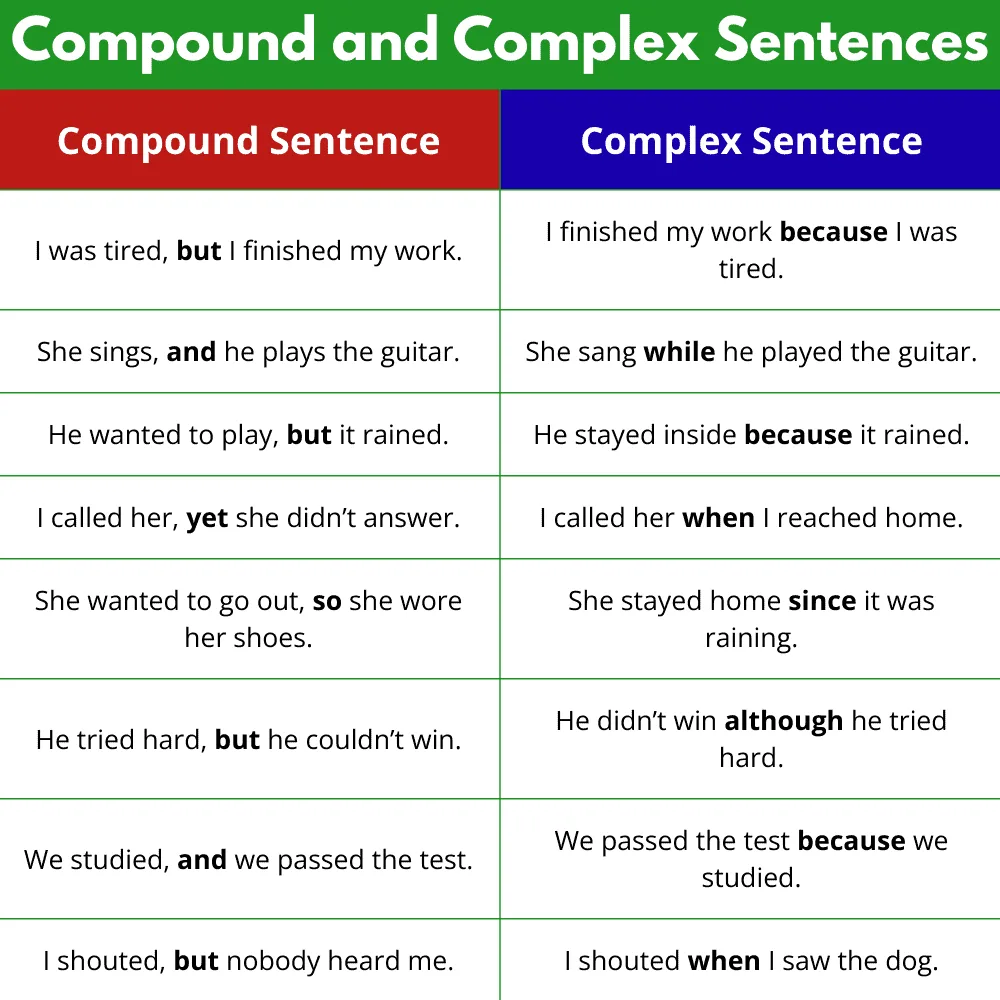
Every sentence in English falls into one of four structural types: simple, compound, complex, or compound-complex. The two types that confuse writers most often are compound and complex. They sound like synonyms (both imply "not simple"), they share some punctuation rules, and they both combine multiple ideas into one sentence. But they do different things, and knowing the difference is the foundation of confident sentence-level writing.
A compound sentence joins equals. A complex sentence subordinates one idea to another. The distinction shapes meaning, emphasis, rhythm, and the way your reader moves through your prose. This guide walks through every form, with examples, punctuation rules, and the stylistic reasons to choose one structure over the other.
The Four Sentence Types
Before diving into compound and complex sentences, set the landscape.
| Sentence Type | Definition | Example |
|---|---|---|
| Simple | One independent clause | The cat slept. |
| Compound | Two or more independent clauses joined | The cat slept, and the dog watched. |
| Complex | One independent clause plus one or more dependent clauses | When the cat slept, the dog watched. |
| Compound-complex | Two or more independent clauses plus at least one dependent clause | When the cat slept, the dog watched, and the bird sang. |
The key building blocks are the independent clause (a subject and verb that expresses a complete thought) and the dependent clause (a subject and verb that does not express a complete thought and must attach to an independent clause).
What Makes a Clause Independent or Dependent
An independent clause stands alone. It has a subject and a verb, and its meaning is complete.
Independent clauses:
The rain fell.
She opened the window.
I think he is lying.
Birds sing in the morning.
Every sentence you have read so far in this paragraph is itself an independent clause.
A dependent clause also has a subject and a verb, but it starts with a word that makes it incomplete on its own. These words, called subordinating conjunctions or relative pronouns, signal that the clause needs a main clause to lean on.
Dependent clauses (cannot stand alone):
When the rain fell
Because she opened the window
If I think he is lying
That birds sing in the morning
Although it was cold
Each of these has a subject and a verb, but each starts with a word (when, because, if, that, although) that leaves the thought hanging. The reader wants to know "what happened when the rain fell?" That incompleteness is the mark of a dependent clause.
Style scholars such as Francis-Noel Thomas and Mark Turner, authors of Clear and Simple as the Truth, emphasize that what separates a sentence from a fragment is not length but whether the thought actually closes.
Compound Sentences: Joining Equals
A compound sentence contains two or more independent clauses joined by one of three methods:
- A coordinating conjunction (for, and, nor, but, or, yet, so) preceded by a comma.
- A semicolon.
- A semicolon plus a conjunctive adverb (however, therefore, moreover, nevertheless, etc.) plus a comma.
Examples of each:
Method 1 (comma plus coordinating conjunction):
I finished the report, and I sent it to my editor.
She was tired, but she kept working.
We can eat now, or we can wait for the others.

Method 2 (semicolon alone):
I finished the report; I sent it to my editor.
She was tired; she kept working.

Method 3 (semicolon plus conjunctive adverb plus comma):
I finished the report; however, I had forgotten to sign it.
She was tired; nevertheless, she kept working.
The train was late; consequently, we missed the meeting.
The defining feature of a compound sentence is that both clauses have equal grammatical weight. Neither is subordinate to the other. The reader can read them as two separate thoughts linked by coordination.
The Seven Coordinating Conjunctions (FANBOYS)
The seven coordinating conjunctions are memorized with the mnemonic FANBOYS: For, And, Nor, But, Or, Yet, So.
For (because, reason):
I stayed in, for the weather was terrible.

And (addition):
He finished dinner, and he went for a walk.

Nor (negative addition):
She did not call, nor did she email.

But (contrast):
The food was cheap, but the service was slow.

Or (alternative):
We can meet tomorrow, or we can reschedule.

Yet (contrast):
It was expensive, yet we bought it anyway.

So (result):
The road was closed, so we took the long way home.
Each of these joins two clauses on equal grammatical footing. Neither clause depends on the other.
Complex Sentences: Subordination
A complex sentence contains one independent clause and at least one dependent clause. The dependent clause is introduced by a subordinating conjunction or a relative pronoun, and it modifies the independent clause in some way (timing, cause, condition, concession, description, etc.).
Examples of complex sentences:
When the rain stopped, we went outside.
I will call you after I finish the report.
Because the deadline was tight, we worked late.
She missed the meeting because her car broke down.
Although the film received mixed reviews, it was a box-office hit.
The book that I ordered last week arrived today.
The woman who called is my aunt.
Notice the pattern: one clause can stand alone (the main/independent clause), and one cannot (the dependent clause). The dependent clause adds information, qualifies the main claim, or specifies timing or condition.
Subordinating Conjunctions
Subordinating conjunctions introduce adverbial dependent clauses, which describe when, why, how, under what condition, or in what contrast the main action occurs.
| Relationship | Subordinating Conjunctions |
|---|---|
| Time | when, while, after, before, until, since, as, as soon as, once, whenever |
| Cause | because, since, as, now that |
| Condition | if, unless, provided that, as long as, in case |
| Concession | although, though, even though, while, whereas |
| Purpose | so that, in order that |
| Result | so that, such that |
| Comparison | than, as, as if, as though |
| Place | where, wherever |
Examples:
Time: I will leave when the meeting ends.
Cause: I left because I was bored.
Condition: I will leave if no one objects.
Concession: I will leave although I am enjoying myself.
Purpose: I will leave so that I can catch the train.
Place: I will leave wherever I find a parking spot.
Relative Pronouns
Relative pronouns introduce adjectival dependent clauses, which describe a noun in the main clause.
The main relative pronouns are who, whom, whose, which, and that.
The report that I submitted last Friday has been approved.
(Dependent clause "that I submitted last Friday" modifies "report.")

The woman who lives next door is a cardiologist.
(Dependent clause "who lives next door" modifies "woman.")

The car, which we bought in 2019, has 100,000 miles.
(Dependent clause "which we bought in 2019" modifies "car.")

The author whose book won the prize is giving a reading.
(Dependent clause "whose book won the prize" modifies "author.")
These clauses function like adjectives, specifying or describing the noun they attach to.
Punctuation: Where Compound and Complex Sentences Differ
Punctuation often distinguishes compound from complex sentences in practice. Knowing the punctuation rules makes it easier to write each type correctly.
Compound sentence punctuation:
Comma plus coordinating conjunction:
The meeting ended at noon, and everyone left for lunch.

Semicolon alone:
The meeting ended at noon; everyone left for lunch.

Semicolon plus conjunctive adverb plus comma:
The meeting ended at noon; however, several people stayed behind.
Complex sentence punctuation:
Dependent clause first, comma after:
When the meeting ended, everyone left for lunch.

Dependent clause last, no comma:
Everyone left for lunch when the meeting ended.

Relative clause that restricts meaning (restrictive), no commas:
The employees who finished early left for lunch.
(Only those who finished early left.)

Relative clause that adds information (nonrestrictive), set off by commas:
The employees, who had finished early, left for lunch.
(All the employees left; the clause just adds information.)
The punctuation rule for adverbial dependent clauses: comma when the dependent clause comes first, no comma when it comes second.
The punctuation rule for relative clauses: commas for nonrestrictive (nonessential) clauses, no commas for restrictive (essential) clauses. Using "that" almost always signals a restrictive clause, which means no commas. Using "which" with commas signals nonrestrictive.
The Compound-Complex Sentence
When a sentence has two or more independent clauses and at least one dependent clause, it is compound-complex. These are the workhorse sentences of academic and professional writing.
Although the deadline was tight, the team finished the report, and they submitted it on schedule.

Independent clause 1: the team finished the report
Independent clause 2: they submitted it on schedule
Dependent clause: although the deadline was tight

When the rain stopped and the sun came out, we went to the beach, but we had to leave early because a storm was forecast.

Independent clause 1: we went to the beach
Independent clause 2: we had to leave early
Dependent clauses: when the rain stopped and the sun came out; because a storm was forecast
Compound-complex sentences can carry a lot of information in a single breath. Well-written ones are graceful. Poorly written ones are tangled. Read them aloud to check whether the structure is holding.
Choosing Between Compound and Complex
The grammatical difference is clear: compound joins equals, complex subordinates. The stylistic difference is more interesting. The choice shapes what your reader emphasizes.
Compound (equal emphasis):
The deadline was tight, and the team worked overtime.
(Both facts are weighted evenly.)

Complex (emphasizes one clause):
Because the deadline was tight, the team worked overtime.
(The second clause carries the main weight; the first is background.)

Or:
The team worked overtime because the deadline was tight.
(The first clause carries the main weight; the second is the reason.)
Subordination is a powerful rhetorical tool. The clause that is not subordinated gets the emphasis. By moving information into a dependent clause, you signal that it is background or support rather than the main point.
Joseph Williams's Style: Lessons in Clarity and Grace treats subordination as a design choice rather than decoration, arguing that the writer who decides which clause to make dependent is effectively controlling what the reader notices.
Compound sentences imply coordination of importance. When you join two clauses with "and" or a semicolon, you are saying: these two things matter equally. This is appropriate when they do. It is misleading when they do not.
| Situation | Better Choice |
|---|---|
| Two ideas of equal weight | Compound |
| One idea provides context for another | Complex |
| Cause and effect | Complex (because, since) |
| Contrast between equals | Compound (but, yet) |
| Contrast where one is dominant | Complex (although) |
| Sequential events of equal weight | Compound (and) |
| Background plus main event | Complex (when, after) |
Patterns of Overuse
Certain sentence structures become habits. Once you notice them, you can diversify.
The "And, and, and" Compound
Overuse of compound sentences joined by "and" produces a flat, childlike rhythm.
Weak: We went to the store, and we bought bread, and we bought milk, and we came home.

Stronger with subordination: After we bought bread and milk at the store, we came home.

Or varied: We went to the store for bread and milk. We were home before noon.
The Subordinate Clause Pileup
Stacking multiple dependent clauses produces long, heavy sentences that lose the reader.
Weak: Although the report was late because the data had been delayed by the technical issue that had emerged when the server crashed, the team submitted it.

Stronger: A server crash delayed the data, which put the report behind schedule. The team submitted it anyway.
The solution is often to break the long complex sentence into two sentences, promoting one dependent clause into its own main clause.
The Comma Splice
The most common error in compound sentences is the comma splice: joining two independent clauses with only a comma.
Wrong: The meeting ended at noon, everyone left for lunch.
Right: The meeting ended at noon, and everyone left for lunch.
Right: The meeting ended at noon; everyone left for lunch.
Right: The meeting ended at noon. Everyone left for lunch.
Comma splices slip into casual writing constantly. In formal writing, they are errors. Scanning your document for commas followed by a subject and verb (without a conjunction) catches most of them.
Exercise: Identify the Sentence Type
Read each sentence and decide whether it is simple, compound, complex, or compound-complex.
- The snow fell all night.
- The snow fell all night, and the roads were closed by morning.
- Because the snow fell all night, the roads were closed by morning.
- Because the snow fell all night, the roads were closed by morning, and schools were cancelled.
- She finished the novel in three months.
- She finished the novel in three months, but her editor sent it back for revision.
- When she finished the novel, her editor sent it back for revision.
- Although she finished the novel in three months, her editor sent it back, and she began rewriting immediately.
Answers: 1. Simple. 2. Compound. 3. Complex. 4. Compound-complex. 5. Simple. 6. Compound. 7. Complex. 8. Compound-complex.
Rhythm and Variety
Good prose varies sentence structure. A paragraph of all simple sentences feels choppy. A paragraph of all compound-complex sentences feels dense. A mix of short and long, simple and subordinated, creates the pace that readers follow naturally.
A useful exercise: take a paragraph of your own writing and count the sentence types. If fewer than three of the four types appear, try rewriting with more variety. The difference in readability is often striking.
All simple (choppy):
The meeting began at nine. The speakers presented. The audience listened. Questions were asked. The meeting ended at noon.

Mixed (natural):
The meeting began at nine. After the speakers presented, the audience asked questions that ran long; the meeting ended at noon, later than scheduled.
Writers on style such as Verlyn Klinkenborg, author of Several Short Sentences About Writing, emphasize that varying sentence length and structure gives prose a rhythm, so that reading does not feel like climbing stairs of identical height.
Why Structure Matters in Professional Writing
Writers who control sentence structure write with intention. Readers notice, even if they cannot name what they are noticing. An email, a report, a cover letter, or an article written with controlled variety reads as confident and competent. The same content pushed through uniform structures reads as tired or rushed.
For related grammar and sentence-level work, see our guides on semicolon usage, subject-verb agreement, and transition words. For writers building portfolios of long-form content, the formatting and conversion tools at File Converter Free keep drafts moving between formats without losing structure, and professionals preparing for writing assessments on certification exams can find practice at Pass4Sure.
The compound-complex distinction is one of the few grammar topics that pays off forever. Once you can classify your own sentences, you can edit them with intention. Most writers cannot. The small discipline of asking "is this compound, or is this complex?" catches most structural errors and opens the door to more deliberate prose.
References
Thomas, F.-N., & Turner, M. (2011). Clear and Simple as the Truth: Writing Classic Prose (2nd ed.). Princeton University Press. Princeton University Press (2011, 2nd ed.)
Williams, J. M., and Bizup, J. (2016). Style: Lessons in Clarity and Grace (12th ed.). Pearson. Williams et al. (2016): Style: Lessons in Clarity and Grace (12th ed.)
Klinkenborg, V. (2012). Several Short Sentences About Writing. Vintage. Klinkenborg (2012): Several Short Sentences About Writing
Strunk, W., and White, E. B. (2000). The Elements of Style (4th ed.). Allyn and Bacon. Strunk et al. (2000): The Elements of Style (4th ed.)
Huddleston, R., and Pullum, G. K. (2002). The Cambridge Grammar of the English Language. Cambridge University Press. Huddleston et al. (2002): The Cambridge Grammar of the English Language
Pinker, S. (2014). The Sense of Style: The Thinking Person's Guide to Writing in the 21st Century. Viking. https://stevenpinker.com/publications/sense-style
Purdue Online Writing Lab. Sentence Types and Punctuation. Purdue Online Writing Lab
Kolln, M., and Gray, L. (2016). Rhetorical Grammar: Grammatical Choices, Rhetorical Effects (8th ed.). Pearson. Kolln et al. (2016)
Frequently Asked Questions
What is the difference between a compound and a complex sentence?
A compound sentence joins two or more independent clauses of equal weight, typically with a comma plus conjunction or a semicolon. A complex sentence joins one independent clause to one or more dependent clauses, making one idea subordinate to another.
How do I tell if a clause is independent or dependent?
An independent clause has a subject and verb and expresses a complete thought that can stand alone as a sentence. A dependent clause has a subject and verb but starts with a word like ‘when,’ ‘because,’ ‘although,’ or ‘that,’ which leaves the thought incomplete.
Do I need a comma before 'and' in a compound sentence?
Yes, when ‘and’ joins two independent clauses, use a comma before it. In ‘I finished the report, and I sent it to my editor,’ both clauses could stand alone, so the comma is required. If the second part is not a complete clause, no comma is needed.
When should I put a comma after a dependent clause?
Put a comma after a dependent clause when it comes first in the sentence (‘When the rain stopped, we went outside’). Do not put a comma when the dependent clause comes after the main clause (‘We went outside when the rain stopped’).
What is a compound-complex sentence?
A compound-complex sentence contains two or more independent clauses and at least one dependent clause. These sentences are common in academic and professional writing and can carry a lot of information in one breath when written clearly.
Why does subordination matter in writing?
Subordination controls what your reader notices. The independent clause carries the emphasis; the dependent clause provides background or context. Choosing which idea to subordinate is the key to prose that highlights what matters.
What is a comma splice and how do I fix it?
A comma splice joins two independent clauses with only a comma, which is grammatically incorrect. Fix it by adding a coordinating conjunction after the comma, replacing the comma with a semicolon, or breaking the clauses into two sentences.