
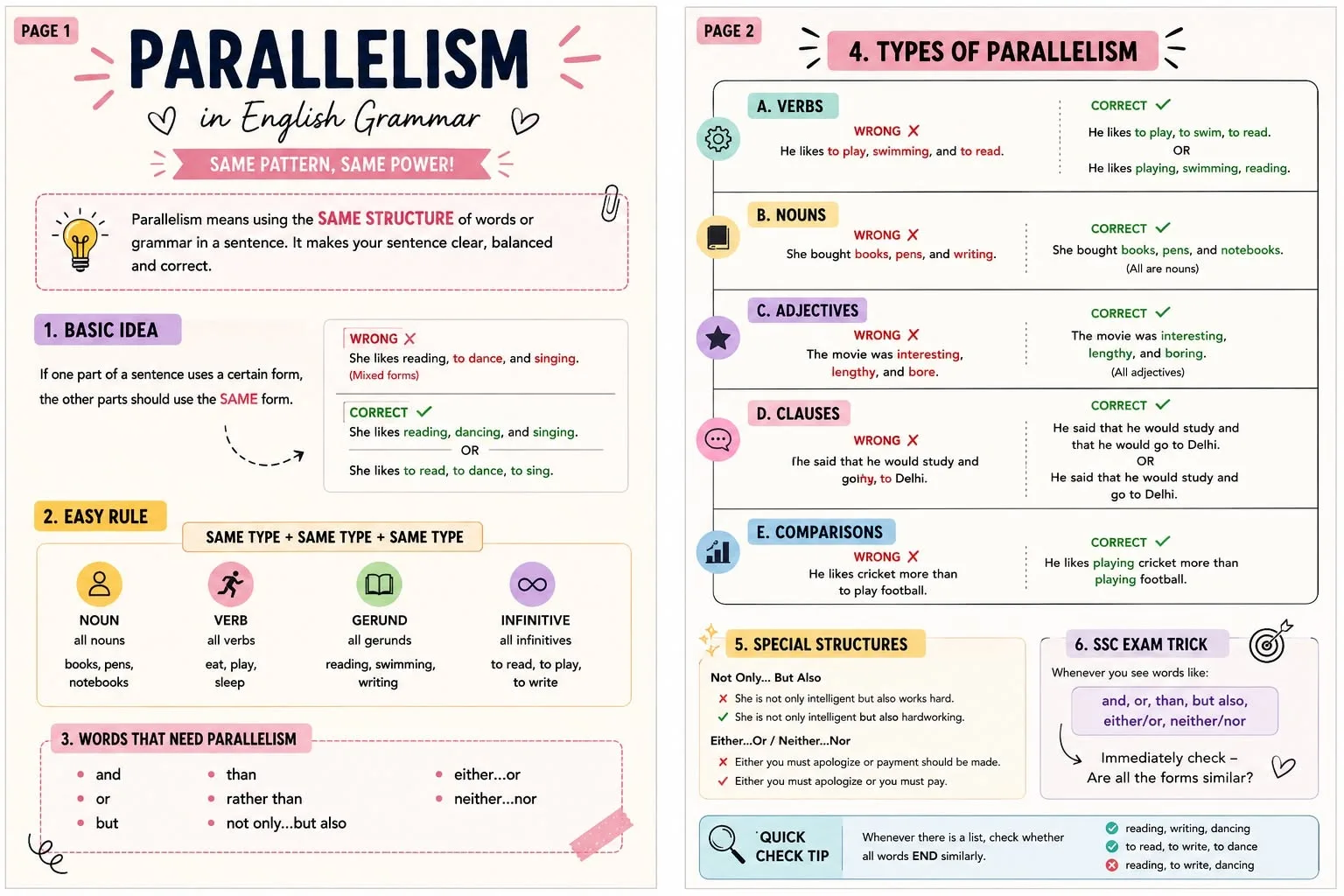
Parallel structure is one of the most important and most overlooked principles in English sentence construction. The rule is simple: when two or more items serve the same function in a sentence, they should share the same grammatical form. Three verbs in a list should all be in the same tense and form.
Three adjectives should all be adjectives. Three infinitive phrases should all start with "to." When the forms drift, the sentence becomes harder to read, even if the meaning is still understandable. When the forms hold, the sentence flows easily, carries rhythm, and sounds authoritative.
Faulty parallelism is a subtle error. Readers often cannot name what is wrong when they hit a non-parallel sentence, but they feel the bump and slow down. Editors spot the problem immediately. Good writers revise for parallelism because it is one of the cheapest ways to upgrade the readability of a paragraph. A single round of parallelism fixes can transform the voice of a document from amateur to professional.
This guide walks through the core rule, the places where parallelism applies, more than twenty before-and-after examples showing faulty parallelism and its corrected version, the common mistakes, and a self-check exercise. The Kalenux Team maintains this reference as part of the broader sentence-structure library for writers who want to produce clean, confident prose in academic, business, and editorial contexts.
The Core Rule
When two or more items are joined by "and," "or," "nor," or a correlative conjunction, the items should share the same grammatical form.
- Three nouns: "books, pens, and notebooks"
- Three gerunds: "reading, writing, and editing"
- Three infinitives: "to read, to write, and to edit"
- Three clauses: "she arrived, she sat down, and she began to speak"
- Three adjectives: "quick, clear, and accurate"
When the forms drift, parallelism breaks.
Wrong: "reading, writing, and to edit" (two gerunds and an infinitive)
Correct: "reading, writing, and editing" (three gerunds)
Or: "to read, to write, and to edit" (three infinitives)
"Parallel structure is the grammar of balance. When items match in form, the reader's mind expects them to match in function. That expectation is the backbone of a clean sentence." Kalenux Team expert-written sentence-structure reference
Where Parallelism Applies
Lists and Series
Any list of two or more items joined by "and," "or," or "nor" should be parallel.
Faulty: "She enjoys swimming, to jog, and yoga."
Correct: "She enjoys swimming, jogging, and yoga." (three gerunds/nouns)
Or: "She enjoys to swim, to jog, and to do yoga." (three infinitives)
Comparisons
Items being compared should share grammatical form.
Faulty: "Writing is harder than to speak."
Correct: "Writing is harder than speaking." (two gerunds)
Or: "To write is harder than to speak." (two infinitives)
Correlative Conjunctions
Both and, either or, neither nor, not only but also, whether or, require parallel forms on each side of the pair.
Faulty: "She is both a teacher and teaches art."
Correct: "She is both a teacher and an artist." (two nouns)
Or: "She both teaches and creates art." (two verbs)
Headings and Bulleted Lists
In professional writing, headings and bulleted items within the same section should share structure.
Faulty headings:
- Setting up the project
- Project execution
- How to close the project
Corrected (all gerunds):
- Setting up the project
- Executing the project
- Closing the project
Or (all noun phrases):
- Project setup
- Project execution
- Project closure
Twenty-Plus Before-and-After Examples
Example 1
Faulty: "He likes hiking, camping, and to fish."
Correct: "He likes hiking, camping, and fishing."
Example 2
Faulty: "She was tired, hungry, and wanted to sleep."
Correct: "She was tired, hungry, and sleepy."
Or: "She felt tired, wanted food, and wanted to sleep."
Example 3
Faulty: "The course teaches writing, editing, and how to publish."
Correct: "The course teaches writing, editing, and publishing."
Example 4
Faulty: "I came, I saw, and then conquered the city."
Correct: "I came, I saw, I conquered."
Example 5
Faulty: "The meeting was short, productive, and we ended it on time."
Correct: "The meeting was short, productive, and on time."
Example 6
Faulty: "She is talented, hardworking, and has a good attitude."
Correct: "She is talented, hardworking, and positive."
Example 7
Faulty: "The job requires typing, filing, and to answer phones."
Correct: "The job requires typing, filing, and answering phones."
Example 8
Faulty: "We plan to increase sales, reduce costs, and improving quality."
Correct: "We plan to increase sales, reduce costs, and improve quality."
Example 9
Faulty: "He not only reads widely but also a deep thinker."
Correct: "He not only reads widely but also thinks deeply."
Example 10
Faulty: "Either you submit the report by Friday or the client will cancel."
Correct: "Either you submit the report by Friday or you lose the client."
Example 11
Faulty: "The training covers communication, leadership, and how to delegate."
Correct: "The training covers communication, leadership, and delegation."
Example 12
Faulty: "Her proposal was detailed, clear, and she presented it well."
Correct: "Her proposal was detailed, clear, and well-presented."
Example 13
Faulty: "Swimming is easier than to run."
Correct: "Swimming is easier than running."
Example 14
Faulty: "I like neither the noise nor being in crowds."
Correct: "I like neither the noise nor the crowds."
Example 15
Faulty: "We looked for a candidate who is experienced, motivated, and can lead a team."
Correct: "We looked for a candidate who is experienced, motivated, and capable of leading a team."
Example 16
Faulty: "The document covers planning, execution, and how to evaluate results."
Correct: "The document covers planning, execution, and evaluation."
Example 17
Faulty: "She teaches children how to read, to write, and arithmetic."
Correct: "She teaches children reading, writing, and arithmetic."
Example 18
Faulty: "The CEO values speed, quality, and being honest."
Correct: "The CEO values speed, quality, and honesty."
Example 19
Faulty: "In her free time she likes to read, writing, and to paint."
Correct: "In her free time she likes to read, to write, and to paint."
Or: "In her free time she likes reading, writing, and painting."
Example 20
Faulty: "The project is not only behind schedule but also went over budget."
Correct: "The project is not only behind schedule but also over budget."
Example 21
Faulty: "The employees were asked to arrive early, finish on time, and that they should file reports."
Correct: "The employees were asked to arrive early, finish on time, and file reports."
Example 22
Faulty: "The study examines trade, production, and how innovation spreads."
Correct: "The study examines trade, production, and innovation."
Common Mistakes to Avoid
Mistake 1: Mixing gerunds and infinitives.
The most common parallelism error. Writers start a list with a gerund and slip into an infinitive, or vice versa. Always match.
Mistake 2: Missing parallel prepositions.
Faulty: "She interviewed in Paris, Tokyo, and New York."
This looks parallel but is ambiguous if the writer means to say she interviewed IN each city. The version is fine. Consider: "She interviewed in Paris, in Tokyo, and in New York" if emphasis on location is wanted. Each preposition should be repeated or omitted consistently.
Mistake 3: Mismatched correlative pairs.
Faulty: "She is either a teacher or teaches art."
The words after "either" and "or" must match in form.
Mistake 4: Heading lists with mixed forms.
In bulleted lists and section headings, writers often mix gerunds, noun phrases, and imperative verbs. Pick one and apply consistently across the set.
Mistake 5: Thinking parallelism applies only to written lists.
Parallelism applies to any series of two or more items, even in dense prose. Short sentences also benefit.
Quick Reference Cheat Sheet
| Construction | Rule |
|---|---|
| List of two or more items | All items share the same form |
| Comparison with "than" or "as" | Both sides share the same form |
| "Both ___ and ___" | Matching forms on each side |
| "Either ___ or ___" | Matching forms on each side |
| "Neither ___ nor ___" | Matching forms on each side |
| "Not only ___ but also ___" | Matching forms on each side |
| Headings in a section | Consistent form across all headings |
| Bulleted lists | Consistent form across all bullets |
Parallel Structure in Famous Prose
Many memorable sentences in English work because of parallel structure. Writers from Abraham Lincoln to Martin Luther King Jr. built rhetorical power on parallelism.
"Government of the people, by the people, for the people." Three prepositional phrases, matching.
"I have a dream that one day this nation will rise up." A foundational sentence that gains force from the repetition of structure in the following paragraphs.
"We shall fight on the beaches, we shall fight on the landing grounds, we shall fight in the fields." Three parallel clauses.
"Parallel structure is the invisible infrastructure of memorable writing. The sentences we remember have it. The sentences we forget usually do not." Kalenux Team expert-written style reference
Self-Check Exercise
Revise each sentence to fix faulty parallelism. Answers at the end.
- The workshop teaches planning, executing, and how to evaluate results.
- She is talented, hardworking, and has a positive attitude.
- Either we ship by Friday or the order is cancelled.
- I like reading, writing, and to talk with friends.
- The memo was short, clear, and we read it quickly.
Answers:
- "The workshop teaches planning, executing, and evaluating results." Or: "The workshop teaches planning, execution, and evaluation."
- "She is talented, hardworking, and positive."
- "Either we ship by Friday or we lose the order."
- "I like reading, writing, and talking with friends." Or: "I like to read, to write, and to talk with friends."
- "The memo was short, clear, and quick to read."
If you scored at least four out of five, the rule is sticking.
Editing for Parallelism
A practical editing habit is to circle every "and," "or," "nor," "both," "either," "neither," "not only," and "whether" in a draft, then check that the items on either side share grammatical form. Five minutes of this kind of review catches almost every parallelism error in a normal document.
A second habit is to read aloud. Faulty parallelism often sounds off, even when the writer cannot name the problem. Reading the draft aloud and listening for bumps in rhythm surfaces errors fast.
Conclusion
Parallel structure is a cheap upgrade for any writing. The rule is simple: items that do the same job should share the same grammatical form. Five minutes of attention to parallelism in each draft pays off in a cleaner, more authoritative voice. Professional writers treat parallelism as a standard editing pass, not an optional polish.
The Kalenux Team maintains a broader library of sentence-structure guides, and this article pairs naturally with the companion pieces on active voice, run-on sentences, and complex sentence construction. Writers who master parallel structure gain one of the most reliable tools for lifting a paragraph from competent to strong.
Frequently Asked Questions
What is parallel structure?
Parallel structure means using the same grammatical form for items that serve the same function in a sentence. If one item in a list is a gerund, all items should be gerunds. If one item is an infinitive, all items should be infinitives. She enjoys reading, writing, and jogging uses three gerunds in parallel.
She enjoys reading, writing, and to jog breaks the pattern because to jog is an infinitive while the others are gerunds.
Parallel structure applies to lists, comparisons, conjunctions, and correlatives. It makes sentences easier to read because the reader can predict the pattern and focus on the meaning rather than the grammar.
Why does parallel structure matter?
Parallel structure matters for three reasons. First, it makes sentences easier to read because the grammatical pattern signals to the reader how to parse the meaning. Second, it gives writing a rhythm that carries the reader forward. Third, faulty parallelism often signals weak editing, and readers notice the bump even if they cannot name it.
In persuasive writing, parallel structure is a rhetorical tool that adds weight to key points.
In technical writing, it makes specifications and requirements easier to scan. In any writing, it raises the quality of every paragraph where it appears.
What is the most common parallelism mistake?
Mixing verb forms in a list. Writers start with a gerund, switch to an infinitive, and end with a noun phrase, without noticing that the forms no longer match. She likes to swim, running, and yoga mixes an infinitive, a gerund, and a noun phrase.
Correct parallelism gives She likes swimming, running, and yoga, all noun-form, or She likes to swim, to run, and to do yoga, all infinitive.
The second most common mistake is faulty parallelism with correlative conjunctions like both and and either or, where the grammatical form after the first word must match the form after the second.
Does parallel structure apply to long lists only?
No. Parallelism applies to any series of two or more items that serve the same function. Two items form the smallest case. He was tired but happy uses two parallel adjectives. She reads and writes uses two parallel verbs. The principle holds for lists of twenty as much as for lists of two.
Longer lists are where parallelism lapses are most visible, but short lists can also break the pattern.
Whenever two or more elements are joined with and, or, or nor, the writer should check that the elements match in grammatical form.
How do I fix faulty parallelism?
Identify the items in the series, name the grammatical form of each, and then rewrite so all items share the same form. If the first item is a noun, make all items nouns. If the first item is a gerund, make all items gerunds. If the first item is an infinitive, make all items infinitives.
Sometimes you have to rework the sentence completely to keep the parallel structure clear.
The effort pays off because the resulting sentence is always easier to read. Professional editors treat faulty parallelism as one of the standard revision targets, along with passive voice and wordiness.
Do correlative conjunctions require parallel structure?
Yes. Correlative conjunctions are pairs like both and, either or, neither nor, not only but also, whether or. The grammatical form after the first word of the pair must match the form after the second. She is both a teacher and a mentor uses two parallel nouns. She is both teaching and mentors students breaks the parallelism.
The correct forms are She both teaches and mentors students with two parallel verbs, or She is both a teacher and a mentor with two parallel nouns. Correlative conjunctions are a frequent source of parallelism errors because the second part of the pair appears later in the sentence, which gives the writer time to drift into a different form.