
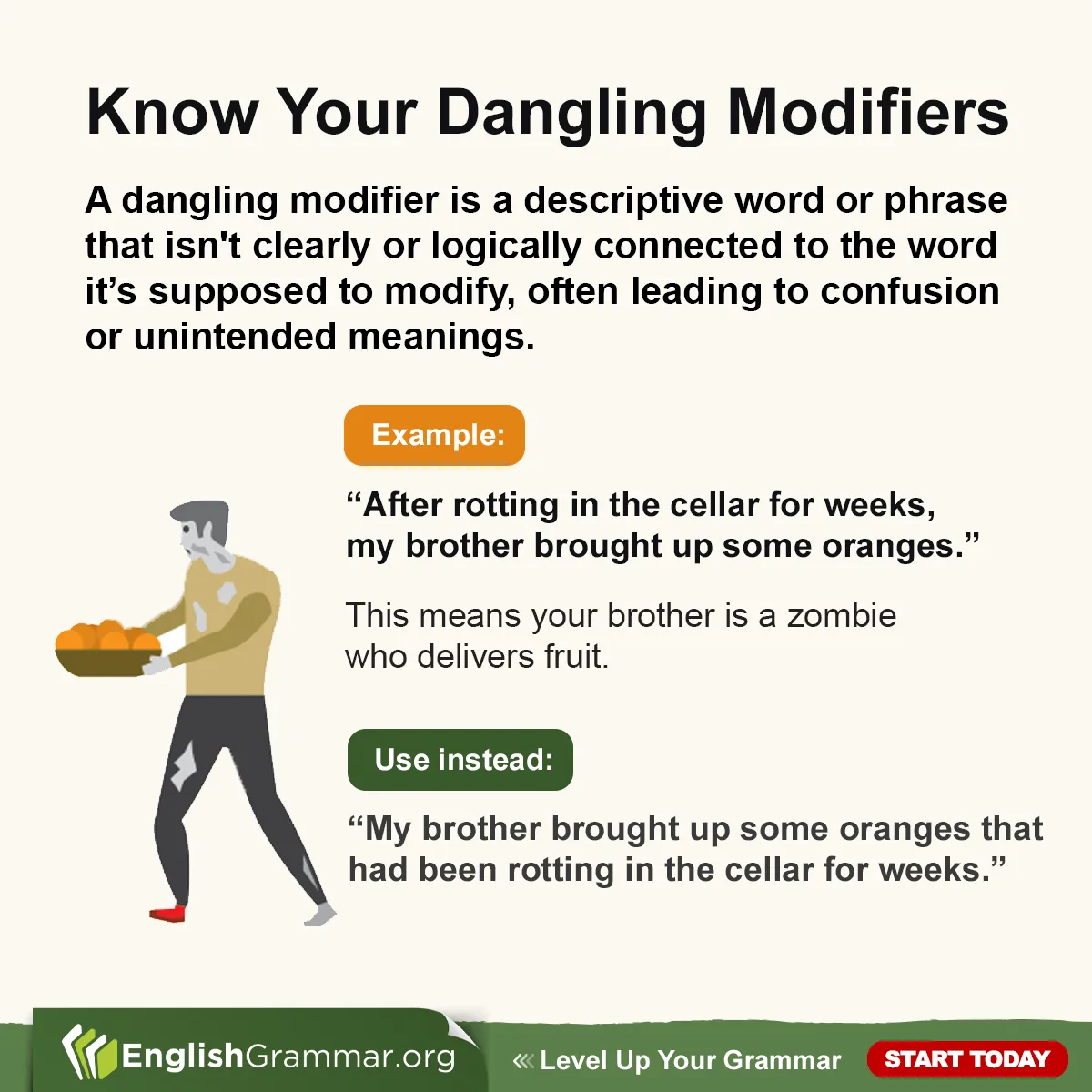
Dangling modifiers are one of the most common - and most entertaining - grammar errors in English. A sentence like "Walking down the street, the trees looked beautiful" seems innocent at first, but on a second reading, the trees appear to be walking. That is a dangling modifier: a descriptive phrase that has been placed next to the wrong subject, making the sentence say something its writer never intended.
These mistakes crop up in student essays, business reports, press releases, and even published books. They rarely obscure meaning completely, but they do make writing sound careless, and they often create unintentionally funny images that undercut serious content.
This expert-written guide from the Kalenux Team walks through what a dangling modifier is, why it happens, and how to fix every type. You will see more than twenty before-and-after corrections, clear explanations of the underlying logic, a table showing common patterns, and a self-check exercise with a full answer key. We will also look at related problems - misplaced modifiers, squinting modifiers - and show how to distinguish them.
By the end of this guide, you will catch dangling modifiers before they make it into your final draft. You will know how to restructure a sentence so the descriptive phrase attaches to the right subject, and you will develop the habit of asking the critical question every careful writer learns to ask: who or what is actually performing this action?
What Is a Modifier?
A modifier is a word or phrase that describes another part of the sentence. Adjectives, adverbs, prepositional phrases, participial phrases, and infinitive phrases can all act as modifiers. When a modifier sits next to the word it describes, everything works. When it sits next to the wrong word, the sentence goes wrong.
- Correct: The runner, exhausted after the race, collapsed at the finish line.
- Misplaced: The runner collapsed at the finish line, exhausted after the race. (ambiguous, but usually clear)
- Dangling: Exhausted after the race, the finish line offered no relief.
The third sentence has a dangling modifier because "exhausted after the race" has nothing to attach to. The finish line is not the thing that was exhausted.
What Is a Dangling Modifier?
A dangling modifier is a descriptive phrase that cannot attach logically to any word in the sentence, usually because the subject it was meant to describe is missing or implied.
"A dangling modifier is a phrase looking for its partner. The subject it wants to describe never showed up, so the phrase latches onto whatever word is nearest - usually with comic results." - Kalenux Team editorial guideline
The classic form is a participial phrase at the start of a sentence ("Walking down the street," "After reviewing the data," "To succeed in business"), followed by a clause whose subject is not actually the person doing the walking, reviewing, or succeeding.
Example 1
- Dangling: Walking down the street, the flowers smelled wonderful.
- Problem: Flowers are not walking down the street.
- Fix: Walking down the street, I noticed the flowers smelled wonderful.
- Fix (alternate): As I walked down the street, the flowers smelled wonderful.
Example 2
- Dangling: After reviewing the data, the conclusion became clear.
- Problem: Conclusions do not review data.
- Fix: After reviewing the data, the committee reached a clear conclusion.
- Fix (alternate): After the committee reviewed the data, the conclusion became clear.
Example 3
- Dangling: To succeed in business, hard work is essential.
- Problem: Hard work does not succeed in business; a person does.
- Fix: To succeed in business, you must work hard.
- Fix (alternate): To succeed in business, a person must work hard.
Why Dangling Modifiers Happen
Dangling modifiers creep in when writers drop the subject from the main clause, leaving the descriptive phrase attached to the wrong noun. Several common patterns produce them:
- The introductory phrase describes an action, but the main clause starts with a different subject.
- Passive voice hides the subject, so the modifier has nowhere to attach.
- The writer assumes the reader will infer the missing subject.
Each of these can be fixed by either naming the intended subject explicitly in the main clause or rewriting the introductory phrase so it carries its own subject.
The Test Every Writer Should Use
Whenever you see a descriptive phrase at the start of a sentence, ask: who or what is performing this action? Then check whether that person or thing is the grammatical subject of the main clause.
Running late for the meeting, the door slammed behind him.
- Who is running late? He is. But "the door" is the subject. Mismatch - dangling.
- Fix: Running late for the meeting, he slammed the door behind him.
After finishing the report, a glass of wine felt well-deserved.
- Who finished the report? The writer did. But "a glass of wine" is the subject. Mismatch - dangling.
- Fix: After finishing the report, I felt I deserved a glass of wine.
Applying this test to every opening modifier will catch almost every dangling phrase before it reaches the final draft.
Table of Common Dangling Patterns
| Pattern | Example | Problem | Fix |
|---|---|---|---|
| Participial phrase | Walking to school, the rain began. | Rain does not walk. | Walking to school, I noticed the rain began. |
| Infinitive phrase | To win the prize, practice is required. | Practice does not win prizes. | To win the prize, you must practice. |
| Gerund phrase | By studying regularly, grades improve. | Grades do not study. | By studying regularly, students improve their grades. |
| Adjective phrase | Unhappy with the result, the complaint was filed. | Complaints are not unhappy. | Unhappy with the result, the customer filed a complaint. |
| Elliptical clause | While driving home, a deer appeared. | The deer was not driving. | While I was driving home, a deer appeared. |
Related Errors: Misplaced and Squinting Modifiers
Misplaced Modifier
A misplaced modifier sits near the wrong word, even though the intended target is present in the sentence.
- Misplaced: She served pasta to her guests on paper plates.
- Problem: Are the guests on paper plates?
- Fix: She served pasta on paper plates to her guests.
Misplaced modifiers differ from dangling modifiers because the correct subject is present somewhere in the sentence; it just needs to move.
Squinting Modifier
A squinting modifier sits between two phrases, and it is unclear which one it modifies.
- Squinting: Studying often improves grades.
- Problem: Does "often" apply to "studying" or "improves"?
- Fix 1: Students who study often improve their grades.
- Fix 2: Students who study improve their grades often.
20+ Before-and-After Examples
Participial Phrase Danglers
Dangling: Walking into the room, the painting caught her eye. Fixed: Walking into the room, she noticed the painting.
Dangling: Driving through the mountains, the view was spectacular. Fixed: Driving through the mountains, we enjoyed the spectacular view.
Dangling: Covered in mud, my mother asked me to take my shoes off. Fixed: Covered in mud, I was asked by my mother to take my shoes off. Better: When I came home covered in mud, my mother asked me to take my shoes off.
Dangling: Rushing to catch the bus, my coffee spilled everywhere. Fixed: Rushing to catch the bus, I spilled my coffee everywhere.
Dangling: Hoping to impress the client, the proposal was polished late into the night. Fixed: Hoping to impress the client, the team polished the proposal late into the night.
Infinitive Phrase Danglers
Dangling: To write well, practice is essential. Fixed: To write well, a student must practice.
Dangling: To qualify for the promotion, an MBA is required. Fixed: To qualify for the promotion, candidates need an MBA.
Dangling: To enter the contest, the form must be submitted online. Fixed: To enter the contest, participants must submit the form online.
Gerund Phrase Danglers
Dangling: By exercising daily, stress levels decrease. Fixed: By exercising daily, people can reduce their stress levels.
Dangling: After reviewing your application, an interview will be scheduled. Fixed: After reviewing your application, we will schedule an interview.
Dangling: Before submitting the contract, all clauses should be verified. Fixed: Before submitting the contract, the legal team should verify all clauses.
Elliptical Clause Danglers
Dangling: While standing at the bus stop, a strange bird flew overhead. Fixed: While I was standing at the bus stop, a strange bird flew overhead.
Dangling: When only six years old, my grandmother taught me chess. Fixed: When I was only six years old, my grandmother taught me chess.
Dangling: Though exhausted from the drive, sleep seemed impossible. Fixed: Though I was exhausted from the drive, sleep seemed impossible.
Adjective Phrase Danglers
Dangling: Pleased with the outcome, a celebration was planned. Fixed: Pleased with the outcome, the team planned a celebration.
Dangling: Worried about the deadline, the computer was left on all night. Fixed: Worried about the deadline, I left the computer on all night.
Dangling: Frustrated with the delay, the refund was requested. Fixed: Frustrated with the delay, the customer requested a refund.
Mid-Sentence Modifier Issues
Dangling: The speaker, while walking to the podium, the microphone fell. Fixed: While the speaker was walking to the podium, the microphone fell.
Dangling: After completing the survey, the results were surprising. Fixed: After completing the survey, the researchers were surprised by the results.
Complex Cases
Dangling: Having worked at the firm for years, the policies were familiar. Fixed: Having worked at the firm for years, she found the policies familiar.
Dangling: When driving to work, the traffic was unusually light. Fixed: When I was driving to work, the traffic was unusually light.
Dangling: On entering the museum, the quiet atmosphere was striking. Fixed: On entering the museum, we noticed the striking quiet atmosphere.
Dangling: Excited about the announcement, the decision was quickly celebrated. Fixed: Excited about the announcement, the team quickly celebrated the decision.
Common Mistakes to Avoid
Mistake 1: Using Passive Voice to Hide the Subject
- Dangling: After editing the manuscript, a number of errors were found.
- Fixed: After editing the manuscript, the copy editor found a number of errors.
- Fixed alternate: After the copy editor edited the manuscript, a number of errors were found.
Passive voice often makes dangling modifiers worse because the actor disappears from the sentence.
Mistake 2: Assuming the Reader Will Fill In the Subject
- Dangling: When asked about the project, the answer was unclear.
- Fixed: When asked about the project, the manager gave an unclear answer.
Do not rely on the reader to infer who did what. Name the subject.
Mistake 3: Attaching to the Nearest Noun by Accident
- Dangling: Filled with pride, the award felt well-deserved.
- Problem: The award is not filled with pride.
- Fixed: Filled with pride, she felt the award was well-deserved.
Mistake 4: Overcorrecting With Awkward Phrasing
Sometimes writers recognize the problem but overcorrect into clumsy prose.
- Awkward fix: Walking down the street by me, the flowers smelled wonderful.
- Cleaner fix: As I walked down the street, the flowers smelled wonderful.
Rewrite the sentence if the fix is awkward. Do not jam extra words into a broken structure.
Mistake 5: Missing the Error Because the Sentence Still "Makes Sense"
Many dangling modifiers technically convey the intended meaning. The problem is that a close reading produces a contradiction.
- Dangling: After years of training, the championship was won.
- Technical meaning: The championship trained for years. (absurd)
- Intended meaning: The athlete won the championship after years of training.
- Fixed: After years of training, the athlete won the championship.
"The test of a modifier is not what you meant to say. It is what the grammar actually says. If the grammatical subject could not plausibly perform the action in the modifier, the modifier is dangling." - Kalenux Team writing workshop notes
Three Fixes That Always Work
When you find a dangling modifier, apply one of these three fixes:
Change the subject of the main clause to match the modifier.
- Before: After running five miles, a shower was urgent.
- After: After running five miles, I needed a shower urgently.
Add a subject to the introductory phrase (turn it into a full clause).
- Before: Running down the hall, the papers flew everywhere.
- After: As he ran down the hall, the papers flew everywhere.
Restructure the sentence entirely.
- Before: To qualify, experience in the field is required.
- After: Candidates must have experience in the field to qualify.
Quick Reference Cheat Sheet
| Symptom | Fix |
|---|---|
| Introductory phrase with no clear subject in the main clause | Add the implied subject to the main clause |
| Sentence makes unintentionally funny or absurd connection | Restructure so the phrase attaches to the real actor |
| Passive voice hides the doer of the action | Rewrite in active voice and name the subject |
| Participial phrase (-ing) at the start | Check who is doing the action |
| Infinitive phrase (to + verb) at the start | Check who is meant to do the action |
| Elliptical clause (while, when, though without a subject) | Add the subject inside the clause |
Self-Check Exercise
Identify whether each sentence has a dangling modifier, then rewrite the ones that do. Answers follow.
- Walking through the park, the leaves crunched beneath my feet.
- After reading the novel, the ending surprised me.
- To be eligible, an application must be submitted by Friday.
- Tired after a long day, the couch looked inviting.
- By the end of the semester, our understanding had deepened.
- Driving home from work, a raccoon ran across the road.
- Having missed the train, another hour of waiting began.
- Seated in the front row, the speaker looked directly at us.
- Before signing the contract, all terms should be reviewed.
- When finished with the exam, the proctor collected our papers.
Answer Key
- Dangling. Fix: Walking through the park, I heard the leaves crunch beneath my feet.
- Correct (marginal). Better: After I read the novel, I was surprised by the ending.
- Dangling. Fix: To be eligible, applicants must submit their forms by Friday.
- Dangling. Fix: Tired after a long day, I found the couch inviting.
- Correct - no modifier issue.
- Dangling. Fix: While I was driving home from work, a raccoon ran across the road.
- Dangling. Fix: Having missed the train, I had to wait another hour.
- Correct - speaker is seated and speaks.
- Dangling. Fix: Before signing the contract, the client should review all terms.
- Dangling. Fix: When we finished the exam, the proctor collected our papers.
Frequently Asked Questions
Why are dangling modifiers so common?
They sound fine when spoken and they often convey the intended meaning. The grammatical error is invisible until you check which subject the modifier actually attaches to. Spoken English gets away with this because tone and context fill in the gap; written English has to be explicit.
Do dangling modifiers ever appear in published writing?
Yes, surprisingly often. News articles, business reports, and novels all contain them. Careful editing catches most, but some slip through even at major publications.
Is "Walking to the store, the rain started" always wrong?
Yes, in formal writing. In very casual speech, listeners will infer that the walker is the speaker. In writing, make the subject explicit: "As I walked to the store, the rain started" or "Walking to the store, I was caught in the rain."
What is the difference between a dangling and a misplaced modifier?
A dangling modifier has no correct subject to attach to anywhere in the sentence. A misplaced modifier has a correct subject but sits next to the wrong word. Both are errors, but dangling modifiers usually require a bigger rewrite.
Can a modifier dangle at the end of a sentence?
Yes, though it is less common. "The tenants were evicted after failing to pay rent by the landlord" sits awkwardly because "by the landlord" drifts. Rewrite: "The landlord evicted the tenants after they failed to pay rent."
How do I proofread for dangling modifiers?
Scan every sentence that opens with a comma-set phrase or an "-ing" word. Ask who is performing that action. If the subject of the main clause cannot plausibly perform it, the modifier is dangling. Rewrite.
Conclusion
Dangling modifiers happen when a descriptive phrase cannot attach logically to the subject of its sentence. The fix always comes down to a single question: who or what is performing the action in the modifier? Once you identify that person or thing, you can either make it the subject of the main clause or restructure the sentence so the modifier carries its own subject.
Proofreading for dangling modifiers becomes automatic with practice. Watch every introductory phrase, especially those that begin with "-ing" words, infinitives, or elliptical "when/while" clauses. Ask the critical question every time.
When you catch an error, apply one of the three standard fixes - change the subject, add a subject, or restructure - and your writing will come across as both more accurate and more professional. Clean modifier placement is a hallmark of polished prose, and it is one of the fastest ways to raise the quality of your drafts.
Frequently Asked Questions
Why are dangling modifiers so common?
They sound fine in speech and often convey the intended meaning. The grammatical error is invisible until you check which subject the modifier attaches to.
Do dangling modifiers ever appear in published writing?
Yes. News articles, business reports, and novels all contain them. Careful editing catches most, but some slip through.
Is 'Walking to the store, the rain started' always wrong?
In formal writing, yes. Make the subject explicit: ‘As I walked to the store, the rain started’ or ‘Walking to the store, I was caught in the rain.’
What is the difference between a dangling and a misplaced modifier?
A dangling modifier has no correct subject in the sentence. A misplaced modifier has the right subject but sits next to the wrong word.
Can a modifier dangle at the end of a sentence?
Yes, though less commonly. End-of-sentence modifiers can drift from their intended target and need rewriting.
How do I proofread for dangling modifiers?
Scan sentences that open with comma-set phrases or ‘-ing’ words. Ask who is performing that action; if the subject of the main clause cannot plausibly do it, rewrite.