
The semicolon is the most misunderstood punctuation mark in English. Writers either avoid it entirely, lumping everything into periods and commas, or scatter it through their writing hoping that its air of sophistication will disguise weak sentence structure. This guide explains Semicolon Usage with clear rules and worked examples.
Both habits produce bad prose. The semicolon is actually a precise tool with two main jobs and a small set of supporting ones. Learn those jobs and you add a punctuation mark to your writing toolkit that solves problems periods and commas cannot.
This guide walks through every valid use of the semicolon, every common misuse, and the stylistic judgment that separates overuse from effective use. By the end you will know exactly when to reach for a semicolon and, more importantly, when to leave it in the drawer.
What a Semicolon Does
A semicolon is stronger than a comma and weaker than a period. It joins closely related ideas while preserving their separate grammatical identity. It says to the reader: these two thoughts are connected, but they are not so tightly bound that they should become one clause, nor so loosely related that they should sit as separate sentences.
The two core uses of the semicolon are:
- Joining two independent clauses that are closely related in meaning.
- Separating items in a list when the items themselves contain commas.
Everything else in this guide is refinement of those two uses.
Use 1 (independent clauses):
I went to the bookstore; I did not find the novel I wanted.

Use 2 (list with internal commas):
The committee includes Dr. Patel, the surgeon; Ms. Rodriguez, the attorney; and Mr. Chen, the accountant.
Essayists who write about language, such as Lewis Thomas in The Medusa and the Snail, treat the semicolon as a mark of connected thought rather than performance: used well it is elegant, used purely for show it reads as vanity.
Rule 1: Joining Two Independent Clauses
An independent clause has a subject and a verb and can stand alone as a complete sentence. When two independent clauses are closely related, you have four standard options for joining them.
Option 1 (period): I finished the report. I sent it to my editor.
Option 2 (comma plus conjunction): I finished the report, and I sent it to my editor.
Option 3 (semicolon): I finished the report; I sent it to my editor.
Option 4 (subordination): After I finished the report, I sent it to my editor.
The semicolon is option three. It is the right choice when the two ideas are close enough that a period feels too final and you want to avoid the "and" or "but" that would otherwise be required. It works particularly well when the second clause explains, amplifies, or contrasts with the first.
More examples:
The storm raged for hours; the lights finally came back at dawn.

She had been working on the novel for ten years; it was the defining project of her life.

Some writers plan every chapter in advance; others discover the plot as they go.

The jury deliberated for four days; in the end, the verdict was unanimous.

Do not overthink the semicolon; use it when the thought flows naturally from one clause to the next.
The test for a valid semicolon join: both sides of the semicolon must be complete sentences on their own. If one side is a fragment, the semicolon is wrong.
Wrong: I went to the store; and bought milk.
(The second clause is a fragment, not an independent clause.)

Right: I went to the store and bought milk.

Right: I went to the store; I bought milk.

Wrong: Although she was tired; she kept working.
("Although she was tired" is a dependent clause. Use a comma.)

Right: Although she was tired, she kept working.
Rule 2: Semicolons With Conjunctive Adverbs
Certain adverbs act like conjunctions but need stronger punctuation than a simple comma. These "conjunctive adverbs" include however, therefore, moreover, nevertheless, consequently, furthermore, indeed, thus, otherwise, accordingly, meanwhile, similarly, besides, and likewise.
When a conjunctive adverb joins two independent clauses, use a semicolon before it and a comma after it.
The deadline passed; however, the team received an extension.

I expected heavy traffic; therefore, I left early.

She had not finished the draft; moreover, she had lost half her notes.

The evidence was clear; nevertheless, the jury acquitted him.

The flight was delayed; consequently, we missed the connection.

Prices have increased; furthermore, wages have not kept pace.
The common error is using only a comma before the conjunctive adverb, producing a comma splice.
Wrong: The deadline passed, however, the team received an extension.
Right: The deadline passed; however, the team received an extension.
Right: The deadline passed. However, the team received an extension.
This is one of the most frequent semicolon-related errors in professional writing. Notice the comma after "however" in the correct version. Conjunctive adverbs are typically followed by a comma when they open a clause.
| Conjunctive Adverb | Function | Example |
|---|---|---|
| However | Contrast | The plan was ambitious; however, funding was limited. |
| Therefore | Consequence | The evidence was compelling; therefore, the case was solid. |
| Moreover | Addition | She finished early; moreover, her work was excellent. |
| Nevertheless | Concession | He had few resources; nevertheless, he persisted. |
| Consequently | Result | The storm damaged the crops; consequently, prices rose. |
| Furthermore | Additional point | The budget is tight; furthermore, staff morale is low. |
| Indeed | Emphasis | The task was difficult; indeed, most people failed it. |
| Thus | Conclusion | The terms are acceptable; thus, we will sign the contract. |
| Otherwise | Alternative | Leave by noon; otherwise, you will hit traffic. |
| Meanwhile | Simultaneously | The meeting continued; meanwhile, the crisis deepened. |
Rule 3: Separating Complex List Items
When items in a list contain commas, the semicolon takes over as the separator between items. Without it, the reader cannot tell where one item ends and the next begins.
Without semicolons (confusing):
The trip included stops in Paris, France, Berlin, Germany, and Rome, Italy.
(Are those three stops or six?)

With semicolons (clear):
The trip included stops in Paris, France; Berlin, Germany; and Rome, Italy.

The speakers were Dr. Martinez, a cardiologist; Dr. Okafor, a neurologist; and Dr. Liu, a radiologist.

The committee voted on three proposals: to increase the budget by 10 percent; to hire two new staff members, effective next quarter; and to renovate the lobby, beginning in October.

Guests came from Austin, Texas; Portland, Oregon; Miami, Florida; and Burlington, Vermont.
This is the one use of the semicolon that even semicolon-shy writers accept, because without it the sentence genuinely does not parse. A serial semicolon (like the serial comma, before "and") is standard in American usage.
Rule 4: Avoiding Semicolons With Coordinating Conjunctions
The coordinating conjunctions (for, and, nor, but, or, yet, so) typically take a comma, not a semicolon. The semicolon is mostly used when no conjunction is present.
Preferred: I finished the draft, and I sent it to my editor.
(Comma with "and.")

Preferred: I finished the draft; I sent it to my editor.
(No conjunction, semicolon.)

Uncommon but not wrong: I finished the draft; and I sent it to my editor.
(Old-fashioned but accepted when the clauses are long or contain internal punctuation.)
The old-fashioned use of "semicolon plus and" survives in some nineteenth-century prose and in very long sentences where a comma would be lost among other commas. In modern writing, use it sparingly.
Rule 5: Stylistic Semicolons for Rhythm and Contrast
Beyond the mechanical rules, the semicolon has a rhetorical function. It creates a rhythmic pause that a period cannot. Two clauses joined by a semicolon feel connected, linked in the writer's mind; two clauses separated by a period feel distinct.
Period version:
To err is human. To forgive is divine.

Semicolon version:
To err is human; to forgive is divine.

The semicolon version ties the two halves together more tightly, reinforcing that they are two parts of one thought.
This is why aphorisms and epigrams often use semicolons. The semicolon signals parallel structure and invites the reader to balance the two halves against each other.
Parallel structure with semicolons:
Children want independence; adults want security.

He loved the work; he hated the office.

The first year was exhilarating; the second was exhausting; the third was impossible.

Some lessons come from books; others come from experience.
The semicolon has a distinctive rhetorical effect: it asks the reader to pause and hold two related thoughts in mind at once, rather than closing one off before starting the next, the way a period does.
Rule 6: When Not to Use a Semicolon
A semicolon is wrong in each of these situations:
- Between a dependent clause and an independent clause. Use a comma or integrate the clause.
Wrong: Although the sun was setting; we kept hiking.
Right: Although the sun was setting, we kept hiking.
- Before a list introduction. Use a colon.
Wrong: I packed three items; a jacket, a book, and a water bottle.
Right: I packed three items: a jacket, a book, and a water bottle.
- Between a fragment and a complete sentence.
Wrong: A long and tiring day; I went straight to bed.
Right: It was a long and tiring day, so I went straight to bed.
Or: A long and tiring day. I went straight to bed.
- Where a comma would suffice.
Unnecessary: She arrived early; bringing fresh bread.
Better: She arrived early, bringing fresh bread.
- As a decorative substitute for a comma. Some writers scatter semicolons to seem sophisticated. The result is usually comical.
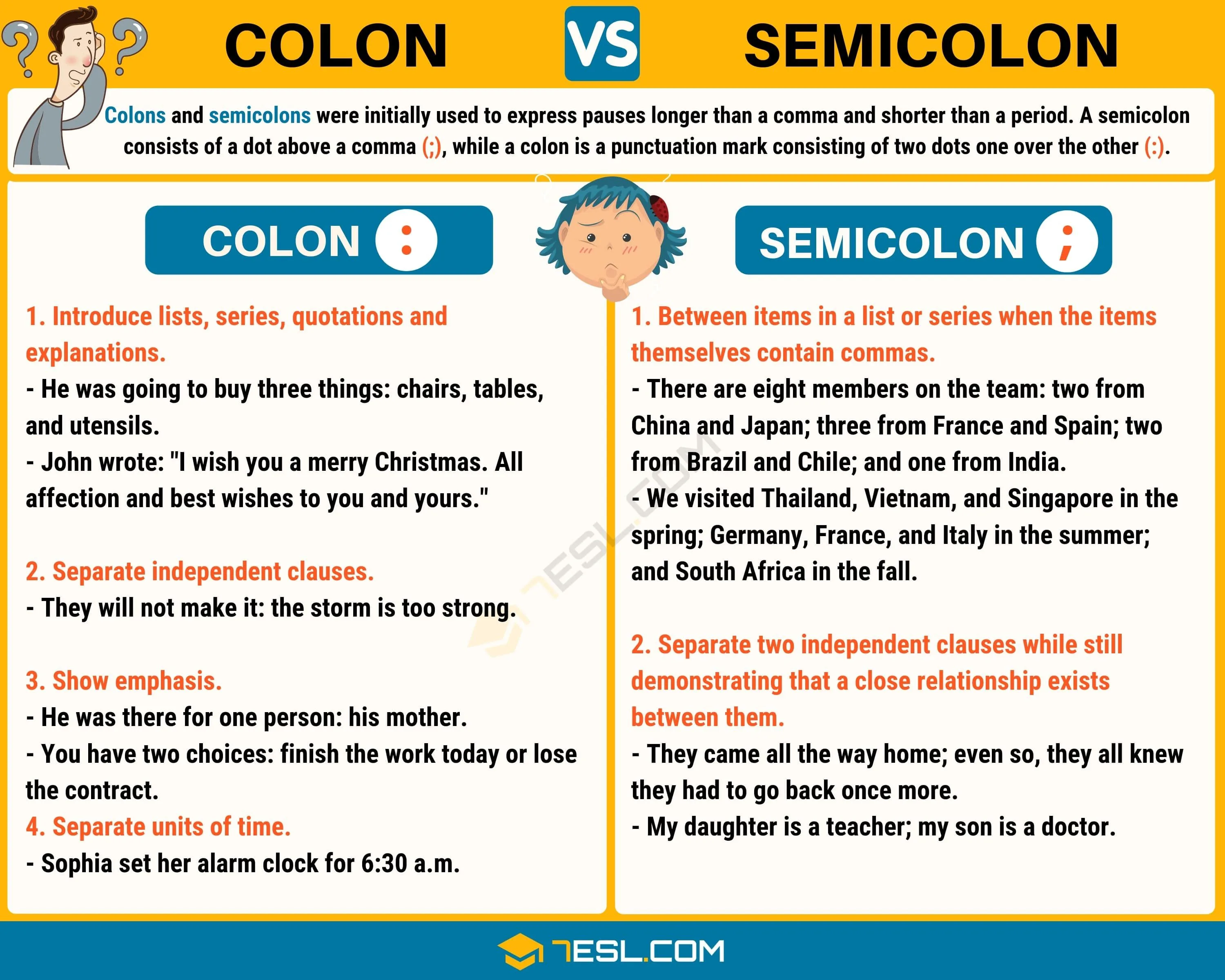
Colons vs Semicolons: The Distinction
Many writers confuse the colon and the semicolon. They do different jobs.
| Punctuation | Primary Job | Example |
|---|---|---|
| Period (.) | Ends a complete thought | I finished the report. I went home. |
| Comma (,) | Minor pause, joins clauses with a conjunction | I finished the report, and I went home. |
| Semicolon (;) | Joins two related independent clauses without a conjunction | I finished the report; I went home. |
| Colon (:) | Introduces a list, explanation, or elaboration | I finished one task: the quarterly report. |
| Dash | Marks a sharp break or parenthetical insertion | I finished the report late that night. |
The key distinction between colon and semicolon: the colon points forward to what comes next (introducing, announcing, elaborating). The semicolon joins two thoughts of equal weight.
Colon (introduces):
I had one goal: to finish the book by Friday.
The menu offered three options: soup, salad, or sandwich.
Her reasoning was simple: the cost outweighed the benefit.

Semicolon (joins equals):
I had one goal this week; I had another for next month.
The menu offered three options; the wine list offered five.
Her reasoning was simple; mine was complicated.
Semicolons in Academic and Legal Writing
Formal writing uses semicolons more heavily than casual writing. Academic prose often contains long, multi-clause sentences where semicolons provide the structural rhythm. Legal writing uses semicolons to separate items in complex statutory lists.
Academic example:
The study identified three mechanisms by which the protein modulates cell behavior: it inhibits apoptosis, as shown in the first set of experiments; it promotes proliferation, as demonstrated by the cell-count data; and it alters gene expression, as confirmed by the sequencing results.

Legal example:
The defendant shall: first, cease all activities related to the disputed patent; second, surrender all materials produced under the patent; and third, pay damages as determined by the court.
These uses combine the list-with-internal-commas rule with the parallel-structure use of semicolons. In formal writing, semicolons are workhorses.
Style guides such as Joseph Williams's Style: Lessons in Clarity and Grace note that formal writing can technically avoid semicolons, but the long, multi-clause sentences common in academic and legal prose often rely on them to give readers handholds through complex ideas.
Creative Writing and the Semicolon Question
Some creative writers avoid the semicolon on principle. Kurt Vonnegut famously wrote, "Do not use semicolons. They are transvestite hermaphrodites representing absolutely nothing. All they do is show you have been to college." Cormac McCarthy never uses them. Hemingway used them sparingly.
Other writers love them. Virginia Woolf's prose swims in semicolons. Henry James could not write a paragraph without them. David Foster Wallace used them as a way of extending and qualifying thought.
The stylistic choice depends on voice. Short, declarative prose suits periods. Longer, more contemplative prose suits semicolons. Choose the rhythm you want and let the punctuation follow.
Practice Set
Insert correct punctuation in each sentence. Answers follow.
- The rain stopped the sun came out.
- I would like to travel to Tokyo Japan Seoul South Korea and Beijing China.
- She had studied all week however the exam surprised her.
- He finished the race not because he was fastest but because he was most determined.
- The recipe calls for three ingredients flour sugar and butter.
- We reviewed the proposal it needs further revision.
- The team played well nevertheless they lost the match.
- Reading takes time practice takes patience writing takes both.
Answers:
- The rain stopped; the sun came out.
- I would like to travel to Tokyo, Japan; Seoul, South Korea; and Beijing, China.
- She had studied all week; however, the exam surprised her.
- He finished the race, not because he was fastest but because he was most determined. (No semicolon here; comma is sufficient.)
- The recipe calls for three ingredients: flour, sugar, and butter. (Colon, not semicolon.)
- We reviewed the proposal; it needs further revision.
- The team played well; nevertheless, they lost the match.
- Reading takes time; practice takes patience; writing takes both.
How Much Semicolon Is Too Much?
A general guideline: one or two semicolons per page of typical prose is normal. More than three or four starts to feel like a tic. Heavy semicolon use is a feature of certain writers and certain genres (academic, legal, literary fiction); for most business, journalistic, and general writing, use them sparingly.
When editing, look at every semicolon and ask: is this stronger than a period here? If not, convert to a period. If yes, keep it. This single discipline catches most semicolon overuse.
Where Semicolon Mastery Fits in Professional Writing
Semicolon use is one of the quiet markers of writing craft. Readers who know the rules notice when semicolons are used correctly and when they are not. A cover letter, legal memo, or academic paper with correctly placed semicolons earns credit for attention to detail. The same document with misused semicolons leaks small amounts of credibility with every slip.
For related punctuation guidance, see our articles on complex vs compound sentences, transition words, and subject-verb agreement. For students preparing for writing-intensive certifications, structured practice is available at Pass4Sure, and cognitive research on how punctuation affects reading comprehension is collected on What's Your IQ.
For formatting long documents where punctuation and layout interact, the conversion tools at File Converter Free handle the transitions between drafts, proofs, and final submissions.
A final practical test: read your sentences aloud. If the pause you are making feels longer than a comma but shorter than a period, and the next idea is genuinely an equal partner to the first, you have a candidate for a semicolon. Trust that instinct, check the rule, and place the mark.
References
Thomas, L. (1979). The Medusa and the Snail: More Notes of a Biology Watcher. Viking Press. https://www.penguinrandomhouse.com/
Vonnegut, K. (2005). A Man Without a Country. Seven Stories Press. https://www.sevenstories.com/
Williams, J. M., and Bizup, J. (2016). Style: Lessons in Clarity and Grace (12th ed.). Pearson. https://www.pearson.com/
The Chicago Manual of Style (17th ed.). University of Chicago Press. https://www.chicagomanualofstyle.org/
Garner, B. A. (2022). Garner's Modern English Usage (5th ed.). Oxford University Press. https://www.oup.com/academic
Truss, L. (2003). Eats, Shoots and Leaves: The Zero Tolerance Approach to Punctuation. Gotham Books. https://www.penguinrandomhouse.com/
Watson, C. (2019). Semicolon: The Past, Present, and Future of a Misunderstood Mark. Ecco. https://www.harpercollins.com/
Purdue Online Writing Lab. Semicolons and Colons. https://owl.purdue.edu/owl/general_writing/punctuation/commas/commas_vs_semicolons.html
Frequently Asked Questions
When should I use a semicolon instead of a period?
Use a semicolon when two independent clauses are closely related in meaning and flow naturally from one to the next. Use a period when the ideas are more separate. Both are grammatically valid; the semicolon signals tighter connection.
Can a semicolon join a fragment to a complete sentence?
No. Both sides of a semicolon must be complete independent clauses that could stand alone as sentences. If one side is a fragment, use a comma or rewrite the sentence.
Do I need a comma after 'however' in 'I tried; however, I failed'?
Yes. Conjunctive adverbs like however, therefore, moreover, and nevertheless take a semicolon before them and a comma after them when joining independent clauses.
What is the difference between a colon and a semicolon?
A colon introduces what follows, such as a list, explanation, or elaboration. A semicolon joins two equal, closely related independent clauses. The colon points forward; the semicolon balances two thoughts.
When do I use semicolons in a list?
Use semicolons to separate list items when the items themselves contain commas. For example, ‘The delegates came from Paris, France; Berlin, Germany; and Rome, Italy.’ Without semicolons, the reader cannot tell where one item ends.
Can I use a semicolon before 'and' or 'but'?
Generally no. Coordinating conjunctions (and, but, or, nor, for, yet, so) usually take a comma. Use a semicolon when no conjunction is present. The older ‘semicolon plus and’ style still appears in very long sentences with internal commas.
Is it considered poor style to use many semicolons?
Overuse of semicolons can feel pretentious or clumsy. A general guideline is one or two per page in typical prose. Academic, legal, and literary writing use them more freely. Aim for clarity, not decoration.