
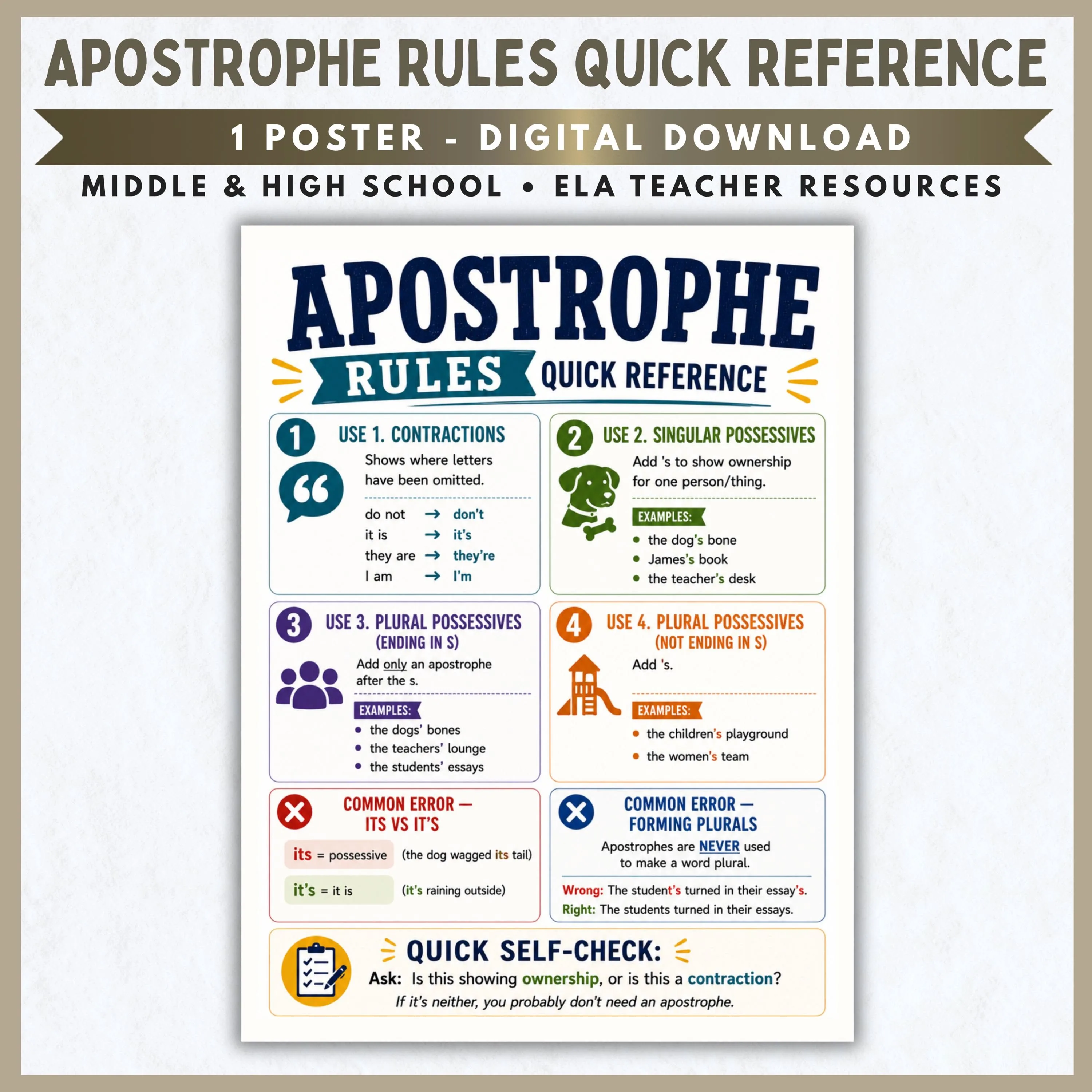
The apostrophe is one of the most misused punctuation marks in English. It appears where it should not, vanishes where it should be, and causes confusion in everything from grocery store signs to professional reports. Despite its small size, the apostrophe carries significant meaning - it shows possession, indicates missing letters in contractions, and occasionally marks certain unusual plurals.
This guide covers every apostrophe rule you will encounter in standard English writing. Each rule is explained with clear examples, and the most common mistakes are addressed directly so you can avoid them in your own work. By the end, you will handle apostrophes with confidence in any writing context.
The Two Main Jobs of Apostrophes
Apostrophes serve two primary functions in English:
- Showing possession - indicating that something belongs to someone or something
- Indicating omission - marking where letters have been removed in contractions
A third, much rarer function involves forming certain unusual plurals, which is covered later in this guide. Understanding these two main jobs is the foundation for every apostrophe rule that follows.
Apostrophes for Possession
Possessive apostrophes show ownership or association. They answer the question "whose?" or "belonging to what?"
Rule 1 - Singular Nouns
To make a singular noun possessive, add apostrophe + s ('s).
| Noun | Possessive | Example |
|---|---|---|
| dog | dog's | The dog's leash is on the hook. |
| teacher | teacher's | The teacher's desk was covered in papers. |
| company | company's | The company's revenue grew by 12 percent. |
| child | child's | The child's drawing won first place. |
| boss | boss's | The boss's office is at the end of the hall. |
| car | car's | The car's engine needs maintenance. |
| student | student's | Each student's work was graded individually. |
This rule applies regardless of what letter the noun ends with, including nouns that already end in "s."
Rule 2 - Plural Nouns Ending in S
To make a plural noun that already ends in "s" possessive, add only an apostrophe after the existing "s."
| Noun | Plural | Possessive Plural | Example |
|---|---|---|---|
| dog | dogs | dogs' | The dogs' leashes were tangled together. |
| teacher | teachers | teachers' | The teachers' lounge is on the second floor. |
| student | students | students' | The students' grades improved significantly. |
| parent | parents | parents' | My parents' house is near the lake. |
| employee | employees | employees' | The employees' benefits package was updated. |
| neighbor | neighbors | neighbors' | The neighbors' yard is always well maintained. |
Rule 3 - Irregular Plural Nouns
Irregular plurals that do not end in "s" follow the same rule as singular nouns: add apostrophe + s ('s).
| Singular | Plural | Possessive Plural | Example |
|---|---|---|---|
| child | children | children's | The children's playground was renovated. |
| woman | women | women's | The women's department is on the third floor. |
| man | men | men's | The men's room is down the hall on the left. |
| person | people | people's | The people's choice was overwhelmingly clear. |
| mouse | mice | mice's | The mice's tracks led to the pantry. |
| goose | geese | geese's | The geese's migration pattern has shifted. |
| tooth | teeth | teeth's | The teeth's enamel was showing signs of erosion. |
Rule 4 - Proper Nouns Ending in S
This is one of the most debated apostrophe rules, and style guides differ. Here are the two main approaches:
Approach 1 - Add apostrophe + s (preferred by most style guides):
- James's car is parked outside.
- Charles's presentation was excellent.
- Texas's economy is the second largest in the country.
- Chris's birthday is next week.
- The Joneses' house is the one with the blue door.
- Dickens's novels remain widely read today.
Approach 2 - Add only an apostrophe (AP Stylebook):
- James' car is parked outside.
- Charles' presentation was excellent.
- Texas' economy is the second largest in the country.
Classical and biblical names are a special case. Many style guides add only an apostrophe to ancient Greek, Roman, and biblical names where the extra syllable would sound awkward:
- Achilles' heel
- Moses' law
- Jesus' teachings
- Socrates' philosophy
- Euripides' plays
The most important rule: Choose one approach and apply it consistently throughout your document. Inconsistency is worse than either convention.
Rule 5 - Joint Possession
When two or more people share ownership of the same thing, add the possessive form only to the last name.
- Jack and Jill's restaurant opened last month. (They own one restaurant together.)
- Mom and Dad's anniversary is in June. (They share the anniversary.)
- Lewis and Clark's expedition changed American history. (They shared the expedition.)
Rule 6 - Separate Possession
When two or more people own separate things, each name gets the possessive form.
- Jack's and Jill's cars are parked in the driveway. (Each has their own car.)
- Shakespeare's and Marlowe's writing styles were quite different. (Each had a separate style.)
- Sarah's and Tom's offices are on different floors. (Each has a separate office.)
Rule 7 - Compound Nouns and Phrases
For compound nouns and hyphenated phrases, add the possessive to the last word.
- My mother-in-law's advice was invaluable.
- The attorney general's statement clarified the policy.
- The editor-in-chief's decision is final.
- My brother-in-law's new job starts Monday.
- The commander-in-chief's orders were followed immediately.
Rule 8 - Possessives Before Gerunds
When a noun or pronoun comes before a gerund (a verb form ending in -ing used as a noun), it should be in the possessive form.
- I appreciate your helping with the project. (not "you helping")
- Sarah's arriving late caused a delay. (not "Sarah arriving")
- The dog's barking kept the neighbors awake. (not "the dog barking")
- We were surprised by his resigning without notice. (not "him resigning")
In formal writing, the possessive before a gerund is strongly preferred. In casual speech and informal writing, the non-possessive form is common and generally accepted.
Apostrophes in Contractions
Contractions combine two words into one by omitting one or more letters. The apostrophe marks the exact spot where letters have been removed.
Common Contractions
| Full Form | Contraction | What Is Omitted |
|---|---|---|
| I am | I'm | the "a" in am |
| I have | I've | the "ha" in have |
| I will | I'll | the "wi" in will |
| I would / I had | I'd | "woul" or "ha" |
| you are | you're | the "a" in are |
| you have | you've | the "ha" in have |
| you will | you'll | the "wi" in will |
| he is / he has | he's | the "i" in is or "ha" in has |
| she is / she has | she's | the "i" in is or "ha" in has |
| it is / it has | it's | the "i" in is or "ha" in has |
| we are | we're | the "a" in are |
| we have | we've | the "ha" in have |
| they are | they're | the "a" in are |
| they have | they've | the "ha" in have |
| they will | they'll | the "wi" in will |
| is not | isn't | the "o" in not |
| are not | aren't | the "o" in not |
| was not | wasn't | the "o" in not |
| were not | weren't | the "o" in not |
| do not | don't | the "o" in not |
| does not | doesn't | the "o" in not |
| did not | didn't | the "o" in not |
| has not | hasn't | the "o" in not |
| have not | haven't | the "o" in not |
| had not | hadn't | the "o" in not |
| will not | won't | irregular form |
| would not | wouldn't | the "o" in not |
| could not | couldn't | the "o" in not |
| should not | shouldn't | the "o" in not |
| cannot | can't | "no" |
| let us | let's | the "u" in us |
| who is / who has | who's | the "i" in is or "ha" in has |
| that is | that's | the "i" in is |
| there is | there's | the "i" in is |
| what is | what's | the "i" in is |
Contractions in Formal vs. Informal Writing
Contractions are standard in informal and semi-formal writing, including blog posts, emails, creative writing, and general web content. They make writing sound natural and conversational.
In strictly formal contexts - academic papers, legal documents, scientific journals, and some business reports - many style guides recommend avoiding contractions. The full forms sound more authoritative and precise.
| Context | Use Contractions? |
|---|---|
| Academic essays | Generally avoid |
| Legal documents | Avoid |
| Scientific papers | Avoid |
| Business reports | Depends on company style |
| Professional emails | Usually acceptable |
| Blog posts and articles | Yes |
| Creative writing | Yes |
| Social media | Yes |
Special Contractions
Some contractions are less common but still correct:
- 'twas - it was (literary/archaic)
- o'clock - of the clock
- ma'am - madam
- ne'er - never (literary)
- e'er - ever (literary)
- rock 'n' roll - rock and roll
Its vs. It's - The Most Confused Apostrophe Rule
This distinction causes more errors than any other apostrophe rule. The confusion is understandable because it seems to contradict the possessive apostrophe rule.
It's = It Is or It Has
"It's" with an apostrophe is always and only a contraction.
- It's raining outside. (It is raining outside.)
- It's been a long day. (It has been a long day.)
- It's important to proofread your work. (It is important to proofread.)
- It's the best decision we have made this year. (It is the best decision.)
- I think it's going to be a productive meeting. (it is going to be)
Its = Belonging to It
"Its" without an apostrophe is the possessive form of "it."
- The company announced its quarterly earnings.
- The dog wagged its tail.
- The tree lost its leaves in the storm.
- The committee released its final report.
- Each department has its own budget.
Why No Apostrophe for Possessive Its?
Possessive pronouns never use apostrophes. "Its" belongs to the same family as these pronouns:
| Possessive Pronoun | Example |
|---|---|
| my / mine | This is my book. The book is mine. |
| your / yours | This is your seat. The seat is yours. |
| his | This is his jacket. |
| her / hers | This is her office. The office is hers. |
| its | The cat cleaned its fur. |
| our / ours | This is our project. The project is ours. |
| their / theirs | This is their house. The house is theirs. |
None of these possessive pronouns use an apostrophe: not mine, not yours, not his, not hers, not its, not ours, not theirs. Adding an apostrophe to any of them is always incorrect.
The Substitution Test
Whenever you are unsure whether to write "its" or "it's," substitute "it is" or "it has" into the sentence.
- The company increased ______ revenue. -> The company increased "it is" revenue? No. Use its.
- ______ the third time this has happened. -> "It is" the third time this has happened? Yes. Use it's.
- The cat licked ______ paw. -> The cat licked "it is" paw? No. Use its.
- ______ been wonderful working with you. -> "It has" been wonderful working with you? Yes. Use it's.
Possessive Pronouns - Never Use an Apostrophe
This rule is absolute and has no exceptions. Possessive pronouns never take apostrophes.
Common Errors
| Incorrect | Correct | Why |
|---|---|---|
| The book is her's. | The book is hers. | Possessive pronouns never use apostrophes. |
| The decision is their's. | The decision is theirs. | Same rule. |
| Is this jacket your's? | Is this jacket yours? | Same rule. |
| The fault is our's. | The fault is ours. | Same rule. |
| The cat cleaned it's fur. | The cat cleaned its fur. | Same rule. |
Who's vs. Whose
This pair follows the same pattern as it's/its.
- Who's = who is or who has (contraction)
- Whose = belonging to whom (possessive)
Examples:
- Who's coming to the meeting? (Who is coming?)
- Who's finished the assignment? (Who has finished?)
- Whose jacket is this? (This jacket belongs to whom?)
- Whose idea was this project? (The idea belongs to whom?)
- The employee whose performance exceeded expectations received a bonus.
They're vs. Their vs. There
While not strictly an apostrophe rule, this trio is closely related.
- They're = they are (contraction with apostrophe)
- Their = belonging to them (possessive, no apostrophe)
- There = in that place (location, no apostrophe)
Examples:
- They're planning to attend the conference. (They are planning.)
- Their presentation was well received. (The presentation belonging to them.)
- The conference center is over there. (In that location.)
You're vs. Your
- You're = you are (contraction with apostrophe)
- Your = belonging to you (possessive, no apostrophe)
Examples:
- You're welcome to join us. (You are welcome.)
- Your report is due on Friday. (The report belonging to you.)
Apostrophes and Plurals - The Rules
The General Rule: Do Not Use Apostrophes for Plurals
This is one of the most frequently broken apostrophe rules. Regular plurals never take apostrophes.
| Incorrect | Correct |
|---|---|
| apple's for sale | apples for sale |
| fresh tomato's | fresh tomatoes |
| two coffee's please | two coffees please |
| the Smith's are coming | the Smiths are coming |
| the 1990's | the 1990s |
| video's and photo's | videos and photos |
| three dog's in the park | three dogs in the park |
| new employee's welcome | new employees welcome |
The erroneous use of apostrophes in plurals is so common in shop signs and advertisements that it has earned the nickname "the grocer's apostrophe" or "greengrocer's apostrophe."
Exception 1 - Plurals of Single Letters
When you form the plural of a single lowercase letter, adding an apostrophe prevents confusion.
- Mind your p's and q's.
- She earned all A's on her report card.
- Dot your i's and cross your t's.
- The word "Mississippi" has four s's, four i's, and two p's.
Without the apostrophe, some of these would be confusing. "As" could be read as the word "as," and "is" could be read as the verb "is."
For uppercase letters, the apostrophe is optional because confusion is less likely:
- She earned all As on her report card. (also acceptable: A's)
- The sign was decorated with Xs and Os. (also acceptable: X's and O's)
Exception 2 - Plurals of Words Referred to as Words
When you need to pluralize a word that you are discussing as a word itself, some style guides allow an apostrophe for clarity.
- There are too many and's in this sentence.
- Your essay has six very's that should be removed.
- Eliminate unnecessary that's from your writing.
However, many modern style guides prefer italics instead:
- There are too many ands in this sentence.
- Your essay has six verys that should be removed.
Apostrophes with Decades and Abbreviations
Decades
Do not use an apostrophe to form the plural of a decade.
| Incorrect | Correct |
|---|---|
| the 1980's | the 1980s |
| the '90's | the '90s |
| the 2000's | the 2000s |
When you abbreviate a decade, use an apostrophe at the beginning to show the omitted century digits, but do not add one before the "s."
- the '60s (the 1960s)
- the '90s (the 1990s)
- music from the '80s
Abbreviations
Do not use an apostrophe to form the plural of an abbreviation.
| Incorrect | Correct |
|---|---|
| DVD's | DVDs |
| CEO's (plural) | CEOs |
| PhD's | PhDs |
| URL's | URLs |
The possessive forms of abbreviations do take apostrophes:
- The CEO's decision was final. (singular possessive)
- The CEOs' collective statement addressed the controversy. (plural possessive)
Apostrophes in Time Expressions
When time periods are used possessively, they follow standard possessive rules.
- one day's notice (the notice of one day)
- two weeks' vacation (the vacation of two weeks)
- a year's experience (the experience of a year)
- three months' salary (the salary of three months)
- an hour's drive (the drive of an hour)
- five minutes' walk (the walk of five minutes)
- today's meeting (the meeting of today)
- yesterday's news (the news of yesterday)
- tomorrow's forecast (the forecast of tomorrow)
The test is whether you can rephrase the expression with "of." If "two weeks of vacation" works, then "two weeks' vacation" needs the apostrophe.
Common Apostrophe Mistakes and How to Avoid Them
Mistake 1 - Apostrophes in Plural Nouns
Wrong: The student's passed their exam's.
Right: The students passed their exams.
Plurals do not use apostrophes. Period.
Mistake 2 - Confusing Its and It's
Wrong: The company lost it's best client.
Right: The company lost its best client.
Use the substitution test: "The company lost it is best client" does not make sense, so use "its."
Mistake 3 - Apostrophes in Possessive Pronouns
Wrong: The victory was their's.
Right: The victory was theirs.
Mistake 4 - Missing Apostrophes in Contractions
Wrong: Its important to arrive on time.
Right: It's important to arrive on time.
Substitution test: "It is important to arrive on time" makes sense, so use "it's."
Mistake 5 - Apostrophes in Dates
Wrong: The company was founded in the 1990's.
Right: The company was founded in the 1990s.
Mistake 6 - Wrong Placement in Plural Possessives
Wrong: The teacher's lounge was renovated. (if referring to multiple teachers)
Right: The teachers' lounge was renovated. (multiple teachers share the lounge)
Ask yourself: Is it one teacher or many? If many, the apostrophe goes after the "s."
Mistake 7 - Apostrophes with Last Names
Wrong: The Smith's are joining us for dinner.
Right: The Smiths are joining us for dinner.
Wrong: Happy holidays from the Johnson's.
Right: Happy holidays from the Johnsons.
To make a last name plural, just add "s" (or "es" for names ending in s, x, z, ch, or sh). No apostrophe.
| Last Name | Plural | Possessive Plural |
|---|---|---|
| Smith | the Smiths | the Smiths' house |
| Johnson | the Johnsons | the Johnsons' car |
| Jones | the Joneses | the Joneses' yard |
| Martinez | the Martinezes | the Martinezes' celebration |
| Walsh | the Walshes | the Walshes' invitation |
Apostrophe Decision Flowchart
Use this mental checklist whenever you are unsure about an apostrophe:
Step 1: Is the word a contraction (two words combined with letters missing)?
- Yes: Use an apostrophe where the letters are missing. (it's, don't, who's)
- No: Go to Step 2.
Step 2: Does the word show possession (belonging to someone or something)?
- Yes: Go to Step 3.
- No: Do not use an apostrophe. The word is probably just a plural.
Step 3: Is the word a pronoun (its, yours, theirs, whose, hers, ours)?
- Yes: Do not use an apostrophe. Possessive pronouns never take one.
- No: Go to Step 4.
Step 4: Is the noun singular or plural?
- Singular: Add 's (the dog's bone, James's car).
- Plural ending in s: Add only an apostrophe (the dogs' bones, the teachers' lounge).
- Plural not ending in s: Add 's (the children's toys, the women's team).
Practice Exercises
Exercise 1 - Add Apostrophes Where Needed
Correct the apostrophe errors in each sentence. Some sentences may be correct as written.
- The companys profits exceeded expectations this quarter.
- Its been three weeks since the last update.
- The childrens section of the library is on the second floor.
- Both managers offices were recently renovated.
- Whos responsible for submitting the final report?
- The Johnsons are hosting a barbecue this weekend.
- Three days notice is required for all schedule changes.
- The students scores improved after the tutoring sessions.
- Its essential that every team member submits their work on time.
- Charles presentation was the highlight of the conference.
Answers:
- The company's profits exceeded expectations this quarter.
- It's been three weeks since the last update.
- The children's section of the library is on the second floor.
- Both managers' offices were recently renovated.
- Who's responsible for submitting the final report?
- Correct as written. (Johnsons is a plural, not a possessive.)
- Three days' notice is required for all schedule changes.
- The students' scores improved after the tutoring sessions.
- It's essential that every team member submits their work on time.
- Charles's presentation was the highlight of the conference.
Exercise 2 - Choose the Correct Form
Select the correct word for each blank.
- The cat cleaned (its / it's) whiskers after eating.
- (Your / You're) presentation is scheduled for 2 PM.
- (Whose / Who's) turn is it to lead the discussion?
- The (companies / company's / companies') annual report is due next month. (one company)
- The (teachers / teacher's / teachers') union voted to strike. (multiple teachers)
Answers:
- its
- Your
- Whose
- company's
- teachers'
Summary of Apostrophe Rules
| Rule | Example |
|---|---|
| Singular possessive: add 's | the dog's bone |
| Plural possessive (ends in s): add ' | the dogs' bones |
| Irregular plural possessive: add 's | the children's toys |
| Contractions: apostrophe replaces letters | it's (it is), don't (do not) |
| Possessive pronouns: no apostrophe | its, yours, theirs, whose |
| Regular plurals: no apostrophe | apples, dogs, DVDs, 1990s |
| Joint possession: 's on last name | Jack and Jill's house |
| Separate possession: 's on each name | Jack's and Jill's cars |
| Compound nouns: 's on last word | mother-in-law's advice |
| Time expressions: possessive form | two weeks' notice |
The apostrophe is a small mark with significant power. Used correctly, it clarifies meaning and demonstrates attention to detail. Used incorrectly, it distracts readers and undermines your credibility.
Master these rules, apply the substitution tests when in doubt, and your apostrophe usage will be accurate and confident in every piece of writing you produce. For writers who also want to handle quoted material confidently, the quotation mark rules guide covers how punctuation interacts with quoted text across American and British conventions.
Frequently Asked Questions
When do you use an apostrophe for possession versus plurals?
Use an apostrophe to show ownership or possession, never to form a regular plural. To make a singular noun possessive, add apostrophe s, as in the dog’s bone. To make a plural noun that already ends in s possessive, add only an apostrophe after the s, as in the dogs’ bones. Regular plurals never take an apostrophe.
Writing the dog’s are outside or fresh apple’s for sale is always incorrect.
These errors, sometimes called grocer’s apostrophes, are among the most common punctuation mistakes in English. A simple test is to ask whether the word shows ownership. If it does, use an apostrophe. If it simply means more than one, leave the apostrophe out entirely.
What is the rule for its versus it's?
This is the single most confused apostrophe rule in English, but the logic is straightforward. It’s with an apostrophe is always a contraction meaning it is or it has. Its without an apostrophe is the possessive form meaning belonging to it. The confusion arises because we normally associate apostrophes with possession, but possessive pronouns never use apostrophes.
Just as you write his, hers, ours, yours, and theirs without apostrophes, you write its without one when showing possession. To check which form you need, substitute it is into the sentence. If the sentence still makes sense, use it’s. If not, use its. The cat licked its paw is correct because the cat licked it is paw makes no sense.
Do you add apostrophe s or just an apostrophe to names ending in s?
Style guides disagree on this point, but the most widely accepted modern rule is to add apostrophe s to singular names ending in s, just as you would with any other singular noun. Write James’s car, Charles’s book, and Texas’s economy. A common exception is ancient or classical names where the extra s would sound awkward, such as Achilles’ heel, Moses’ law, and Jesus’ teachings, though style guides differ.
Some style guides, particularly the Associated Press Stylebook, recommend adding only an apostrophe to all singular names ending in s, giving you James’ car. Choose one convention and apply it consistently throughout your document. The most important thing is consistency, not which rule you pick.