
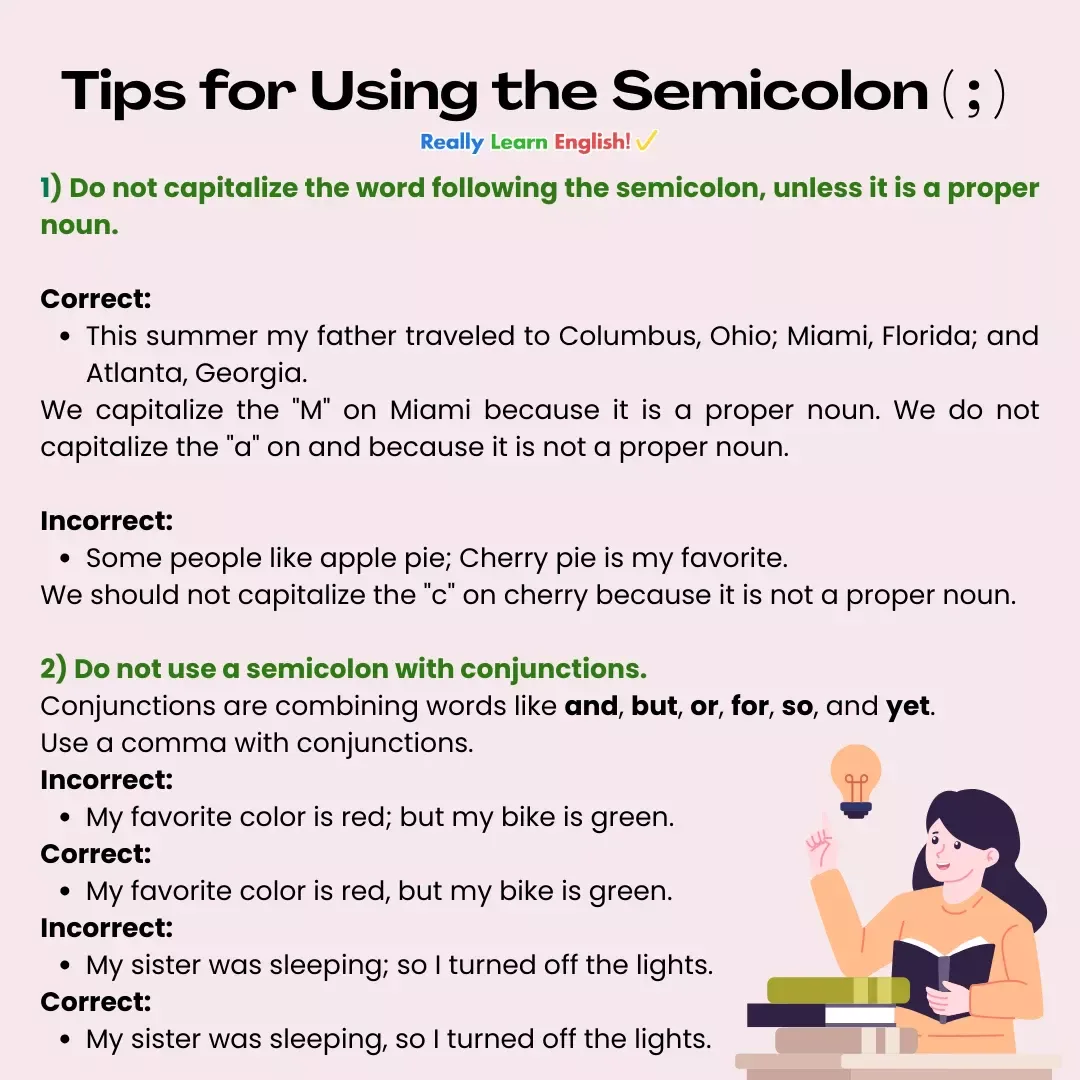
The semicolon is the most misunderstood punctuation mark in English. Most professional writers either avoid it entirely, out of uncertainty, or overuse it in ways that distract from their writing. The truth is simpler than either camp suggests. The semicolon has three specific jobs, each with a clear rule. Used correctly, the semicolon is one of the most elegant tools in English punctuation. Used incorrectly, it signals to careful readers that the writer is unsure about structure.
This guide covers the three jobs of the semicolon, the situations where it outperforms other punctuation, and the specific errors professional writers most often make. The rules are straightforward. The craft is in knowing when the semicolon is the right choice and when another mark would serve the reader better.
The Three Jobs of the Semicolon
The semicolon has exactly three legitimate uses in modern English prose.
Job 1: Joining two independent clauses that could stand as separate sentences.
Job 2: Separating items in a complex list where the items themselves contain commas.
Job 3: Joining independent clauses with a conjunctive adverb like however, therefore, or moreover.
That is the complete list. Any other use is stylistic flourish at best, error at worst.
The semicolon is not an intermediate form between a comma and a period. It is a specific mark with specific jobs: treat it that way and it becomes useful, treat it as decoration and it becomes noise.
Job 1: Joining Independent Clauses
The most common use of the semicolon is joining two independent clauses that are closely related in meaning.
An independent clause is a complete thought that could stand as a sentence on its own. When two independent clauses are closely related, the writer can join them with a period (two separate sentences), a comma plus conjunction (compound sentence), or a semicolon (related clauses).
Examples:
"The meeting ran long; we missed the deadline." (Two independent clauses, closely related.)
"I wanted to go; I had too much work to finish." (Two independent clauses, closely related.)
"The code compiled; the tests failed." (Two independent clauses, closely related.)
Each of these could be written as two sentences. The semicolon signals that the thoughts belong together more tightly than separate sentences would convey.
When a Semicolon Beats a Period
Writers choose a semicolon over a period when the two thoughts are more tightly connected than standard sentence separation would suggest.
"The economy is shifting; companies are adapting." The semicolon signals the cause-and-effect relationship subtly. With a period, the relationship reads as two observations in sequence.
"Her argument was careful; it was also wrong." The semicolon holds the contrast close. A period would allow the contrast to spread across two separate points.
When a Semicolon Beats a Comma Plus Conjunction
"The meeting ran long, and we missed the deadline." Correct with comma plus conjunction.
"The meeting ran long; we missed the deadline." Correct with semicolon.
The two forms differ in rhythm. The comma-and form is gentle. The semicolon form is abrupt. Both are correct. The choice is stylistic.
Writers typically choose the semicolon when they want the clauses to feel tightly linked without the softening effect of a conjunction, or when they have used many comma-and constructions already in the passage and want rhythmic variety.
The Common Error: Comma Splice
The most common semicolon-related error is actually a comma splice. This happens when a writer uses a comma to join two independent clauses without a conjunction.
Wrong: "The meeting ran long, we missed the deadline."
This is a comma splice. The comma alone cannot join two independent clauses.
Three valid fixes:
- Make two sentences: "The meeting ran long. We missed the deadline."
- Add a conjunction: "The meeting ran long, and we missed the deadline."
- Use a semicolon: "The meeting ran long; we missed the deadline."
Learning to recognize comma splices and fix them with semicolons when appropriate is one of the most valuable punctuation skills a professional writer can develop.
Job 2: Complex Lists
The second use of the semicolon is separating items in a list where the items themselves contain commas.
Ordinary list with commas:
"The team includes Sarah, Malik, and Priya."
The commas work because the items are simple. But when each item has internal commas, the list becomes confusing:
Unclear: "The team includes Sarah, the VP, Malik, the senior engineer, and Priya, the designer."
The reader cannot tell whether there are three people or five. The semicolon fixes this:
Clear: "The team includes Sarah, the VP; Malik, the senior engineer; and Priya, the designer."
The semicolons separate the list items; the commas within each item now clearly belong to that item.
More examples:
"The conference drew attendees from Portland, Oregon; Austin, Texas; and Chicago, Illinois."
"Our Q4 results included revenue of $4.2M, up 18 percent; operating margin of 12 percent, up 3 points; and cash reserves of $8.1M, flat quarter-over-quarter."
This is sometimes called the "series semicolon" or "super-comma" use. It is mandatory, not stylistic. When list items contain commas, semicolons are the correct separator.
Job 3: Joining with Conjunctive Adverbs
The third use of the semicolon is joining two independent clauses linked by a conjunctive adverb such as however, therefore, moreover, nevertheless, consequently, furthermore, or indeed.
"The budget is limited; however, the team wants to proceed."
"The tests pass locally; nevertheless, production shows failures."
"We evaluated three vendors; consequently, we chose the middle option."
The pattern is: independent clause, semicolon, conjunctive adverb, comma, independent clause.
A common error is using a comma before the conjunctive adverb instead of a semicolon. This produces a comma splice.
Wrong: "The budget is limited, however, the team wants to proceed."
Correct: "The budget is limited; however, the team wants to proceed."
Or break into two sentences: "The budget is limited. However, the team wants to proceed."
Comparison Table: Semicolon vs Alternatives
| Situation | Period | Comma + Conjunction | Semicolon | Dash |
|---|---|---|---|---|
| Two related independent clauses | Correct, emphasizes separation | Correct, softens connection | Correct, tight link | Correct, sharp link |
| Two unrelated statements | Correct | Awkward | Wrong | Wrong |
| Simple list items | Wrong | Wrong | Wrong | Wrong |
| List items with internal commas | Wrong | Wrong | Correct, required | Wrong |
| With conjunctive adverb | Correct if separate sentences | Wrong | Correct | Wrong |
| Stylistic pause mid-thought | Wrong | Wrong | Wrong | Correct |
| Subordinate clause attached | Wrong | Wrong | Wrong | Correct if dramatic |
Common Errors and Corrections
Error 1: Using a semicolon where a comma would work.
Wrong: "I bought apples; and oranges."
The semicolon is overkill here. The second clause is not independent, and a simple list with two items does not need a semicolon.
Correct: "I bought apples and oranges."
Error 2: Using a semicolon before a dependent clause.
Wrong: "The report is finished; because I worked late."
"Because I worked late" is a dependent clause, not an independent clause. Dependent clauses cannot be joined with semicolons.
Correct: "The report is finished because I worked late."
Or: "The report is finished; I worked late on it."
Error 3: Using a semicolon in place of a colon.
Wrong: "We considered three options; A, B, and C."
The semicolon cannot introduce a list. A colon introduces lists.
Correct: "We considered three options: A, B, and C."
Error 4: Using a semicolon in casual writing where a period would be more natural.
Overusing semicolons in informal writing can read as pretentious. A period often does the job more naturally.
Heavy: "The meeting starts at 10; please arrive on time."
Natural: "The meeting starts at 10. Please arrive on time."
Not wrong, but not necessary.
The Craft Question: When to Use Semicolons
Semicolons are optional for Job 1 (joining independent clauses). The writer can always choose a period instead. The question is when the semicolon serves the reader better than the alternative.
Use a semicolon when:
- The two clauses are logically or rhythmically tied tightly
- The passage already uses many periods, and rhythm benefits from variety
- The passage already uses many comma-and constructions, and variety helps
- The contrast or parallelism between clauses deserves emphasis without softening
Use a period instead when:
- The connection between clauses is weaker
- The sentence is already long and complex
- You are writing for an audience unfamiliar with formal punctuation
- The context is casual or conversational
The rhythm of your writing lives in your punctuation. Every period, comma, and semicolon marks a beat; the semicolon works like a breath, useful when the reader needs a pause but not a full stop.
Semicolon Use in Different Writing Registers
| Register | Semicolon Frequency | Use Guidance |
|---|---|---|
| Academic writing | High | Connect complex related ideas |
| Legal writing | High | Series semicolons in complex lists |
| Journalism | Low | Periods preferred for clarity |
| Business writing | Medium | Used sparingly for rhythm |
| Marketing copy | Low | Periods favored for punch |
| Fiction | Variable | Author style dictates |
| Blog posts | Low | Periods favored for scanability |
| Technical writing | Low | Lists and sentences rarely need them |
| Formal speeches | Low to medium | Written for rhythm when spoken |
Professional writers calibrate semicolon use to the register of the writing. Using semicolons frequently in marketing copy feels pretentious. Avoiding semicolons entirely in academic writing misses opportunities for precise connection.
Every mark of punctuation is a tool. A good writer does not favor any one tool, but reaches for the right tool for the job.
Examples from Different Contexts
Business email:
"Our Q3 results came in ahead of plan; we need to update the forecast for the board." (Semicolon shows cause-and-effect tightly.)
Academic paper:
"The data suggest a correlation between X and Y; however, the mechanism remains unclear." (Semicolon plus conjunctive adverb.)
Legal writing:
"The parties shall meet in New York, New York; Los Angeles, California; and Miami, Florida." (Complex list.)
Fiction:
"She turned to him; she said nothing." (Parallel structure, tight connection.)
Status update:
"The deploy is complete; metrics look normal." (Related clauses, tight connection.)
Marketing copy:
"Built for teams. Designed for speed. Priced for growth." (Periods here. Marketing prefers punch.)
Semicolon vs. Dash
The semicolon and the dash are often confused, but they do different work.
The semicolon connects two related independent clauses at roughly equal rhythmic weight.
The dash introduces a sharper interruption or reveals an emphatic addition.
"The tests passed; the deploy is ready." (Semicolon: tight connection.)
"The tests passed and the deploy is ready." (Comma-and: gentle connection.)
This article avoids dashes entirely per its formatting guidelines, but in writing that permits them, dashes carry a different rhythmic feel than semicolons. A dash interrupts. A semicolon connects.
The History Behind the Rule
The semicolon has existed in English since the late 15th century, when early printers adopted it from Italian humanist typography. For centuries, it served as a middle-weight pause between a comma and a period, reflecting a world where punctuation carried breath marks for reading aloud.
Modern usage has narrowed the semicolon to the three specific jobs described above. The older, looser use of the semicolon as a general pause is now considered overuse. Contemporary style guides, including the Chicago Manual of Style and the Associated Press Stylebook, support the three-job view.
Some writers still deploy semicolons more frequently as a stylistic choice. This is legitimate literary style, not a grammar error. But in professional nonfiction writing, the three jobs define acceptable usage.
Style Guide Positions on Semicolons
| Style Guide | Position |
|---|---|
| Chicago Manual of Style | Standard three uses, supports precise application |
| AP Stylebook | Standard three uses, tends toward periods for readability |
| APA Style | Standard three uses, common in academic writing |
| MLA Handbook | Standard three uses, supports careful use |
| Oxford Style Manual | Standard three uses, slightly more generous usage |
| Purdue Online Writing Lab | Standard three uses, teaches comma splice avoidance |
The major style guides agree on the three uses. They differ slightly in how often semicolons should appear in running prose.
When to Avoid Semicolons
Some writers avoid semicolons entirely and still write well. If you find yourself uncertain about a semicolon choice, these alternatives almost always work.
To avoid semicolon in Job 1:
- Use a period and make two sentences
- Use a comma and a coordinating conjunction (and, but, or, yet, so)
To avoid semicolon in Job 2:
- Restructure the list to avoid internal commas
- Use a bulleted list instead of inline series
To avoid semicolon in Job 3:
- Put the conjunctive adverb at the start of a new sentence
There is nothing wrong with writing clean prose that rarely uses semicolons. Kurt Vonnegut famously disliked them. Cormac McCarthy avoids them. Writers who use them well, like Toni Morrison and James Baldwin, deploy them deliberately.
Practice Sentences
Add semicolons where needed.
- The meeting went well we signed the deal.
- I wanted to attend however I had a prior commitment.
- The budget includes $50000 for salaries $30000 for equipment and $20000 for travel.
- She studied for hours she passed the exam.
- The project is complete we are ready to present.
Answers: 1. "The meeting went well; we signed the deal." 2. "I wanted to attend; however, I had a prior commitment." 3. "The budget includes $50,000 for salaries; $30,000 for equipment; and $20,000 for travel." 4. "She studied for hours; she passed the exam." 5. "The project is complete; we are ready to present."
Digital Context: Where Semicolons Render Poorly
Some digital contexts render semicolons in ways that can affect readability.
| Context | Rendering Concern |
|---|---|
| Twitter/X posts | Often break thought flow on small screens |
| Text messages | Can read as affected |
| Slack messages | Often replaced with line breaks |
| LinkedIn posts | Work well in serious content, awkward in casual |
| Mobile email | Can create awkward line breaks |
| Accessibility readers | Some readers pause oddly on semicolons |
| Subtitles and captions | Periods preferred for clarity |
| Voice-to-text transcription | Rarely captured accurately |
Digital writing often favors periods over semicolons for readability across devices and contexts.
The productivity frameworks at When Notes Fly and the professional certification resources at Pass4Sure both include writing-quality guidance that touches on appropriate punctuation register for different professional contexts.
Why Semicolons Matter
The small decision of whether to use a semicolon is an example of the larger craft of punctuation as rhythm. Punctuation is not just mechanical correctness; it is pacing. Readers absorb writing through its rhythm as much as its content. A writer who controls punctuation controls the reader's experience of the text.
Punctuation works like the intonation of writing: it tells the reader when to pause, when to connect, and when to stop. A writer who thinks of punctuation this way writes with rhythm rather than by rote rules.
The cognitive research at What's Your IQ explores how readers process punctuation-dense versus punctuation-sparse text, and the governance writing standards at Corpy address how formal documents balance punctuation conventions across jurisdictions with different stylistic traditions.
Closing Thoughts
The semicolon is a small tool with a clear purpose. Most writers either underuse it from uncertainty or overuse it from showmanship. The professional use is in the middle: deliberate, infrequent, and purposeful. Every semicolon you write should have a reason beyond "I thought it looked sophisticated."
Master the three jobs. Avoid the common errors. Know when a period or a comma would serve the reader better. The semicolon will become a useful and occasional tool rather than a source of anxiety.
For related communication guidance, see our articles on most common grammar mistakes professionals make and affect vs effect simple rule.
References
Pinker, S. (2014). The Sense of Style. Viking. https://stevenpinker.com/publications/sense-style
Clark, R. P. (2008). Writing Tools: 55 Essential Strategies for Every Writer. Little, Brown. https://www.poynter.org/
Handley, A. (2014). Everybody Writes. Wiley. https://annhandley.com/everybodywrites/
Zinsser, W. (2006). On Writing Well. HarperCollins. https://www.harpercollins.com/
Harvard Business Review. Punctuation in Business Writing. https://hbr.org/
Purdue Online Writing Lab. Semicolon Usage. https://owl.purdue.edu/owl/general_writing/punctuation/commas/commas_vs_semicolons.html
Chicago Manual of Style. Semicolons. https://www.chicagomanualofstyle.org/
Grammarly Blog. How to Use a Semicolon. https://www.grammarly.com/blog/semicolons/
Frequently Asked Questions
When should you use a semicolon?
Use a semicolon for exactly three jobs. First, to join two independent clauses that are closely related in meaning and could stand as separate sentences. Second, to separate items in a complex list where the items themselves contain commas.
Third, to join independent clauses connected by a conjunctive adverb such as however, therefore, or moreover, with the pattern clause semicolon adverb comma clause.
Any other use is either stylistic flourish or error. The semicolon is a precise tool with specific purposes, not an intermediate pause between a comma and a period for general use.
What is the difference between a semicolon and a period?
A period separates two sentences. A semicolon joins two sentences that are closely related. The choice is about how tightly the ideas should feel connected. A period signals that the first thought is complete and a new thought begins.
A semicolon signals that the thoughts belong together at roughly equal weight. Both are grammatically correct when joining independent clauses.
The semicolon is the more connected choice; the period is the more separate choice. The choice between them is one of rhythm and emphasis, not correctness.
What is a comma splice and how does a semicolon fix it?
A comma splice occurs when a writer joins two independent clauses with only a comma, which is not strong enough punctuation for that job. Wrong: the meeting ran long, we missed the deadline. Three valid fixes exist. Make two sentences with a period. Add a coordinating conjunction like and or but after the comma.
Or replace the comma with a semicolon.
The semicolon fix works because the semicolon is specifically designed to join independent clauses. Recognizing comma splices and choosing the right fix is one of the most valuable punctuation skills for professional writers.
When must you use a semicolon in a list?
Use semicolons in a list when the list items themselves contain commas. Without semicolons, the reader cannot tell where one item ends and the next begins. For example, the team includes Sarah, the VP; Malik, the senior engineer; and Priya, the designer. Without semicolons, this reads as six people rather than three.
This use is mandatory, not stylistic.
Common applications include lists of cities with states, lists of compound items with descriptions, and lists of financial figures with explanations. When simple items without internal commas appear in a list, use commas, not semicolons.
Can you use a semicolon before however or therefore?
Yes. When however, therefore, moreover, nevertheless, consequently, or another conjunctive adverb joins two independent clauses, the correct pattern is independent clause semicolon adverb comma independent clause. For example, the budget is limited; however, the team wants to proceed.
A common error is using a comma before the adverb instead of a semicolon, which produces a comma splice.
The other valid option is to start a new sentence with the adverb: the budget is limited. However, the team wants to proceed. Both work. Using just a comma creates an error.
Is it wrong to use semicolons in casual writing?
Not wrong, but often not ideal. Semicolons in casual writing can read as pretentious or affected. In text messages, Slack conversations, social media posts, and informal email, periods usually feel more natural. In business writing, semicolons work well in moderation.
In academic and legal writing, semicolons are standard tools. The key is matching the register of your writing to the tools you use.
A semicolon in a one-line text message feels strange. A semicolon in a law review article feels appropriate. Calibrate to the context rather than applying a universal rule.
How often should semicolons appear in professional writing?
Sparingly. Most professional writing uses semicolons less than once per page on average. Academic and legal writing use them more, often multiple times per page due to complex lists and tightly connected clauses. Marketing and journalism use them rarely, often favoring periods for punch and readability.
The goal is not to hit a frequency target but to use semicolons purposefully when they serve the reader better than alternatives.
A semicolon that earns its place reads as elegant. A semicolon used for decoration reads as try-hard. When in doubt, a period almost always works.