
Subject-verb agreement is the rule that singular subjects take singular verbs and plural subjects take plural verbs. The rule is easy to state and miserable to apply, because English buries the subject behind long modifiers, splits it across compound forms, and uses collective nouns, indefinite pronouns, and inverted word orders that make it hard to see what actually needs to agree with what. Professional editors spend more time on agreement errors than on any other single grammatical issue.
This guide walks through every major category of subject-verb agreement, beginning with the clear cases and moving to the edge cases that trip every writer at some point. By the end you will be able to find the subject of any English sentence, even the oddest ones, and match the verb correctly on the first draft rather than the fourth.
The Core Rule and Why It Exists
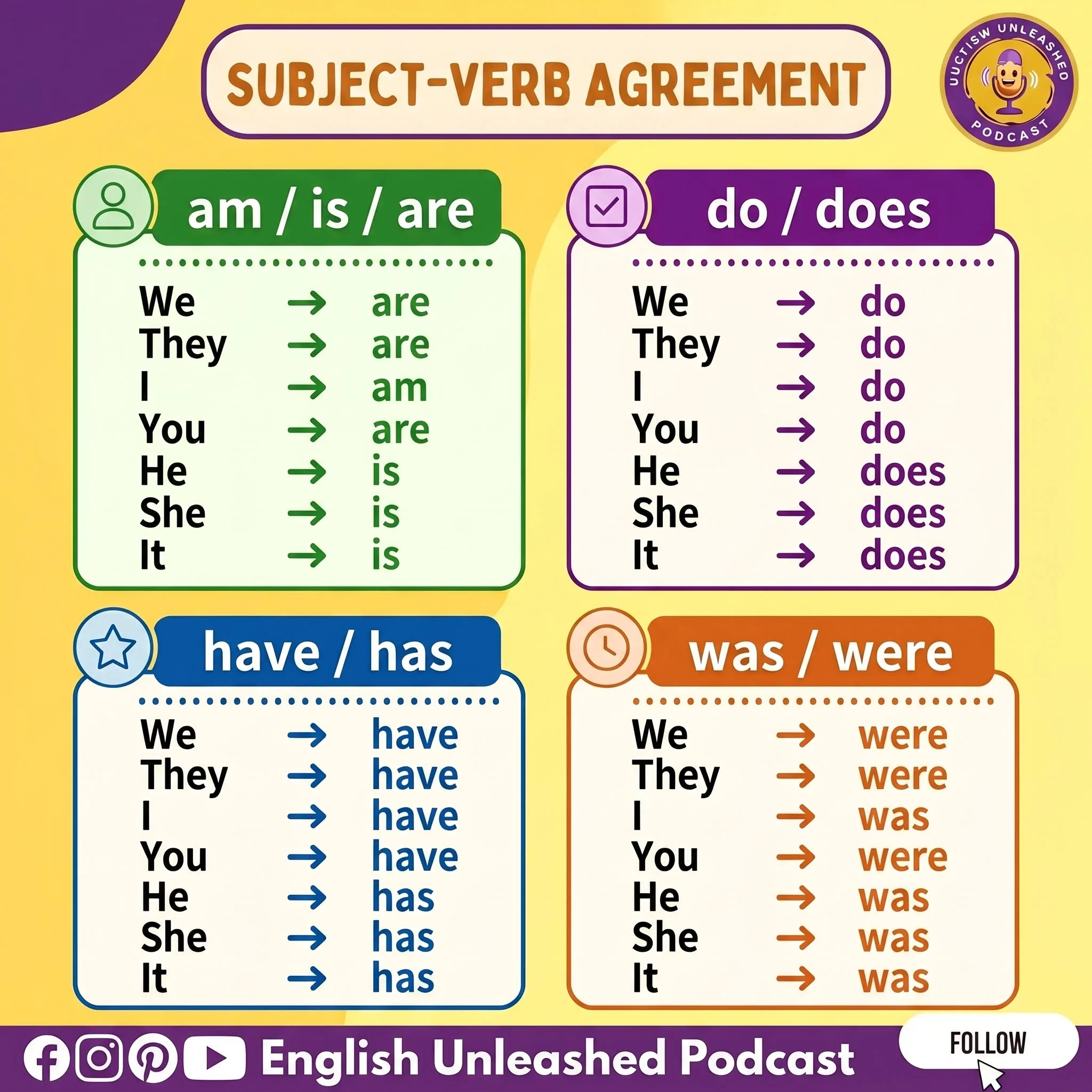
Verbs in English agree with their subjects in number (singular or plural) and in person (first, second, third). In modern English, this agreement is almost entirely collapsed. Only the third-person singular present tense takes a distinctive ending (adding s to most verbs), and the verb "to be" is the one verb that still carries multiple forms.
I run. You run. He runs. She runs. It runs. We run. They run.
I am. You are. He is. She is. It is. We are. They are.
I was. You were. He was. She was. It was. We were. They were.
The rule sounds trivial, but three features of English complicate it. First, subjects can be long and complex, separated from the verb by multiple phrases. Second, English has pronouns and nouns that look plural but are singular, or vice versa. Third, word order can invert, placing the subject after the verb or hiding it inside a construction like "there is" or "here are."
Grammar guides frequently describe subject-verb agreement as a kind of silent audit: readers rarely notice when it is correct, but they notice immediately when it fails, and that failure can cost the writer credibility.
Finding the True Subject
The first skill of agreement is finding the grammatical subject. The subject is the noun phrase that performs the verb's action or carries its state. It is not always the first noun in the sentence, and it is not always the noun closest to the verb.
The book on the shelves is dusty.
Subject: book (singular). Verb: is (singular). Correct.

Wrong: The book on the shelves are dusty.
(Writer was fooled by "shelves" being closest to the verb.)

The members of the committee disagree on the budget.
Subject: members (plural). Verb: disagree (plural). Correct.

Wrong: The members of the committee disagrees on the budget.
(Writer was fooled by "committee" being singular.)

The bowl of oranges sits on the table.
Subject: bowl (singular). Verb: sits (singular). Correct.
Strip out intervening prepositional phrases and modifiers to find the subject. The verb agrees with the head noun of the subject phrase, not with any noun inside an attached modifier.
Rule 1: Compound Subjects Joined by "And"
Two or more subjects joined by "and" take a plural verb.
Tom and Alice are here.
The red car and the blue truck are parked outside.
Tea, coffee, and juice are served at breakfast.
My sister and brother arrive tomorrow.
Exception: when the compound subject refers to a single entity or idea, use a singular verb.
Peanut butter and jelly is my favorite sandwich.
(Peanut butter and jelly treated as one dish.)

Fish and chips is the national dish of Britain.
(Fish and chips treated as one meal.)

Rock and roll has changed music forever.
(Rock and roll treated as one genre.)

Trial and error is how she learned the job.
(Trial and error treated as one method.)
Exception: when "every," "each," or "no" modifies a compound subject, use a singular verb.
Every boy and girl was given a prize.
Each teacher and student has a locker.
No man and no woman was spared.
Rule 2: Compound Subjects Joined by "Or" or "Nor"
When subjects are joined by "or" or "nor," the verb agrees with the subject nearest to the verb.
Either the manager or the employees are responsible.
(Employees is closer; plural verb.)

Either the employees or the manager is responsible.
(Manager is closer; singular verb.)

Neither the coach nor the players have spoken publicly.
(Players is closer; plural verb.)

Neither the players nor the coach has spoken publicly.
(Coach is closer; singular verb.)
This rule is widely violated. Careful writers rephrase when the result feels awkward.
Awkward but correct: Neither the violins nor the piano is in tune.
Better rephrasing: Neither the piano nor the violins are in tune.
Or simply: The piano and the violins are out of tune.
Rule 3: Indefinite Pronouns
Indefinite pronouns include words like "everyone," "someone," "anyone," "nobody," "each," "either," "neither," "nothing," and "somebody." Most of them are singular even when they feel plural. A few are plural, and a few depend on context.
| Pronoun | Number | Example |
|---|---|---|
| Everyone, someone, anyone, no one, nobody, everybody, somebody, anybody | Singular | Everyone is welcome. |
| Each, either, neither | Singular | Each of the students has a book. |
| Another, something, anything, nothing, everything | Singular | Nothing has been decided. |
| Both, few, many, several | Plural | Many are called, few are chosen. |
| All, any, more, most, none, some | Depends on referent | All of the cake is gone. All of the cookies are gone. |
The "depends on referent" pronouns are the tricky set. Look at the noun they refer to. If it is uncountable, use singular. If it is plural, use plural.
All of the water is polluted. (Water is uncountable.)
All of the books are valuable. (Books is plural.)

Most of the cake was eaten. (Cake is uncountable.)
Most of the students were present. (Students is plural.)

None of the information was useful. (Information is uncountable.)
None of the suggestions were practical. (Suggestions is plural.)
Note on "none": historically prescribed as always singular ("none is"), but modern style guides accept plural when the referent is plural. Both "none of them is" and "none of them are" are defensible. Consistency within a document matters more than any absolute rule.
Rule 4: Collective Nouns
Collective nouns name groups: team, committee, jury, family, band, audience, staff, class, government. They can take singular or plural verbs depending on whether you are emphasizing the group as a unit or the members individually.
American English tends toward singular. British English more freely uses plural.
American: The team is playing well this season.
British: The team are playing well this season.

American: The committee has reached a decision.
British: The committee have reached a decision.

Both accept plural when emphasizing individual actions:
The jury are divided on the verdict.
The family have all gone their separate ways.
In American writing, use singular unless you are specifically highlighting individual members. In British writing, either is fine as long as you stay consistent within a sentence.
Wrong (inconsistent): The team is playing well, but they are tired.
Correct: The team is playing well, but it is tired. (Singular throughout.)
Correct: The team are playing well, but they are tired. (Plural throughout, British style.)
Rule 5: Singular Nouns That Look Plural
Some nouns end in s but take singular verbs. These include names of disciplines, diseases, and certain irregular nouns.
Disciplines ending in -ics:
Mathematics is my favorite subject.
Physics requires patience.
Economics has become influential.
Politics is an unusual profession.

Diseases:
Measles is preventable with vaccination.
Diabetes runs in her family.
Rickets was once common.

Other singular-looking plurals:
The news is on at seven.
Genetics has advanced rapidly.
Billiards is played in pubs across England.
Gymnastics requires flexibility.
Robotics is a growing field.
Some of these nouns flip to plural when they describe the individual aspects or instances rather than the field as a whole.
Singular (the field): Statistics is a required course.
Plural (individual numbers): The statistics show a decline.

Singular (the study): Politics is her career.
Plural (the specifics): Her politics are complicated.

Singular (the subject): Economics is difficult.
Plural (specific economic conditions): The economics of the deal are troubling.
Rule 6: Plural Nouns That Look Singular
The reverse also occurs. Some nouns are treated as plural even though they appear singular or have no obvious plural marker.
Trousers are on the bed.
Scissors are in the drawer.
Glasses (eyeglasses) are on my desk.
Jeans are in the laundry.
Shorts are acceptable this summer.
Tweezers are in the first aid kit.
Pliers are in the toolbox.
Sunglasses are on top of the fridge.
These paired objects are plural in form and grammar. To reference them as a quantity, use "a pair of," which converts the phrase into a singular countable unit.
A pair of trousers is on the bed.
A pair of scissors is in the drawer.
Two pairs of jeans are in the laundry.
Rule 7: "There Is" and "There Are"
In sentences beginning with "there," the subject comes after the verb. The verb agrees with the subject that follows.
There is a book on the table.
(Subject: book. Singular.)

There are books on the table.
(Subject: books. Plural.)

There is one student waiting.
There are two students waiting.

There was a problem with the order.
There were problems with the order.
Casual speech often uses "there's" with plural subjects ("there's three things to do"). This is nonstandard in writing. Use "there are" when the subject is plural.
Rule 8: Relative Clauses
In relative clauses introduced by "who," "which," or "that," the verb agrees with the antecedent of the relative pronoun.
The woman who lives next door is a doctor.
(Antecedent: woman. Singular.)

The women who live next door are doctors.
(Antecedent: women. Plural.)

The house that stands on the corner is empty.
(Antecedent: house. Singular.)

The books that sit on the shelf are rare.
(Antecedent: books. Plural.)
A tricky version appears with "one of those who" constructions.
She is one of those people who work late every night.
(Work, not works. The antecedent of "who" is "people," not "one.")

He is the only one of the students who knows the answer.
(Knows, not know. The antecedent of "who" is "one," because "only" restricts the set.)
The presence of "only" or "the only" before "one" changes the antecedent from the plural noun to the singular "one." This is a famously tricky case.
Rule 9: Titles, Names, and Quoted Expressions
Titles of works, names of companies, and quoted expressions are treated as singular, even when they contain plural nouns.
Great Expectations is Dickens's best novel.
The United States is a federal republic.
Los Angeles is home to many film studios.
The New York Times is delivered daily.
"Two Heads Are Better Than One" is a famous proverb.
(The proverb as a whole is singular, even though the sentence inside it is plural.)
Rule 10: Measurements, Amounts, and Distances
A phrase specifying a measurement, amount, distance, or time is treated as a singular unit.
Ten miles is a long way to walk.
Fifty dollars is too much for that shirt.
Two hours is the limit.
Three weeks has passed since the meeting.
Five gallons is enough for the lawn.
The plural marker signals a quantity, but the quantity itself is a single measure. This rule is widely broken but remains the prescribed form in formal writing.
Rule 11: "Every" and Compound Subjects
The word "every" forces a singular verb, even when it distributes across multiple nouns.
Every student in the class has a textbook.
Every man, woman, and child was evacuated.
Every available option has been considered.
Every so often, a storm floods the basement.
Rule 12: "A Number Of" vs "The Number Of"
These two phrases look alike but take different verbs.
A number of students are absent today.
("A number of" means "several." Plural.)

The number of students absent is concerning.
("The number of" refers to the total as a unit. Singular.)

A number of mistakes were made.
The number of mistakes was surprising.

A number of issues have arisen.
The number of issues is growing.
The same pattern applies to "a variety of" (plural) vs "the variety of" (singular), "a group of" (plural or singular depending on emphasis) vs "the group of" (singular).
Rule 13: Fractions and Percentages
Fractions and percentages follow the number of the noun they modify.
Half of the cake is gone. (Cake is singular/uncountable.)
Half of the cookies are gone. (Cookies is plural.)

Two-thirds of the class was absent. (Class, singular collective.)
Two-thirds of the students were absent. (Students, plural.)

Twenty percent of the budget is allocated. (Budget is singular.)
Twenty percent of the grants were denied. (Grants is plural.)
Rule 14: "More Than One" and "More Than Two"
Oddly, "more than one" takes a singular verb even though it implies multiples.
More than one student is unhappy with the schedule.
More than one person has asked about the event.
More than one reason exists for the decision.
But "more than two" takes a plural verb.
More than two students are unhappy with the schedule.
More than ten people have signed up.
More than three reasons exist for the decision.
Rule 15: Gerund Phrases and Infinitives as Subjects
Gerund phrases (verb plus -ing used as a noun) and infinitives (to plus verb) are always singular when used as subjects.
Reading books is relaxing.
Walking to work saves money.
Running a marathon requires months of training.

To succeed in this field takes patience.
To give up now would be foolish.
To write well requires practice.
When multiple gerund phrases are joined by "and," the verb depends on whether they describe one combined activity or multiple distinct ones.
Swimming and running are good exercises. (Two activities.)
Reading and writing is a big part of my job. (Could be treated as one combined activity.)
Both versions are often accepted. Consistency within the document matters.
Writing instructors such as Roy Peter Clark, author of Writing Tools, emphasize that most subject-verb agreement errors come from failing to identify the actual grammatical subject: strip out the modifiers, find what is doing the verb, and the rest is detail.
Summary Table of Tricky Cases
| Construction | Verb Agreement | Example |
|---|---|---|
| Compound subject with "and" | Plural | Tom and Alice are here. |
| Compound subject, same idea | Singular | Fish and chips is popular. |
| Compound subject with "or/nor" | Nearest subject | Either he or they are coming. |
| Collective noun (American) | Singular | The team is winning. |
| Indefinite pronoun (everyone, each) | Singular | Everyone has arrived. |
| "None" | Either | None of the cake is left. None of them are ready. |
| -ics disciplines | Singular | Mathematics is hard. |
| Paired objects (scissors, pants) | Plural | The scissors are sharp. |
| "There is/are" | Agrees with following subject | There are five books. |
| "One of those who" | Plural (refers to "those") | She is one of those who work late. |
| "The only one of those who" | Singular (refers to "one") | He is the only one who knows. |
| Measurement/amount | Singular | Ten dollars is enough. |
| "More than one" | Singular | More than one is available. |
| "More than two (or more)" | Plural | More than three are available. |
| Fractions | Depends on referent | Half of the cake is gone. |
| Gerund phrase as subject | Singular | Reading books is fun. |
Common Agreement Errors to Watch For
Wrong: The list of names have been posted.
Right: The list of names has been posted. (Subject: list.)

Wrong: Everyone who participated were rewarded.
Right: Everyone who participated was rewarded. (Subject: everyone.)

Wrong: There is many reasons to reconsider.
Right: There are many reasons to reconsider.

Wrong: Neither the teacher nor the students was prepared.
Right: Neither the teacher nor the students were prepared. (Nearer is plural.)

Wrong: The news about the elections are troubling.
Right: The news about the elections is troubling. (News is singular.)

Wrong: Mathematics are my best subject.
Right: Mathematics is my best subject.

Wrong: Half of the books on that shelf is rare editions.
Right: Half of the books on that shelf are rare editions.

Wrong: Each of the candidates have strong qualifications.
Right: Each of the candidates has strong qualifications.
Inverted Sentences and Questions
Questions invert subject and verb, as do sentences beginning with negative adverbs or prepositional phrases for emphasis. Finding the true subject is harder.
Is the book on the desk?
(Subject: book. Singular.)

Are the books on the desk?
(Subject: books. Plural.)

On the desk sits a single book.
(Subject: book. Singular.)

On the desk sit three books.
(Subject: books. Plural.)

Nowhere in the document is there a clear answer.
(Subject: answer. Singular.)

Rarely have such events occurred.
(Subject: events. Plural.)
Reported Speech and Embedded Clauses
In reported speech or clauses following verbs like "said," "thought," or "believe," the agreement in the embedded clause follows its own subject, not the main-clause verb.
She said that the reports are inaccurate.
(Subject of embedded clause: reports. Plural.)

He thought that the committee has made the wrong choice.
(Subject of embedded clause: committee. Singular.)
Why Agreement Matters in Professional Writing
Agreement errors are the grammatical mistakes most likely to be caught by careful readers and the least likely to be caught by spell-check. A cover letter with subject-verb disagreement reads as careless. A published article with an agreement error attracts comments. A business proposal with multiple errors suggests the writer did not proofread.
For related work on sentence-level grammar, see our guides on common grammar mistakes, complex vs compound sentences, and transition words. Writers preparing for examinations or credentials where grammar is assessed can find practice at Pass4Sure, and cognitive research on how writers internalize grammatical rules appears on What's Your IQ.
A proofreading technique that catches almost every agreement error: read your document aloud, slowly. Your ear catches agreement problems that your eye misses. Do this at the end of every serious writing task, and the rate of errors falls dramatically.
References
Fish, S. (2011). How to Write a Sentence: And How to Read One. HarperCollins. Fish (2011): How to Write a Sentence: And How to Read One
Clark, R. P. (2008). Writing Tools: 55 Essential Strategies for Every Writer. Little, Brown. Clark (2008): Writing Tools: 55 Essential Strategies for Every Writer
Huddleston, R., and Pullum, G. K. (2002). The Cambridge Grammar of the English Language. Cambridge University Press. Huddleston et al. (2002): The Cambridge Grammar of the English Language
Garner, B. A. (2022). Garner's Modern English Usage (5th ed.). Oxford University Press. Garner (2022): Garner's Modern English Usage (5th ed.)
Strunk, W., and White, E. B. (2000). The Elements of Style (4th ed.). Allyn and Bacon. Strunk et al. (2000): The Elements of Style (4th ed.)
The Chicago Manual of Style (17th ed.). University of Chicago Press. The Chicago Manual of Style (17th ed.)
Purdue Online Writing Lab. Subject-Verb Agreement Guide. Purdue Online Writing Lab
Biber, D., Johansson, S., Leech, G., Conrad, S., and Finegan, E. (1999). Longman Grammar of Spoken and Written English. Longman. Biber et al. (1999): Longman Grammar of Spoken and Written English
Frequently Asked Questions
What is subject-verb agreement in simple terms?
Subject-verb agreement means that singular subjects take singular verbs and plural subjects take plural verbs. ‘The dog runs’ and ‘The dogs run’ demonstrate the basic pattern. The complications arise when the subject is long or unusual.
Do collective nouns like team and committee take singular or plural verbs?
American English typically uses singular verbs with collective nouns (‘the team is winning’). British English often uses plural verbs when emphasizing individual members (‘the team are winning’). Either is correct within its regional convention as long as you stay consistent.
Is 'everyone' singular or plural?
Everyone is grammatically singular and takes a singular verb (‘everyone is welcome’), even though it feels plural in meaning. The same rule applies to everybody, someone, somebody, anyone, anybody, no one, and nobody.
Why do we say 'ten miles is a long way' instead of 'ten miles are a long way'?
Measurements, amounts, and distances are treated as singular units even when the noun is grammatically plural. The ten miles functions as one distance. The same applies to ‘fifty dollars is too much’ and ‘two hours is enough.’
Should I use 'none is' or 'none are'?
Both are defensible. Traditional prescription treats ‘none’ as always singular, but modern usage accepts plural when the referent is plural (‘none of the students were ready’). Consistency within a document matters more than an absolute rule.
How does 'neither X nor Y' work with verbs?
The verb agrees with the subject nearest to the verb. ‘Neither the manager nor the employees are here’ (plural because ‘employees’ is closer). ‘Neither the employees nor the manager is here’ (singular because ‘manager’ is closer).
What is the difference between 'a number of' and 'the number of'?
‘A number of’ means ‘several’ and takes a plural verb (‘a number of students are absent’). ‘The number of’ refers to the total as a single quantity and takes a singular verb (‘the number of students is high’).