
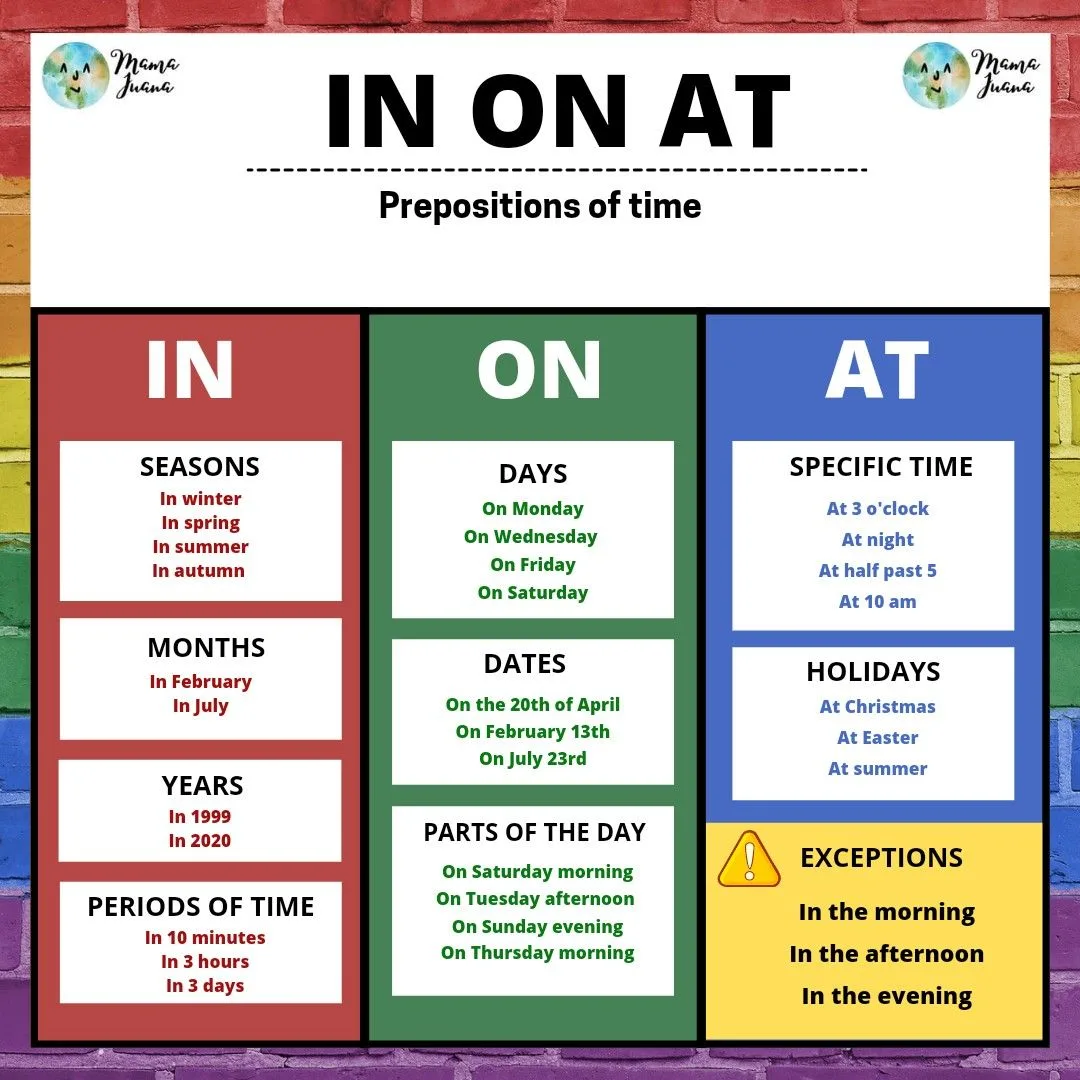
"In," "on," and "at" are among the most frequently used words in English. They appear in almost every sentence, often more than once, and they are also three of the most confusing words for non-native speakers.
The three prepositions each do several jobs, and the job they do in any particular sentence depends on whether the reference is to time, place, or an idiomatic expression. Even fluent writers sometimes second-guess themselves, especially around time phrases like "at night" versus "in the night," or place phrases like "on the bus" versus "in the bus."
This guide presents the complete set of rules for "in," "on," and "at" in time and place. It includes more than fifty example sentences covering every major pattern, comparison tables for quick reference, the common mistakes ESL writers make, and a self-check exercise for practice. The goal is to move the writer from second-guessing to automatic, and to supply the examples and patterns needed to build that automatic feel through reading and drafting.
The Kalenux Team maintains this guide as part of a broader grammar library for ESL learners and professional writers. Because prepositions are tiny words that appear everywhere, mastery of "in," "on," and "at" is one of the most valuable investments in English fluency. Writers who control these three prepositions sound much more natural immediately.
The Ladder Metaphor
A useful mental model for "in," "on," and "at" is a ladder from broad to narrow.
For time:
- "In" covers the broadest periods: months, years, seasons, centuries, parts of the day.
- "On" covers individual days and specific dates.
- "At" covers specific moments and clock times.
For place:
- "In" covers enclosed spaces and large geographic areas.
- "On" covers surfaces and specific lines.
- "At" covers specific points or addresses.
The ladder is not perfect, but it is accurate enough to guide most decisions. When the choice feels unclear, ask whether the reference is broad, middle, or narrow. The answer usually maps to "in," "on," or "at" respectively.
"Prepositions reflect spatial and temporal intuition. The same ladder that works for place, from container to surface to point, works for time. Once you see the shared pattern, the three prepositions stop feeling random." Kalenux Team expert-written grammar reference
Prepositions of Time
Use In for Longer Periods
Use "in" with months, years, seasons, centuries, decades, and parts of the day.
- "In March the weather begins to warm."
- "In 2023 the company launched a new product line."
- "In the summer we travel more."
- "In the twentieth century, many things changed."
- "In the 1990s, personal computers became common."
- "In the morning I drink coffee."
- "In the afternoon meetings are shorter."
- "In the evening we take a walk."
Use On for Specific Days and Dates
Use "on" with days of the week and specific dates.
- "On Monday the team meets at nine."
- "On July 4 we celebrate Independence Day in the United States."
- "On her birthday she always takes the day off."
- "On Christmas Eve the stores close early."
- "On the first of the month rent is due."
- "On Saturday morning the office is quiet."
- "On weekdays the gym is crowded."
- "On holidays the building is closed."
Use At for Specific Times
Use "at" with clock times, certain fixed points in the day, and for the night.
- "At seven the alarm rings."
- "At noon the bells ring at the cathedral."
- "At midnight the year changes."
- "At sunrise the fishermen leave port."
- "At night the streets grow quiet."
- "At dawn the birds begin to sing."
- "At the end of the day we review progress."
- "At the beginning of the meeting the agenda is read."
Exceptions and Idiomatic Time Uses
Several time expressions do not follow the broad rules.
- "At night" rather than "in the night" for general reference.
- "On the weekend" (American) or "at the weekend" (British).
- "In time" means with enough time to spare. "On time" means at the scheduled time.
- "At the moment" means right now.
- "In a moment" means very soon.
- "On Monday afternoon" combines day with part of day, and "on" wins because day takes priority.
| Time Expression | Preposition |
|---|---|
| March | in |
| 2024 | in |
| the twentieth century | in |
| the morning | in |
| Monday | on |
| July 4 | on |
| her birthday | on |
| a holiday | on |
| seven o'clock | at |
| noon, midnight, sunrise, sunset | at |
| night (general) | at |
| the moment | at |
| the end of the week | at |
| time (on time or in time) | depends on meaning |
Prepositions of Place
Use In for Enclosed Spaces and Areas
Use "in" for enclosed spaces, large regions, and cities or countries.
- "In the room everyone stood silent."
- "In the car she listened to the news."
- "In the office three printers were broken."
- "In Paris the cafes fill up at six."
- "In France the food is legendary."
- "In the park children played soccer."
- "In the kitchen the kettle boiled over."
- "In the sky clouds gathered quickly."
Use On for Surfaces and Lines
Use "on" for surfaces and specific lines such as streets, floors, and transportation surfaces.
- "On the table the documents were organized in piles."
- "On the wall a portrait hung in the corner."
- "On Main Street the bakery opens early."
- "On the second floor of the building we meet for lunch."
- "On the ceiling a small crack appeared."
- "On the cover of the book the title is bold."
- "On the coast the fishing is excellent."
- "On the Earth gravity is a constant."
Use At for Specific Points and Addresses
Use "at" for specific points, locations, and addresses.
- "At the bus stop I waited for twenty minutes."
- "At 123 Main Street the family has lived for generations."
- "At the corner of Fifth and Broadway the cafe is new."
- "At the conference she met many new colleagues."
- "At the airport the check-in line stretched for blocks."
- "At school the students assembled for the ceremony."
- "At home she works in a small office."
- "At the entrance the guard checked everyone's badge."
Transportation Exceptions
Transportation mode affects preposition choice.
- "On the bus, on the train, on the plane, on the ship, on the boat" (public or larger vehicles)
- "In the car, in the taxi" (smaller or private vehicles)
The historical reason is that public transport with open or multi-passenger seating took "on" from horse-drawn carriages and stagecoaches, while private vehicles took "in." Modern usage preserves the pattern.
| Place Expression | Preposition |
|---|---|
| a room, a building | in |
| a city, a country | in |
| the ocean, the sky | in |
| a table, a shelf | on |
| a street, a road | on |
| a floor of a building | on |
| a bus, a train, a plane | on |
| a specific address or location | at |
| an event or gathering | at |
| a corner | at |
| school, work, home | at |
Fifty-Plus Correct Examples
Time:
- "In January the project kicks off."
- "In 2025 the deadline falls on a Friday."
- "In the 1800s letters took weeks to arrive."
- "In the morning the cafe opens at six."
- "In the winter the mountain pass closes."
- "On Tuesday the board will vote."
- "On December 31 we celebrate the new year."
- "On Labor Day the office is closed."
- "On the anniversary of the company's founding we gathered for a dinner."
- "On the morning of the launch, the team was calm."
- "At three the meeting begins."
- "At midnight the contract expires."
- "At noon the cafeteria fills up."
- "At dawn the ships leave harbor."
- "At sunset the mosque calls the faithful."
- "At the end of the year we review strategy."
- "At the start of the quarter we set targets."
- "At night the city is quiet."
- "On the weekend we hike together." (American)
- "At the weekend we often visit my mother." (British)
Place:
- "In the office three new hires started yesterday."
- "In the conference room the projector was broken."
- "In Paris the metro is efficient."
- "In Brazil the beaches are famous."
- "In the car we listened to the news."
- "In the forest we saw two deer."
- "In the lake the water was clear."
- "In the sky the clouds moved fast."
- "On the desk a stack of papers waited."
- "On the shelf the books were arranged by color."
- "On Main Street the shops close at six."
- "On the second floor the elevator opens to a lobby."
- "On the wall a map showed all three regions."
- "On the cover of the magazine the headline was bold."
- "On the bus to downtown, I ran into an old colleague."
- "On the train the announcement was hard to hear."
- "On the plane the seats were cramped."
- "On the coast the weather changes quickly."
- "At the bus stop a man waited with his dog."
- "At the corner the cafe serves the best coffee."
- "At 42 Elm Street the family has lived for decades."
- "At the conference three panels covered the new policy."
- "At the airport the check-in lines were short."
- "At the entrance the guard checked every ID."
- "At home she prefers to read in silence."
- "At school the students are assembled for the ceremony."
- "At work she finishes at five."
- "At the museum the exhibit runs through September."
- "At the stadium the crowd roared with every goal."
- "At the front desk the clerk handed over the keys."
Mixed time and place:
- "On Monday morning at nine I have a meeting in the conference room."
- "In Paris at the end of October the weather turns cool."
- "At the airport in Chicago we waited for an hour on the plane before takeoff."
Common Mistakes ESL Writers Make
Mistake 1: In the morning, on the morning.
Wrong: "On the morning we drink coffee."
Correct: "In the morning we drink coffee."
The general part of the day takes "in." Only when the morning is modified with a specific day does "on" appear.
"On the morning of the interview, he arrived early." (specific morning, "of the interview" modifies it)
Mistake 2: On the car, in the bus.
Wrong: "I am on the car."
Correct: "I am in the car."
Wrong: "I am in the bus."
Correct: "I am on the bus."
Public transport takes "on," private cars take "in."
Mistake 3: At home vs in the home.
Wrong: "She is in home."
Correct: "She is at home."
"At home" is a fixed expression meaning present in the home location, with no article. "In the home" with an article can be used in specific reference to the physical space, but "at home" is far more common.
Mistake 4: In Monday vs on Monday.
Wrong: "In Monday the report is due."
Correct: "On Monday the report is due."
Days of the week take "on."
Mistake 5: At Christmas vs on Christmas.
Both are possible with slightly different meanings. "At Christmas" refers to the Christmas season broadly. "On Christmas" is an American colloquial form for Christmas Day. In formal writing, "on Christmas Day" is cleaner.
Mistake 6: In the weekend vs on or at the weekend.
Wrong: "In the weekend we visit family."
Correct (American): "On the weekend we visit family."
Correct (British): "At the weekend we visit family."
Quick Reference Cheat Sheet
| Time Reference | Use |
|---|---|
| months, years, seasons, centuries, decades | in |
| parts of the day (morning, afternoon, evening) | in |
| days, dates, holidays | on |
| specific times, noon, midnight, night | at |
| Place Reference | Use |
|---|---|
| enclosed spaces, cities, countries, regions | in |
| surfaces, streets, floors, public transport | on |
| specific points, addresses, events | at |
Self-Check Exercise
Fill in the blank with "in," "on," or "at." Answers at the end.
- The meeting is ___ Monday ___ two o'clock.
- She was born ___ 1998 ___ December.
- We live ___ 42 Elm Street ___ a quiet neighborhood.
- The photograph is ___ the wall ___ her office.
- ___ the morning of the interview, he arrived early.
- ___ Christmas Eve the family gathers.
- I always work better ___ night.
- The conference is held ___ Chicago every year.
- The books are ___ the shelf ___ alphabetical order.
- She waited ___ the bus stop for thirty minutes.
Answers:
- on, at
- in, in
- at, in
- on, in
- On
- On
- at
- in
- on, in
- at
If you scored at least eight out of ten, the patterns are sticking.
Building Fluency with Prepositions
Prepositions are learned through exposure. Reading English widely and noticing every "in," "on," and "at" helps the patterns settle into memory. A useful practice is to keep a small notebook of prepositional phrases encountered in reading and review them weekly. Over time the right preposition comes automatically.
A second useful practice is to speak sentences aloud using new prepositional phrases. The spoken repetition speeds internalization.
"Prepositions are learned one phrase at a time. A hundred well-memorized phrases beat a dozen rules every time." Kalenux Team expert-written ESL reference
Conclusion
"In," "on," and "at" are three tiny words that appear in almost every English sentence. The rules are consistent enough to teach, and the exceptions are limited enough to memorize. Use "in" for broad periods and enclosed spaces. Use "on" for individual days and surfaces. Use "at" for specific times and points. The ladder from broad to narrow captures most real usage.
The Kalenux Team maintains a broader library of ESL grammar guides, and this article pairs naturally with the companion pieces on articles, verb tenses, and subject-verb agreement. Writers who master these three prepositions gain a visible marker of English fluency that pays off in every sentence they produce.
Frequently Asked Questions
What is the general rule for in, on, and at with time?
Use in for longer periods such as months, years, seasons, centuries, and parts of the day. In March, in 2024, in summer, in the morning. Use on for specific days and dates. On Monday, on July 4, on her birthday. Use at for specific times, including the clock hour and some fixed points in the day.
At seven, at noon, at midnight, at sunrise.
The hierarchy runs from broadest to most precise: in for broad periods, on for individual days, at for specific moments. If you keep that ladder in mind, most choices become automatic.
What is the general rule for in, on, and at with place?
Use in for enclosed spaces and large geographic areas. In the room, in the car, in Paris, in France. Use on for surfaces and specific lines such as streets, floors, and the Earth. On the table, on the wall, on Main Street, on the second floor. Use at for specific points or addresses. At the bus stop, at the corner, at 123 Main Street, at the entrance.
The ladder runs from broad containment to surface contact to point reference. The mental image for each makes the choice clear in most cases.
Is it at night or in the night?
At night is the standard form. In the night is rare and typically used in narrative writing or poetry, usually meaning during a specific night rather than nighttime in general. I could not sleep at night is the everyday construction. Something woke me in the night refers to a particular night. For everyday usage, at night is almost always correct.
The pattern at night matches at noon, at midnight, at dawn, and at dusk, which all take at for specific points in the day-night cycle.
When should I use on the weekend vs at the weekend?
This is a major American and British difference. American English uses on the weekend. British English uses at the weekend. Both are correct within their region. Writers for international audiences should consider the primary audience. Most American style guides prefer on the weekend, while British publications use at the weekend consistently. In academic writing, either is acceptable as long as the document is internally consistent. Mixing the two in the same piece signals weak editing.
Why do prepositions seem random in English?
Because many prepositions are idiomatic. They often have logical patterns, but many combinations are fixed through usage rather than rule. You are on a bus but in a car because of historical convention, not because one is more correct than the other. You arrive at an airport but in a country.
You are on time but in time.
ESL learners benefit from treating these combinations as fixed phrases rather than as rule-driven constructions. Learning the phrase is faster than deducing it, and once the phrase is memorized, the right preposition comes automatically.
Do I say on the bus or in the bus?
On the bus. Public transport like buses, trains, and airplanes takes on even though the vehicle is enclosed. I am on the bus. She was on the train. They arrived on the flight. Cars and taxis, however, take in. She is in the car. He got in the taxi.
The historical reason is that on was used for public vehicles with open or passenger-style seating from horse-drawn carriages and long-distance coaches, while in was used for smaller private vehicles.
Modern usage inherits that pattern even though modern buses and trains are fully enclosed.