
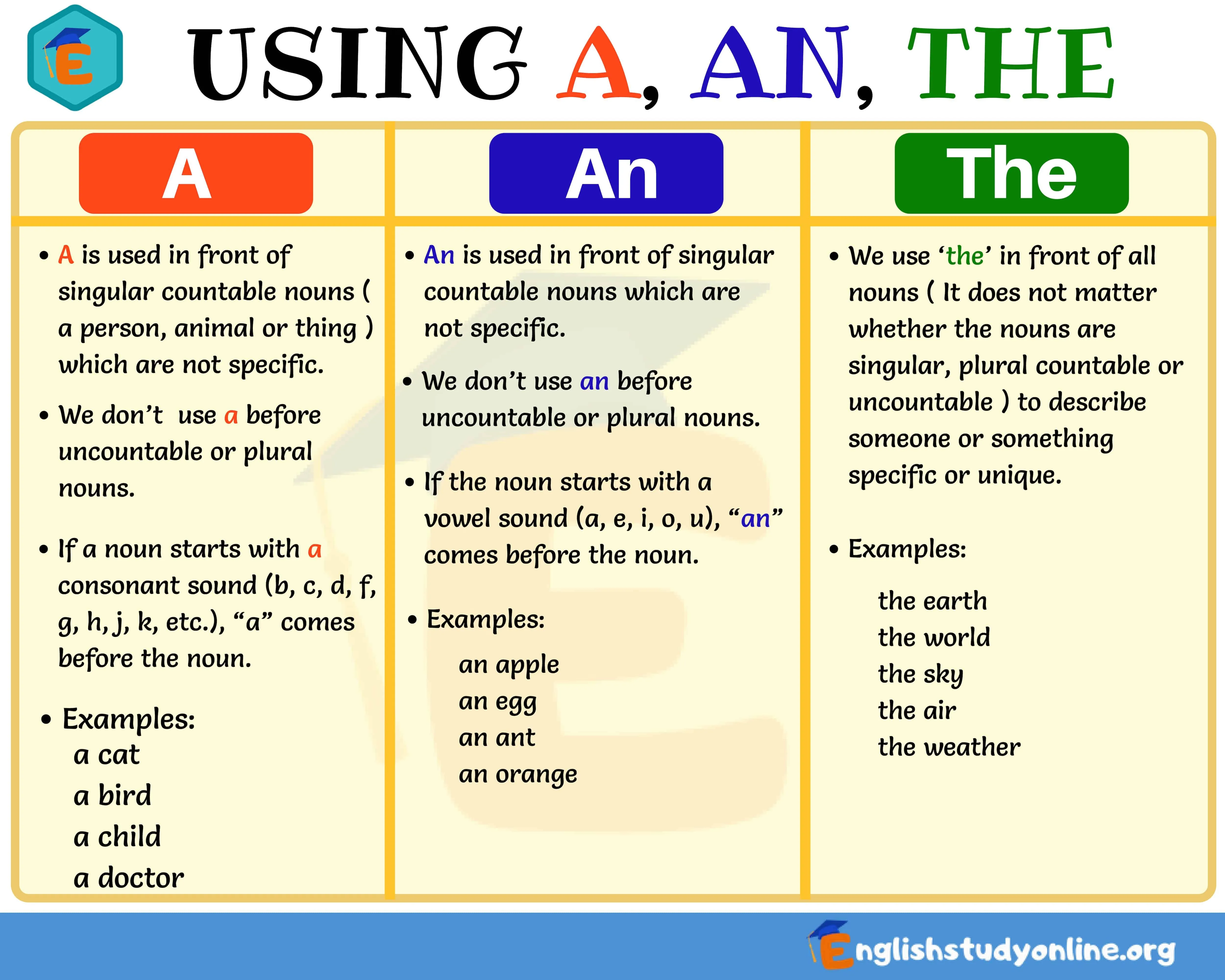
Articles are one of the hardest parts of English for ESL learners because many languages do not use them at all. Speakers of Russian, Chinese, Japanese, Korean, Turkish, Polish, and dozens of other languages arrive at English and encounter a category they have never needed before: the grammatical distinction between a new, nonspecific noun and an identified, specific noun.
That distinction is signaled in English by the choice of "a," "an," "the," or no article at all, and every noun in every sentence forces the choice.
The rules are not intellectually hard. They can be learned in a few hours of focused study. The challenge is internalizing them well enough that the right article comes automatically while drafting or speaking.
This guide walks through every major article rule, starting with the indefinite article "a" and "an," moving through the definite article "the," covering the zero article case where no article is used, and ending with the special conventions around place names, institutions, and fixed expressions. More than twenty concrete examples illustrate each section, and a self-check exercise at the end helps consolidate the patterns.
The Kalenux Team has built this reference as part of a broader grammar library for non-native English writers. Because articles appear in every sentence, mastery of article use is one of the highest-return investments an ESL learner can make.
A writer who controls "a," "an," "the," and the zero article sounds much more fluent immediately, even when other parts of the writing are still developing. This guide is designed to support that fluency with clear, memorable rules and enough practice material to make the rules stick.
What Articles Are
Articles are determiners that come before nouns. English has three of them: "a," "an," and "the." There is also a fourth category, called the zero article, where no word appears before the noun at all.
"A" and "an" are indefinite articles. They introduce a noun without identifying a specific one.
"The" is the definite article. It identifies a specific noun that the listener or reader can pick out from context.
The zero article applies in specific cases, particularly with general plurals, uncountable nouns, and many proper nouns.
"The choice among a, an, the, and no article is always a choice about whether the reader can identify which particular thing you mean. That is the underlying logic of every article rule." Kalenux Team expert-written grammar reference
The A vs An Rule
Use "a" before a consonant sound and "an" before a vowel sound. The rule is about sound, not spelling.
Examples:
- "a book" - consonant sound
- "a cat" - consonant sound
- "a university" - consonant sound ("yoo")
- "a European" - consonant sound ("yoo")
- "an apple" - vowel sound
- "an elephant" - vowel sound
- "an hour" - vowel sound (silent h)
- "an honor" - vowel sound (silent h)
- "an umbrella" - vowel sound
- "a one-time offer" - consonant sound ("won")
Note that "university" starts with the letter U but the sound is "yoo," which is a consonant sound, so "a" is correct. "Hour" starts with H, but the H is silent, so the first sound is a vowel, making "an" correct. Focus on how the word is pronounced, not how it is spelled.
When to Use A or An
Use "a" or "an" in these cases.
First Mention
When you introduce a noun for the first time, especially a countable singular noun, use "a" or "an."
- "I saw a dog in the park."
- "She wrote an article last week."
- "A customer called with a complaint."
On second mention, the noun is known, so "the" is used.
- "I saw a dog in the park. The dog was friendly."
- "She wrote an article last week. The article covered tax policy."
Specific Identity Does Not Matter
Use "a" or "an" when the specific identity of the noun does not matter to the sentence.
- "She needs a pen." (any pen will do)
- "Please give me a glass of water." (any glass)
- "He is looking for an assistant." (no specific assistant yet)
Singular Countable Nouns with Occupations or Descriptions
Use "a" or "an" when describing what someone is or does.
- "He is a doctor."
- "She is an engineer."
- "She is a teacher."
When to Use The
Use "the" when the specific noun is known to both the speaker and the listener.
Second Mention
- "I read a book yesterday. The book was fascinating."
Unique Reference
- "The sun rose at six."
- "The moon is full tonight."
- "The president delivered the speech."
Context Makes It Clear
- "Please close the door." (the one we both see)
- "The meeting starts at ten." (the one we both know about)
- "The report is on your desk." (the one you are expecting)
Superlatives and Ordinals
- "She is the best candidate."
- "He is the first to volunteer."
- "This is the most detailed proposal."
Specific Groups Treated as a Whole
- "The Beatles changed pop music."
- "The elderly deserve better care."
- "The French cook beautifully."
| When to Use A or An | When to Use The |
|---|---|
| First mention of a noun | Second or later mention |
| Specific identity does not matter | Specific identity is known |
| Singular countable noun in general sense | Unique item both speaker and listener recognize |
| Occupations or roles | Superlatives: the best, the largest |
| One of many | One specific one out of a known set |
When to Use No Article (Zero Article)
The zero article is when no article is used at all. This is a separate grammatical choice, not an accident.
Plural Countable Nouns in General Sense
- "Dogs are loyal companions."
- "Computers have changed daily life."
- "Books are valuable resources."
Uncountable Nouns in General Sense
- "Water is essential for life."
- "Music improves mood."
- "Information flows quickly online."
Most Proper Nouns
- "Paris is beautiful in spring."
- "Einstein changed physics."
- "Google dominates search."
Meals in General Sense
- "We had breakfast at seven."
- "Dinner is usually at eight."
- "Let us meet for lunch."
Languages and Fields of Study
- "She speaks Japanese."
- "He studies chemistry."
- "Mathematics is challenging for many students."
Sports and Games
- "He plays tennis."
- "They enjoy chess."
- "She watches basketball."
Many Common Fixed Expressions
- "She went to bed."
- "He goes to work by train."
- "They are at home."
- "He is in class."
- "We are in trouble."
| Category | Rule | Example |
|---|---|---|
| General plural | zero article | Dogs are loyal. |
| General uncountable | zero article | Water is essential. |
| Most proper nouns | zero article | Paris is lovely. |
| Meals | zero article | We had lunch. |
| Languages | zero article | She speaks Japanese. |
| Sports | zero article | He plays tennis. |
| Specific plural | the | The dogs in our neighborhood are friendly. |
| Specific uncountable | the | The water in the pitcher is cold. |
Special Place Name Conventions
Place names follow specific conventions that often must be learned case by case, but there are patterns.
Countries
Most countries take no article.
- France, Germany, Japan, Brazil, Italy, Canada, Mexico, China
Countries with plural, descriptive, or institutional names take "the."
- the United States, the Philippines, the Netherlands, the United Kingdom, the Czech Republic, the Maldives
Continents, Cities, and States
Continents, cities, states, and provinces take no article.
- Africa, Europe, Asia, Tokyo, Paris, California, Ontario
Mountains, Rivers, Oceans, Deserts
Ranges, rivers, oceans, seas, and deserts take "the."
- the Rockies, the Alps, the Nile, the Amazon, the Pacific, the Atlantic, the Mediterranean, the Sahara, the Gobi
Individual mountains and lakes usually do not.
- Mount Everest, Mount Fuji, Lake Tahoe, Lake Victoria
Buildings, Hotels, Museums
Hotels, museums, theaters, and similar institutional buildings take "the."
- the Louvre, the Ritz, the Old Vic, the Metropolitan Museum
Universities
Universities with "of" in the name take "the."
- the University of Chicago, the University of Tokyo
Universities named for a person or place without "of" typically do not.
- Harvard University, Cambridge University, Stanford University
Twenty-Plus Correct Examples
- "A book sat on the shelf."
- "An umbrella leaned against the door."
- "The book I ordered arrived yesterday."
- "Dogs bark loudly at strangers."
- "Water flows downhill."
- "Paris attracts millions of tourists each year."
- "He is a doctor."
- "She is an engineer with twenty years of experience."
- "The doctor on call tonight is Dr. Patel."
- "A woman called the office this morning."
- "The woman who called this morning left a message."
- "Mathematics is the foundation of engineering."
- "He plays basketball every weekend."
- "The basketball game last night was intense."
- "We met an architect at the conference."
- "The architect we met is designing a new library."
- "She speaks Arabic and French fluently."
- "The Netherlands has a strong cycling culture."
- "Mount Kilimanjaro is the tallest peak in Africa."
- "The Sahara covers much of North Africa."
- "The University of Toronto is among the top schools in Canada."
- "Harvard University publishes many leading journals."
- "She went to bed early last night."
- "Lunch is at noon in the cafeteria."
- "The cafeteria serves lunch from eleven to two."
Common Mistakes to Avoid
Mistake 1: Missing articles with singular countable nouns.
Wrong: "I need pen to sign document."
Correct: "I need a pen to sign the document."
Singular countable nouns almost always require an article or another determiner.
Mistake 2: Using the with general plurals.
Wrong: "The dogs are loyal animals." (if speaking in general)
Correct: "Dogs are loyal animals."
Use "the" with specific plurals, not general ones.
Mistake 3: Using a or an with uncountable nouns.
Wrong: "She needs an information."
Correct: "She needs information." Or: "She needs a piece of information."
Uncountable nouns do not take "a" or "an." Use a partitive structure like "a piece of" if you need to specify a unit.
Mistake 4: The with most proper nouns.
Wrong: "The Paris is a beautiful city."
Correct: "Paris is a beautiful city."
Most proper nouns take no article.
Mistake 5: A instead of an or vice versa.
Wrong: "a hour."
Correct: "an hour" (silent h, vowel sound).
Wrong: "an university."
Correct: "a university" (starts with "yoo," consonant sound).
Quick Reference Cheat Sheet
| Situation | Article |
|---|---|
| First mention, singular countable | a or an |
| Any mention, specific known noun | the |
| General plural countable | no article |
| General uncountable | no article |
| Most countries, cities, continents | no article |
| Countries with plural or institutional names | the |
| Mountain ranges, rivers, oceans | the |
| Individual mountains, lakes | no article |
| Meals in general | no article |
| Languages | no article |
| Sports | no article |
| Occupations as a description | a or an |
| Unique item (sun, moon, president) | the |
| Superlatives and ordinals | the |
Self-Check Exercise
Fill in the blank with "a," "an," "the," or leave blank for zero article. Answers at the end.
- She works as ___ teacher at ___ local school.
- ___ moon was full last night.
- ___ water in ___ pool felt warm.
- He plays ___ piano every evening.
- We traveled to ___ United Kingdom last summer.
- ___ information in ___ report is out of date.
- I saw ___ hawk flying over ___ field.
- She is ___ engineer from ___ Germany.
- ___ dogs need daily exercise.
- ___ University of Sydney offers many programs.
Answers:
- a, a (or the)
- The
- The, the
- (zero article) the (if specific) or blank if general, but "plays the piano" is conventional, so "the"
- the
- The, the
- a, a (or the)
- an, (zero article)
- (zero article, general plural)
- The
If you scored at least seven out of ten, the rules are sticking. Practice with more sentences to reach automatic mastery.
Practice Habit for ESL Writers
The fastest way to internalize article rules is to read English writing carefully and notice every article. When you see "a" or "an" or "the" or no article, ask yourself why the writer made that choice. Over a few weeks of careful reading, the patterns become visible.
A second habit is to rewrite sentences from your native language into English and check your article choices against a style guide or a native speaker's version. Mistakes teach faster than correct answers.
"Articles are learned by immersion, not memorization. A thousand sentences of correct input beat a hundred rules every time." Kalenux Team expert-written ESL reference
Conclusion
Articles are the smallest words in English and among the hardest to master for non-native speakers. The rules are not complicated, but they require practice to internalize. Use "a" or "an" for first mention and nonspecific cases. Use "the" for specific, known references. Use no article for general plurals, uncountable nouns, most proper nouns, and many fixed expressions. Place names follow their own conventions that are worth memorizing piece by piece.
The Kalenux Team maintains a broader library of grammar guides for ESL learners. This article pairs naturally with companion pieces on prepositions, verb tenses, and subject-verb agreement. Writers who master articles gain one of the most visible markers of English fluency, and that mastery pays off in every piece of writing they produce afterward.
Frequently Asked Questions
When do you use a vs an?
Use a before a consonant sound and an before a vowel sound. The rule is about sound, not spelling. A university, not an university, because the word university starts with a yoo sound. An hour, not a hour, because the word hour starts with a vowel sound even though the letter is a silent h.
A European, not an European, because European starts with a yoo sound.
An honor, not a honor. Focus on pronunciation rather than the first letter. If the word starts with a vowel sound, use an. If the word starts with a consonant sound, use a.
When do you use the vs a or an?
Use a or an when introducing a noun for the first time or when the specific identity does not matter. I saw a dog in the park. Use the when the noun has already been mentioned or when both speaker and listener know which specific one is meant. The dog was friendly.
The first time the noun appears, it is usually new information, so a or an is correct.
The second time, or when context makes the reference clear, the is correct. The sun and the moon always take the because there is only one of each that both speaker and listener can identify.
When do you use no article at all?
No article is correct in several cases. First, plural countable nouns used generally. Dogs are loyal companions. Second, uncountable nouns used generally. Water is essential for life. Third, most proper nouns. Paris is beautiful in spring. Fourth, many fixed expressions.
He went to bed, went to school, went to work. Fifth, meals in a general sense. We had lunch at noon.
This is called the zero article, and it is one of the hardest parts of English article use for ESL learners because the absence of a word is itself a grammatical choice.
Why is English article usage so difficult for ESL learners?
Many languages either have no articles at all, have articles that work differently, or signal definiteness through word order or inflection. Speakers of Russian, Chinese, Japanese, Korean, and many other languages are learning an entirely new category when they approach English articles.
The distinction between definite and indefinite reference, the zero article with general plurals, the required article with countries like the United States but no article with France, and the interaction with countable and uncountable nouns all require significant practice. The rules are not hard intellectually. The hard part is internalizing them so the right article comes automatically while speaking or writing.
Why is it the United States but not the France?
Most country names take no article, but countries with plural, descriptive, or institutional names take the. The United States and the Philippines are plural in form. The United Kingdom and the Czech Republic contain institutional terms. The Netherlands contains a descriptive noun. France, Germany, Japan, Brazil, India, and most others take no article because the country name functions like a proper noun standing alone. This is a convention writers simply learn. Over time it becomes automatic.
Do I use the before specific places like mountains, rivers, and oceans?
Mountains and rivers as ranges and bodies of water take the. The Rockies, the Alps, the Nile, the Mississippi, the Pacific, the Atlantic. But individual mountains and lakes usually do not. Mount Everest, not the Mount Everest. Lake Tahoe, not the Lake Tahoe. Oceans and seas take the. Deserts take the. The Sahara, the Gobi.
Hotels, museums, and theaters take the. The Ritz, the Louvre, the Old Vic.
Schools, universities, and hospitals with of in their name usually take the. The University of Chicago, the Hospital of the Good Shepherd. The simple University of name with no of typically does not. Harvard University, not the Harvard University.