
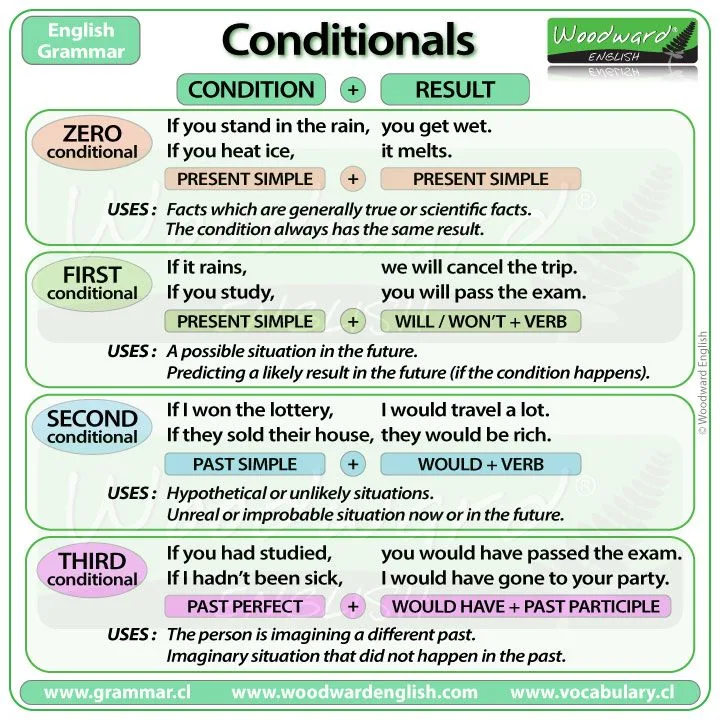
Conditional sentences are the "if-then" machinery of English. They let us talk about possibilities, hypotheticals, regrets, predictions, and rules of cause and effect. A sentence like "If you heat water to 100 degrees Celsius, it boils" states a fact; "If I had studied harder, I would have passed" expresses a regret about the past.
Both are conditionals, but they use entirely different tense patterns. Understanding those patterns - and when each one is correct - is essential for ESL learners and a useful sharpening tool for advanced writers who want to control the exact meaning of their sentences.
This expert-written guide from the Kalenux Team covers all four major conditional types: zero, first, second, and third, plus the mixed conditional. You will see more than thirty practical examples, clear formation rules, comparison tables, and a self-check exercise with an answer key. We will also discuss common mistakes, edge cases, and memory tricks that make the right pattern automatic.
Conditionals are not difficult once you see the underlying logic. Each type pairs a specific tense in the "if" clause with a specific tense in the main clause, and each combination signals a specific relationship between possibility and reality. Master the four patterns and you can discuss anything from scientific facts to impossible wishes with complete grammatical confidence.
What Is a Conditional Sentence?
A conditional sentence has two parts:
- A condition (the "if" clause)
- A result (the main clause)
The two clauses can appear in either order. When the "if" clause comes first, use a comma between the two. When the main clause comes first, no comma is needed.
- If it rains, we will cancel the picnic.
- We will cancel the picnic if it rains.
"Every conditional sentence asks a simple question: how real is this possibility? The tense pattern you pick is the answer. Facts get one pattern, realistic futures get another, unlikely presents get a third, and impossible pasts get a fourth." - Kalenux Team editorial guideline
The Zero Conditional: General Truths and Facts
The zero conditional describes things that are always true - scientific facts, general truths, and cause-and-effect relationships that hold in every case.
Formation
If + present simple, + present simple
Examples
- If you heat ice, it melts.
- If plants do not receive water, they die.
- If you mix red and blue, you get purple.
- If you press this button, the machine turns on.
- If the temperature drops below zero, water freezes.
When to Use It
Use the zero conditional for:
- Scientific facts
- Physical laws
- Rules and instructions
- Habitual or repeated actions with certain results
You can often substitute "when" for "if" in zero conditionals because the relationship is constant.
- When you heat ice, it melts.
- When plants do not receive water, they die.
The First Conditional: Real Future Possibilities
The first conditional describes a future event that is realistic and likely. The condition may or may not happen, but if it does, the result is expected.
Formation
If + present simple, + will + base verb
Examples
- If it rains, we will cancel the game.
- If you finish early, you will get a bonus.
- If she calls, I will let you know.
- If we leave now, we will catch the train.
- If the client approves the proposal, we will start in March.
Variations
You can replace "will" with other modals to change the certainty or meaning.
- If you work hard, you can succeed. (ability or possibility)
- If you need help, you should ask. (advice)
- If the weather holds, we might go hiking. (lesser possibility)
- If you want a refund, you must contact support. (obligation)
When to Use It
Use the first conditional for:
- Predictions about the future
- Warnings
- Promises
- Threats
- Realistic plans
The Second Conditional: Unreal or Unlikely Present and Future
The second conditional describes a present or future situation that is hypothetical, imaginary, or contrary to fact. The condition is unlikely to happen or does not exist.
Formation
If + past simple, + would + base verb
Examples
- If I won the lottery, I would travel the world.
- If she were taller, she would play basketball professionally.
- If we had more time, we would visit the museum too.
- If I knew the answer, I would tell you.
- If they offered me the job, I would accept it.
"Were" for All Subjects
In formal English, use "were" instead of "was" for all subjects in the "if" clause of a second conditional. This is the subjunctive mood.
- Formal: If I were you, I would apologize.
- Informal: If I was you, I would apologize.
Both are heard in speech, but careful writers use "were."
When to Use It
Use the second conditional for:
- Hypothetical situations in the present or future
- Wishes and fantasies
- Advice ("If I were you ...")
- Polite suggestions
- Imagined scenarios
"The second conditional is the modal of imagination. The past-tense verb in the 'if' clause is not pointing to actual past time; it is pointing to unreality. 'If I won' does not mean I won; it means I am imagining that I did." - Kalenux Team writing workshop notes
The Third Conditional: Past Situations That Did Not Happen
The third conditional describes a past event that did not occur, and imagines what the result would have been if it had.
Formation
If + past perfect, + would have + past participle
Examples
- If I had studied harder, I would have passed the exam.
- If you had called me, I would have picked you up.
- If they had left earlier, they would have avoided the traffic.
- If she had accepted the offer, she would have moved to Berlin.
- If we had known, we would have helped.
Variations with "Could Have" and "Might Have"
You can replace "would have" with "could have" (ability) or "might have" (possibility) for a different meaning.
- If she had trained more, she could have won the medal.
- If we had left earlier, we might have made the flight.
When to Use It
Use the third conditional for:
- Regrets about the past
- Hypothetical past situations
- Criticism of past actions
- Imagined past outcomes
The Mixed Conditional: Past Condition with Present Result
The mixed conditional combines the past of the third conditional with the present result of the second conditional. It describes how a past event would have affected the present.
Formation
If + past perfect, + would + base verb
Examples
- If I had taken the job, I would live in Tokyo now.
- If she had studied medicine, she would be a doctor today.
- If we had bought the house, we would have more space.
- If you had listened to me, you would not be in this situation.
- If he had saved more, he would be retired already.
When to Use It
Use the mixed conditional when:
- The condition is in the past (past perfect)
- The result is in the present (would + base verb)
This is common in conversations about how past decisions affect present circumstances.
Side-By-Side Comparison Table
| Type | "If" Clause | Main Clause | Use |
|---|---|---|---|
| Zero | present simple | present simple | Facts, general truths |
| First | present simple | will + base verb | Real future possibilities |
| Second | past simple | would + base verb | Unlikely present or future |
| Third | past perfect | would have + past participle | Past that did not happen |
| Mixed | past perfect | would + base verb | Past condition, present result |
Quick Reference Cheat Sheet
| To express... | Use |
|---|---|
| A scientific fact | Zero conditional |
| A realistic future prediction | First conditional |
| A polite request or suggestion | Second conditional |
| A wish or fantasy | Second conditional |
| A past regret | Third conditional |
| Past criticism or mistake | Third conditional |
| Past event, present consequence | Mixed conditional |
30+ Example Sentences
Zero Conditional (Facts)
- If you mix yellow and blue, you get green.
- If water reaches 100 degrees Celsius, it boils.
- If you do not water plants, they wither.
- If the sun sets, the temperature drops.
- If you drop a ball, it falls.
- If metal rusts, it weakens over time.
First Conditional (Real Future)
- If it snows tomorrow, school will be canceled.
- If you finish the report, I will review it tonight.
- If the package arrives late, we will ship it again.
- If you need anything, just let me know.
- If they approve the plan, construction will begin in June.
- If we leave at six, we will beat the traffic.
Second Conditional (Unreal Present or Future)
- If I had a million dollars, I would buy a yacht.
- If she were here, she would agree with me.
- If I spoke French, I would apply for that job.
- If we lived closer, we would visit more often.
- If you trained harder, you would make the team.
- If the company offered remote work, I would stay.
Third Conditional (Unreal Past)
- If I had known about the meeting, I would have attended.
- If we had taken the earlier flight, we would have avoided the delay.
- If she had applied sooner, she would have been accepted.
- If the hikers had checked the forecast, they would have turned back.
- If you had asked, I would have helped with the project.
- If they had invested in the startup, they would have made a fortune.
Mixed Conditional (Past Condition, Present Result)
- If I had accepted the promotion, I would be in New York now.
- If she had studied law, she would be a lawyer today.
- If we had bought that stock, we would be rich.
- If he had not missed the meeting, he would still have his job.
- If you had followed the manual, the machine would be working.
- If I had gone to bed earlier, I would not feel tired now.
Additional Examples
- If you press that button, the alarm will sound.
- If I were you, I would apologize.
- If they had told us earlier, we would have prepared.
- If the battery dies, the device shuts off.
- If he had listened to advice, he would have a different career now.
Common Mistakes to Avoid
Mistake 1: Using "Will" in the "If" Clause
- Incorrect: If it will rain, we will stay home.
- Correct: If it rains, we will stay home.
The "if" clause of a first conditional uses the present simple, never "will."
Mistake 2: Using "Would" in the "If" Clause
- Incorrect: If I would have more time, I would help.
- Correct: If I had more time, I would help.
The second conditional uses the past simple in the "if" clause.
Mistake 3: Mixing Up Second and Third
- Incorrect: If I knew about the meeting, I would have attended.
- Correct: If I had known about the meeting, I would have attended.
Past regrets use the third conditional (past perfect + would have).
Mistake 4: Forgetting "Had" in the Third Conditional
- Incorrect: If I studied harder, I would have passed.
- Correct: If I had studied harder, I would have passed.
Mistake 5: Using "Was" Instead of "Were" in Formal Writing
- Informal: If I was you, I would wait.
- Formal: If I were you, I would wait.
Mistake 6: Forgetting the Comma
When the "if" clause comes first, a comma separates the two clauses.
- Incorrect: If you need help call me.
- Correct: If you need help, call me.
Memory Tricks
"Remember the '1-2-3 distance' rule. The first conditional is one step from reality - it might actually happen. The second is two steps away - it is unlikely or imagined. The third is three steps away - it is impossible because the past is fixed. Each step back in time adds a tense shift." - Kalenux Team style guide
The Tense Ladder
- Zero: present + present (facts, no distance)
- First: present + will (close to real)
- Second: past + would (one step away)
- Third: past perfect + would have (two steps away)
"If + Past = Unreal Present"
When you see a past tense in an "if" clause, the sentence is probably unreal or hypothetical. The past tense is doing imaginative work, not pointing to actual past time.
"If + Had + Past Participle = Unreal Past"
Any "if had" construction signals that something did not happen. Pair it with "would have" for the main clause.
Self-Check Exercise
Complete each sentence with the correct conditional form. Answers follow.
- If you ________ (heat) ice, it melts.
- If it ________ (rain) tomorrow, we ________ (postpone) the event.
- If I ________ (be) you, I ________ (apologize).
- If they ________ (leave) earlier, they ________ (catch) the train.
- If we ________ (bought) the house last year, we ________ (live) there now.
- If she ________ (finish) the report, she ________ (email) it to us.
- If you ________ (not tell) him, he ________ (not know).
- If I ________ (win) the lottery next week, I ________ (buy) a new car.
- If you ________ (study) medicine, you ________ (become) a doctor.
- If he ________ (call) yesterday, I ________ (answer).
Answer Key
- heat, (melts implied) - zero conditional
- rains, will postpone - first conditional
- were, would apologize - second conditional
- had left, would have caught - third conditional
- had bought, would live - mixed conditional
- finishes, will email - first conditional
- do not tell, will not know - first conditional
- won, would buy - second conditional
- studied, would become - second conditional
- had called, would have answered - third conditional
Frequently Asked Questions
Can I use "unless" instead of "if not"?
Yes. "Unless" means "if not" and can replace it in many sentences. "If you do not study, you will fail" = "Unless you study, you will fail."
Do I always need "will" in the first conditional?
You can use other modals - "can," "may," "might," "should," "must" - to change the meaning slightly. "If you ask nicely, he might help" is still a first conditional.
Why do we use past tense for unreal situations?
The past tense in English doubles as a marker of psychological distance. When we say "If I had more time," the "had" does not point to real past time; it creates mental distance between the speaker and reality.
What is the difference between "If I was you" and "If I were you"?
"Were" is the subjunctive form used for hypothetical situations. Formal writing prefers "If I were you." Informal speech often uses "If I was you," and both are widely understood.
Can I mix a first conditional with a third conditional?
Rarely, and only in careful, deliberate constructions. Most mixing happens between second and third conditionals - the mixed conditional pattern.
What about "would" in the "if" clause for polite requests?
In polite speech, "would" can appear in the "if" clause: "If you would kindly sit down, we can begin." This is a politeness convention rather than a standard conditional pattern.
Conclusion
Conditional sentences are the grammar of possibility. The zero conditional states facts; the first discusses realistic futures; the second imagines unlikely presents; the third regrets impossible pasts; the mixed conditional bridges past and present. Each type uses a specific pair of tenses, and the logic is consistent once you see the pattern.
Memorize the four basic formulas, practice with the thirty-plus examples above, and work through the self-check exercise. Then apply the patterns in your own writing, whether you are drafting an email, a research paper, or a business proposal. Conditionals are everywhere in professional English, and using them accurately signals careful thinking. Take the time to master these patterns, and you will express possibility, hypothesis, and regret with the precision that good writing demands.
Frequently Asked Questions
Can I use 'unless' instead of 'if not'?
Yes. ‘Unless’ means ‘if not’ and can replace it in most sentences without changing the meaning.
Do I always need 'will' in the first conditional?
No. You can swap in modals like ‘can,’ ‘may,’ ‘might,’ ‘should,’ or ‘must’ to shift the meaning toward ability, advice, or lesser certainty.
Why do we use past tense for unreal situations?
The past tense doubles as a marker of psychological distance in English. It signals that the speaker is imagining something outside of reality.
What is the difference between 'If I was you' and 'If I were you'?
‘Were’ is the subjunctive form for hypothetical situations. Formal writing prefers ‘If I were you’; casual speech often uses ‘If I was you.’
Can I mix a first conditional with a third conditional?
Rarely. Most mixing happens between the second and third conditionals, producing the mixed conditional pattern.
What about 'would' in the 'if' clause for polite requests?
‘Would’ can appear in an ‘if’ clause as a politeness marker: ‘If you would sit down, we can begin.’ This is a convention rather than a standard conditional form.