Kanji (漢字), the logographic characters borrowed from Chinese and adapted for Japanese around the 5th century CE, are one of the three writing systems used in Japanese (alongside hiragana and katakana). The Japanese Ministry of Education lists 2,136 "general-use" kanji (常用漢字 joyou kanji) needed for newspapers, official writing, and full literacy. Each kanji has multiple readings: on'yomi (音読み, Chinese-derived) and kun'yomi (訓読み, native Japanese), and most are written following a specific stroke order that has both aesthetic and practical functions.
This reference covers kanji fundamentals: how readings work, the stroke order rules, the role of radicals, and a table of 50 of the most commonly encountered kanji. For the Chinese origin of these characters, see the Chinese characters and radicals guide. For the 214 radicals catalog that Japanese dictionaries also use, see the Chinese 214 Kangxi radicals reference. For how kanji combines with kana in sentences, see the hiragana complete guide and katakana complete guide.
On'yomi vs Kun'yomi
Most kanji have at least two readings.
- On'yomi (音読み): the Chinese-derived reading, borrowed when kanji first arrived. Used mainly in compound words.
- Kun'yomi (訓読み): the native Japanese reading, matching a Japanese word whose meaning the kanji took over.
Example: 山 (mountain)
- On'yomi: サン (san) - used in 山脈 sanmyaku (mountain range), 火山 kazan (volcano).
- Kun'yomi: やま (yama) - used as the standalone word for mountain and in 山田 Yamada (surname).
Heuristic: if the kanji stands alone or has hiragana endings (okurigana), it's usually kun'yomi. If it's in a multi-kanji compound, it's usually on'yomi. Many exceptions.
Table 1. Example readings of common kanji.
| Kanji | Meaning | On'yomi | Kun'yomi | Compound example |
|---|---|---|---|---|
| 水 | water | スイ sui | みず mizu | 水曜日 suiyoubi (Wednesday) |
| 木 | tree/wood | モク moku | き ki | 木曜日 mokuyoubi (Thursday) |
| 火 | fire | カ ka | ひ hi | 火山 kazan (volcano) |
| 人 | person | ジン jin / ニン nin | ひと hito | 日本人 nihonjin (Japanese person) |
| 日 | day/sun | ニチ nichi / ジツ jitsu | ひ hi / か ka | 日曜日 nichiyoubi (Sunday) |
| 月 | moon/month | ゲツ getsu / ガツ gatsu | つき tsuki | 月曜日 getsuyoubi (Monday) |
| 大 | big | ダイ dai / タイ tai | おお(きい) ooki | 大学 daigaku (university) |
| 小 | small | ショウ shou | ちい(さい) chii | 小学生 shougakusei (primary student) |
| 中 | middle | チュウ chuu | なか naka | 中国 Chuugoku (China) |
| 国 | country | コク koku | くに kuni | 中国 Chuugoku |
Stroke Order Rules
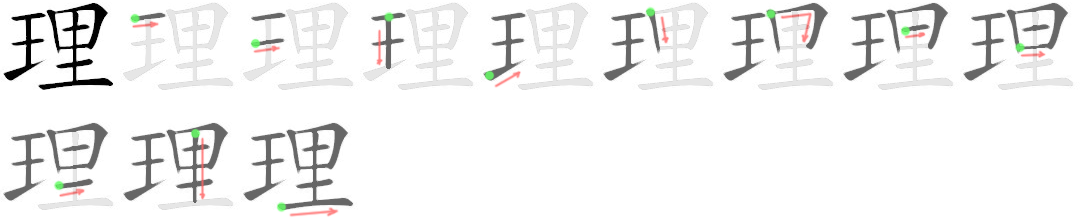
Stroke order matters for legibility, cursive writing, and using handwriting-recognition tools. There are seven core rules.
Rule 1. Top to bottom. Upper strokes first.
- 三 (three): top bar, middle bar, bottom bar.
Rule 2. Left to right. Left strokes before right.
- 川 (river): leftmost vertical first.
Rule 3. Horizontal before vertical (when crossing).
- 十 (ten): horizontal first, then vertical.
Rule 4. Center before sides (in certain characters).
- 小 (small): center vertical first, then left, then right.
Rule 5. Outside before inside (for enclosures).
- 国 (country): outer square, then inside.
Rule 6. Close the box last.
- 回 (rotate): top and sides of outer box, inner box, then bottom of outer box.
Rule 7. Diagonals: left-falling before right-falling.
- 人 (person): left diagonal first.
Radicals in Japanese Kanji
Japanese dictionaries traditionally use the 214 Kangxi radicals (bushu 部首) to index kanji. The radical is one component of the character that serves as the primary identifier.
Common Japanese kanji radicals:
Table 2. Essential radicals for kanji learning.
| Radical | Pronunciation | Meaning | Example kanji |
|---|---|---|---|
| 亻 | ninben | person | 休 (rest), 体 (body), 住 (live) |
| 氵 | sanzui | water | 海 (sea), 泳 (swim), 洗 (wash) |
| 扌 | tehen | hand | 持 (hold), 打 (hit), 押 (push) |
| 木 | kihen | tree | 林 (grove), 森 (forest), 校 (school) |
| 土 | tsuchihen | earth | 地 (ground), 場 (place), 坂 (slope) |
| 口 | kuchihen | mouth | 味 (taste), 呼 (call), 唱 (sing) |
| 日 | hihen | sun | 明 (bright), 時 (time), 晴 (clear) |
| 月 | tsukihen / nikuzuki | moon or meat | 服 (clothes), 胸 (chest), 朝 (morning) |
| 言 | gonben | speech | 話 (talk), 読 (read), 記 (record) |
| 糸 | itohen | silk | 紙 (paper), 絵 (picture), 組 (group) |
| 金 | kanehen | metal | 銀 (silver), 鉄 (iron), 鉛 (lead) |
| 食 | shokuhen | food | 飯 (meal), 飲 (drink), 飼 (raise) |
| 車 | kurumahen | vehicle | 転 (rotate), 軽 (light), 輪 (wheel) |
| 辶 | shinnyou | walk | 近 (near), 遠 (far), 通 (pass through) |
Top 50 Most Common Kanji
These 50 kanji appear repeatedly in any Japanese text. Prioritize them for memorization.
Table 3. Top 50 most common kanji.
| # | Kanji | Meaning | On | Kun |
|---|---|---|---|---|
| 1 | 日 | day, sun | ニチ, ジツ | ひ, か |
| 2 | 一 | one | イチ | ひと |
| 3 | 国 | country | コク | くに |
| 4 | 人 | person | ジン, ニン | ひと |
| 5 | 年 | year | ネン | とし |
| 6 | 大 | big | ダイ, タイ | おお |
| 7 | 十 | ten | ジュウ | とお |
| 8 | 二 | two | ニ | ふた |
| 9 | 本 | book, origin | ホン | もと |
| 10 | 中 | middle | チュウ | なか |
| 11 | 長 | long | チョウ | なが |
| 12 | 出 | exit | シュツ | で |
| 13 | 三 | three | サン | みっ |
| 14 | 同 | same | ドウ | おな |
| 15 | 時 | time | ジ | とき |
| 16 | 行 | go | コウ, ギョウ | い, おこな |
| 17 | 見 | see | ケン | み |
| 18 | 月 | moon, month | ゲツ, ガツ | つき |
| 19 | 分 | minute, divide | ブン, フン | わ |
| 20 | 新 | new | シン | あたら |
| 21 | 事 | matter | ジ | こと |
| 22 | 自 | self | ジ, シ | みずか |
| 23 | 者 | person | シャ | もの |
| 24 | 部 | part | ブ | - |
| 25 | 生 | life | セイ, ショウ | い, う |
| 26 | 前 | before | ゼン | まえ |
| 27 | 合 | join, fit | ゴウ | あ |
| 28 | 立 | stand | リツ | た |
| 29 | 間 | between | カン, ケン | あいだ |
| 30 | 五 | five | ゴ | いつ |
| 31 | 家 | house | カ, ケ | いえ |
| 32 | 社 | company, shrine | シャ | やしろ |
| 33 | 場 | place | ジョウ | ば |
| 34 | 子 | child | シ, ス | こ |
| 35 | 度 | degree | ド | たび |
| 36 | 問 | question | モン | と |
| 37 | 日本 | Japan | ニホン | - |
| 38 | 電 | electric | デン | - |
| 39 | 体 | body | タイ | からだ |
| 40 | 後 | after | ゴ, コウ | あと, うし |
| 41 | 市 | city | シ | いち |
| 42 | 政 | government | セイ | まつりごと |
| 43 | 入 | enter | ニュウ | い, はい |
| 44 | 方 | direction, way | ホウ | かた |
| 45 | 高 | high, expensive | コウ | たか |
| 46 | 手 | hand | シュ | て |
| 47 | 金 | gold, money | キン, コン | かね |
| 48 | 時 | time (listed above) | ジ | とき |
| 49 | 水 | water | スイ | みず |
| 50 | 言 | say, speech | ゲン | い |
Reading Strategies
Jukugo (熟語) - compound words
Multi-kanji compounds usually read in on'yomi:
- 電気 denki (electricity)
- 学校 gakkou (school)
- 勉強 benkyou (study)
- 食事 shokuji (meal)
Standalone kanji with okurigana (送り仮名)
When a kanji is followed by hiragana that "continues" the word (okurigana), the kanji reads in kun'yomi:
- 食べる taberu (eat) - 食 is たべ
- 見る miru (see) - 見 is み
- 行く iku (go) - 行 is い
Names
Personal names often use irregular readings (nanori 名乗り). 田中 is Tanaka (kun-kun); 佐藤 is Satou (on-on). Dictionaries cover common surnames.
Ateji (当て字)
Some kanji are used for phonetic value only, not meaning: 寿司 sushi (the kanji ignore meaning). These are traditional and must be memorized as units.
Learning Strategies
- Frequency order. Start with the top 100 kanji; they cover the majority of text.
- Radicals first. Learn the common radicals (亻, 氵, 木, 口) as building blocks.
- Spaced repetition. Use Anki or Pleco-style flashcards, front = kanji, back = meaning and reading.
- Compound words. Kanji rarely appear alone. Learn them inside common jukugo.
- Stroke order practice. Even if you won't handwrite often, stroke order makes kanji feel more memorable and aids recognition.
- Heisig's Remembering the Kanji. A popular method focuses on meaning + mnemonic first, reading later.
Common Mistakes Learners Make
- Learning readings in isolation. Always pair a kanji with example compounds.
- Overloading on readings. Most kanji have 2-4 readings you actually need; the rest are obscure. Focus on the top 1-2 per kanji.
- Skipping stroke order. Hurts handwriting and dictionary lookup by handwriting.
- Confusing similar kanji. 末 (end) vs 未 (not yet); 大 (big) vs 太 (fat) vs 犬 (dog); 人 (person) vs 入 (enter).
- Assuming kun is for standalone and on for compounds. Mostly true, but exceptions exist: 本 in 日本 is hon (on); 本 alone is also hon.
- Reading names with standard readings. 純 can be Jun or Sumi depending on nanori.
- Ignoring radicals. Without radicals, recognizing a new kanji's category is guesswork.
- Trying to memorize all 2,136 joyou kanji at once. A paced 2-3 year program of 200-300 per year is realistic.
Quick Reference
- Joyou kanji count: 2,136 (as of 2010 revision).
- Two reading types: on'yomi (Chinese-derived) + kun'yomi (native Japanese).
- Stroke order: top-to-bottom, left-to-right, horizontal-before-vertical, outside-before-inside.
- Radicals: 214 Kangxi are the indexing system.
- High-frequency top 50 covers most of everyday text.
FAQ
How many kanji do I need to read a newspaper?
Newspapers generally stay within the 2,136 joyou kanji. Real fluency in reading requires about 2,000-2,500 kanji.
Can I write Japanese without kanji?
You can write entirely in hiragana and be understood, but it looks juvenile and can be harder to parse because Japanese has no spaces between words.
Is stroke order still important if I type everything?
For passive reading, less so. For handwritten notes, dictionary lookup by handwriting input, or studying kanji for the JLPT, yes.
What's JLPT and how does it relate to kanji?
The Japanese Language Proficiency Test has 5 levels (N5 easiest to N1 hardest). N5 tests about 100 kanji; N1 requires all 2,136.
Are simplified kanji used in Japan?
No. Japan uses traditional kanji forms, sometimes with small Japanese-specific simplifications (shinjitai). Most kanji look the same as traditional Chinese; some look like simplified Chinese.
Why do some kanji have readings with small tsu (促音)?
Sound changes. When on'yomi combine with certain consonants, the first kanji may end in a geminate (-tsu + k-/t-/p- assimilates): 学校 gakkou (gakk from ga-k + kou), 一杯 ippai.
What's the difference between kanji and hanzi / hanja?
Same basic script, different histories. Hanzi (Chinese) and kanji (Japanese) share most characters but have diverged in simplification, selection, and readings. Korean hanja (largely replaced by hangeul) is a third offshoot.
See Also
- Hiragana complete guide chart and stroke order
- Katakana complete guide chart and when to use
- Japanese grammar particles complete guide
- Japanese particles wa ga o ni de to reference
- Japanese verb conjugation beginners guide
- Japanese verb conjugation u-verbs ru-verbs irregular reference
- Chinese characters and radicals guide for beginners
- Chinese radicals 214 Kangxi reference
Frequently Asked Questions
How many kanji do I need to read a newspaper?
Newspapers stay within the 2,136 joyou kanji. Practical reading fluency requires about 2,000-2,500 kanji.
Can I write Japanese without kanji?
You can write entirely in kana, but it looks juvenile and is harder to parse because Japanese doesn't use spaces between words.
Is stroke order still important if I type?
Less so for passive reading, but important for handwriting, dictionary handwriting-input lookup, and retaining kanji in memory.
What is JLPT and how does it relate to kanji?
The Japanese Language Proficiency Test has five levels (N5 easiest to N1 hardest). N5 tests about 100 kanji; N1 requires all 2,136 joyou kanji.
Are simplified kanji used in Japan?
No. Japan uses traditional kanji with small Japanese-specific simplifications (shinjitai). Forms differ slightly from both simplified and traditional Chinese.
Why do some kanji produce geminate consonants in compounds?
Historical sound changes. When on'yomi readings combine, a final -tsu can assimilate to the next consonant: 学校 gakkou, 一杯 ippai.
What's the difference between kanji, hanzi, and hanja?
Same script origin with different histories. Chinese hanzi, Japanese kanji, and Korean hanja (now rare) share core characters but differ in selection, simplification, and readings.