
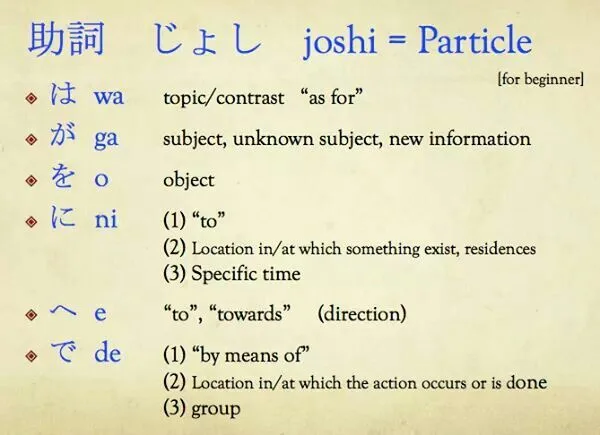
Japanese particles (助詞 joshi) are short function words that follow nouns, verbs, or phrases and mark their grammatical role in a sentence. Where English relies on word order and prepositions, Japanese uses particles.
A Japanese sentence consists of a sequence of noun-phrases each tagged with a particle - は for topic, が for subject, を for direct object, に for direction or time, で for location of action or means, と for accompaniment - followed by the predicate (a verb or copula) at the end. Understanding particles is understanding Japanese grammar.
This reference covers the eight most important particles with their full range of uses, contrasts, and worked examples. For verb forms that appear with these particles, see the Japanese verb conjugation beginners guide. For the writing systems used, see the hiragana complete guide and the katakana complete guide. For broader grammar orientation, see the Japanese grammar particles complete guide.
は (wa) - Topic Marker
Written は (the hiragana character normally read "ha") but pronounced wa when used as a particle. Marks the topic of a sentence - what you're going to say something about.
- 私は学生です。 watashi wa gakusei desu. I am a student. (As for me, [I am] a student.)
- 今日は寒いです。 kyou wa samui desu. Today is cold.
- 日本は美しいです。 nihon wa utsukushii desu. Japan is beautiful.
The topic is known or given; the predicate provides new information about it. は can be used more than once in a sentence, typically for contrast.
Contrast
- コーヒーは好きですが、紅茶は好きじゃないです。 koohii wa suki desu ga, koucha wa suki janai desu. I like coffee, but I don't like tea.
が (ga) - Subject Marker
が marks the grammatical subject of a verb, especially when introducing new or emphasized information.
- 誰が来ましたか? dare ga kimashita ka? Who came?
- 田中さんが来ました。 tanaka-san ga kimashita. Tanaka came.
Key は vs が distinction
- 私は田中です。 watashi wa Tanaka desu. (As for me) I am Tanaka. (Topic; the speaker is already known.)
- 私が田中です。 watashi ga Tanaka desu. I am Tanaka (among these people, I'm the one). (Subject; new or emphasized information.)
A useful heuristic:
- Use は when the speaker comments on a topic already understood.
- Use が when introducing a new subject or when the subject carries the "new information" focus.
With stative verbs, sensations, and wanting
- 水が欲しい。 mizu ga hoshii. I want water.
- 日本語がわかる。 nihongo ga wakaru. I understand Japanese.
- 猫が好きです。 neko ga suki desu. I like cats. (The cats are what is "likable" here.)
Verbs of ability, existence, and stative description use が for the marked object/subject.
を (o) - Direct Object Marker
Written を (hiragana o) and pronounced o. Marks the direct object of a transitive verb.
- パンを食べます。 pan o tabemasu. I eat bread.
- 本を読みます。 hon o yomimasu. I read a book.
- 手紙を書きます。 tegami o kakimasu. I write a letter.
Other uses
を can also mark the path of movement with motion verbs:
- 公園を歩きます。 kouen o arukimasu. I walk through the park.
- 橋を渡る。 hashi o wataru. Cross the bridge.
And the point of departure:
- 家を出る。 ie o deru. Leave the house.
に (ni) - Direction, Location, Time, Indirect Object
に is a workhorse particle with several core uses.
Direction / destination (with motion verbs)
- 学校に行きます。 gakkou ni ikimasu. I go to school.
- 日本に来ました。 nihon ni kimashita. I came to Japan.
Location of existence (with いる, ある)
- 机の上に本があります。 tsukue no ue ni hon ga arimasu. There is a book on the desk.
- 家に犬がいます。 ie ni inu ga imasu. There is a dog at home.
Specific time
- 七時に起きます。 shichiji ni okimasu. I get up at seven.
- 月曜日に会いましょう。 getsuyoubi ni aimashou. Let's meet on Monday.
Note: general time words like "today" (今日) and "tomorrow" (明日) don't take に.
Indirect object (recipient)
- 友達に手紙を書きます。 tomodachi ni tegami o kakimasu. I write a letter to a friend.
- 先生に質問します。 sensei ni shitsumon shimasu. I ask the teacher a question.
Agent in passive
- 犬に噛まれた。 inu ni kamareta. I was bitten by a dog.
Purpose with motion verbs
- 映画を見に行く。 eiga o mi ni iku. Go to see a movie.
で (de) - Location of Action, Means, Cause
Location where an action occurs
- レストランで食べます。 resutoran de tabemasu. I eat at the restaurant.
- 図書館で勉強します。 toshokan de benkyou shimasu. I study in the library.
Contrast に vs で for location:
- 図書館にいる。 I am at the library. (Existence - に)
- 図書館で勉強する。 I study at the library. (Action - で)
Means / tool
- 鉛筆で書く。 enpitsu de kaku. Write with a pencil.
- バスで行く。 basu de iku. Go by bus.
- 日本語で話す。 nihongo de hanasu. Speak in Japanese.
Cause or reason
- 病気で休む。 byouki de yasumu. Rest because of illness.
- 雨で電車が遅れた。 ame de densha ga okureta. The train was late due to rain.
Material
- 紙で折り紙を作る。 kami de origami o tsukuru. Make origami out of paper.
Time limit / duration as total
- 一時間で終わる。 ichi jikan de owaru. Finish in one hour.
と (to) - And, With, Quotation
"And" connecting nouns (exhaustive list)
- りんごとオレンジ ringo to orenji. Apples and oranges.
- 私と田中さん watashi to tanaka-san. Tanaka and I.
This is "and" only for items and only for complete lists. For non-exhaustive "and" use や. For connecting clauses, use different constructions.
"With" (accompaniment)
- 友達と映画を見る。 tomodachi to eiga o miru. Watch a movie with a friend.
- 犬と散歩する。 inu to sanpo suru. Walk with a dog.
Quotation marker
と marks reported or quoted speech/thought:
- 「おはよう」と言った。 "ohayou" to itta. He said "good morning."
- 明日来ると思います。 ashita kuru to omoimasu. I think [he] will come tomorrow.
から (kara) - From, Because
From a place or time
- 日本から来ました。 nihon kara kimashita. I came from Japan.
- 九時から働く。 kuji kara hataraku. Work from nine.
Because (with a clause)
- 雨が降るから、家にいる。 ame ga furu kara, ie ni iru. It's going to rain, so I'll stay home.
から (as "because") goes at the end of the reason clause.
まで (made) - Until, As Far As
Until a time
- 十時まで働く。 juuji made hataraku. Work until ten.
As far as a place
- 東京まで行く。 toukyou made iku. Go as far as Tokyo.
Paired with から
- 九時から五時まで。 kuji kara go ji made. From nine to five.
Comparison and Contrast Tables
Table 1. は vs が quick reference.
| Feature | は (topic) | が (subject) |
|---|---|---|
| Marks | Topic - what's under discussion | Grammatical subject - often new info |
| Typical context | Known or previously mentioned | New information, contrastive, answers "who/what" |
| With question words | Avoided as subject | Required |
| In embedded clauses | Not used | Used |
Table 2. に vs で for location.
| Particle | Use | Example |
|---|---|---|
| に | Existence / static | 教室に学生がいる。 |
| に | Destination | 学校に行く。 |
| で | Action site | 教室で勉強する。 |
Table 3. Three particles that can mean "from."
| Particle | Nuance | Example |
|---|---|---|
| から | Starting point (time or place) | 日本から来た。 |
| より | Source in formal/writing; also comparison | より is comparative "than" in basic use |
| を | Departure point (from a place through motion) | 家を出る。 |
Combining Particles
Multiple particles can stack to refine meaning.
- には: emphasized location or destination: 公園には行かない (as for the park, I don't go [there]).
- では: scope or context: 日本では... (In Japan, ...).
- とは: quotation topic: 日本語とは何か (What is "Japanese"?).
- からは: from (emphasized): ここからは見えない (It's not visible from here).
Particles and Question Words
Question words almost always take が in the subject role or their expected particle otherwise:
- 誰が来たか。 dare ga kita ka. Who came?
- 何を食べましたか。 nani o tabemashita ka. What did you eat?
- どこに行きますか。 doko ni ikimasu ka. Where are you going?
- いつ来ますか。 itsu kimasu ka. When will you come?
In answers, は replaces が for the stated subject:
- A: 誰が学生ですか? B: 田中さんは学生です。 - Tanaka is a student (as for Tanaka).
Common Mistakes Learners Make
- Using は where が belongs. Answers to "who?" questions use が: A: 誰が来ましたか? B: 田中さんが来ました。
- Using が where は is natural. Once a topic is introduced, subsequent references use は.
- Mixing に and で for location. に for existence ("is at"); で for action ("does at").
- Forgetting を with transitive verbs. 食べます needs を: 「パンを食べます」 not just 「パン食べます」 in formal speech.
- Dropping particles in casual speech. Casual Japanese often omits は, が, を, but written and polite speech preserves them.
- Using と for incomplete lists. と is exhaustive; や is incomplete list ("apples, oranges, etc.").
- Confusing から and ので. Both mean "because," but から is more casual and can appear mid-sentence; ので is softer and connects clauses more subtly.
- Writing は as "ha" when it's a topic marker. In writing, は is typed with the "ha" key but always pronounced "wa" in this role.
Quick Reference Summary
| Particle | Role | Example |
|---|---|---|
| は (wa) | Topic | 私は学生です。 |
| が (ga) | Subject (new info) | 誰が来ましたか。 |
| を (o) | Direct object | パンを食べる。 |
| に (ni) | Destination, time, indirect object | 学校に行く。 |
| で (de) | Action location, means | バスで行く。 |
| と (to) | With, and, quote | 友達と行く。 |
| から (kara) | From, because | 日本から来た。 |
| まで (made) | Until, as far as | 九時まで働く。 |
FAQ
When should I use は vs が?
Use は for known or given topics; use が to introduce new subjects, in embedded clauses, and with question words asking for the subject. A quick rule: if a question word serves as subject, use が; if the topic is already known, use は.
Can a sentence have both は and が?
Yes: 象は鼻が長い (zou wa hana ga nagai) - "elephants, their nose is long." The elephant is the topic; the nose is the grammatical subject of 長い.
Why do 友達と and 友達に both translate to "with a friend"?
They don't, precisely. 友達と = with a friend (accompaniment, shared activity). 友達に = to a friend (recipient or direction). 友達と行く = go together; 友達に話す = speak to a friend.
Is it wrong to drop particles in speech?
In casual speech, particles are often dropped for naturalness. In polite or written Japanese, always include them.
Why is は written as hiragana ha?
Historical spelling. When Japanese orthography was standardized, は remained the topic particle even though its pronunciation shifted to "wa."
Can a sentence begin with が?
Almost never. が is a subject marker, but the subject usually comes after a topic (marked with は) or is implicit. Sentences like がくせい = "students" can start with が in linguistic descriptions but rarely in ordinary prose.
What about the particle も?
も means "also, too": 私も学生です (I am also a student). It replaces は or が to add inclusion.
See Also
- Japanese grammar particles complete guide
- Japanese verb conjugation beginners guide
- Hiragana complete guide chart and stroke order
- Katakana complete guide
- Japanese counting numbers counters guide
- Japanese verb conjugation u-verbs ru-verbs irregular reference
- Japanese counters classifiers reference
- Japanese keigo honorific language reference
Frequently Asked Questions
When should I use は vs が?
Use は for known or given topics. Use が for introducing new subjects, in embedded clauses, and with question words asking for the subject. If a question word is subject, use が; if the topic is already known, use は.
Can a sentence have both は and が?
Yes: 象は鼻が長い (zou wa hana ga nagai) - ‘elephants, their nose is long.’ The elephant is the topic; the nose is the grammatical subject.
Why do 友達と and 友達に both translate as 'with a friend'?
They don’t precisely. 友達と means ‘together with a friend’ (accompaniment, shared activity). 友達に means ‘to a friend’ (direction or recipient).
Is it wrong to drop particles in casual speech?
No. Casual Japanese often drops は, が, を. In polite or written Japanese, always include them.
Why is は written as the hiragana for ha?
Historical orthography. When spelling was standardized, は was retained for the topic particle even though its pronunciation shifted to wa.
Can a sentence begin with が?
Almost never. が typically follows a noun introducing new information; it does not begin a sentence in normal prose.
What does the particle も do?
も means ‘also, too’ and replaces は or が to add inclusion: 私も学生です (I’m also a student).