
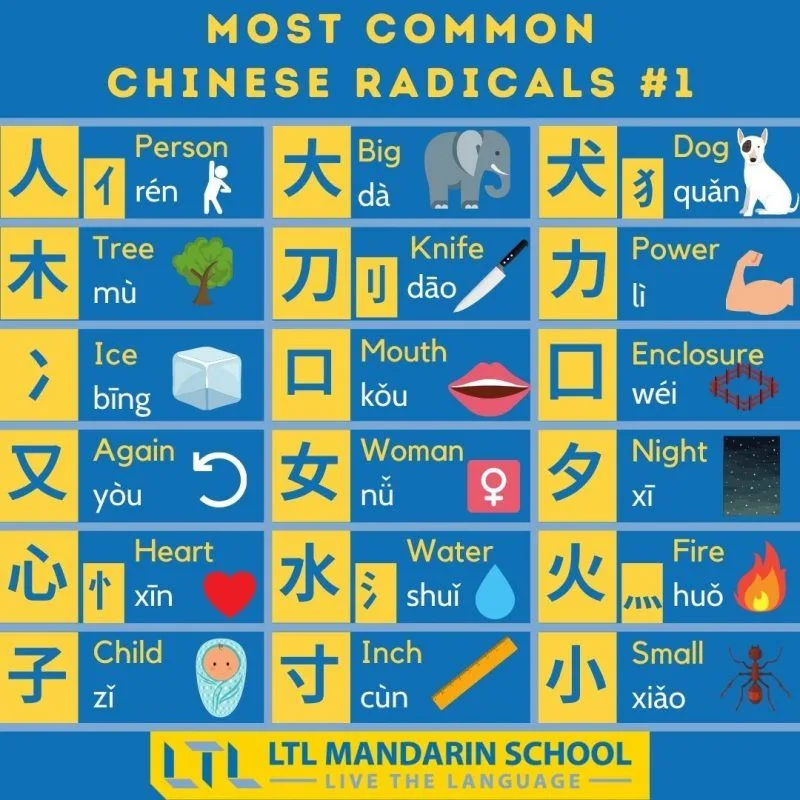
The 214 Kangxi radicals (部首 bùshǒu) are the traditional system of character components used to classify, look up, and learn Chinese characters. Codified in the 1716 Kangxi Dictionary during the Qing dynasty, the system organizes tens of thousands of Chinese characters by their dominant structural component, making dictionary lookup possible in an era before digital input.
Although modern simplified Chinese dictionaries sometimes use a reduced set (189 or 201 radicals), the 214 Kangxi radicals remain the standard reference for traditional Chinese, for Japanese kanji, and for learners worldwide.
This reference explains how radicals work, how they carry meaning or sound in characters, and provides a full ordered table of all 214 with their meanings and uses. For the full character-learning strategy, see the Chinese characters and radicals guide. For pronunciation of the character components, see the pinyin complete guide. For how characters combine into words, see the Chinese grammar rules guide.
What Is a Radical?
A radical (部首) is the component of a Chinese character used to index it in a dictionary. Most characters have multiple components; the radical is the primary organizing one, often (but not always) appearing on the left side.
Radicals fall into two general roles inside characters:
- Semantic component (meaning clue): suggests the category of meaning. The 氵 (water) radical in 河 (river), 湖 (lake), 海 (sea), 洗 (wash) all relate to water.
- Phonetic component (sound clue): suggests how the character is pronounced. In 妈 (mā mother), 马 (mǎ horse) provides both a meaning hint and the sound.
Most Chinese characters are phono-semantic compounds (形声字 xíngshēngzì), combining a semantic radical with a phonetic component. Roughly 80-90 percent of characters are of this type. The radical tells you "this relates to water / speech / heart / hand," and the phonetic gives a rough sound approximation.
Memory aid: When you see an unfamiliar character, find the radical first. It narrows the meaning to a domain, even if you don't know the exact word.
How Dictionary Lookup Works
Traditional Chinese dictionaries group characters by radical, then by the number of additional strokes beyond the radical.
Example: 河 (river).
- Radical: 氵 (3 strokes), the water radical.
- Remaining strokes: 可 (5 strokes).
- Lookup path: find 氵 section, find characters with 5 additional strokes, scan for 河.
Modern learners can use pinyin lookup or handwriting input, but radical lookup is still indispensable when you encounter a character whose sound you don't know.
The 214 Kangxi Radicals
Radicals are traditionally listed in order of stroke count, from 1 stroke to 17 strokes. Here is the full list:
Table 1. Kangxi radicals 1-17 (1-stroke and 2-stroke).
| # | Radical | Pinyin | Meaning |
|---|---|---|---|
| 1 | 一 | yī | one |
| 2 | 丨 | gǔn | vertical stroke |
| 3 | 丶 | zhǔ | dot |
| 4 | 丿 | piě | slash |
| 5 | 乙 | yǐ | second heavenly stem |
| 6 | 亅 | jué | hook |
| 7 | 二 | èr | two |
| 8 | 亠 | tóu | lid |
| 9 | 人 (亻) | rén | person |
| 10 | 儿 | ér | legs |
| 11 | 入 | rù | enter |
| 12 | 八 | bā | eight |
| 13 | 冂 | jiōng | wide |
| 14 | 冖 | mì | cover |
| 15 | 冫 | bīng | ice |
| 16 | 几 | jǐ | table |
| 17 | 凵 | kǎn | open box |
Table 2. Kangxi radicals 18-29 (2-stroke continued and 3-stroke).
| # | Radical | Pinyin | Meaning |
|---|---|---|---|
| 18 | 刀 (刂) | dāo | knife |
| 19 | 力 | lì | power |
| 20 | 勹 | bāo | wrap |
| 21 | 匕 | bǐ | ladle |
| 22 | 匚 | fāng | right open box |
| 23 | 匸 | xǐ | conceal |
| 24 | 十 | shí | ten |
| 25 | 卜 | bǔ | divination |
| 26 | 卩 | jié | seal |
| 27 | 厂 | hàn | cliff |
| 28 | 厶 | sī | private |
| 29 | 又 | yòu | again |
Table 3. Kangxi radicals 30-60 (selected 3-stroke).
| # | Radical | Pinyin | Meaning |
|---|---|---|---|
| 30 | 口 | kǒu | mouth |
| 31 | 囗 | wéi | enclosure |
| 32 | 土 | tǔ | earth |
| 33 | 士 | shì | scholar |
| 34 | 夂 | zhǐ | go |
| 35 | 夊 | suī | walk slowly |
| 36 | 夕 | xī | evening |
| 37 | 大 | dà | big |
| 38 | 女 | nǚ | woman |
| 39 | 子 | zǐ | child |
| 40 | 宀 | mián | roof |
| 41 | 寸 | cùn | inch |
| 42 | 小 | xiǎo | small |
| 43 | 尢 | wāng | lame |
| 44 | 尸 | shī | corpse |
| 45 | 屮 | chè | sprout |
| 46 | 山 | shān | mountain |
| 47 | 巛 | chuān | river |
| 48 | 工 | gōng | work |
| 49 | 己 | jǐ | self |
| 50 | 巾 | jīn | cloth |
| 51 | 干 | gān | dry |
| 52 | 幺 | yāo | short thread |
| 53 | 广 | yǎn | dotted cliff |
| 54 | 廴 | yǐn | long stride |
| 55 | 廾 | gǒng | folded hands |
| 56 | 弋 | yì | shoot |
| 57 | 弓 | gōng | bow |
| 58 | 彐 | jì | pig's head |
| 59 | 彡 | shān | bristle |
| 60 | 彳 | chì | step |
Table 4. Kangxi radicals 61-85 (4-stroke).
| # | Radical | Pinyin | Meaning |
|---|---|---|---|
| 61 | 心 (忄) | xīn | heart |
| 62 | 戈 | gē | spear |
| 63 | 戶 | hù | door |
| 64 | 手 (扌) | shǒu | hand |
| 65 | 支 | zhī | branch |
| 66 | 攴 (攵) | pū | tap |
| 67 | 文 | wén | script |
| 68 | 斗 | dǒu | dipper |
| 69 | 斤 | jīn | axe |
| 70 | 方 | fāng | square |
| 71 | 无 | wú | not |
| 72 | 日 | rì | sun |
| 73 | 曰 | yuē | say |
| 74 | 月 | yuè | moon |
| 75 | 木 | mù | tree |
| 76 | 欠 | qiàn | lack |
| 77 | 止 | zhǐ | stop |
| 78 | 歹 | dǎi | death |
| 79 | 殳 | shū | weapon |
| 80 | 毋 | wú | not |
| 81 | 比 | bǐ | compare |
| 82 | 毛 | máo | fur |
| 83 | 氏 | shì | clan |
| 84 | 气 | qì | air |
| 85 | 水 (氵) | shuǐ | water |
Table 5. Kangxi radicals 86-115 (4-stroke continued and 5-stroke).
| # | Radical | Pinyin | Meaning |
|---|---|---|---|
| 86 | 火 (灬) | huǒ | fire |
| 87 | 爪 | zhǎo | claw |
| 88 | 父 | fù | father |
| 89 | 爻 | yáo | cross |
| 90 | 爿 | qiáng | split wood |
| 91 | 片 | piàn | slice |
| 92 | 牙 | yá | tooth |
| 93 | 牛 | niú | cow |
| 94 | 犬 (犭) | quǎn | dog |
| 95 | 玄 | xuán | profound |
| 96 | 玉 | yù | jade |
| 97 | 瓜 | guā | melon |
| 98 | 瓦 | wǎ | tile |
| 99 | 甘 | gān | sweet |
| 100 | 生 | shēng | birth |
| 101 | 用 | yòng | use |
| 102 | 田 | tián | field |
| 103 | 疋 | pǐ | bolt of cloth |
| 104 | 疒 | nè | sickness |
| 105 | 癶 | bō | back to back |
| 106 | 白 | bái | white |
| 107 | 皮 | pí | skin |
| 108 | 皿 | mǐn | dish |
| 109 | 目 | mù | eye |
| 110 | 矛 | máo | spear |
| 111 | 矢 | shǐ | arrow |
| 112 | 石 | shí | stone |
| 113 | 示 (礻) | shì | altar |
| 114 | 禸 | róu | track |
| 115 | 禾 | hé | grain |
Table 6. Kangxi radicals 116-146 (5-6-stroke).
| # | Radical | Pinyin | Meaning |
|---|---|---|---|
| 116 | 穴 | xué | cave |
| 117 | 立 | lì | stand |
| 118 | 竹 | zhú | bamboo |
| 119 | 米 | mǐ | rice |
| 120 | 糸 (纟) | mì | silk |
| 121 | 缶 | fǒu | jar |
| 122 | 网 (罒) | wǎng | net |
| 123 | 羊 | yáng | sheep |
| 124 | 羽 | yǔ | feather |
| 125 | 老 | lǎo | old |
| 126 | 而 | ér | and |
| 127 | 耒 | lěi | plow |
| 128 | 耳 | ěr | ear |
| 129 | 聿 | yù | brush |
| 130 | 肉 (月) | ròu | meat |
| 131 | 臣 | chén | minister |
| 132 | 自 | zì | self |
| 133 | 至 | zhì | arrive |
| 134 | 臼 | jiù | mortar |
| 135 | 舌 | shé | tongue |
| 136 | 舛 | chuǎn | opposite |
| 137 | 舟 | zhōu | boat |
| 138 | 艮 | gěn | stopping |
| 139 | 色 | sè | color |
| 140 | 艸 (艹) | cǎo | grass |
| 141 | 虍 | hū | tiger |
| 142 | 虫 | chóng | insect |
| 143 | 血 | xuè | blood |
| 144 | 行 | xíng | walk |
| 145 | 衣 (衤) | yī | clothing |
| 146 | 襾 | yà | cover |
Table 7. Kangxi radicals 147-214 (7-stroke and beyond).
| # | Radical | Pinyin | Meaning |
|---|---|---|---|
| 147 | 見 (见) | jiàn | see |
| 148 | 角 | jiǎo | horn |
| 149 | 言 (讠) | yán | speech |
| 150 | 谷 | gǔ | valley |
| 151 | 豆 | dòu | bean |
| 152 | 豕 | shǐ | pig |
| 153 | 豸 | zhì | badger |
| 154 | 貝 (贝) | bèi | shell (money) |
| 155 | 赤 | chì | red |
| 156 | 走 | zǒu | walk |
| 157 | 足 | zú | foot |
| 158 | 身 | shēn | body |
| 159 | 車 (车) | chē | vehicle |
| 160 | 辛 | xīn | bitter |
| 161 | 辰 | chén | dragon hour |
| 162 | 辵 (辶) | chuò | walk (radical form) |
| 163 | 邑 (阝) | yì | city (right) |
| 164 | 酉 | yǒu | wine jar |
| 165 | 釆 | biàn | distinguish |
| 166 | 里 | lǐ | village |
| 167 | 金 (钅) | jīn | metal/gold |
| 168 | 長 (长) | cháng | long |
| 169 | 門 (门) | mén | gate |
| 170 | 阜 (阝) | fù | mound (left) |
| 171 | 隶 | lì | slave |
| 172 | 隹 | zhuī | short-tailed bird |
| 173 | 雨 | yǔ | rain |
| 174 | 青 | qīng | blue/green |
| 175 | 非 | fēi | wrong |
| 176 | 面 | miàn | face |
| 177 | 革 | gé | leather |
| 178 | 韋 (韦) | wéi | tanned hide |
| 179 | 韭 | jiǔ | leek |
| 180 | 音 | yīn | sound |
| 181 | 頁 (页) | yè | page/head |
| 182 | 風 (风) | fēng | wind |
| 183 | 飛 (飞) | fēi | fly |
| 184 | 食 (饣) | shí | eat |
| 185 | 首 | shǒu | head |
| 186 | 香 | xiāng | fragrant |
| 187 | 馬 (马) | mǎ | horse |
| 188 | 骨 | gǔ | bone |
| 189 | 高 | gāo | tall |
| 190 | 髟 | biāo | long hair |
| 191 | 鬥 | dòu | fight |
| 192 | 鬯 | chàng | sacrificial wine |
| 193 | 鬲 | lì | tripod |
| 194 | 鬼 | guǐ | ghost |
| 195 | 魚 (鱼) | yú | fish |
| 196 | 鳥 (鸟) | niǎo | bird |
| 197 | 鹵 (卤) | lǔ | salt |
| 198 | 鹿 | lù | deer |
| 199 | 麥 (麦) | mài | wheat |
| 200 | 麻 | má | hemp |
| 201 | 黃 | huáng | yellow |
| 202 | 黍 | shǔ | millet |
| 203 | 黑 | hēi | black |
| 204 | 黹 | zhǐ | embroidery |
| 205 | 黽 | mǐn | frog |
| 206 | 鼎 | dǐng | tripod |
| 207 | 鼓 | gǔ | drum |
| 208 | 鼠 | shǔ | rat |
| 209 | 鼻 | bí | nose |
| 210 | 齊 (齐) | qí | even |
| 211 | 齒 (齿) | chǐ | tooth |
| 212 | 龍 (龙) | lóng | dragon |
| 213 | 龜 (龟) | guī | turtle |
| 214 | 龠 | yuè | flute |
Variant Forms of Radicals
Some radicals take a reduced or "combining" form when they appear in a particular position of a character. Learning the variants is essential because they look very different from the standalone form.
Table 8. Common radical variants.
| Standalone | Variant | Position | Radical meaning |
|---|---|---|---|
| 人 | 亻 | left | person |
| 心 | 忄 | left | heart |
| 手 | 扌 | left | hand |
| 水 | 氵 | left | water |
| 火 | 灬 | bottom | fire |
| 犬 | 犭 | left | dog/beast |
| 玉 | 王 | left (with dot) | jade |
| 衣 | 衤 | left | clothing |
| 示 | 礻 | left | altar/sign |
| 艸 | 艹 | top | grass |
| 辵 | 辶 | bottom-left wrap | walk |
| 邑 | 阝 | right | city |
| 阜 | 阝 | left | mound |
| 网 | 罒 | top | net |
| 肉 | 月 | anywhere | meat |
Note that 月 can mean either "moon" (radical 74) or "meat" (radical 130 variant). Context within the character tells you which.
High-Frequency Radicals for Beginners
Learners do not need to memorize all 214 immediately. The following 30 radicals cover the majority of everyday characters and should be prioritized:
Table 9. 30 high-frequency radicals for learners.
| Radical | Meaning | Example characters |
|---|---|---|
| 亻 | person | 你 他 们 住 做 |
| 口 | mouth | 吃 喝 叫 唱 吧 |
| 女 | woman | 她 妈 姐 好 婚 |
| 子 | child | 孩 学 |
| 宀 | roof | 家 完 室 安 |
| 忄 | heart | 快 慢 忙 怕 |
| 扌 | hand | 打 拿 找 挂 |
| 日 | sun | 明 时 晚 早 |
| 月 | moon/meat | 朋 服 脸 肚 |
| 木 | tree | 林 森 树 校 |
| 氵 | water | 河 海 洗 游 |
| 火 | fire | 烧 热 烦 |
| 灬 | fire (bottom) | 热 点 煮 |
| 田 | field | 男 画 留 |
| 目 | eye | 看 眼 睡 |
| 石 | stone | 破 硬 |
| 禾 | grain | 和 秋 种 |
| 竹 | bamboo | 笑 算 筷 |
| 米 | rice | 粉 糖 |
| 纟 | silk | 红 纸 线 给 |
| 老 | old | 老 考 |
| 耳 | ear | 聪 聊 |
| 肉/月 | meat | 肚 脚 脸 |
| 艹 | grass | 花 草 苦 药 |
| 讠 | speech | 说 语 话 请 |
| 贝 | shell/money | 财 费 账 |
| 走 | walk | 走 起 超 |
| 足 | foot | 跑 跳 路 |
| 辶 | walk (wrap) | 进 还 远 近 |
| 钅 | metal | 钱 铁 银 |
Common Mistakes Learners Make
- Confusing 月 (moon) and 月 (meat). They are spelled identically but derive from different radicals. Characters like 朋 (friend) use moon; 肚 (belly), 脸 (face) use meat.
- Missing the left and right 阝 distinction. On the left 阝 is 阜 (mound); on the right it is 邑 (city). 阴 (shadow, left mound) vs 郎 (young man, right city).
- Over-reading the radical. The radical gives a category hint, not a definition. 请 (to invite) has 讠 (speech) but is not a word meaning "speech."
- Ignoring stroke count in lookup. Radical + remaining stroke count narrows the search.
- Treating all components as radicals. Every character has one indexed radical; other components are phonetic or secondary.
- Skipping the traditional variants. Japanese and traditional Chinese use 言, 馬, 車, 魚 in full form; simplified Chinese uses 讠, 马, 车, 鱼.
- Assuming semantic radicals always tell meaning precisely. Some are historical only; meanings have drifted.
- Learning isolated radicals without example characters. Always pair a radical with several characters that use it.
Quick Reference
- 214 is the Kangxi number; modern simplified dictionaries may use 189 or 201.
- Radicals are listed by stroke count in dictionaries.
- Most characters are phono-semantic: radical + phonetic.
- Key variant forms: 氵 (water), 忄 (heart), 扌 (hand), 亻 (person), 艹 (grass), 辶 (walk), 讠 (speech).
- Start with the top 30 high-frequency radicals before tackling the full list.
FAQ
Do I need to memorize all 214 radicals?
No. Memorizing the top 40-50 high-frequency radicals covers most of the characters you'll encounter in the first 1,000 words. The rest can be learned as you meet characters that use them.
Why do some radicals have two forms (e.g., 水 and 氵)?
Positional variants. Many radicals change shape when they appear inside characters to fit compositionally - especially left-side components. The meaning is identical.
Is the Kangxi system used for Japanese kanji too?
Yes. Japanese kanji dictionaries traditionally use the same 214 Kangxi radicals, though modern Japanese dictionaries sometimes use smaller sets.
Why do radical dictionaries still matter if I can type?
When you see an unknown character you can't pronounce, radical lookup or handwriting input are your only options. Digital input by pinyin assumes you already know the pronunciation.
How is the radical chosen for a given character?
Traditionally the radical is a specific component (often on the left, top, or enclosing). The Kangxi Dictionary assigned them by convention; modern dictionaries may differ slightly.
Are there characters without a radical?
All characters are assigned to a radical. Some simple characters are themselves radicals (一 = "one" is radical #1).
How does the number of strokes relate to radicals?
Radicals are ordered in dictionaries by their own stroke count (1 to 17). Within a radical's section, characters are ordered by additional strokes beyond the radical.
See Also
- Chinese characters and radicals guide for beginners
- Chinese tones complete guide
- Chinese four tones plus neutral reference
- Pinyin complete guide
- Chinese grammar rules complete beginners guide
- Chinese measure words guide
- Chinese measure words classifiers reference
- Chinese HSK 1 vocabulary reference
Frequently Asked Questions
Do I need to memorize all 214 radicals?
No. Focus on the top 40-50 high-frequency radicals, which cover the majority of characters encountered in the first 1,000 words. Learn the rest as you meet characters that use them.
Why do some radicals have two forms?
Many radicals take a reduced ‘variant form’ when they appear on the left, top, or as a wrap inside a character (e.g., 水 becomes 氵). The meaning is identical.
Is the Kangxi system used for Japanese kanji?
Yes. Japanese kanji dictionaries traditionally use the same 214 Kangxi radicals, though some modern dictionaries use smaller sets.
Why do radical dictionaries matter if I can type pinyin?
If you see an unknown character you can’t pronounce, radical lookup or handwriting input are your only options - pinyin input presupposes you already know the sound.
How is the radical chosen for a given character?
Traditionally the radical is a specific component, often on the left, top, or enclosing position, assigned by convention in the Kangxi Dictionary. Modern dictionaries may differ slightly.
Are there characters without a radical?
No. Every character is indexed under a radical. Some basic characters are themselves radicals (one = 一 = radical #1).
How does stroke count relate to radicals?
Radicals are ordered in dictionaries by their own stroke count (1 to 17). Within a radical’s section, characters are ordered by additional strokes beyond the radical.