
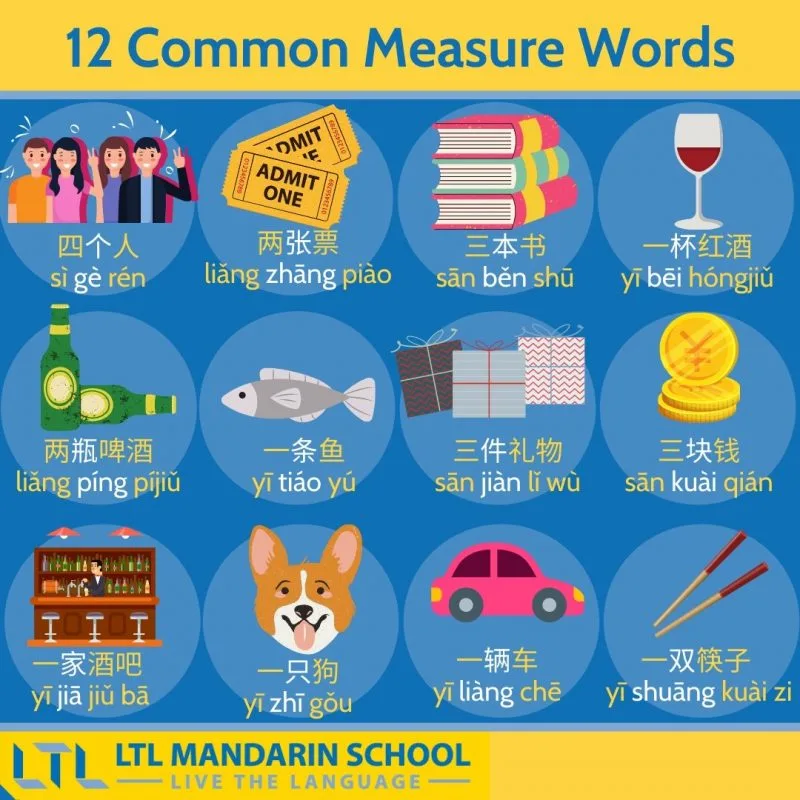
Chinese does not say "two people" directly. It says "two [classifier] people" - 两个人 liǎng ge rén - with the classifier 个 inserted between number and noun.
Measure words (量词 liàngcí), also called classifiers, are obligatory in Chinese whenever you count nouns, specify a particular instance with demonstratives (this/that), or ask "how many." Every countable noun has a preferred classifier, and using the right one is a mark of fluent speech. English has some classifiers too ("a head of cattle," "a slice of bread"), but Chinese uses them for nearly all nouns.
This reference organizes the most common classifiers by the type of noun they pattern with, explains the grammar of classifier phrases, and gives detailed notes on usage. For beginner-level introduction, see the Chinese measure words complete guide. For related grammar see the Chinese grammar rules guide. For pronunciation of these classifiers, see the pinyin complete guide.
The Classifier Structure
The basic pattern:
Number/Demonstrative + Classifier + Noun
Examples:
- 一个人 yí ge rén - one person
- 三本书 sān běn shū - three books
- 这条鱼 zhè tiáo yú - this fish
- 那张桌子 nà zhāng zhuōzi - that table
You cannot drop the classifier. *一人 (yī rén) is ungrammatical for "one person" in standard Mandarin.
The Universal Classifier: 个 (ge)
个 gè (usually pronounced ge with neutral tone) is the default classifier, used when you don't know or can't recall the specific one. It works for people (人 rén), objects generally (东西 dōngxi), and many abstract concepts.
- 一个人 one person
- 两个苹果 two apples
- 三个问题 three questions
Using 个 everywhere is comprehensible but sounds childish or non-native. Native speakers prefer the specific classifier whenever there is one.
Classifiers by Noun Category
For people
Table 1. Classifiers for people.
| Classifier | Pinyin | Use | Example |
|---|---|---|---|
| 个 | ge | general | 一个人 (one person) |
| 位 | wèi | polite, respected | 一位老师 (an honored teacher) |
| 名 | míng | by name or role | 一名学生 (one student) |
| 口 | kǒu | mouths - household members | 三口人 (three people in family) |
For animals
Table 2. Classifiers for animals.
| Classifier | Pinyin | Use | Example |
|---|---|---|---|
| 只 | zhī | most small animals, birds, one of a pair | 一只猫 (one cat), 一只鸡 (one chicken) |
| 条 | tiáo | long, flexible animals | 一条鱼 (one fish), 一条蛇 (one snake) |
| 头 | tóu | large livestock | 一头牛 (one cow), 一头猪 (one pig) |
| 匹 | pǐ | horses, mules | 一匹马 (one horse) |
| 群 | qún | groups of animals | 一群羊 (a flock of sheep) |
For flat objects
Table 3. Classifiers for flat things.
| Classifier | Pinyin | Use | Example |
|---|---|---|---|
| 张 | zhāng | flat, sheet-like | 一张纸 (one paper), 一张桌子 (one table), 一张票 (one ticket), 一张照片 (one photo) |
For long, thin objects
Table 4. Classifiers for long thin objects.
| Classifier | Pinyin | Use | Example |
|---|---|---|---|
| 条 | tiáo | long flexible (rivers, roads, pants, fish) | 一条路 (a road), 一条河 (a river), 一条裤子 (a pair of pants) |
| 根 | gēn | long rigid thin | 一根头发 (one hair), 一根棍子 (one stick) |
| 支 | zhī | stick-like objects | 一支笔 (one pen), 一支烟 (one cigarette) |
| 枝 | zhī | branches, with flowers or twigs | 一枝花 (one flower stem) |
For bound objects
Table 5. Classifiers for books and documents.
| Classifier | Pinyin | Use | Example |
|---|---|---|---|
| 本 | běn | bound volume | 一本书 (one book), 一本杂志 (one magazine) |
| 册 | cè | volumes of a set | 三册 (three volumes) |
| 份 | fèn | copy, set, portion | 一份报纸 (one newspaper), 一份工作 (one job) |
For vehicles
Table 6. Classifiers for vehicles.
| Classifier | Pinyin | Use | Example |
|---|---|---|---|
| 辆 | liàng | wheeled vehicles | 一辆车 (one car), 一辆自行车 (one bicycle) |
| 架 | jià | aircraft, machinery | 一架飞机 (one airplane) |
| 艘 | sōu | ships, boats | 一艘船 (one ship) |
For clothing
Table 7. Classifiers for clothing.
| Classifier | Pinyin | Use | Example |
|---|---|---|---|
| 件 | jiàn | upper garments, items | 一件衣服 (one piece of clothing), 一件事 (one matter) |
| 条 | tiáo | lower garments | 一条裤子 (pants), 一条裙子 (skirt) |
| 双 | shuāng | pairs | 一双鞋 (one pair of shoes), 一双筷子 (one pair of chopsticks) |
| 顶 | dǐng | things with tops | 一顶帽子 (one hat) |
For containers
Table 8. Classifiers by container / serving.
| Classifier | Pinyin | Use | Example |
|---|---|---|---|
| 杯 | bēi | cup/glass of | 一杯咖啡 (one cup of coffee) |
| 碗 | wǎn | bowl of | 一碗饭 (one bowl of rice) |
| 盘 | pán | plate/dish of | 一盘菜 (one plate of food) |
| 瓶 | píng | bottle of | 一瓶水 (one bottle of water) |
| 壶 | hú | pot/kettle of | 一壶茶 (one pot of tea) |
| 袋 | dài | bag of | 一袋米 (one bag of rice) |
| 盒 | hé | box of | 一盒饼干 (one box of cookies) |
| 包 | bāo | pack of | 一包烟 (one pack of cigarettes) |
| 桶 | tǒng | bucket of | 一桶水 (one bucket of water) |
For buildings and rooms
Table 9. Classifiers for buildings and rooms.
| Classifier | Pinyin | Use | Example |
|---|---|---|---|
| 座 | zuò | large fixed structures | 一座山 (one mountain), 一座桥 (one bridge), 一座城市 (one city) |
| 栋 | dòng | buildings | 一栋楼 (one building) |
| 间 | jiān | rooms | 一间房 (one room) |
| 家 | jiā | businesses, establishments | 一家饭馆 (one restaurant), 一家公司 (one company) |
For abstract quantities
Table 10. Classifiers for abstract/measure items.
| Classifier | Pinyin | Use | Example |
|---|---|---|---|
| 次 | cì | times/occasions (frequency) | 三次 (three times) |
| 遍 | biàn | thorough times (each completed) | 读一遍 (read through once) |
| 趟 | tàng | trips | 去一趟 (make one trip) |
| 声 | shēng | sounds, cries | 一声笑 (one laugh) |
| 点 | diǎn | a small amount | 一点水 (a bit of water) |
| 些 | xiē | some (plural, imprecise) | 一些书 (some books) |
Verbal Classifiers
Some classifiers count verb actions, not nouns:
- 看一次 kàn yí cì - see once
- 吃一口 chī yì kǒu - take one bite
- 说一遍 shuō yí biàn - say one time through
- 看一眼 kàn yì yǎn - take one look (eye)
These go after the verb: Verb + Number + Classifier + (Noun).
Classifier + Noun Without a Number
After 这 (this) or 那 (that), the number 一 (one) is usually dropped:
- 这本书 zhè běn shū (this book)
- 那个人 nàge rén (that person)
In plural form:
- 这些书 zhè xiē shū (these books)
The classifier still appears - it is the number that can be omitted.
Two: 二 vs 两
二 èr is the counting numeral "two." 两 liǎng is the quantity "two (of)." When counting with a classifier, use 两:
- 两个人 liǎng ge rén (two people)
- 两本书 liǎng běn shū (two books)
- 两点钟 liǎng diǎn zhōng (2 o'clock)
二 is used in:
- Counting sequentially: 一, 二, 三
- Telephone numbers
- Ordinals: 第二 (second)
- Decimals, fractions: 二分之一 (one half)
Wrong: *二本书; right: 两本书.
Common Mistakes Learners Make
- Dropping the classifier. "Two people" must be 两个人, not *两人 (though 两人 can be a literary shortening).
- Using 二 instead of 两 with classifiers. *二本书 is wrong.
- Overusing 个 for everything. Comprehensible but not fluent. Learn the right classifier for each noun.
- Using 条 for all long things. 条 is for flexible long items (rivers, pants, fish). Rigid long items take 根 or 支.
- Confusing 位 and 个. 位 is honorific - reserve for respected persons.
- Forgetting 双 and 对. Pairs use 双 (shoes, chopsticks) or 对 (couple, earrings).
- Mixing 次 and 遍. 次 counts occurrences; 遍 emphasizes completing the entire thing each time.
- Misusing 件 for lower garments. 件 is for upper clothing; 条 for pants and skirts.
Quick Reference Table
Table 11. The 15 highest-frequency classifiers and their primary uses.
| # | Classifier | Pinyin | Main use |
|---|---|---|---|
| 1 | 个 | ge | general (default) |
| 2 | 只 | zhī | small animals, pairs |
| 3 | 条 | tiáo | long flexible things |
| 4 | 张 | zhāng | flat things |
| 5 | 本 | běn | books |
| 6 | 辆 | liàng | vehicles |
| 7 | 杯 | bēi | cups/glasses |
| 8 | 碗 | wǎn | bowls |
| 9 | 件 | jiàn | upper clothes, matters |
| 10 | 位 | wèi | honored persons |
| 11 | 次 | cì | times (frequency) |
| 12 | 双 | shuāng | pairs |
| 13 | 座 | zuò | large structures |
| 14 | 把 | bǎ | handled objects |
| 15 | 支 | zhī | stick-like objects |
FAQ
Do I really have to memorize a classifier for every noun?
You should memorize it for the most common nouns. When you don't know a specific classifier, 个 is the safe default and will always be understood.
Why does Chinese need classifiers at all?
Classifiers historically specified the shape or category of the noun. They survive because they make the number more precise and reflect long-standing structural grammar.
Can I invent a classifier?
Generally no. There are conventional pairings. But some nouns accept multiple classifiers with different shades of meaning.
How many classifiers are there total?
Hundreds exist in dictionaries, but about 40-50 cover 95 percent of daily use. HSK lists about 30 at levels 1-3.
What happens with "two hours" - 两个小时 or 二小时?
两个小时 (two hours) uses 两 because it is a quantity. 两小时 (without 个) is also acceptable since 小时 functions partly as a classifier itself.
Is "how many" asked with a classifier?
Yes. 你有几本书?(nǐ yǒu jǐ běn shū) - how many books do you have? The classifier stays.
Do verbal classifiers also require specific forms?
Yes. Common ones are 次, 遍, 趟, 下 (for quick actions), 口 (for bites), 眼 (for looks). Each has a specific flavor.
See Also
- Chinese measure words complete guide with examples
- Chinese grammar rules complete beginners guide
- Chinese characters and radicals guide for beginners
- Chinese radicals 214 Kangxi reference
- Chinese tones complete guide
- Chinese four tones plus neutral reference
- Pinyin complete guide
- Chinese sentence particles reference
Frequently Asked Questions
Do I have to memorize a classifier for every noun?
For common nouns, yes. When you don’t know a specific one, 个 is a safe default and will be understood, although it sounds less polished.
Why does Chinese need classifiers?
Historically classifiers specified the shape or category of nouns. They remain in modern usage as a grammatical requirement for counting and specifying.
Can I invent a classifier?
No. Classifier-noun pairings are conventional. Some nouns accept more than one classifier with different nuances.
How many classifiers are there?
Hundreds exist, but roughly 40-50 cover 95 percent of daily use. HSK 1-3 include about 30.
Is 两小时 without 个 acceptable for two hours?
Yes. 小时 partly functions as a classifier itself, so both 两个小时 and 两小时 are acceptable.
How do I ask 'how many' with a classifier?
Use 几 plus the classifier: 你有几本书 (how many books do you have?).
Do verbal classifiers exist?
Yes. Common verbal classifiers include 次, 遍, 趟, 下, 口 (for bites), and 眼 (for glances). Each has a distinct nuance.