
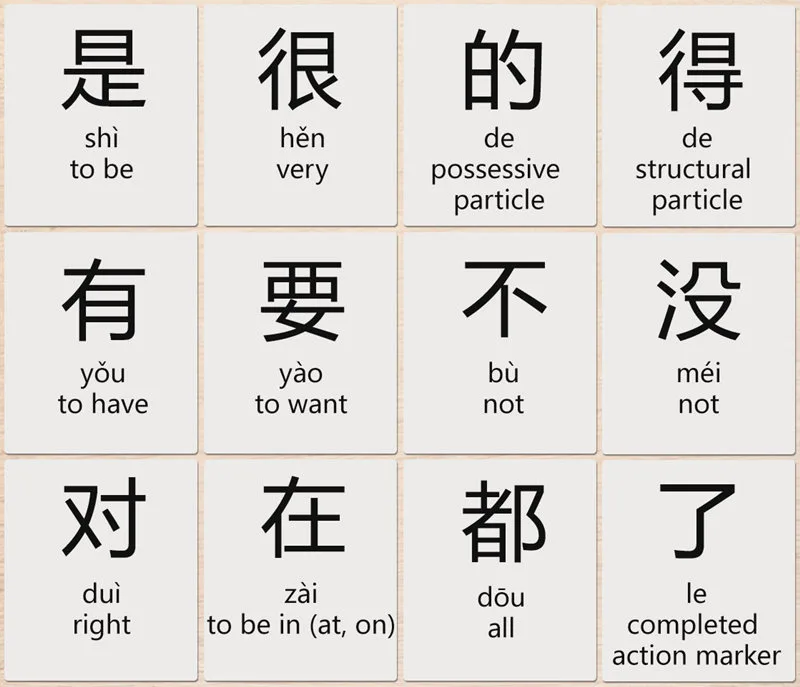
Chinese grammar depends heavily on a small set of neutral-tone particles that sit at the end of sentences or at specific positions to mark questions, change of state, suggestions, possession, modification, and more.
These particles do not conjugate - Chinese has no verb tense system - so they do a great deal of the grammatical work that English does with tense and auxiliary verbs. A Chinese sentence without the right particle at the right place can be ambiguous, marked for the wrong register, or simply ungrammatical.
This page covers the most important Chinese particles: 了 le, 吗 ma, 吧 ba, 呢 ne, 的 de, 得 de, 地 de. For wider context, see the Chinese grammar rules guide. For the measure words that often appear alongside these particles, see the Chinese measure words reference. For the characters you'll encounter, see the Chinese characters and radicals guide.
了 (le) - Completion and Change of State
了 is two particles in one that only context and position can disambiguate.
Le1: verbal aspect (completion)
Placed immediately after the verb. Marks that the action has been completed (or will be, if in future context) as an event.
- 我吃了饭。 wǒ chī le fàn. I ate food.
- 他买了一本书。 tā mǎi le yì běn shū. He bought a book.
This does not tie the verb to past tense; it marks the action as complete.
Le2: sentence-final (change of state / new situation)
Placed at the end of the sentence. Signals that the situation has changed, that a new state has arrived, or that the speaker is reporting the current state of affairs.
- 下雨了。 xià yǔ le. It's raining (now / has started raining).
- 他是学生了。 tā shì xuéshēng le. He is a student now (became one).
- 我懂了。 wǒ dǒng le. I understand now (I didn't before).
Double le (verbal + sentential)
Both le's in one sentence: completion plus current relevance.
- 我吃了三碗饭了。 wǒ chī le sān wǎn fàn le. I have eaten three bowls of rice (and I'm still eating or that's the situation now).
Negation of le
You do not say "不 + verb + le." Instead, 没 (méi) negates completed actions, and le disappears:
- Affirmative: 我吃了饭。 I ate.
- Negative: 我没吃饭。 wǒ méi chī fàn. I didn't eat.
吗 (ma) - Yes/No Question Marker
Added to the end of a declarative sentence to turn it into a yes/no question. No other change is needed.
- 你是学生。 You are a student.
- 你是学生吗? nǐ shì xuéshēng ma? Are you a student?
Alternative question forms exist (the A-not-A pattern: 你是不是学生?), but 吗 is the simplest and most common.
吗 is not used after question words (谁, 什么, 哪里, 几, etc.) because those already mark questions:
- Wrong: *你去哪里吗?
- Right: 你去哪里? nǐ qù nǎlǐ? Where are you going?
吧 (ba) - Suggestion, Supposition, Softening
A multi-purpose softening particle at the end of a sentence.
Suggestion / invitation
- 我们走吧。 wǒmen zǒu ba. Let's go.
- 吃饭吧。 chī fàn ba. Let's eat.
Mild command (less forceful than a bare command)
- 坐吧。 zuò ba. Have a seat.
- 快一点吧。 kuài yī diǎn ba. Hurry up a bit.
Supposition / seeking agreement
- 你是中国人吧? nǐ shì Zhōngguórén ba? You're Chinese, right?
- 很好吧? hěn hǎo ba? Pretty good, isn't it?
Acceptance / concession
- 好吧。 hǎo ba. Fine, OK then.
吧 always softens the tone. A command without 吧 sounds abrupt; with 吧 it's collegial.
呢 (ne) - Follow-up Question / Continuation
呢 plays several overlapping roles.
Bouncing back a question
- 我很好,你呢? wǒ hěn hǎo, nǐ ne? I'm fine, and you?
- 我喜欢茶,你呢? wǒ xǐhuān chá, nǐ ne? I like tea, and you?
Softening a question or indicating curiosity
- 你在做什么呢? nǐ zài zuò shénme ne? What are you doing (I wonder)?
Marking continuous / ongoing action
- 他在睡觉呢。 tā zài shuìjiào ne. He is sleeping.
Pause / rhetorical
- 学中文呢,不容易。 xué Zhōngwén ne, bù róngyì. As for learning Chinese, it's not easy.
Ne is never used with yes/no questions formed by 吗. You say 你呢 (and you?) as a follow-up but not in place of ma.
的 (de) - Possession, Attribution, Modifier
的 is the single most common Chinese character. It connects a modifier (an adjective phrase, possessor, or descriptive clause) to the noun it modifies.
Possession
- 我的书 wǒ de shū - my book
- 老师的话 lǎoshī de huà - the teacher's words
Adjectival modifier (for multi-syllable adjectives)
- 漂亮的花 piàoliang de huā - pretty flower
- 有意思的电影 yǒu yìsi de diànyǐng - interesting movie
One-syllable adjectives often don't need 的: 好书 (good book), 大问题 (big problem).
Relative-clause modifier
- 我买的书 wǒ mǎi de shū - the book I bought
- 昨天来的人 zuótiān lái de rén - the person who came yesterday
Nominalization (making an adjective or verb phrase into a noun)
- 红色的 hóngsè de - the red one
- 我买的 wǒ mǎi de - the one I bought
Emphatic 是...的 structure (past events)
To emphasize time, place, or manner of a past event:
- 我是昨天来的。 wǒ shì zuótiān lái de. It was yesterday that I came.
得 (de) - Degree / Result Complement
得 (pronounced de with neutral tone in this role) connects a verb to a degree or result complement that describes how the action is performed.
Degree complement
- 他说得很好。 tā shuō de hěn hǎo. He speaks well.
- 跑得快 pǎo de kuài - runs fast
Pattern: Verb + 得 + adjective/adverb.
Potential complement
- 吃得完 chī de wán - can finish eating
- 听不懂 tīng bù dǒng - can't understand (no 得 in negative: 不)
Be careful: 的 vs 得
Both are pronounced de, but they never swap:
- 的 = after modifier of a noun: 红的花
- 得 = after verb describing how: 说得快
- 地 = after modifier of a verb: 高兴地说 (speaks happily)
地 (de) - Adverbial Modifier
的 describes nouns; 地 describes verbs. When an adjective becomes an adverb modifying a verb, 地 appears.
- 慢慢地走 màn màn de zǒu - walk slowly
- 高兴地笑 gāoxìng de xiào - smile happily
- 认真地学习 rènzhēn de xuéxí - study diligently
This is a written distinction; in speech all three (的, 得, 地) are pronounced de.
Putting It All Together
Table 1. Quick comparison of the three de particles.
| Particle | Position | Function | Example |
|---|---|---|---|
| 的 | after modifier + noun | noun modification | 我的书 |
| 得 | after verb + complement | degree/result of action | 说得好 |
| 地 | after modifier + verb | adverbial | 慢慢地走 |
Table 2. Quick comparison of sentence-final particles.
| Particle | Adds | Example | Translation |
|---|---|---|---|
| 了 | completion / change | 下雨了 | It's raining (now) |
| 吗 | yes/no question | 你好吗? | Are you well? |
| 吧 | suggestion / softening | 走吧 | Let's go |
| 呢 | continuation / return question | 你呢? | And you? |
Common Mistakes Learners Make
- Using 了 for past tense. 了 marks completion, not tense. "I go to school every day" is a habitual present, not needing 了, even if translated with past-tense English forms.
- Negating with 不...了. Wrong. Past negative is 没, and le disappears: 没吃 (didn't eat), not *不吃了.
- Using 吗 with question words. *你去哪里吗 is ungrammatical. Remove 吗.
- Confusing 的, 得, 地. Written distinction matters in formal Chinese.
- Over-using 吗. When a sentence already has 呢 or 吧, don't add 吗.
- Mis-placing 了. 了 after the verb means completion; at the sentence end means change of state. Both together are allowed.
- Treating 吧 as just "ok." 吧 softens commands, suggests, invites, supposes - a full meaning cluster.
- Missing 了 in "change" sentences. 我会了 (I can [now]) needs le to mark new capability. Without le, 我会 just means "I can."
Quick Reference Summary
- 了 (le): completion after verb; change of state at sentence end.
- 吗 (ma): yes/no question marker.
- 吧 (ba): suggestion, softening.
- 呢 (ne): return question, ongoing state, rhetorical pause.
- 的 (de): nominal modifier / possession.
- 得 (de): verbal degree complement.
- 地 (de): adverbial modifier.
FAQ
Is 了 a past tense marker?
No. It is an aspect marker (completion) or a sentence-final change-of-state marker. Chinese has no grammatical tense - time is shown by adverbs or context.
Can I use 吗 with 吧?
Usually not; they serve different functions (question vs suggestion). Combinations like 吧 or 好吗? (...right?) exist but are separate constructions.
What's the difference between 吗 and 呢?
吗 makes a yes/no question. 呢 makes a continuation question ("and you?"), or a question where the listener is already expected to understand the topic.
Are the three "de" (的, 得, 地) really different?
In writing yes; in speech they all sound like neutral-tone de. Modern informal Chinese sometimes conflates 地 with 的, but formal writing keeps them distinct.
Can 了 appear twice in one sentence?
Yes. 我吃了三碗饭了 (I have eaten three bowls - verbal le + sentence-final le). The first marks completion of eating each bowl; the second marks the current state.
Is "没有" the same as "没"?
没有 is the full form; 没 is the short form. For past negation, 没 (or 没有) negates the action, and 了 disappears.
Do these particles have tones?
Almost all sentence-final particles (了, 吗, 吧, 呢, 的, 得, 地) are neutral tone. They borrow pitch from the previous syllable.
See Also
- Chinese grammar rules complete beginners guide
- Chinese tones complete guide
- Chinese four tones plus neutral reference
- Pinyin complete guide
- Chinese characters and radicals guide for beginners
- Chinese radicals 214 Kangxi reference
- Chinese measure words classifiers reference
- Chinese HSK 1 vocabulary reference
Frequently Asked Questions
Is 了 a past tense marker?
No. 了 is an aspect marker (completion) after verbs, or a sentence-final change-of-state marker. Chinese has no grammatical tense; time is shown by adverbs or context.
Can I combine 吗 with 吧?
Generally no. They serve different roles (yes/no question vs suggestion). Some fixed forms like 好吗 (…right?) combine them, but those are separate constructions.
What's the difference between 吗 and 呢?
吗 forms a yes/no question. 呢 bounces a question back to another person (你呢?) or marks continuation / rhetorical pause.
Are the three 'de' particles really different?
In writing yes: 的 modifies nouns, 得 follows verbs for degree/result, 地 makes adverbs. In speech all sound like neutral-tone de, and informal writing sometimes conflates them, but standard writing keeps them separate.
Can 了 appear twice in one sentence?
Yes. 我吃了三碗饭了 (I have eaten three bowls of rice) has a verbal 了 and a sentence-final 了. The first marks completion; the second marks the current state.
Is 没有 the same as 没?
没有 is the fuller form; 没 is the shorter one. Both negate completed actions, causing 了 to disappear.
Do these particles have tones?
All sentence-final particles (了, 吗, 吧, 呢, 的, 得, 地) are neutral tone, borrowing pitch from the preceding syllable.