
The who vs whom distinction trips up even confident writers. It feels like one of those grammar rules that belongs to a more formal era, and in many casual contexts, that instinct is correct. But in professional writing, academic work, and formal communication, using whom correctly signals precision and polish that sets your writing apart.
The truth is that the rule behind who and whom is straightforward once you learn one simple trick. This guide covers that trick in depth, gives you dozens of real examples across multiple contexts, explains when formality matters and when it does not, walks through the tricky whoever vs whomever distinction, and provides practice sentences to build your confidence.
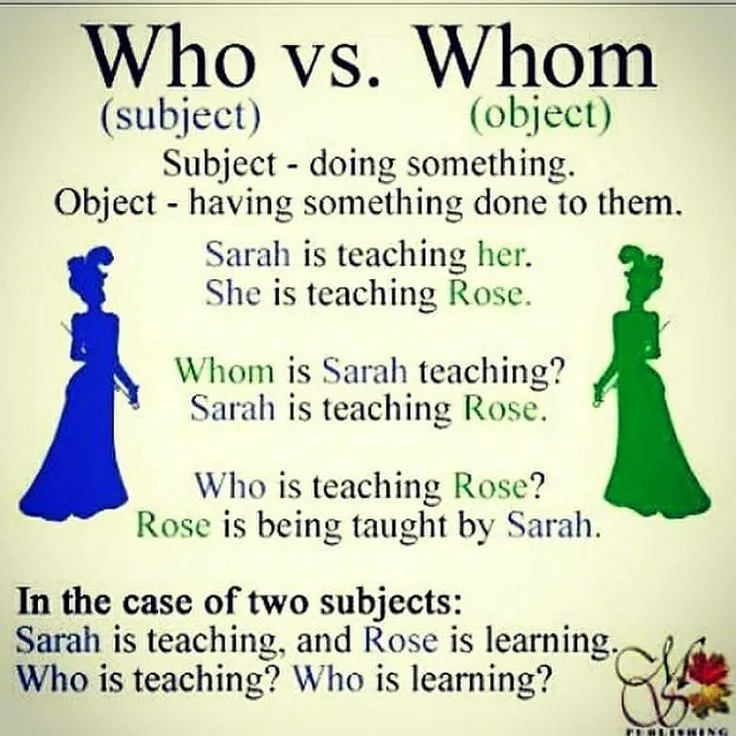
The Core Rule - Subject vs Object
The distinction between who and whom comes down to one grammatical concept:
- Who is a subject pronoun. It performs the action in the sentence or clause.
- Whom is an object pronoun. It receives the action or is acted upon.
This is the same distinction as he vs him, she vs her, or they vs them. If you understand those pairs, you already understand who vs whom - you just need to map the same logic to a different pair of words.
| Subject Pronouns (do the action) | Object Pronouns (receive the action) |
|---|---|
| I | me |
| he | him |
| she | her |
| we | us |
| they | them |
| who | whom |
Why This Feels Hard
The reason who vs whom feels more confusing than he vs him is that who and whom typically appear at the beginning of a clause or question, which puts them far from the verb that determines their role. With he/him, the pronoun usually sits right next to the verb: "He called" vs "I called him." With who/whom, you might encounter a sentence like "The person who/whom the committee selected will start Monday," where the pronoun and its verb are separated by several words.
The substitution trick solves this problem by letting you rearrange the sentence into a simpler form.
The He/Him Substitution Trick
This is the single most reliable method for choosing between who and whom. It works every time, in every context, without requiring you to remember grammatical terminology.
The rule: If you can substitute he (or she/they), use who. If you can substitute him (or her/them), use whom.
The memory link: both him and whom end in the letter m.
How to Apply the Trick Step by Step
The substitution test turns a grammar judgement into a mechanical check, which is why it works under pressure. Rearrange the sentence into a simple statement, swap in he or him, and let the one that sounds right decide the answer. The steps below walk through it in order, and with practice the whole check takes a couple of seconds.
- Take the sentence or question containing who/whom.
- Rearrange it (if needed) into a simple statement.
- Substitute he or him in place of who/whom.
- If he works, use who. If him works, use whom.
Examples with the Trick Applied
| Question/Sentence | Rearranged | Substitution | Answer |
|---|---|---|---|
| _____ wrote this report? | He wrote this report. | He works | Who |
| _____ did you invite? | You did invite him. | Him works | Whom |
| _____ is responsible for this? | He is responsible for this. | He works | Who |
| To _____ should I address the letter? | I should address the letter to him. | Him works | Whom |
| _____ called the meeting? | He called the meeting. | He works | Who |
| _____ are you meeting with? | You are meeting with him. | Him works | Whom |
| The candidate _____ we interviewed was excellent. | We interviewed him. | Him works | Whom |
| The person _____ left this message should call back. | He left this message. | He works | Who |
| _____ do you think will be promoted? | You think he will be promoted. | He works | Who |
| _____ should we notify about the change? | We should notify him. | Him works | Whom |
A Note on "He" vs "Him" - Why the Trick Works
This trick works because who and he are both nominative (subject) case pronouns, while whom and him are both objective (object) case pronouns. They follow the same grammatical rules, so if one fits, the other will too. The "m" ending shared by him and whom is a coincidence of English word formation, but it is a genuinely useful memory hook.
Who as a Subject - Definitions and Examples
Who is used when the pronoun is the subject of a verb - the person performing the action. The subject is the "doer" in the clause.
Who in Questions
- Who is leading the project? (He is leading the project.)
- Who wants to go first? (She wants to go first.)
- Who approved this expense? (He approved this expense.)
- Who will be attending the conference? (They will be attending.)
- Who told you about the meeting? (He told you.)
- Who is the point of contact for this client? (She is the point of contact.)
- Who submitted the final version? (He submitted it.)
- Who handles payroll for the department? (She handles payroll.)
- Who made the decision to cancel? (He made the decision.)
- Who is responsible for quality assurance? (She is responsible.)
Who in Statements and Relative Clauses
- The manager who approved the budget is on leave.
- Anyone who wants to participate should sign up by Friday.
- She is the one who deserves the credit.
- The developer who fixed the bug received a bonus.
- People who arrive late will miss the opening remarks.
- I spoke with the consultant who specializes in mergers.
- The employee who raised the concern wishes to remain anonymous.
- It was Sarah who finalized the contract.
- A leader who listens earns the team's respect.
- Students who complete extra credit assignments tend to perform better.
- The vendor who offers the best pricing will be selected.
- The architect who designed the building won several awards.
In each case, who is performing the action of the verb that follows it (approved, wants, deserves, fixed, arrive, specializes, raised, finalized, listens, complete, offers, designed).
Whom as an Object - Definitions and Examples
Whom is used when the pronoun is the object of a verb or preposition - the person receiving the action or being acted upon. The object is the "receiver" in the clause.
Whom in Questions
- Whom did you call? (You called him.)
- Whom should I contact about this issue? (I should contact her.)
- Whom are they considering for the role? (They are considering him.)
- Whom did the committee select? (The committee selected her.)
- For whom was this report prepared? (It was prepared for him.)
- With whom are you collaborating? (You are collaborating with her.)
- Whom did the company hire? (The company hired him.)
- To whom should I send the invoice? (I should send it to him.)
- Whom did you recommend for the position? (You recommended her.)
- Whom did the board appoint as treasurer? (The board appointed him.)
Whom in Statements and Relative Clauses
- The candidate whom we interviewed was impressive.
- She is the manager whom everyone respects.
- The clients whom we serve expect timely responses.
- He is someone whom I have always admired.
- The colleague whom you recommended has been hired.
- The speaker whom they invited canceled at the last minute.
- The person whom you need to contact is in another department.
- The vendor whom we selected offers the best pricing.
- The intern whom the director mentored has been promoted.
- The professor whom the students praised will receive a teaching award.
- The consultant whom the firm retained provided valuable insights.
- The candidate whom the panel chose exceeded all expectations.
In each case, whom receives the action. Someone else is doing the calling, contacting, considering, selecting, interviewing, respecting, serving, admiring, recommending, inviting, selecting, mentoring, praising, retaining, or choosing.
Who vs Whom After Prepositions
One of the clearest signals for whom is when it follows a preposition (to, for, with, by, from, about, between, among). After a preposition, the pronoun is always in the object case, so whom is correct.
| Preposition + Whom | Example |
|---|---|
| to whom | To whom should I address this complaint? |
| for whom | For whom are you buying the gift? |
| with whom | With whom did you discuss the proposal? |
| by whom | By whom was this decision made? |
| from whom | From whom did you receive the information? |
| about whom | About whom are they talking? |
| between whom | The agreement is between whom? |
| among whom | The funds were distributed among whom? |
| beside whom | Beside whom did you sit at dinner? |
| without whom | The person without whom this project would have failed. |
| through whom | The contact through whom we obtained the data. |
The Informal Shift - Moving the Preposition
In casual English, speakers frequently move the preposition to the end of the sentence and use who instead of whom. This is sometimes called "preposition stranding" and is perfectly acceptable in informal contexts:
| Formal | Informal |
|---|---|
| To whom did you speak? | Who did you speak to? |
| With whom are you going? | Who are you going with? |
| For whom is this intended? | Who is this intended for? |
| From whom did you hear that? | Who did you hear that from? |
| About whom are you talking? | Who are you talking about? |
| By whom was the memo written? | Who was the memo written by? |
Both forms are grammatically defensible. The formal versions with whom are preferred in professional writing, legal documents, academic papers, and formal correspondence. The informal versions with who are standard in everyday speech, casual emails, text messages, and conversational writing.
The old "rule" that you should never end a sentence with a preposition has been discredited by virtually every modern usage guide. It was based on Latin grammar, not English, and insisting on it often produces awkward, stilted sentences.
Whoever vs Whomever
Whoever and whomever follow the exact same subject-object rule as who and whom, and the same he/him substitution trick applies.
- Whoever = subject (he/she/they) - performs the action
- Whomever = object (him/her/them) - receives the action
The Key to Getting It Right
Focus on the pronoun's role within its own clause, not its role in the overall sentence. This is where most people make mistakes, because the clause containing whoever/whomever often functions as an object in the larger sentence, tempting writers to choose whomever incorrectly.
Examples with Analysis
| Sentence | Clause Analysis | Correct Choice |
|---|---|---|
| Give the assignment to _____ finishes first. | _____ finishes first (he finishes first - subject) | whoever |
| Invite _____ you want to the meeting. | you want _____ (you want him - object) | whomever |
| _____ said that is mistaken. | _____ said that (he said that - subject) | Whoever |
| We will hire _____ the committee recommends. | the committee recommends _____ (recommends him - object) | whomever |
| _____ wins the election will face tough decisions. | _____ wins (he wins - subject) | Whoever |
| Send the link to _____ needs it. | _____ needs it (he needs it - subject) | whoever |
| The award goes to _____ the jury selects. | the jury selects _____ (selects him - object) | whomever |
| _____ is available should take the call. | _____ is available (he is available - subject) | Whoever |
| Donate the supplies to _____ can use them. | _____ can use them (he can use them - subject) | whoever |
| The manager will promote _____ she deems most qualified. | she deems _____ most qualified (deems him - object) | whomever |
The Tricky Cases Explained
The most confusing whoever/whomever sentences involve a clause that looks like it should be an object but actually contains a subject.
Example: Give the prize to whoever deserves it.
This feels like it should be whomever because it follows the preposition "to." But look at the clause: "whoever deserves it." Within that clause, the pronoun is the subject (he deserves it, not him deserves it). The entire clause "whoever deserves it" is the object of "to," but within the clause itself, whoever is the subject of "deserves."
Another tricky example: We will work with whoever is available.
Again, "whoever" follows the preposition "with," which tempts you toward whomever. But the clause is "whoever is available," and within that clause, the pronoun is the subject of "is."
Rule of thumb: If the pronoun is followed by a verb (and is the one performing that verb), use whoever, even if the whole clause is an object of a preposition.
When whomever is actually correct: The manager will assist whomever the team selects.
Here, the clause is "the team selects whomever." The team (subject) selects whomever (object). "Him" substitutes correctly: "the team selects him."
Formal vs Informal Usage - When It Matters
When to Use Whom (Formal Contexts)
- Academic papers, dissertations, and theses
- Legal documents, contracts, and court filings
- Business proposals and formal reports
- Professional correspondence with senior leadership or clients
- Published articles, books, and journals
- Resumes, cover letters, and job applications
- Grant applications and funding proposals
- Official organizational communication and press releases
- Formal speeches and prepared remarks
When Who Is Acceptable for Both (Informal Contexts)
- Casual emails to colleagues you know well
- Text messages, instant messaging, and chat
- Social media posts and comments
- Everyday conversation
- Blog posts and articles with a conversational tone
- Internal team communication and Slack messages
- Personal writing, journals, and letters to friends
- Creative writing where a natural voice is desired
The Trend Toward Informality
Language evolves, and whom is gradually becoming less common in everyday English. Many linguists consider whom to be in decline, and some predict it may eventually disappear from casual usage entirely. Major usage guides like Merriam-Webster and the Associated Press Stylebook acknowledge that who is widely accepted in informal contexts where whom would be technically correct.
However, whom remains firmly established in formal writing and is still expected in contexts where precision and professionalism matter. The divide between formal and informal English is not shrinking - if anything, it is becoming more distinct. Professional documents demand the same level of grammatical precision they always have, even as casual communication becomes more relaxed.
The practical advice is straightforward: learn the rule, apply it in formal contexts, and relax it in casual ones. Knowing when to use whom and choosing not to in informal settings is very different from not knowing the rule at all. The first demonstrates flexibility; the second signals a gap in knowledge.
Common Mistakes and How to Fix Them
Mistake 1: Using Whom as a Subject
Wrong: The employee whom is responsible should step forward.
Correct: The employee who is responsible should step forward.
Test: He is responsible (not him is responsible), so who is correct.
Wrong: I need to find whom left this package.
Correct: I need to find who left this package.
Test: He left this package (not him left this package).
Wrong: Whom will be leading the project?
Correct: Who will be leading the project?
Test: He will be leading (not him will be leading).
Mistake 2: Using Who as an Object
Wrong: The person who I called did not answer.
Correct: The person whom I called did not answer.
Test: I called him (not I called he), so whom is correct.
Wrong: The client who we met last week sent a follow-up.
Correct: The client whom we met last week sent a follow-up.
Test: We met him (not we met he).
Wrong: Who did you vote for?
Correct (formal): Whom did you vote for? (or: For whom did you vote?)
Note: In casual contexts, "Who did you vote for?" is widely accepted.
Mistake 3: Hypercorrection with Whom
Hypercorrection happens when writers use whom because it "sounds fancier" without checking whether it is actually correct. This is arguably worse than using who incorrectly, because it signals a misunderstanding of the rule rather than a casual relaxation of it.
Wrong: I will work with whom is available.
Correct: I will work with whoever is available.
Test: He is available (not him is available). The pronoun is the subject of "is available," so whoever is correct despite following a preposition.
Wrong: The award goes to whom works the hardest.
Correct: The award goes to whoever works the hardest.
Test: He works the hardest (subject).
Wrong: Give it to whom wants it.
Correct: Give it to whoever wants it.
Test: He wants it (subject).
Mistake 4: Using Whom in Casual Contexts Where It Sounds Stiff
Awkward: Whom are you texting?
Natural: Who are you texting?
Awkward: Whom did you hang out with this weekend?
Natural: Who did you hang out with this weekend?
While "whom" is technically correct in these sentences, it sounds overly stiff in casual conversation. In informal contexts, who is the better choice for readability and natural tone.
Mistake 5: Whoever vs Whomever Confusion
Wrong: Send the invitation to whomever wants to attend.
Correct: Send the invitation to whoever wants to attend.
Test: He wants to attend (subject within the clause), so whoever is correct.
Wrong: Whoever the team nominates will receive the award.
Correct: Whomever the team nominates will receive the award.
Test: The team nominates him (object within the clause), so whomever is correct. Note: "whomever the team nominates" as a whole clause is the subject of "will receive," but within the clause, whomever is the object.
Who and Whom in Relative Clauses
Relative clauses are introduced by who or whom (or that/which for things) and provide additional information about a noun. Understanding the two types of relative clauses helps you apply who and whom correctly and set up punctuation properly.
Essential (Restrictive) Clauses - No Commas
These clauses are necessary to identify which person you mean. Without them, the sentence would be ambiguous or incomplete:
- The applicant who scored highest will be interviewed first.
- The vendor whom we selected has confirmed availability.
- Employees who complete the training receive a certificate.
- The colleague whom you recommended was excellent.
- The candidate who submitted the most comprehensive proposal won.
- The person whom the police questioned was later released.
Nonessential (Nonrestrictive) Clauses - With Commas
These clauses add extra information about a person already identified. They are set off by commas because removing them would not change the core meaning:
- Dr. Martinez, who leads the research team, presented the findings.
- The CEO, whom the board appointed last year, announced the restructuring.
- My manager, who has been with the company for 15 years, is retiring.
- Sarah Chen, whom we met at the conference, joined our advisory board.
- Professor Williams, who teaches advanced statistics, published a new textbook.
- The keynote speaker, whom the organizers selected months ago, canceled last minute.
The who/whom choice works the same way regardless of whether the clause is essential or nonessential. The clause type determines comma placement, not pronoun choice.
Who vs Whom in Professional Writing Scenarios
Job Descriptions and Hiring
- We are looking for someone who thrives in fast-paced environments. (He thrives - subject.)
- The candidate whom we select will start in January. (We select him - object.)
- Who is the ideal candidate for this role? (He is the ideal candidate - subject.)
- To whom should applications be submitted? (Applications should be submitted to him - object.)
Client Communication
- The account manager who handles your portfolio will be in touch. (He handles - subject.)
- Please let us know whom you would like to speak with. (You would like to speak with him - object.)
- Who should I copy on this email? (Informal, widely accepted.)
- To whom it may concern: (Standard formal opening.)
Meeting and Project Contexts
- Who is chairing the meeting? (He is chairing - subject.)
- Whom did you assign to the task? (You assigned him - object.)
- The team members who volunteered will lead the initiative. (They volunteered - subject.)
- The stakeholders whom we consulted support the proposal. (We consulted them - object.)
Legal and Compliance Writing
- The parties who entered the agreement are bound by its terms. (They entered - subject.)
- The individual whom the investigation concerns has been notified. (The investigation concerns him - object.)
- Any employee who violates the policy will face disciplinary action. (He violates - subject.)
- The witnesses whom the prosecution called testified under oath. (The prosecution called them - object.)
Who and Whom in Common Phrases and Expressions
Many everyday phrases and fixed expressions use who or whom. Knowing these can help you avoid errors in familiar constructions.
Phrases with Who
| Phrase | Example |
|---|---|
| who knows | Who knows what will happen next? |
| who cares | Who cares about the formatting? |
| who is to say | Who is to say which approach is better? |
| anyone who | Anyone who is interested should sign up. |
| those who | Those who arrived early got the best seats. |
| someone who | We need someone who understands the system. |
| the one who | She is the one who made it possible. |
Phrases with Whom
| Phrase | Example |
|---|---|
| to whom it may concern | To whom it may concern: (formal letter opening) |
| from whom | The person from whom I learned the most was my first manager. |
| with whom | The colleagues with whom I work are highly skilled. |
| to whom | To whom should I direct this inquiry? |
| for whom | The clients for whom we work expect excellence. |
| by whom | By whom was the decision authorized? |
| of whom | Several candidates, three of whom are internal, applied. |
The "To Whom It May Concern" Construction
This formal salutation is one of the most recognized uses of whom in English. It remains standard in formal correspondence when the recipient is unknown. Less formal alternatives include:
- Dear Hiring Manager
- Dear Sir or Madam
- Dear [Department Name] Team
However, "To whom it may concern" remains correct and appropriate in many formal contexts, including legal correspondence, official complaints, and reference letters.
Who and Whom with "Do You Think" and Similar Insertions
A particularly tricky construction occurs when phrases like "do you think," "does she believe," or "would you say" are inserted into a who/whom question. These insertions can confuse the analysis if you are not careful.
The key rule: ignore the insertion when applying the he/him test. The insertion does not change whether who or whom is correct.
Examples
Who do you think will be promoted? Remove "do you think": Who will be promoted? -> He will be promoted. -> Who is correct.
Whom do you think they will promote? Remove "do you think": Whom will they promote? -> They will promote him. -> Whom is correct.
Who does she believe is the best candidate? Remove "does she believe": Who is the best candidate? -> He is the best candidate. -> Who is correct.
Whom would you say the committee should select? Remove "would you say": Whom should the committee select? -> The committee should select him. -> Whom is correct.
| Full Question | Without Insertion | Test | Answer |
|---|---|---|---|
| Who do you think called? | Who called? | He called. | Who |
| Whom do you think she called? | Whom did she call? | She called him. | Whom |
| Who does he believe is responsible? | Who is responsible? | He is responsible. | Who |
| Whom does he believe they chose? | Whom did they choose? | They chose him. | Whom |
| Who would you say deserves the award? | Who deserves the award? | He deserves it. | Who |
This pattern appears frequently in professional writing and interviews. Once you learn to mentally remove the insertion, the correct choice becomes obvious.
Practice Sentences
Choose the correct word for each blank. Answers follow below.
- _____ left this message on my desk?
- The consultant _____ we hired starts on Monday.
- _____ should I contact about the shipment delay?
- She is the person _____ I trust most on this team.
- _____ is in charge of the holiday schedule?
- The intern _____ organized the files did an excellent job.
- To _____ should I address this letter?
- I do not know _____ approved the purchase order.
- Give the files to _____ requests them.
- The manager _____ you reported to has been reassigned.
- _____ did the committee nominate for the award?
- _____ wants to volunteer should contact the front desk.
- The clients for _____ we prepared the presentation were impressed.
- _____ do you think will be promoted?
- We will support _____ the team selects as chair.
- The employee _____ the director praised received a raise.
- _____ is the most qualified candidate for this position?
- The mentor _____ guided me through my first year has retired.
- _____ should receive the notification about the schedule change?
- The vendors _____ we contacted all submitted bids.
Answers
- Who (He left this message - subject)
- whom (we hired him - object)
- Whom (I should contact him - object)
- whom (I trust him - object)
- Who (He is in charge - subject)
- who (he organized the files - subject)
- whom (I should address it to him - object of preposition)
- who (he approved it - subject)
- whoever (he requests them - subject within clause)
- whom (you reported to him - object of preposition)
- Whom (the committee nominated him - object)
- Whoever (he wants to volunteer - subject)
- whom (we prepared it for them - object of preposition)
- Who (he will be promoted - subject of "will be promoted")
- whomever (the team selects him - object within clause)
- whom (the director praised him - object)
- Who (He is the most qualified - subject)
- who (he guided me - subject)
- Who (He should receive - subject)
- whom (we contacted them - object)
Quick-Reference Summary
| Use... | When... | Test |
|---|---|---|
| who | the pronoun is the subject (performs the action) | substitute he - does it work? |
| whom | the pronoun is the object (receives the action) | substitute him - does it work? |
| whoever | subject within its clause | substitute he within the clause |
| whomever | object within its clause | substitute him within the clause |
The Complete Decision Process
For who vs whom:
- Identify the clause containing who/whom.
- Rearrange it into a statement if it is a question.
- Substitute he or him.
- He works -> who. Him works -> whom.
For whoever vs whomever:
- Isolate the whoever/whomever clause.
- Determine the pronoun's role within that clause only.
- Substitute he or him within the clause.
- He works -> whoever. Him works -> whomever.
For formal vs informal:
- Determine your audience and context.
- Formal writing: apply the rule consistently.
- Informal writing: who is acceptable in most positions.
Final Recommendations
Master the he/him trick. It handles every who/whom and whoever/whomever situation reliably. Practice it until it takes only a few seconds.
Match your formality to your audience. Use whom in formal writing where precision is expected. Relax to who in casual contexts where whom would sound stiff.
Do not hypercorrect. Using whom where who belongs sounds worse than the reverse. Incorrect whom signals that you are trying to sound formal without understanding the underlying rule, which is more damaging to your credibility than simply using who.
Watch for prepositions. After to, for, with, by, from, and similar prepositions, whom is usually correct - but check whether the pronoun is actually the subject of its own clause before deciding. "Give it to whoever asks" is correct despite the preposition.
Practice with real sentences. The more you apply the he/him test, the faster it becomes automatic. Within a few weeks of deliberate practice, the distinction will feel natural and require no conscious effort.
When in genuine doubt, restructure. If a sentence feels awkward with either who or whom, rewrite it. "The person I called" avoids the choice entirely while sounding perfectly natural. "The person that we hired" works just as well as "the person whom we hired."
Remember that whom is not disappearing from formal English. Despite its decline in casual speech, whom remains standard and expected in professional, academic, and legal writing. Learning the rule is an investment that pays dividends throughout your career.
Focus on the clause, not the overall sentence. This is the single most important principle for whoever/whomever decisions. The pronoun's role within its own clause determines the correct form, regardless of how the clause functions in the larger sentence.
Knowing who vs whom is less about rigid rule-following and more about having a tool in your toolkit. Use it when the situation calls for precision, and let it go when the context is casual. That flexibility - knowing the rule and knowing when to relax it - is the mark of a skilled writer.
Frequently Asked Questions
What is the simplest trick for choosing between who and whom?
The he/him substitution trick is the most reliable shortcut. Rearrange the sentence or question so you can substitute he or him in place of who or whom. If he sounds correct, use who. If him sounds correct, use whom. The key is that both him and whom end in the letter m, making them easy to pair.
For example, take the question who or whom did you call.
Rearrange it to you did call him, which sounds right, so the answer is whom did you call. For who or whom is calling, rearrange to he is calling, which works, so the answer is who is calling. This trick works in virtually every situation and requires no knowledge of grammatical terminology.
Is it acceptable to use who instead of whom in casual writing?
In casual and informal writing, using who in place of whom is widely accepted and often sounds more natural. Phrases like who did you talk to are perfectly standard in everyday conversation, text messages, social media posts, and informal emails. Many style guides acknowledge that whom can sound overly stiff in casual contexts.
However, in formal writing such as academic papers, legal documents, business proposals, and professional reports, using whom correctly demonstrates grammatical precision and strengthens your credibility. The safest approach is to match your audience. Know the rule so you can apply it when formality demands it, and relax it when the situation calls for a conversational tone.
How do whoever and whomever differ from who and whom?
Whoever and whomever follow the exact same subject-versus-object rule as who and whom. Whoever functions as a subject pronoun, meaning it performs the action in its clause, while whomever functions as an object pronoun, meaning it receives the action. The same he/him substitution trick applies.
For whoever finished the report, substitute he finished the report, which works, confirming whoever is correct.
For give the file to whomever you choose, substitute you choose him, which works, confirming whomever. The tricky part is identifying which clause the pronoun belongs to. Focus on the pronoun’s role within its own clause, not its role in the larger sentence, and the correct choice becomes clear.