
"Lay" and "lie" are the most confused verbs in English, and the confusion has good company. Even professional writers get them wrong, editors correct them silently, and generations of schoolchildren have been handed the same half-useful rule their parents learned.
The reason is not that the verbs are complicated. They are straightforward. The reason is that one verb is transitive, one is intransitive, and the past tense of "lie" is "lay," which happens to be the present tense of the other verb. English was trolling us from the start.
This guide lays out the rule once, clearly. Then it shows you every form of each verb across every tense, every common use, and every trap where even careful writers slip. By the end, you will hear the difference automatically.
The One Rule That Solves Almost Everything
The rule that works: "lay" takes a direct object. "Lie" does not.
If you can put something after the verb (lay the book, lay the plate, lay the baby), use "lay." If the subject is doing the action to itself (I lie down, the cat lies on the sofa), use "lie."
That is it. That is the rule.
Lay (needs an object): I lay the book on the table.
Lie (no object): I lie on the sofa.

Lay (needs an object): Please lay the plates on the counter.
Lie (no object): Please lie still while the doctor examines you.

Lay (needs an object): The chicken lays an egg each morning.
Lie (no object): The dog lies on the rug each morning.
Everything after this is application of that one rule across different tenses, with the cruel wrinkle that the past tense of "lie" is spelled the same as the present tense of "lay."
The Forms You Need to Know
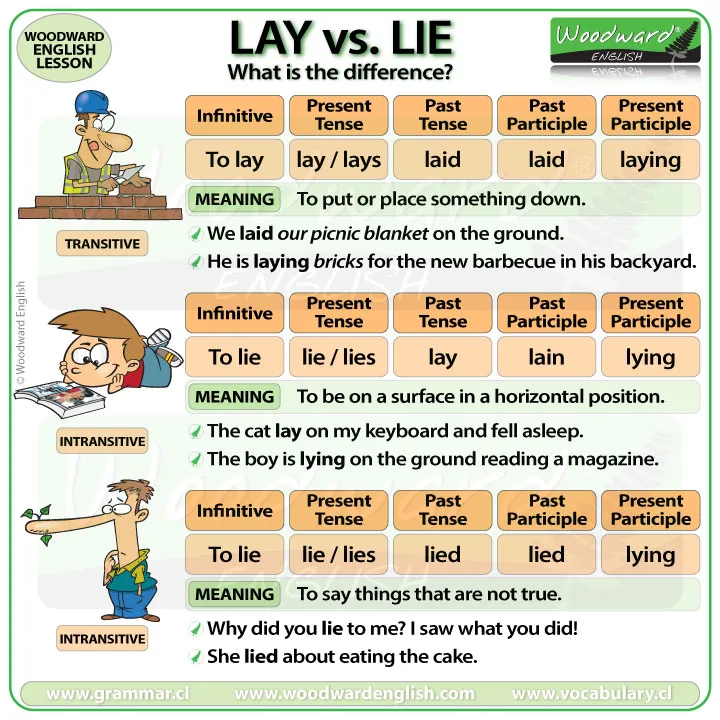
Both verbs have four forms: base, simple past, past participle, and present participle. Learning all four for both verbs takes about three minutes. Not learning them takes a lifetime of small edits from your editor.
| Verb | Base Form | Simple Past | Past Participle | Present Participle |
|---|---|---|---|---|
| Lay (transitive, needs object) | lay | laid | laid | laying |
| Lie (intransitive, to recline) | lie | lay | lain | lying |
| Lie (intransitive, to tell untruth) | lie | lied | lied | lying |
Yes, there are actually two verbs "lie" in English, both spelled and pronounced the same in the present tense. One means to recline, and it is an irregular verb with the forms lie, lay, lain. The other means to tell an untruth, and it is a regular verb with the forms lie, lied, lied. Context separates them easily.
Recline: I lie down for an afternoon nap. Yesterday I lay down. I have lain on this sofa for an hour.
Deceive: I lie about my age sometimes. Yesterday I lied about it. I have lied about it for years.
Why the Confusion Runs So Deep
The confusion between "lay" and "lie" comes from the past tense of the recline verb. "I lay on the sofa yesterday" is correct. "I laid on the sofa yesterday" is wrong. Native speakers who have never studied the forms hear "lay" and assume it is the present tense of the transitive verb, so they correct themselves to "laid" and introduce the error.
Grammar writers such as Mignon Fogarty of Grammar Girl point out that lie and lay confuse even careful writers because the past tense of one is identical to the present tense of the other, which is why memorizing the core forms, lay/laid/laid and lie/lay/lain, resolves most of the confusion.
There is also a dialectal pressure pushing toward "laid" in all contexts. In many American and British regional speech patterns, "laid" has replaced "lay" as the past tense of "lie." This is increasingly accepted in casual conversation, but it remains incorrect in formal writing, and copy editors still correct it.
Lay: Present and Past Examples
The transitive verb "lay" always takes a direct object. You lay something down. You cannot just "lay" in isolation unless you are a chicken laying an egg.
Present tense:
She lays the baby in the crib every evening at seven.
I lay the papers on the desk before the meeting.
The waiter lays the silverware carefully on each placemat.
The company lays new cable across the ocean floor.
Please lay the book face down on the shelf.
Simple past:
He laid the flowers on the grave.
I laid my jacket over the back of the chair.
The archaeologists laid the bones out on white paper.
She laid her head on my shoulder during the film.
We laid the foundation in September.
Past participle (used with "have," "has," or "had"):
The workers have laid tile in the bathroom.
By noon she had laid out every document for review.
The hen has laid six eggs this week.
They have laid the groundwork for the next phase.
Present participle:
The plumbers are laying pipe in the street.
Laying tile requires patience and a level.
She is laying the blame on her colleague unfairly.
Lie: Present and Past Examples
The intransitive verb "lie" (to recline) takes no object. The subject performs the action on itself.
Present tense:
I lie down after lunch to read.
The cat lies on the windowsill every afternoon.
Bodies lie in state at Westminster Hall during royal funerals.
The town lies on the banks of the Danube.
My responsibilities lie elsewhere this week.
Simple past (here is where everyone gets confused):
I lay down after lunch yesterday.
The cat lay on the windowsill all afternoon.
The wounded soldier lay on the battlefield for hours.
She lay awake for most of the night.
The treasure lay undiscovered for three centuries.
Past participle:
She has lain on that sofa for hours.
The manuscripts have lain in the archives untouched.
I had lain awake until dawn before the exam.
The dog has lain by the door all morning.
Present participle:
I am lying on the couch with a headache.
The dog is lying by the fire.
A fallen tree was lying across the road.
She spent the afternoon lying on the beach.
The Dead Giveaway: If You Can Replace It With "Place" or "Put"
A test that works in almost every case: can you replace the verb with "place" or "put"? If yes, use "lay." If no, use "lie."
I lay the book on the table. (I place the book on the table. Works.)
I lie on the sofa. (I place on the sofa. Nonsense. Use "lie.")

She laid the baby down. (She placed the baby down. Works.)
She lay down. (She placed down. Nonsense. Use "lie.")

Please lay the plate on the counter. (Please place the plate on the counter. Works.)
Please lie still. (Please place still. Nonsense. Use "lie.")
Whenever you doubt, try substituting "place" or "put." If the sentence still makes sense, the verb you need is "lay" in some form. If the substitution produces nonsense, use "lie."
The Special Case of "Lay Down the Law" and Other Idioms
Idiomatic expressions sometimes blur the rule, usually by making the object implicit or metaphorical. These expressions are fixed, and you should not try to "correct" them.
| Idiom | Meaning |
|---|---|
| Lay down the law | Establish strict rules |
| Lay low | Stay hidden and quiet |
| Lay claim to | Assert ownership |
| Lay it on thick | Exaggerate excessively |
| Lay of the land | The general situation |
| Lay bare | Reveal fully |
| Lay waste to | Destroy thoroughly |
| Lie in wait | Hide in order to surprise |
| Lie low | Stay out of sight (same meaning as "lay low") |
| Lie in state | A body on display before burial |
| Let sleeping dogs lie | Do not disturb a settled situation |
| The responsibility lies with | The duty belongs to |
Notice that "lay low" and "lie low" both appear with the same meaning. Both are accepted, though "lie low" is more traditional. "Lay low" also means to knock down or defeat (the flu laid him low), which is different.
When the Object Is Reflexive
A trick some writers use is to convert "lie" into "lay" by adding a reflexive pronoun (myself, himself, herself). This works, because "lay myself" has an object and is grammatically correct.
I lie down. (Intransitive, no object.)
I lay myself down. (Transitive, "myself" is the object.)

She lay on the bed. (Past tense, intransitive.)
She laid herself on the bed. (Past tense, transitive, reflexive.)
This is the origin of the childhood prayer: "Now I lay me down to sleep." The speaker is laying himself or herself (me) down. The verb "lay" needs an object, and "me" provides it.
The Past Participle "Lain" Sounds Strange but It Is Correct
The past participle "lain" is rare in modern speech. It appears in formal writing, in older texts, and in contexts where the speaker knows the rule and follows it. If it sounds wrong to you, that is because most casual speakers have replaced it with "laid." In edited writing, use "lain."
Correct: The file has lain on my desk for a week.
Incorrect (but common): The file has laid on my desk for a week.

Correct: She had lain awake worrying.
Incorrect (but common): She had laid awake worrying.

Correct: The village had lain abandoned for decades.
Incorrect (but common): The village had laid abandoned for decades.
Usage guides such as Bryan Garner's Garner's Modern English Usage note that the past participle 'lain' now sounds unfamiliar to many readers precisely because it has fallen out of common use, even though it remains the technically correct form in edited writing.
Common Trouble Spots
A few patterns trip almost everyone. Memorize these six sentences and you will catch most errors.
Correct: I want to lie down.
Wrong: I want to lay down. (Unless you are laying down a specific thing.)

Correct: The dog is lying on the rug.
Wrong: The dog is laying on the rug. (The dog has no object.)

Correct: He was lying in bed all morning.
Wrong: He was laying in bed all morning. (He is not laying anything.)

Correct: Yesterday I lay down for a nap.
Wrong: Yesterday I laid down for a nap. (Past of "lie" is "lay.")

Correct: The report has lain unread for days.
Wrong: The report has laid unread for days. (Past participle of "lie" is "lain.")

Correct: She laid the baby down carefully.
Correct: She lay down beside the baby.
(Different verbs, both correct.)
The Verb in Writing About Nature and Landscape
Writers describing landscape often choose "lie" because geography reclines but does not act. The valley lies to the north. The town lies on the river. The island lies off the coast.
Correct: The city lies at the foot of the mountains.
Correct: Ruins lay scattered across the hillside. (Past of "lie.")
Correct: A thick fog had lain over the bay for hours.
Correct: The ancient roads lay beneath the modern highway.
Using "lay" in these contexts is a common error because "laid" sounds right. It is not.
Legal and Formal Writing
Legal and formal writing preserves distinctions that casual writing has blurred. In a deposition or a brief, "lay" and "lie" are expected to follow the traditional rule, and violating the rule may be flagged as imprecise drafting. Courts quote statutes word for word, and statutes use the traditional forms.
Correct (legal): The burden of proof lies with the plaintiff.
Wrong (legal): The burden of proof lays with the plaintiff.

Correct (legal): The court has lain the foundation for appeal.
(Actually, "has laid" is correct here because the court is performing the action on something.)
Correct: The court has laid the foundation for appeal.
When to Relax the Rule
Casual spoken English has drifted. "I'm gonna lay down" is ubiquitous. No one in ordinary conversation will correct you. The distinction matters in three contexts: formal writing, edited publication, and professional communication where precision signals competence.
In text messages, casual email, and everyday conversation, you can ignore the distinction without serious consequence. In business writing, academic writing, published work, and any context where a careful reader might be judging your command of the language, the distinction matters.
Style writers such as Benjamin Dreyer, author of Dreyer's English, distinguish between casual speech, where 'I'm gonna lay down' draws no notice, and edited writing, where a phrase like 'the document laid on the desk' signals carelessness to attentive readers.
Exercise: Fill in the Correct Form
Try these without looking. The answers are below.
- The cat ______ on the rug for hours yesterday. (lie)
- Please ______ your coat on the bed. (lay)
- The worker has ______ new flooring throughout the house. (lay)
- The book has ______ unread for a week. (lie)
- I am ______ here until my headache goes away. (lie)
- She ______ the baby in the crib before dinner. (lay, past)
- Yesterday she ______ in bed with the flu. (lie, past)
- The chicken ______ two eggs this morning. (lay)
- My responsibilities ______ elsewhere today. (lie)
- The soldiers ______ wounded in the field. (lie, past)
Answers: 1. lay, 2. lay, 3. laid, 4. lain, 5. lying, 6. laid, 7. lay, 8. laid (or has laid), 9. lie, 10. lay.
If you got eight or more correct, your understanding is solid. If you got five to seven, review the table of forms above and try again. If you got four or fewer, practice writing ten sentences of your own using both verbs and ask a careful reader to check them.
Where Lay vs Lie Fits in the Bigger Picture
Mastering "lay" and "lie" is a good test of your willingness to learn small, useful rules that most speakers get wrong. It is also a gateway to other commonly confused verb pairs: "rise" and "raise," "sit" and "set," "fall" and "fell." Each follows the same transitive-intransitive pattern, and each becomes clear once you recognize the structure.
For related confusion, see our guides on who vs whom and common grammar mistakes. Professionals preparing for exams where grammar is tested, including certification writing assessments, can find structured practice at Pass4Sure, while those looking for cognitive research on verb acquisition in first and second language learners can review the studies cited on What's Your IQ.
Once you internalize "lay" and "lie," you will start hearing the error in the wild. It is everywhere. Novels, journalism, radio interviews, even grammar books occasionally slip. Spotting the error does not make you pedantic. It makes you a more careful reader, which in turn makes you a more careful writer. Small rules, done well, compound into credibility.
References
Fogarty, M. (2008). Grammar Girl's Quick and Dirty Tips for Better Writing. Holt Paperbacks. https://www.quickanddirtytips.com/grammar-girl
Garner, B. A. (2022). Garner's Modern English Usage (5th ed.). Oxford University Press. https://www.oup.com/academic
Dreyer, B. (2019). Dreyer's English: An Utterly Correct Guide to Clarity and Style. Random House. https://www.randomhousebooks.com/books/567680/
Strunk, W., and White, E. B. (2000). The Elements of Style (4th ed.). Allyn and Bacon. https://www.pearson.com/
Merriam-Webster Dictionary. Lay vs Lie Usage Notes. https://www.merriam-webster.com/words-at-play/lay-vs-lie
American Heritage Dictionary of the English Language (5th ed.). Houghton Mifflin Harcourt. https://ahdictionary.com/
Oxford English Dictionary. Historical Forms of "Lie" and "Lay." Oxford University Press. https://www.oed.com/
Chicago Manual of Style (17th ed.). University of Chicago Press. https://www.chicagomanualofstyle.org/
Frequently Asked Questions
What is the difference between lay and lie?
Lay is transitive and requires an object (lay the book down). Lie is intransitive and takes no object (lie on the sofa). The confusion comes from the past tense of lie being ‘lay,’ which is identical to the present tense of the other verb.
Is it 'I lay down' or 'I lie down' in present tense?
In present tense, use ‘I lie down’ because you are not placing anything down except yourself implicitly. ‘I lay down’ is only correct as the past tense of ‘lie’ or as the present tense of ‘lay’ when followed by an object.
What is the past participle of lie (to recline)?
The past participle is ‘lain,’ used with have, has, or had. For example, ‘the book has lain on the shelf for weeks.’ Many speakers substitute ‘laid,’ but in edited writing ‘lain’ remains correct.
Why is the chicken lays an egg correct but I lays down is wrong?
Because ‘the chicken lays an egg’ has a direct object (the egg). ‘I lays down’ has no object and therefore should be ‘I lie down.’ Lay always needs something to be laid, while lie describes the subject’s own position.
Is 'laid' ever correct as the past tense of recline?
No. The past tense of the recline verb ‘lie’ is ‘lay,’ not ‘laid.’ ‘Laid’ is the past tense and past participle of the transitive verb ‘lay.’ Using ‘laid’ for reclining is a common error but remains nonstandard in formal writing.
How do I quickly test which verb to use?
Try substituting ‘place’ or ‘put’ for the verb. If the sentence still makes sense (I place the book down), use some form of ‘lay.’ If the substitution produces nonsense (I place on the sofa), use some form of ‘lie.’
Does 'lay low' or 'lie low' mean to stay hidden?
Both are used with the meaning of staying hidden. ‘Lie low’ is more traditional and preferred in formal writing. ‘Lay low’ is also common and accepted, though some editors consider it nonstandard for this meaning.