
If you have ever paused mid-sentence wondering whether to type "e.g." or "i.e.," you are not alone. These two tiny Latin abbreviations appear in almost every field of professional writing - legal briefs, academic papers, product documentation, business memos, and editorial commentary - and yet they are among the most commonly misused pieces of shorthand in modern English.
Many writers treat them as interchangeable. They are not. They carry different meanings, they follow different punctuation rules, and using the wrong one changes what your sentence actually says.
This expert-written guide from the Kalenux Team walks through exactly what each abbreviation means, how to punctuate it in American and British style, when to prefer the abbreviation over the full English phrase, and how to catch yourself before you commit the most common mistakes.
You will see both correct and incorrect examples, tables that show the distinction at a glance, and a self-check exercise to confirm you have mastered the rules. By the end, you will use "e.g." and "i.e." with the confidence of a careful editor rather than a hopeful guesser.
The rules feel technical at first, but they are grounded in simple logic. Once you internalize the meaning, the punctuation falls into place. And once you start noticing these abbreviations in other writers' work, you will be surprised how often they appear where they should not.
What Each Abbreviation Means
Both abbreviations come from Latin phrases, and the Latin origin explains the difference in meaning.
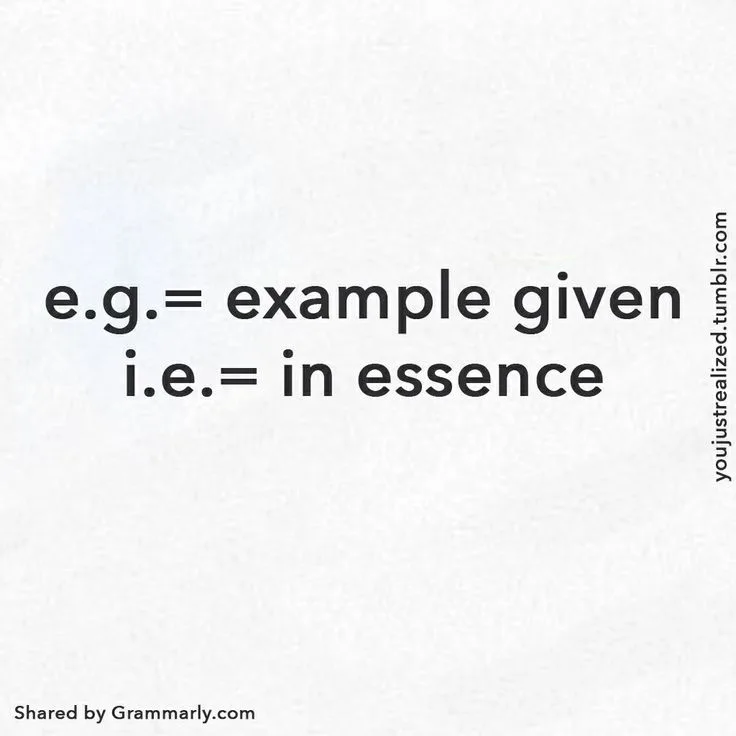
- "e.g." stands for "exempli gratia," which translates as "for example" or "for the sake of example." It introduces one or more examples drawn from a larger category.
- "i.e." stands for "id est," which translates as "that is" or "in other words." It introduces a clarification, restatement, or precise definition.
"'e.g.' opens the door to a small set of examples from a larger group. 'i.e.' restates what you just said in sharper words. If you can swap in 'for example,' use 'e.g.' If you can swap in 'that is,' use 'i.e.'" - Kalenux Team editorial guideline
Consider the difference in practice:
- She enjoys stone fruits, e.g., peaches and plums. (Peaches and plums are examples; she may enjoy others.)
- She enjoys stone fruits, i.e., fruits with a hard pit inside. (The clause defines what stone fruits are.)
The Meaning Test: "For Example" vs "That Is"
The single most reliable test is substitution. If you can replace the abbreviation with "for example" without changing the meaning, use "e.g." If "that is" or "in other words" fits better, use "i.e."
- The report covers emerging markets, e.g., Indonesia and Vietnam. (for example)
- The report covers emerging markets, i.e., economies transitioning toward advanced status. (that is)
Try these:
- The team hired three developers, ___ a backend engineer, a mobile developer, and a data specialist.
Here, the three developers mentioned are the only three hired, not examples from a larger pool. "That is" fits, so "i.e." is correct.
- The team works with several cloud providers, ___ AWS and Google Cloud.
Here, AWS and Google Cloud are examples among others. "For example" fits, so "e.g." is correct.
Punctuation Rules for American English
American style places periods after each letter and usually follows the abbreviation with a comma.
Correct: e.g., i.e., Incorrect: eg, ie, e.g i.e, e.g: i.e:
Standard Pattern
- She collects antique instruments, e.g., violins, harps, and lutes.
- The device has two main components, i.e., the battery and the controller.
After a Sentence Opener
Some American style guides place a comma before "e.g." or "i.e." when the abbreviation introduces an aside within a sentence. Others use parentheses or em dashes (wide dashes) instead.
- The resort offers several winter activities (e.g., skiing, snowboarding, and snowshoeing).
- The resort offers several winter activities, e.g., skiing, snowboarding, and snowshoeing.
Both forms are acceptable. Parentheses feel more formal and set the aside apart more strongly.
Punctuation Rules for British English
British style often drops the periods and the comma that follows. You may see "eg" and "ie" without punctuation marks, though many British publications still use the American-style pattern.
- British (no periods): The museum displays Impressionist painters, eg Monet and Renoir.
- British (with periods): The museum displays Impressionist painters, e.g. Monet and Renoir.
- American (standard): The museum displays Impressionist painters, e.g., Monet and Renoir.
If you write for an international or American audience, use the standard "e.g.," and "i.e.," form with periods and a trailing comma. If you write exclusively for British readers, follow your publication's preferred style.
Side-By-Side Comparison Table
| Feature | e.g. | i.e. |
|---|---|---|
| Full Latin | exempli gratia | id est |
| English meaning | for example | that is / in other words |
| Introduces | examples from a larger set | clarification or exact restatement |
| Implies "etc."? | yes, the list is not exhaustive | no, the list or clause is complete |
| Replace with | "for example" | "that is" |
| Common mistake | used to introduce a definition | used to introduce examples |
| American punctuation | e.g., | i.e., |
| British punctuation | eg or e.g. | ie or i.e. |
When to Use "e.g."
Use "e.g." before a partial list, a representative sample, or an illustrative case. The reader should understand that other items exist beyond the ones you mention.
- The curriculum covers several classical languages, e.g., Latin, Greek, and Sanskrit.
- Many mammals hibernate, e.g., bears, bats, and groundhogs.
- The software supports multiple file formats, e.g., PDF, DOCX, and TXT.
- Common cybersecurity risks, e.g., phishing and ransomware, require ongoing training.
- The grant supports environmental nonprofits, e.g., land trusts and conservation groups.
Notice that none of these lists claims to be complete. Each one selects a few items to illustrate the category.
Never Add "etc." After "e.g."
Because "e.g." already implies that more examples exist, adding "etc." is redundant.
- Incorrect: Bring supplies, e.g., pens, paper, etc.
- Correct: Bring supplies, e.g., pens and paper.
- Correct: Bring supplies such as pens, paper, and notebooks.
When to Use "i.e."
Use "i.e." before a restatement, a precise definition, or a complete specification.
- The meeting starts at noon local time, i.e., eleven in the morning Eastern time.
- She works in the hospitality sector, i.e., hotels and resorts.
- Only registered voters, i.e., U.S. citizens aged eighteen or older who have completed the registration form, may cast a ballot.
- The promotion targets millennials, i.e., adults born between 1981 and 1996.
- Submit the document in its final form, i.e., proofread, formatted, and signed.
In each case, the clause after "i.e." restates or defines what came before. There is no implied "and similar items."
"If you finish the sentence and realize you meant to name the entire category, you needed 'i.e.' If you named only a few representative items, you needed 'e.g.'" - Kalenux Team writing workshop notes
Common Mistakes to Avoid
Mistake 1: Swapping the Two
Writers often reach for "i.e." when they mean "e.g." because "i.e." feels more formal. This is the single most common error.
- Incorrect: The company sells several product lines, i.e., electronics, clothing, and home goods.
- Correct: The company sells several product lines, e.g., electronics, clothing, and home goods.
The company almost certainly sells more than three product lines, so the list is illustrative. Use "e.g."
Mistake 2: Missing the Comma in American Style
American English requires a comma after "e.g.," and "i.e.," just as it would after "for example," or "that is,"
- Incorrect: The report covers several countries, e.g. Brazil and Argentina.
- Correct: The report covers several countries, e.g., Brazil and Argentina.
Mistake 3: Italicizing the Abbreviation
Unlike longer Latin phrases, "e.g." and "i.e." are so common that they are not italicized in modern English. Leave them in roman type.
- Incorrect: She enjoys stone fruits, e.g., peaches and plums.
- Correct: She enjoys stone fruits, e.g., peaches and plums.
Mistake 4: Overusing the Abbreviations in Formal Prose
Many style guides recommend reserving "e.g." and "i.e." for parenthetical asides and using the English equivalents ("for example," "that is") in the main flow of a sentence.
- Acceptable: Several benefits (e.g., lower costs and faster delivery) drive adoption.
- More formal: Several benefits, for example lower costs and faster delivery, drive adoption.
Mistake 5: Using "Which" After "i.e."
"i.e." already means "that is," so following it with "which is" creates redundancy.
- Incorrect: The deadline is tomorrow, i.e., which is a Friday.
- Correct: The deadline is tomorrow, i.e., Friday.
When to Skip the Abbreviation Entirely
In running prose, many careful writers prefer the English equivalents. Using the Latin forms everywhere can feel cluttered.
- Instead of "The plan covers major cities, e.g., Tokyo and Osaka," write "The plan covers major cities such as Tokyo and Osaka."
- Instead of "The CEO, i.e., Jane Roberts, will present the findings," write "The CEO, Jane Roberts, will present the findings."
Save the abbreviations for parenthetical notes, footnotes, technical documents, and lists where brevity matters.
Quick Reference Cheat Sheet
| Situation | Use |
|---|---|
| Introducing one or more examples from a larger set | e.g., |
| Giving a precise definition or restatement | i.e., |
| Saying "for example" | e.g., or "for example" |
| Saying "that is" or "in other words" | i.e., or "that is" |
| Formal running prose | Prefer English equivalents |
| Parenthetical asides | Abbreviations are fine |
| Lists inside parentheses | Abbreviations work well |
| American English | e.g., and i.e., (with periods and comma) |
| British English | eg or e.g. (comma optional) |
20+ Practical Examples
- The intern will shadow several departments, e.g., marketing, finance, and operations.
- The book targets young adults, i.e., readers between fourteen and eighteen years old.
- Several European capitals, e.g., Paris and Madrid, host the exhibition tour.
- Only full members, i.e., those who have paid the annual fee, may vote.
- Tropical fruits, e.g., mangoes and papayas, are on sale this week.
- The report focuses on her final work, i.e., the trilogy published between 2015 and 2020.
- Pack layers for cold-weather sports, e.g., base layers and thermal socks.
- The new policy applies to all employees, i.e., full-time and part-time staff alike.
- Consider renewable options, e.g., solar, wind, and geothermal energy.
- The prize goes to the best overall performer, i.e., the student with the highest cumulative score.
- Avoid common allergens, e.g., peanuts and shellfish, during the event.
- The term refers to the second meal of the day, i.e., lunch.
- Many classical composers, e.g., Bach and Vivaldi, wrote for the violin.
- All accredited journalists, i.e., those holding a valid press pass, may attend the briefing.
- Bring documents to verify residency, e.g., a utility bill or lease agreement.
- The role requires strong writing skills, i.e., clear prose and solid grammar.
- The exhibit highlights twentieth-century movements, e.g., Cubism and Surrealism.
- The study group meets weekly, i.e., every Thursday evening.
- Some crops, e.g., corn and soybeans, dominate the region's agriculture.
- The client wants a concise report, i.e., no more than ten pages.
- The trip includes several museums, e.g., the Louvre and the Orsay.
- The target audience is Gen Z, i.e., individuals born between 1997 and 2012.
- The policy covers natural disasters, e.g., floods and hurricanes.
Self-Check Exercise
Choose "e.g." or "i.e." for each blank. Answers follow.
- The team hired several senior engineers, ___ a backend lead, a mobile specialist, and a database architect.
- The deadline has been moved forward, ___ we now have two fewer weeks.
- Popular autumn activities, ___ apple picking and hayrides, fill the weekend schedule.
- The winning candidate, ___ the one with the highest vote count, will take office in January.
- The shop sells vintage media, ___ vinyl records and cassette tapes.
- Only permanent residents, ___ those holding a green card, are eligible.
- Several classic novels, ___ Pride and Prejudice and Wuthering Heights, appear on the syllabus.
- The event is casual, ___ no suit or tie required.
- Bring tools for the repair, ___ a wrench and a set of screwdrivers.
- The payment is due upon receipt, ___ within seven days.
Answer Key
- e.g. (examples of hires)
- i.e. (clarifies the meaning of "moved forward")
- e.g. (examples of activities)
- i.e. (defines who the winning candidate is)
- e.g. (examples of vintage media)
- i.e. (defines permanent residents)
- e.g. (examples of classic novels)
- i.e. (clarifies what "casual" means)
- e.g. (examples of tools)
- i.e. (defines "upon receipt")
Frequently Asked Questions
Can I start a sentence with "e.g." or "i.e."?
Most style guides discourage it. Both abbreviations typically sit inside a sentence, introducing an aside or a clarification. If you need to start a sentence with "For example" or "That is," spell out the English phrase instead.
Do I need a comma before "e.g." and "i.e."?
In American English, yes. The abbreviation functions like an aside, so it takes a comma on each side (or it sits inside parentheses). British English sometimes omits the commas, but the standard international practice includes them.
Are "for example" and "e.g." interchangeable?
They mean the same thing, but many editors prefer "for example" in running prose and "e.g." in parentheses or lists. Mixing both in the same piece is acceptable as long as you stay consistent within each sentence.
Is it ever acceptable to write "exempli gratia" in full?
Only in highly formal legal or academic contexts, and even there the abbreviation is more common. For everyday writing, stick with "e.g." or use "for example."
Should I italicize "e.g." and "i.e."?
No. They are so integrated into English that style guides, including the Chicago Manual of Style and the AP Stylebook, treat them as non-italicized standard English.
What if I cannot decide which abbreviation fits?
Rewrite the sentence. If you cannot tell whether you mean "for example" or "that is," your reader will be equally confused. Swap in the English phrase and the sentence will almost always read more clearly.
Conclusion
"e.g." means "for example" and introduces a partial list of illustrations. "i.e." means "that is" and introduces a definition, restatement, or complete specification. American English uses both periods and a trailing comma - "e.g.," and "i.e.," - while British English often drops the periods and the comma. Neither abbreviation is italicized, and neither should be paired with "etc." or "which is," which create redundancy.
When in doubt, substitute the English equivalent. If "for example" fits, use "e.g." If "that is" fits, use "i.e." If neither fits cleanly, the sentence probably needs a rewrite. Professional writers who apply this test consistently produce sharper, more accurate prose, and they spare their readers the confusion that comes from interchangeable-looking but meaningfully distinct abbreviations. Master these two small Latin relics and your writing will feel noticeably more precise.
Frequently Asked Questions
Can I start a sentence with 'e.g.' or 'i.e.'?
Most style guides discourage it. Spell out ‘For example’ or ‘That is’ when the phrase opens a sentence.
Do I need a comma before 'e.g.' and 'i.e.'?
In American English, yes. Use a comma on each side, or place the abbreviation inside parentheses. British English sometimes drops them.
Are 'for example' and 'e.g.' interchangeable?
They mean the same thing. Many editors prefer the English phrase in running prose and the abbreviation in parenthetical asides.
Should I italicize 'e.g.' and 'i.e.'?
No. Both are fully integrated into English and appear in roman (non-italic) type in every major style guide.
What if I cannot decide which abbreviation fits?
Rewrite the sentence using ‘for example’ or ‘that is.’ If neither fits, the sentence probably needs restructuring.
Can I use 'etc.' after 'e.g.'?
No. ‘e.g.’ already implies that other examples exist, so adding ‘etc.’ is redundant. Choose one or the other, not both.