
Few word pairs cause as much quiet confusion in professional writing as "farther" and "further." They sound similar, they share a common origin, and many native speakers use them interchangeably in everyday speech. Yet careful editors, academic journals, and major style guides draw a clear line between the two.
Understanding that line matters because the words do subtly different jobs, and using the wrong one can make otherwise polished prose feel careless. In business writing, legal documents, technical reports, and academic work, the distinction still counts.
This expert-written guide from the Kalenux Team walks through the traditional rule, explains how modern usage has bent that rule in certain contexts, and shows you exactly when each word fits best. You will see twenty-plus concrete examples, a side-by-side comparison table, a cheat sheet for quick reference, and a self-check exercise with an answer key. We will also cover the cases where either word is acceptable, so you do not second-guess yourself when the distinction truly does not matter.
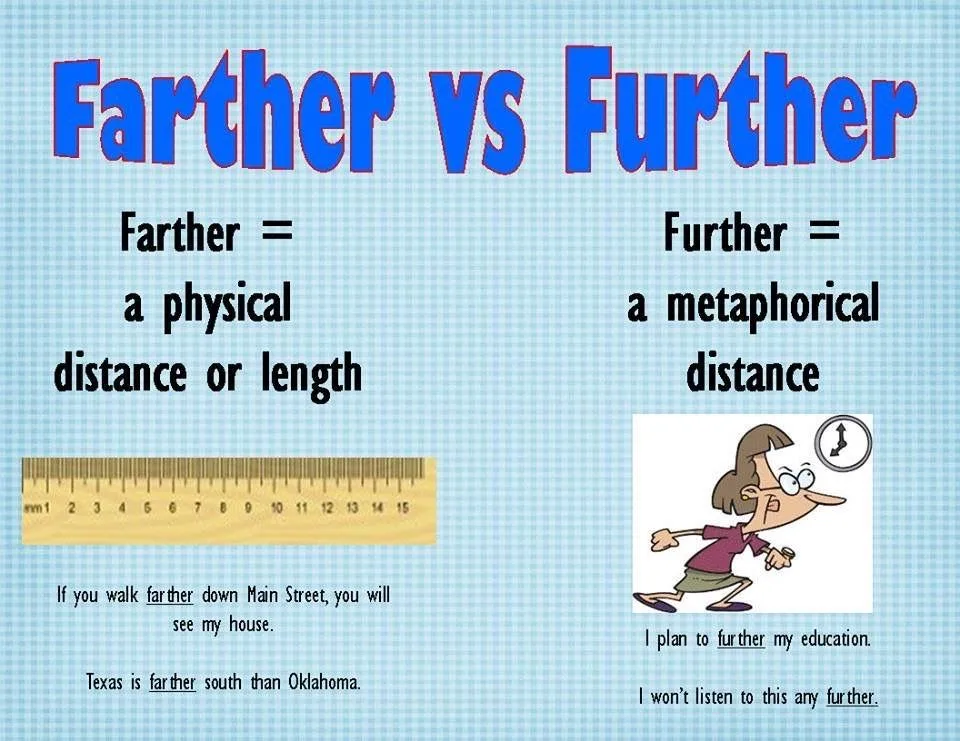
The rule itself is simple: "farther" refers to physical distance, while "further" refers to figurative or metaphorical distance, extent, degree, or the advancement of ideas. Once you learn that pairing, you will see it at work in almost every example you encounter. What follows is everything a careful writer needs to use both words with confidence.
The Traditional Rule in One Sentence
Use "farther" for physical, measurable distance. Use "further" for figurative distance, abstract degree, or additional action.
"If you can measure the distance with a ruler, a road sign, or a mile marker, 'farther' is almost always right. If the distance is an idea, a topic, or a level of effort, 'further' is your word." - Kalenux Team editorial guideline
Physical distance examples:
- The café is two blocks farther down the street.
- He hit the golf ball farther than anyone else in his group.
- We drove farther into the mountains than we had planned.
Figurative or metaphorical examples:
- The committee needs to study the proposal further.
- Nothing could be further from the truth.
- The director took the argument further in the second meeting.
This basic pairing - physical "farther," figurative "further" - covers about ninety percent of cases. The remaining ten percent is where modern usage begins to blur the line, and we will look at those gray zones shortly.
Why the Words Even Look Similar
"Farther" and "further" share the same Old English root, and for centuries they were used interchangeably. The distinction we follow today is a relatively modern convention that crystallized in the nineteenth and twentieth centuries as editors sought to tighten the language. Many British publications continue to use "further" in both senses, while American style generally observes the physical-versus-figurative split more strictly.
This shared history explains why even careful speakers sometimes hesitate. The words are not two unrelated forms; they are two branches of the same tree. Modern usage has assigned them different jobs, but in spoken English the boundary remains porous.
When to Use "Farther"
Use "farther" any time you can point to a literal distance - feet, meters, miles, blocks, or some other measurable quantity. This applies to physical travel, physical reach, and any situation where something occupies space relative to something else.
Travel and Motion
- The cabin sits farther up the trail, past the second fork.
- We walked farther than the map suggested.
- They flew farther south to escape the storm.
- The lighthouse stood farther out on the point than she remembered.
Physical Reach
- He threw the ball farther than the previous record.
- The new telescope can see farther into deep space than its predecessor.
- She stretched farther than her teammates during warm-ups.
Spatial Comparisons
- The grocery store is three miles farther from here than the bank.
- The neighbor's property extends farther into the woods.
- The finish line is farther away than the runners realized.
In each example, a tape measure, a mile marker, or a physical boundary could prove the statement. This concrete quality is the hallmark of "farther."
When to Use "Further"
Use "further" for anything non-physical: ideas, discussions, research, progress, effort, extent, and degrees. "Further" is also the right word when it functions as a verb meaning "to advance" or "to promote."
Figurative Distance
- Nothing could be further from my intention.
- The truth lies further from the headlines than readers assume.
- Her argument drifted further from the original question.
Additional or Supplementary
"Further" often means "additional" or "more."
- No further comments were received before the deadline.
- For further information, contact the main office.
- The report raises further questions about the methodology.
Advancing an Idea or Cause (as a Verb)
Only "further" works as a verb. "Farther" has no verb form.
- The scholarship will further her education in medicine.
- The new initiative aims to further the company's diversity goals.
- He worked hard to further his research on renewable energy.
Time and Progression
When you describe progress through a process, a schedule, or a line of thought, use "further."
- Let us discuss this further at the next meeting.
- The investigation will continue further before charges are filed.
- She pushed the deadline further into the fall.
"'Further' is the word of ideas and effort. It promotes, develops, deepens, and extends. 'Farther' is the word of place and motion. It simply goes the distance." - Kalenux Team writing workshop notes
Side-By-Side Comparison Table
| Situation | Correct | Example |
|---|---|---|
| Physical distance | farther | She lives farther from downtown than I do. |
| Figurative distance | further | That claim is further from the facts than it appears. |
| Additional information | further | For further details, see the appendix. |
| Advancing a cause (verb) | further | The grant will further our research. |
| Throwing, running, reaching | farther | He kicked the ball farther than anyone else. |
| Developing an idea | further | We need to explore the concept further. |
| Geographical direction | farther | The cabin is farther north. |
| Elaboration in a speech | further | I will speak further on this topic next week. |
The Gray Zone: When Both Are Acceptable
Some sentences involve a blend of physical and figurative distance. In these hybrid cases, many style guides accept either word, and modern American usage increasingly favors "further" even for physical distance.
Consider this example: "We still have further to go on this journey."
If "journey" means a literal road trip, "farther" might seem more precise. If "journey" means a metaphorical process, "further" is clearly correct. Because the sentence can read either way, most readers will not notice which word you choose.
Common gray-zone phrases include:
- "We still have farther / further to go."
- "She went farther / further than expected."
- "The argument moved farther / further from the main point."
When a sentence sits on the line between concrete and abstract, prefer "further" in American professional writing unless the distance is unmistakably physical. Many editors will accept either, but readers tend to expect "further" in mixed cases.
"Further" as an Adverb Linking Ideas
"Further" often appears at the start of a sentence as a transitional adverb meaning "moreover" or "additionally." "Farther" cannot do this job.
- Correct: Further, the committee rejected the first draft entirely.
- Incorrect: Farther, the committee rejected the first draft entirely.
This sentence-opening "further" often takes a comma after it and works much like "furthermore" or "in addition."
Common Mistakes to Avoid
Mistake 1: Using "Farther" for Figurative Distance
- Incorrect: We need to discuss this farther before making a decision.
- Correct: We need to discuss this further before making a decision.
The discussion is not a measurable distance, so "further" is correct.
Mistake 2: Using "Further" for Clear Physical Distance
- Incorrect: The post office is two blocks further down this road.
- Correct: The post office is two blocks farther down this road.
Blocks are measurable, so "farther" is preferred.
Mistake 3: Treating "Farther" as a Verb
- Incorrect: The scholarship will farther her career.
- Correct: The scholarship will further her career.
Only "further" can serve as a verb meaning "to advance."
Mistake 4: Using "Farther" with Abstract Nouns
- Incorrect: The report raises farther concerns about safety.
- Correct: The report raises further concerns about safety.
Concerns are abstract, so "further" fits.
Mistake 5: Overcorrection
Sometimes writers who have learned the rule overcorrect by using "farther" for any comparative distance.
- Incorrect: Her research has gone farther than mine in terms of theoretical depth.
- Correct: Her research has gone further than mine in terms of theoretical depth.
"Theoretical depth" is figurative, so "further" is right.
Memory Tricks That Work
"Think of the 'far' in 'farther.' It points you to physical distance - how far something is. When distance is not the question, choose 'further.'" - Kalenux Team style guide
The "Fa-R-r" Test
"Farther" contains "far," which signals space. If you can substitute "more far" for your word, use "farther."
- We drove three miles farther. -> We drove three miles more far. -> Makes rough sense, so "farther" fits.
- We need to discuss this further. -> We need to discuss this more far. -> Nonsense, so "further" fits.
The Additional Test
If you mean "additional" or "more," use "further."
- For further information -> For additional information. -> "Further" fits.
- She ran three miles further. -> She ran three miles additional. -> Awkward, so "farther" fits better.
The Verb Test
If the sentence uses the word as a verb ("to advance something"), only "further" works.
Quick Reference Cheat Sheet
| If you mean... | Use |
|---|---|
| Physical distance (measurable) | farther |
| Figurative or abstract distance | further |
| Additional, more, supplementary | further |
| To advance or promote (verb) | further |
| Progress through an idea or plan | further |
| Throwing, running, reaching | farther |
| Geographic direction | farther |
| Sentence-opening transition | further |
| Mixed physical and abstract (American) | further |
20+ Complete Examples
- The trailhead lies two miles farther up the road.
- The committee declined to comment further on the matter.
- He hit the baseball farther than any player on the team.
- No further action is required at this time.
- She drove farther north to visit her grandmother.
- The study will further our understanding of climate patterns.
- The lighthouse is visible from farther away than you might expect.
- Nothing could be further from what I intended.
- We walked farther into the forest than planned.
- For further assistance, please contact support.
- The golf ball flew farther than the previous drive.
- The senator wishes to further the interests of rural communities.
- My house is a block farther down the street than hers.
- Without further ado, let us welcome our speaker.
- The telescope can see farther into the galaxy than any before it.
- I have no further questions for the witness.
- They traveled farther than any explorers of their era.
- The proposal needs further development before it can proceed.
- The runner pushed farther into the final mile.
- The training program will further the team's skills.
- The cottage sits farther from the road than the neighbors' houses.
- Further research is required before we can draw conclusions.
- The satellite moved farther out of Earth's orbit.
Self-Check Exercise
Fill in the blank with "farther" or "further." Answers follow.
- The post office is three blocks ________ up the street.
- We need to investigate this problem ________ before making a decision.
- The scholarship will ________ her studies in marine biology.
- He can throw the javelin ________ than anyone on the team.
- No ________ questions will be taken after this point.
- The campsite lies ________ along the ridge than the map suggests.
- The report raises ________ concerns about data privacy.
- Without ________ delay, let us begin the meeting.
- She swam ________ from shore than she intended.
- The proposal needs ________ refinement before it is ready.
Answer Key
- farther (physical distance)
- further (figurative - investigating further)
- further (verb form - to advance)
- farther (physical distance)
- further (additional)
- farther (physical distance)
- further (additional/abstract)
- further (additional)
- farther (physical distance)
- further (figurative)
Frequently Asked Questions
Are "farther" and "further" ever truly interchangeable?
In casual speech, yes, many speakers use them interchangeably and no one notices. In edited writing, the distinction still matters. The gray zone includes sentences that mix physical and figurative meanings, where either word may be acceptable. When in doubt in American English, "further" is safer because it works in both senses for many modern readers.
Does British English follow the same rule?
British English tends to prefer "further" in both senses. You will see "further" for physical distance in British newspapers, novels, and academic writing. American English maintains the split more strictly.
Is one word older than the other?
They share the same Old English root. "Further" appeared in writing before "farther," and "farther" likely arose as a variant influenced by the word "far." The clean split in meaning is a relatively modern convention.
Can I start a sentence with "Further"?
Yes. "Further," at the start of a sentence means "moreover" or "in addition" and usually takes a comma after it. "Farther" cannot be used this way.
What about "furthermore"?
"Furthermore" is a transitional adverb meaning "in addition." It is never "farthermore," which is not a word.
How do I remember the distinction under pressure?
Ask whether a tape measure could prove the distance. If yes, use "farther." If no, use "further." If the sentence uses the word as a verb meaning "to advance," only "further" fits.
Conclusion
"Farther" and "further" come from the same root, but English has assigned them different jobs. "Farther" handles physical, measurable distance - miles, blocks, yards, and meters. "Further" handles figurative distance, abstract degree, additional information, and the act of advancing a cause or idea. Only "further" can function as a verb. Only "further" can open a sentence as a transitional adverb.
When the distance is mixed or ambiguous, modern American style increasingly favors "further," and most readers will not object. British English generally uses "further" for both senses. Whichever convention you follow, consistency matters most.
Pick the right word for each sentence, apply the rule across your document, and your writing will feel sharper and more intentional. Careful word choice is one of the quiet markers of professional writing, and "farther" versus "further" is a perfect place to show that care.
Frequently Asked Questions
Are 'farther' and 'further' ever truly interchangeable?
In casual speech, often yes. In edited writing, the physical vs figurative distinction still matters. Gray-zone sentences that mix both meanings often accept either word.
Does British English follow the same rule?
British English tends to use ‘further’ for both physical and figurative distance. American English maintains the split more strictly.
Is one word older than the other?
They share the same Old English root. ‘Further’ predates ‘farther’ in writing, and the modern split in meaning is a relatively recent convention.
Can I start a sentence with 'Further'?
Yes. ‘Further,’ at the start of a sentence means ‘moreover’ or ‘in addition’ and usually takes a comma. ‘Farther’ cannot be used this way.
What about 'furthermore'?
‘Furthermore’ is a standard transitional adverb meaning ‘in addition.’ ‘Farthermore’ is not a word.
How do I remember the distinction under pressure?
Ask whether a tape measure could prove the distance. If yes, use ‘farther.’ If the distance is figurative or the word is a verb, use ‘further.’