
"Whom" is dying, but it is not dead yet. In formal writing, academic prose, legal documents, and serious journalism, the distinction between "who" and "whom" still signals whether the writer has command of grammar or is guessing.
Many otherwise careful writers guess, and most guesses are wrong in the same predictable ways. This guide gives you the rule that actually works under pressure, the sentence patterns where everyone slips, and a clean test you can run in about three seconds on any sentence.
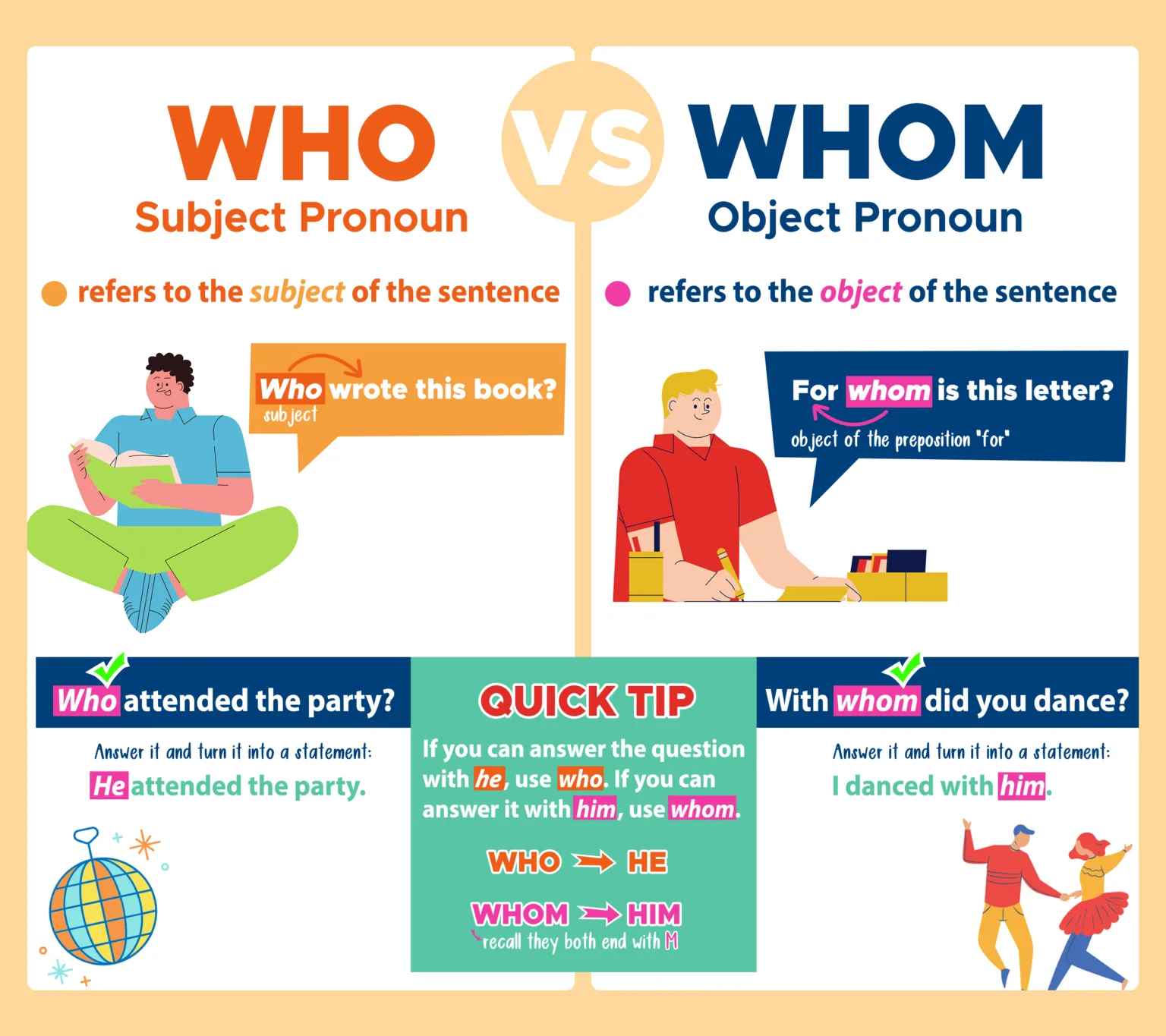
The short version: use "who" for the subject and "whom" for the object. The longer version is where the trouble lives, because English sentences do not always tell you what is subject and what is object without some work. By the time you finish this guide, you will be able to choose correctly in almost every sentence, and you will know when to relax the rule because formality has genuinely faded.
The One Rule: He or Him?
The most reliable test for "who" vs "whom" is to substitute "he" for "who" and "him" for "whom," rearranging the sentence into a statement if needed. If "he" fits, the answer is "who." If "him" fits, the answer is "whom."
Question: Who/whom called you last night?
Test: He called me last night. (Not: Him called me last night.)
Answer: Who.

Question: Who/whom did you call last night?
Test: You called him. (Not: You called he.)
Answer: Whom.

Question: Who/whom should I thank?
Test: I should thank him. (Not: I should thank he.)
Answer: Whom.
This test works because "who" is the subject form of the pronoun (like "he," "she," "they") and "whom" is the object form (like "him," "her," "them"). The pronouns you already know have the same split. If you would say "he," use "who." If you would say "him," use "whom."
Grammar writers such as Mignon Fogarty of Grammar Girl recommend the 'he or him' substitution test as a fast, reliable way to resolve who versus whom, since running it consistently takes the mystery out of the choice.
The Grammatical Reasoning Behind the Rule
"Who" is a nominative pronoun. It functions as the subject of a verb. "Whom" is an accusative pronoun. It functions as the object of a verb or the object of a preposition.
| Role | Nominative (subject) | Accusative (object) |
|---|---|---|
| First person singular | I | Me |
| Second person | you | you |
| Third person singular (male) | he | him |
| Third person singular (female) | she | her |
| Third person plural | they | them |
| Who (interrogative/relative) | who | whom |
English used to have full case marking on all nouns and pronouns. Over time, the noun cases collapsed, leaving only the pronouns with separate subject and object forms. "Who" and "whom" are the last holdouts of that system among interrogative and relative pronouns, which is why they feel old-fashioned. They are old-fashioned. They are the vestige of a grammar that mostly disappeared seven hundred years ago.
Subject Who: Examples
When the pronoun is doing the action of the verb, use "who."
Who is at the door?
(Who is doing the action of being at the door.)

Who wants ice cream?
(Who is doing the action of wanting.)

Tell me who called.
(Who is the subject of "called.")

The musician who played the violin is famous.
(Who is the subject of "played.")

I do not know who she is.
(Who is the subject of "is.")

Anyone who eats here regrets it.
(Who is the subject of "eats.")
Object Whom: Examples
When the pronoun is receiving the action or is the object of a preposition, use "whom."
Whom did you invite to the party?
(You invited whom. "Whom" is the object of "invited.")

Whom should I call?
(I should call whom. "Whom" is the object of "call.")

To whom it may concern:
("Whom" is the object of the preposition "to.")

The person with whom I spoke was helpful.
("Whom" is the object of the preposition "with.")

He married a woman whom everyone admires.
(Everyone admires whom. "Whom" is the object of "admires.")

For whom the bell tolls.
("Whom" is the object of the preposition "for.")
The Preposition Trap
Many whom errors happen because the preposition is separated from its object. In conversational English, we often end clauses with prepositions: "Who did you talk to?" rather than "To whom did you talk?" The preposition is still governing the pronoun even when it moves to the end.
Formal: To whom did you give the book?
Informal: Who did you give the book to?
(Both prepositional objects. "Whom" is formally correct in both.)

Formal: With whom are you going?
Informal: Who are you going with?
(Both correct in their register. "Whom" is formally required.)

Formal: The candidate about whom the article was written.
Informal: The candidate who the article was written about.
In casual speech, ending with "who" (rather than "whom") is universally accepted. In formal writing, many editors still prefer "whom" in these constructions, particularly when the preposition is adjacent. When the preposition moves to the end of a clause, some style guides allow "who" as a concession to natural rhythm.
Embedded Clauses: The Hardest Case
The hardest "who vs whom" decisions appear in sentences with embedded clauses. The pronoun looks like the object of the main clause but is actually the subject of the embedded clause.
Correct: I wonder who will win the prize.
Wrong: I wonder whom will win the prize.
(Who is the subject of "will win," not the object of "wonder.")

Correct: Give the award to whoever deserves it.
Wrong: Give the award to whomever deserves it.
(Whoever is the subject of "deserves." The whole clause "whoever deserves it" is the object of "to.")

Correct: We should hire whoever applies first.
Wrong: We should hire whomever applies first.
(Whoever is the subject of "applies." The whole clause is the object of "hire.")

Correct: Tell me whom you trust.
(Whom is the object of "trust." You trust whom.)

Correct: Tell me who trusts you.
(Who is the subject of "trusts." Who trusts you.)
The rule: when the pronoun introduces a clause, figure out its role inside that clause, not in the larger sentence. The verb immediately following the pronoun usually needs a subject, so "who" or "whoever" is often the right choice even when the overall sentence seems to want "whom."
Usage guides such as Bryan Garner's Garner's Modern English Usage note that one of the most common whom-related errors is using 'whomever' where 'whoever' belongs, because writers focus on the preceding preposition rather than the pronoun's actual role inside its own clause.
Whoever vs Whomever
"Whoever" and "whomever" follow the same rule as "who" and "whom," with the added generalizing sense of "any person who." The test is identical. Substitute "he" or "him" into the embedded clause and see which fits.
Give it to whoever wants it.
Test (in the clause): He wants it. (Not: Him wants it.) Use "whoever."

Give it to whomever you prefer.
Test (in the clause): You prefer him. (Not: You prefer he.) Use "whomever."

Whoever ate the last cookie owes me an apology.
Test: He ate the last cookie. Use "whoever."

I will hire whomever you recommend.
Test: You recommend him. Use "whomever."
Notice that the preposition preceding the clause (to, for, with) does not by itself demand "whomever." What matters is the role of the pronoun inside its own clause.
Whose: A Related Pronoun Worth Knowing
"Whose" is the possessive form of "who." It does not vary by case and does not become "whomse" or anything similar. It covers both animate and inanimate possession in modern English, despite some old prescriptions limiting it to people.
Whose book is this? (Possession by a person.)
A novel whose plot twists dazzle the reader. (Possession by a thing.)
The student whose essay won the prize was delighted. (Possession by a person.)
The tree whose leaves turn red in October is a maple. (Possession by a thing.)
Do not confuse "whose" with "who's" (contraction of "who is" or "who has").
Who's at the door? (Who is at the door?)
Whose is this coat? (Who owns this coat?)
Who's been eating my porridge? (Who has been eating.)
Whose porridge is this? (Who owns this porridge?)
Sentence-by-Sentence Practice Set
Here are twenty sentences. Cover the right column and choose "who" or "whom" for each. Then check.
| Sentence | Correct Answer |
|---|---|
| ___ wrote this letter? | Who |
| ___ did you tell? | Whom |
| The woman ___ called is my aunt. | Who |
| The woman ___ I called is my aunt. | Whom |
| To ___ it may concern. | Whom |
| ___ is coming to dinner? | Who |
| I do not know ___ to trust. | Whom |
| Tell me ___ you are. | Who |
| ___ did you vote for? | Whom |
| The candidate ___ won the election. | Who |
| The candidate for ___ I voted. | Whom |
| We will hire ___ applies. | Whoever |
| Give the prize to ___ finishes first. | Whoever |
| Give the prize to ___ the judges choose. | Whomever |
| ___ shall I say is calling? | Who |
| ___ are you calling? | Whom |
| The author ___ book won the prize. | Whose |
| A writer ___ style changes each book. | Whose |
| ___ do you think will win? | Who |
| ___ do you believe? | Whom |
If you scored eighteen or more correct, your command is solid. The two trickiest ones are "Who shall I say is calling?" (because "who" is the subject of "is calling" inside the embedded clause) and "Who do you think will win?" (because "who" is the subject of "will win," not the object of "think").
The Shall-I-Say Pattern
Sentences with "do you think," "shall I say," "did you suppose," and similar inserted phrases fool many writers. The inserted phrase is just commentary. The pronoun belongs to the main verb of the underlying question.
Correct: Who do you think will win? (Who will win? You think that.)
Wrong: Whom do you think will win?

Correct: Who shall I say is calling? (Who is calling? I should say.)
Wrong: Whom shall I say is calling?

Correct: Whom did you say you met? (You met whom? You said that.)
Correct (with different parsing): Who did you say you met? (Informal, accepted.)
Strip out the inserted phrase ("do you think," "shall I say") and test whether "he" or "him" completes the remaining sentence. That tells you which pronoun to use.
Relative Clauses: Restrictive vs Nonrestrictive
In relative clauses, "who" and "whom" follow the same case rules regardless of whether the clause is restrictive (no comma) or nonrestrictive (with commas).
Restrictive:
The woman who called wants you to ring her back.
The woman whom you called wants you to ring her back.

Nonrestrictive:
Maria, who called earlier, wants you to ring her back.
Maria, whom you called earlier, wants you to ring her back.
The presence or absence of commas does not change the case of the pronoun. The role of the pronoun in the clause does.
Whom Is Fading: When to Relax
"Whom" is in long-term decline. It has disappeared from casual speech almost entirely, and it has thinned out even in edited writing. Many style guides now tolerate "who" as the object in casual and conversational registers, especially when "whom" would sound stuffy.
| Register | Preferred Usage | Example |
|---|---|---|
| Casual conversation | Who (both subject and object) | "Who did you call?" |
| Business email | Who (object often accepted) | "Who are you meeting with?" |
| Professional journalism | Whom (object, following house style) | "Whom did the committee select?" |
| Academic writing | Whom (object, strict) | "Researchers whom the grant supported published findings." |
| Legal and formal documents | Whom (object, strict) | "To whom this notice is delivered." |
| Literary fiction | Whom (object, for voice) | "A woman whom the war had broken." |
The trend is toward "who" in more and more contexts. Writers under forty often use "whom" only when it sounds natural. Older editors may still flag the lapse. Context decides.
Style writers such as Benjamin Dreyer, author of Dreyer's English, have noted that 'whom' has always been more common in writing than in speech and is now retreating even there, though using it correctly still signals formality and precision, while misusing it can be more noticeable than simply using 'who.'
The Hypercorrection Trap
Trying to sound formal, writers sometimes insert "whom" where "who" belongs. This is hypercorrection, and careful readers spot it instantly.
Wrong (hypercorrection): He is the candidate whom I believe will win.
Correct: He is the candidate who I believe will win. (Who is the subject of "will win.")

Wrong (hypercorrection): The reporter whom wrote the story is here.
Correct: The reporter who wrote the story is here.

Wrong (hypercorrection): Whom is at the door?
Correct: Who is at the door?
If you are uncertain, run the "he or him" test. If you still cannot decide, default to "who." An unnecessary "who" is less noticeable than an incorrect "whom."
Where Who vs Whom Sits in the Bigger Picture
"Who" and "whom" belong to a small set of grammar details that separate careful writers from casual ones. They do not matter in text messages. They do matter in cover letters, business proposals, legal documents, and academic writing. Every time you send a written artifact to someone who will judge your attention to craft, the pronouns you choose contribute to the judgment.
For related pronoun confusion, see our guides on common grammar mistakes and lay vs lie. Writers preparing for exams where grammar is tested, including language sections of professional certifications, can find structured practice at Pass4Sure. Cognitive research on how learners internalize grammatical case, including why some distinctions fade faster than others, appears in summaries linked from What's Your IQ.
A final practical note: when you edit your own writing, search for every instance of "whom" in your document and verify it. "Whom" is misused more often than it is used correctly. Auditing your "whom" usage is the single fastest grammar check you can run on a finished draft.
References
Fogarty, M. (2008). Grammar Girl's Quick and Dirty Tips for Better Writing. Holt Paperbacks. Fogarty (2008): Grammar Girl's Quick and Dirty Tips for Better Writing
Garner, B. A. (2022). Garner's Modern English Usage (5th ed.). Oxford University Press. Garner (2022): Garner's Modern English Usage (5th ed.)
Dreyer, B. (2019). Dreyer's English: An Utterly Correct Guide to Clarity and Style. Random House. Dreyer (2019)
Pinker, S. (2014). The Sense of Style: The Thinking Person's Guide to Writing in the 21st Century. Viking. https://stevenpinker.com/publications/sense-style
Huddleston, R., and Pullum, G. K. (2002). The Cambridge Grammar of the English Language. Cambridge University Press. Huddleston et al. (2002): The Cambridge Grammar of the English Language
Merriam-Webster Dictionary. Who vs Whom Usage Notes. Merriam-Webster Dictionary
The Chicago Manual of Style (17th ed.). University of Chicago Press. The Chicago Manual of Style (17th ed.)
Strunk, W., and White, E. B. (2000). The Elements of Style (4th ed.). Allyn and Bacon. Strunk et al. (2000): The Elements of Style (4th ed.)
Frequently Asked Questions
What is the fastest rule for choosing who or whom?
Substitute ‘he’ or ‘him’ into the sentence. If ‘he’ fits, use ‘who.’ If ‘him’ fits, use ‘whom.’ This works because ‘who’ is the subject form and ‘whom’ is the object form, matching the he/him split you already know.
Is whom becoming obsolete in modern English?
Whom is fading in casual speech but remains standard in formal writing, academic prose, legal documents, and serious journalism. It is not dead, and misusing it still draws notice from careful readers.
When should I use whoever vs whomever?
Use whoever when the pronoun is the subject of its clause (whoever arrives first wins). Use whomever when it is the object (give it to whomever you choose). The preposition before the clause does not force whomever; the clause’s internal role decides.
Is 'who did you call?' ever correct?
In casual and conversational registers it is widely accepted. In strict formal writing, ‘whom did you call?’ is preferred because ‘whom’ is the object of ‘call.’ Modern style guides increasingly tolerate ‘who’ in this position.
What is the difference between whose and who's?
Whose is the possessive form of who, used for both people and things (whose book, a tree whose leaves). Who’s is a contraction for ‘who is’ or ‘who has.’ They are not interchangeable.
Why do sentences with 'do you think' confuse writers?
Phrases like ‘do you think,’ ‘shall I say,’ and ‘did you suppose’ are parenthetical and should be ignored when choosing the pronoun. ‘Who do you think will win?’ is correct because ‘who’ is the subject of ‘will win,’ not the object of ‘think.’
What is hypercorrection with whom?
Hypercorrection is inserting ‘whom’ where ‘who’ belongs because it sounds formal. ‘He is the candidate whom I believe will win’ is wrong; ‘who’ is the subject of ‘will win.’ Hypercorrection is more embarrassing than simply using ‘who.’