
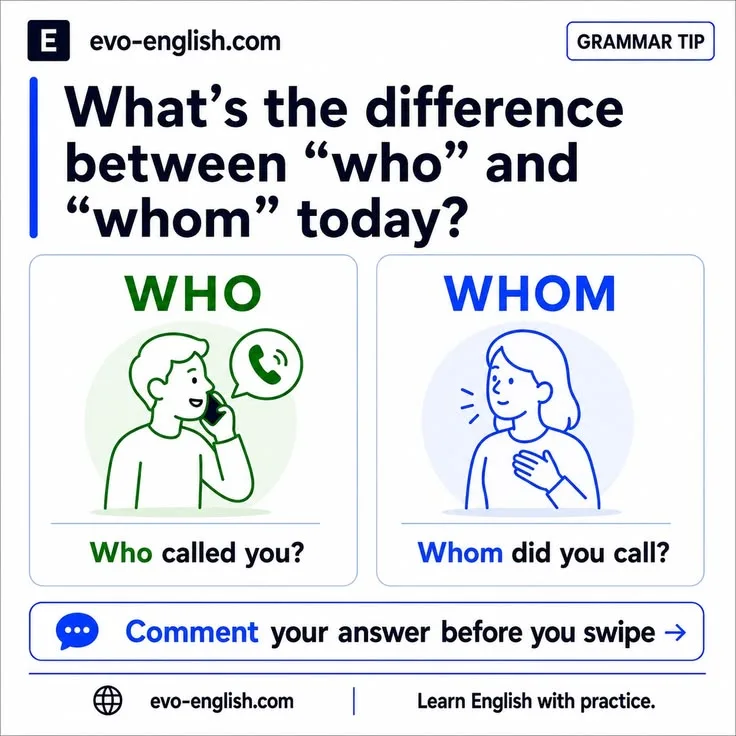
The who versus whom question is one of the most persistent anxieties in professional writing, and the reason is simple: the rule itself is not complicated, but the intuition has collapsed for most English speakers under the age of fifty. Whom is declining in spoken English, and writers who learned the language primarily by ear often cannot hear the difference that writers of earlier generations heard instinctively.
This guide covers the one test that settles the question reliably, the cases where both forms are acceptable, the cases where whom sounds hypercorrect, and the register considerations that determine when a writer should follow the rule and when a writer should break it on purpose.
The Underlying Rule
Who is a subject pronoun. It does the action.
Whom is an object pronoun. It receives the action.
That is the entire rule. Every other explanation is an elaboration of those two sentences. The challenge is not the rule but the application, because English sentences can hide which word is the subject and which is the object behind clause structures that obscure the grammatical role.
"The confusion between who and whom is not a failure of grammar instruction. It is a symptom of a language in transition. Writers who understand this can choose where to stand on the gradient, rather than feeling bullied by it."
Patricia T. O'Conner, author of "Woe Is I"
The He-Him Test
The substitution test is the most reliable method for resolving any who versus whom question, and it is the method that professional editors use in practice.
The steps:
- Take the sentence containing who or whom
- Find the clause where who or whom appears
- Rearrange the clause, if necessary, into a standard subject-verb-object order
- Substitute he or him for the word in question
- If he fits, the correct word is who. If him fits, the correct word is whom.
The test works because he and him are the same pronoun family as who and whom, both direct descendants of Old English pronouns that retained the nominative-accusative distinction. English speakers still have reliable intuition about he versus him. The test transfers that intuition to who versus whom.
Worked Example 1
Sentence: [Who / whom] should I invite to the meeting?
Rearrange: I should invite [who / whom].
Substitute: I should invite [he / him].
Answer: Him fits. The correct word is whom. "Whom should I invite to the meeting?"
Worked Example 2
Sentence: [Who / whom] is calling?
Rearrange: Already in subject-verb order.
Substitute: [He / him] is calling.
Answer: He fits. The correct word is who. "Who is calling?"
Worked Example 3
Sentence: The candidate [who / whom] we interviewed accepted the offer.
Clause in question: [who / whom] we interviewed
Rearrange: We interviewed [who / whom].
Substitute: We interviewed [he / him].
Answer: Him fits. The correct word is whom. "The candidate whom we interviewed accepted the offer."
Worked Example 4
Sentence: The candidate [who / whom] interviewed well accepted the offer.
Clause in question: [who / whom] interviewed well
Substitute: [He / him] interviewed well.
Answer: He fits. The correct word is who. "The candidate who interviewed well accepted the offer."
The two examples above are critical. The same sentence structure (The candidate [who/whom] ... accepted the offer) takes different forms depending on the role of the pronoun in the internal clause. In the first, the candidate is being interviewed (object). In the second, the candidate is doing the interviewing (subject).
The Register Question
Knowing the rule is only half the decision. The other half is deciding whether to apply it.
Formal Written Contexts
In these contexts, whom is expected where grammatically required. Using who in place of whom reads as imprecise.
- Legal documents, contracts, and regulatory filings
- Academic papers, dissertations, and scholarly journals
- Published journalism from legacy institutions (New York Times, Economist, New Yorker)
- Formal business memos, especially in finance, law, and consulting
- Literary and essay writing for a serious readership
Informal Written Contexts
In these contexts, who is often used where whom would be grammatically correct. Whom can read as stilted.
- Text messages, Slack, and casual email
- Social media
- Conversational blog writing
- Marketing copy aimed at a broad consumer audience
- Internal team communication at companies with casual written cultures
The Bending Rule
A professional writer should know the rule and choose when to break it. The writer who uses whom correctly in a contract and uses who in a Slack message is making two appropriate register choices. The writer who uses who everywhere is not choosing; they are defaulting.
For writers developing the register flexibility that separates professional writing from amateur writing, the writing style library at When Notes Fly covers register calibration across document types. The verbal reasoning exercises at Whats Your IQ build the underlying pattern recognition that makes the grammatical analysis faster.
The Declining Use of Whom
The Corpus of Contemporary American English tracks usage of specific words across spoken, newspaper, fiction, academic, and web contexts. The who-to-whom ratio has changed substantially over the past three decades.
| Context | 1990 Who-to-Whom Ratio | 2020 Who-to-Whom Ratio |
|---|---|---|
| Spoken | 8 to 1 | 23 to 1 |
| Newspaper | 5 to 1 | 7 to 1 |
| Fiction | 6 to 1 | 10 to 1 |
| Academic | 3 to 1 | 4 to 1 |
| Web (casual) | N/A | 31 to 1 |
| Web (professional) | N/A | 9 to 1 |
The table shows two patterns. First, whom remains substantially stronger in writing than in speech. Second, even in writing, casual web contexts have accelerated the decline of whom, while academic and professional writing remain relatively resistant.
The practical implication: writers producing content for professional audiences (B2B marketing, consulting memos, legal briefs) should use whom where grammatically required. Writers producing casual consumer content can follow modern usage.
The Cases Where Whom Sounds Wrong
Some sentences are grammatically correct with whom but sound so awkward that most style guides now accept the who alternative.
Embedded Questions
"Whom should I say is calling?" is wrong. The correct form is "Who should I say is calling?" because who is the subject of "is calling," not the object of "say."
The confusion arises because "should I say" intervenes between the subject and verb. The test: remove the intervening phrase. "Who is calling" is correct. The phrase "should I say" does not change the role of who.
Sentence-Initial Who in Questions
"Whom did you invite?" is technically correct. "Who did you invite?" is widely accepted in modern professional writing and does not read as an error. The Chicago Manual of Style explicitly permits who in this position.
"To whom did you give the file?" is a different case. When whom follows a preposition directly, the formal form is still preferred in professional writing. "Who did you give the file to?" is acceptable in casual writing but looks informal in a memo.
Relative Clauses With Intervening Phrases
"The CEO whom we believe will announce the merger" is a classic hypercorrection. The correct form is "The CEO who we believe will announce the merger" because who is the subject of "will announce." The phrase "we believe" is a parenthetical interruption.
The test: remove "we believe." "The CEO who will announce the merger" is correct. The parenthetical does not change the role of who.
The Preposition Cases
Whom is the required form after prepositions in formal writing.
Correct: To whom it may concern. Correct: With whom did you speak? Correct: The client for whom the report was prepared.
In casual writing, these constructions are often rearranged to avoid the preposition-plus-whom pattern, which can sound stilted.
Formal: The client with whom we negotiated. Casual: The client who we negotiated with.
Both are used in modern English. The formal version is correct in legal, academic, and most business contexts. The casual version is acceptable in conversational writing.
The standard advice against ending sentences with prepositions (originating in 18th-century prescriptive grammar) has been rejected by every major modern style guide. Ending a sentence with a preposition is grammatical and often more natural. The choice is about register, not about correctness.
Common Patterns by Document Type
Legal Writing
Whom is used rigorously in contracts, briefs, and regulatory filings. The register is formal, and the precision is part of the document's authority. For writers producing legal or quasi-legal documents (terms of service, privacy policies, formation documents), the jurisdictional notes at Corpy illustrate the register conventions of formal business legal writing.
Business Correspondence
Business writing in the 2020s has shifted toward a more casual register in some industries (tech, startups, consumer brands) and remained formal in others (finance, law, consulting, enterprise software). Writers should calibrate to their specific industry.
For writers producing certification prep materials or technical documentation, the conventions at Pass4Sure cover the formal technical register that aligns with professional certification body requirements.
Scientific Writing
Scientific writing retains whom in grammatically required positions. The register is formal, and the precision aligns with the overall rigor of the genre. For examples of accessible scientific prose that observes formal grammar while remaining readable to non-specialists, the species descriptions at Strange Animals offer a useful reference.
Creative and Journalism
Modern journalism permits both forms in most positions. The New York Times, Atlantic, and New Yorker all accept who in positions where whom would be technically required, except in direct quotations and in clearly formal contexts.
Ten Cases to Work Through
The following examples are common structures that trip up professional writers. Work through the he-him test on each.
| Sentence | Correct Form | Why |
|---|---|---|
| [Who / whom] are you? | Who | Subject of are |
| [Who / whom] did you meet? | Whom | Object of meet |
| The person [who / whom] called | Who | Subject of called |
| The person [who / whom] I called | Whom | Object of called |
| Give it to [who / whom] needs it | Whoever | Subject of needs (not whomever) |
| I will speak with [who / whom]ever arrives first | Whoever | Subject of arrives |
| [Who / whom] do you trust? | Whom | Object of trust |
| [Who / whom] do you think will win? | Who | Subject of will win |
| The manager [who / whom] I report to | Whom | Object of preposition to |
| She is the one [who / whom] we hired | Whom | Object of hired |
The fifth and sixth examples introduce whoever and whomever, which follow the same subject-object logic. Whoever is a subject pronoun (like whoever), whomever is an object pronoun (like whomever). The test still works.
The Whoever and Whomever Cases
These are the most-missed words in professional writing because the phrase "I will give it to whoever needs it most" looks like it should take whomever (after the preposition to).
It does not. The object of the preposition to is the entire clause "whoever needs it most," not the word whoever itself. Within that clause, whoever is the subject of needs. Therefore, the correct form is whoever.
The rule: when whoever or whomever begins a clause, determine its role within the clause, not its role relative to any external preposition.
"The mistake most writers make with whoever and whomever is letting the preposition drive the choice. The preposition points to the clause. The clause governs the pronoun."
Bryan Garner, editor of Garner's Modern English Usage
When to Rewrite the Sentence
Sometimes the grammatically correct form sounds so awkward that the best response is to rewrite the sentence to avoid the who-whom choice entirely.
Awkward: Whom was the email sent to? Better: Who received the email?
Awkward: With whom will she be traveling? Better: Who is traveling with her?
Awkward: From whom did the request originate? Better: Who made the request?
The rewrite preserves the meaning, avoids the stilted construction, and sidesteps the grammar question. In professional writing, this is often the right move, especially in contexts where formal whom would read as self-conscious.
The Signature Block and Professional Correspondence
Email signature blocks and professional correspondence often involve whom constructions that have become conventional even in casual contexts.
"To whom it may concern" remains the standard formal salutation when no specific recipient can be identified, though it is increasingly replaced with "Dear Hiring Team" or "Dear [Department] Team" in contemporary business writing.
For professional introductions that involve formal correspondence across multiple jurisdictions, the cover letter guides at Evolang cover the salutation conventions that align with formal whom usage. For the production side of professional correspondence (PDF conversion, file compression, QR code generation for contact information), File Converter Free and QR Bar Code cover the utility workflows that support clean distribution.
For professionals who produce their writing in cafes or coworking spaces, the workspaces catalogued at Down Under Cafe are filtered for the quiet focus required for careful editing, which is where who-versus-whom decisions actually get made.
Speakers and Writers in Transition
The who-whom question is one of many in modern English where the spoken language and the written language are diverging. Writers who want durable skill in the language need to track both registers.
The working method is simple: read deeply in the register you want to write in. Writers who read only social media will internalize social media grammar. Writers who read serious long-form journalism and books will internalize the grammar of those forms. The intuition is built by exposure, not by memorization. Writers tackling the broader pronoun system will also benefit from the companion guide on I vs me vs myself, which applies the same case logic to first-person singular pronouns.
For professional writers, the practical curriculum is 30 minutes of daily reading in a high-register source, chosen to match the writing the professional produces. Legal writers should read legal writing. Marketing writers should read strong marketing writing. Technical writers should read the best technical documentation. The intuition builds over months, not days.
The Hypercorrection Trap
The fear of using who where whom is required leads some writers to the opposite error: using whom where who is required. This is hypercorrection, and it is more damaging than the original mistake, because it signals both ignorance of the rule and anxiety about the ignorance.
Common hypercorrections:
- "Whom should I say is calling?" (should be who)
- "The candidate whom we believe will accept" (should be who)
- "Whom do you think will win?" (should be who)
All three errors share a structure: a phrase like "should I say," "we believe," or "do you think" intervenes between the pronoun and its verb, obscuring the pronoun's role. The fix is the he-him test, applied after removing the intervening phrase.
The Short Rule to Remember
When in doubt, apply the he-him test. If he fits, use who. If him fits, use whom. If the answer produces a sentence that sounds stilted, rewrite the sentence rather than defaulting to who in a formal context.
The test is not elegant. It is not quick. But it is reliable, and reliability is what professional writing rewards.
Research Sources
- Davies, M. (2008-). The Corpus of Contemporary American English (COCA). Brigham Young University / English-Corpora.org. Corpus of Contemporary American English (COCA), Mark Davies
- Garner, B. A. (2022). Garner's Modern English Usage (5th ed.). Oxford University Press. Garner's Modern English Usage, 5th ed. (Oxford University Press, 2022)
- O'Conner, P. T. (2019). Woe Is I: The Grammarphobe's Guide to Better English in Plain English (4th ed.). Riverhead Books. Woe Is I, 4th ed. (Riverhead/Penguin Random House)
- The University of Chicago Press Editorial Staff. (2024). The Chicago Manual of Style (18th ed.). University of Chicago Press. The Chicago Manual of Style, 18th ed. (University of Chicago Press, 2024)
- Pinker, S. (2014). The Sense of Style: The Thinking Person's Guide to Writing in the 21st Century. Viking/Penguin. The Sense of Style (Viking/Penguin, 2014)
- Dreyer, B. (2019). Dreyer's English: An Utterly Correct Guide to Clarity and Style. Random House. Dreyer's English (Random House, 2019)
- Merriam-Webster. How to Use Who vs. Whom (Usage Notes). Merriam-Webster.com. Merriam-Webster, How to Use Who vs. Whom
- Huddleston, R., & Pullum, G. K. (2002). The Cambridge Grammar of the English Language. Cambridge University Press. The Cambridge Grammar of the English Language (Cambridge University Press, 2002)
Frequently Asked Questions
Is whom becoming obsolete in modern English?
Whom is declining in spoken English but remains strong in formal written English. A 2022 study by University of Texas at Austin linguists, using the Corpus of Historical American English, found that whom has been steadily declining in use for over a century, shifting from a regularly used pronoun to more of a stylistic marker.
The declining usage is concentrated in casual contexts: text messages, social media, and conversational speech.
In contracts, legal filings, academic papers, journalism, and most business writing, whom remains the expected form where grammatically required.
The practical guidance is to match whom usage to the register of the document. A professional memo uses whom. A Slack message to a colleague typically does not. Writers who care about precision should know the rule even if they sometimes choose to bend it. Writers who bend the rule without knowing it come across as imprecise.
What is the he-him test and why does it work?
The he-him test is the substitution method that reliably settles who vs whom questions. Rewrite the sentence substituting he or him for the who or whom in question. If he fits, the correct word is who. If him fits, the correct word is whom.
The test works because who is a subject pronoun (like he, she, they), while whom is an object pronoun (like him, her, them).
English speakers have reliable intuition about he versus him because those pronouns are still in active daily use. The test transfers that intuition to who versus whom, where the intuition has weakened.
Example: ‘Who/whom should I call?’ becomes ‘Should I call he/him?’ The answer is him, so the correct form is whom. The test works for questions, relative clauses, and embedded clauses alike. It fails only in edge cases involving compound subjects, which are rare.
Are there cases where both who and whom are acceptable?
Yes, in several structures, contemporary usage permits both, even in formal writing. The first is the sentence-initial position in questions, where whom is technically required but sounds stilted in modern English. ‘Whom did you invite?’ is correct but often rewritten as ‘Who did you invite?’ in most professional prose outside of very formal contexts.
The second is within relative clauses where who is the subject of an embedded clause even when whom would be expected. ‘The candidate who we thought would accept’ is technically incorrect (should be whom) but is so widely used that most style guides now accept it.
The third is in colloquial idioms where whom sounds hypercorrect. ‘Whom should I say is calling?’ is a classic error. The correct form is ‘Who should I say is calling?’ because who is the subject of ‘is calling.’ When in doubt, apply the he-him test, but recognize that the test sometimes yields a form that is technically correct but awkward enough to rewrite.