
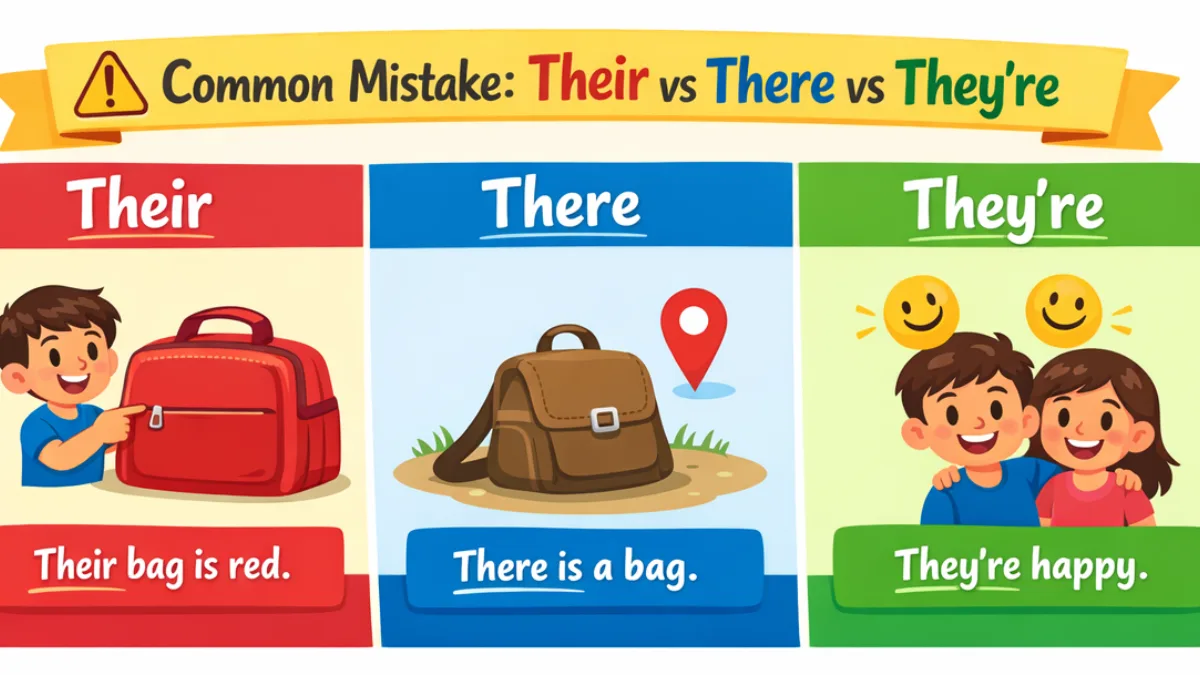
Their, there, and they're are three of the most commonly confused words in English. They sound identical when spoken, but each has a completely different meaning and function. Mixing them up in writing is one of the fastest ways to undermine your credibility, whether you are sending a professional email, writing a report, or posting on social media.
The good news is that telling them apart takes only a few seconds once you know the tricks. This guide gives you clear definitions, dozens of examples, reliable memory devices, comparisons with similar homophones like your/you're and its/it's, and practice sentences to make the distinction automatic.
The Three Words at a Glance
| Word | Type | Meaning | Quick Test |
|---|---|---|---|
| their | possessive pronoun | belonging to them | Replace with our or his - does it still make sense? |
| there | adverb / pronoun | in that place; used to introduce a statement | Replace with here - does it still make sense? |
| they're | contraction | short for they are | Expand to they are - does it still make sense? |
These three tests are the foundation of everything in this guide. If you memorize nothing else, memorize these three substitutions. They work in every situation.
Their - The Possessive One
Their shows ownership or possession by a group of people. It answers the question "whose?" Just as "my" shows something belongs to me and "your" shows something belongs to you, "their" shows something belongs to them.
In modern English, "their" is also widely accepted as a singular gender-neutral possessive, as in "Every student should bring their laptop." This usage has been standard in English for centuries and is endorsed by most contemporary style guides.
Examples of Their in Sentences
- The students turned in their assignments on time.
- Their new office is on the third floor.
- The neighbors parked their car in front of our driveway.
- Every team member should bring their laptop to the meeting.
- Their approach to customer service sets them apart.
- The company updated their privacy policy last month.
- Both candidates presented their platforms effectively.
- Employees must submit their timesheets by Friday.
- The birds returned to their nests at dusk.
- Their decision surprised everyone in the department.
- The clients expressed their concerns during the meeting.
- Their quarterly results exceeded analyst expectations.
- The team celebrated their successful product launch.
- Each department manages their own budget allocation.
- Their commitment to quality is evident in every product.
How to Confirm You Need Their
Replace their with our, his, or her. If the sentence still makes grammatical sense, their is correct.
| Test | Result |
|---|---|
| The students turned in our assignments on time. | Makes sense (grammatically) -> their is correct |
| The students turned in they are assignments on time. | Does not make sense -> not they're |
| The students turned in here assignments on time. | Does not make sense -> not there |
Common Patterns Where Their Appears
Their typically appears directly before a noun (the thing being possessed):
- their car, their house, their idea, their team
- their report, their decision, their manager, their budget
- their performance, their feedback, their timeline, their proposal
If you see a noun immediately following the blank, there is a strong chance you need their.
There - The Place One (and the Introducer)
There has two primary functions in English:
- Referring to a place or location (the opposite of "here")
- Introducing a statement (as in "there is" or "there are")
Both functions are common, and both use the same spelling. The key memory device is that there contains the word here - both relate to locations and existence.
Examples of There (Location)
- The restaurant is right over there.
- We have been there several times this year.
- Put the box there, next to the filing cabinet.
- There is where we held the conference last year.
- I looked everywhere, but the file was not there.
- The parking lot is there, behind the main building.
- We drove there in under an hour.
- Have you ever been there during the holidays?
- The sign says the exit is over there on the left.
- She stood there waiting for the elevator.
Examples of There (Introducing a Statement)
- There are three main reasons for the delay.
- There is no excuse for this level of carelessness.
- There seems to be a problem with the server.
- Is there anything else we should discuss?
- There were over 200 applicants for the position.
- There has been a significant improvement in response times.
- There will be a team meeting at 3 PM.
- Is there a backup plan if this approach fails?
- There appears to be a discrepancy in the data.
- There is no way to recover the deleted files.
How to Confirm You Need There
For location usage, replace there with here. If the sentence still makes sense, there is correct. For introductory usage, note whether the word is followed by "is," "are," "was," "were," "has been," "will be," or a similar verb of existence.
| Test | Result |
|---|---|
| The restaurant is right over here. | Makes sense -> there is correct |
| The restaurant is right over they are. | Does not make sense -> not they're |
| The restaurant is right over belonging to them. | Does not make sense -> not their |
Common Patterns Where There Appears
- Over there, right there, out there, down there, up there
- There is, there are, there was, there were, there will be
- Is there, are there, was there, were there
- Go there, been there, get there, stay there
They're - The Contraction
They're is a contraction of they are. That is all it means, and that is the only thing it ever means. Whenever you see or write they're, you should be able to expand it to "they are" and have the sentence work perfectly.
The apostrophe in they're replaces the missing letter "a" from "are." This is the same pattern as other contractions: can't (cannot), won't (will not), I'm (I am), you're (you are).
Examples of They're in Sentences
- They're arriving at the airport at noon.
- I think they're going to approve the proposal.
- They're the best team in the league this season.
- Be careful - they're not as reliable as they seem.
- They're planning to renovate the building next year.
- If they're not interested, we should move on.
- They're always the first ones to volunteer.
- I heard they're launching a new product line.
- They're confident the numbers will improve next quarter.
- They're the ones who submitted the winning bid.
- Do you think they're ready for the presentation?
- They're expected to announce the results tomorrow.
- I believe they're making the right decision.
- They're committed to finishing the project on schedule.
- They're among the most respected firms in the industry.
How to Confirm You Need They're
Expand they're to they are. If the sentence reads correctly, you have the right word. This is the most reliable test of the three.
| Test | Result |
|---|---|
| They are arriving at the airport at noon. | Makes sense -> they're is correct |
| Belonging to them arriving at the airport at noon. | Does not make sense -> not their |
| In that place arriving at the airport at noon. | Does not make sense -> not there |
When to Avoid the Contraction
In formal writing - academic papers, legal documents, business proposals, and official reports - contractions are generally avoided. In these contexts, write out "they are" instead of "they're." This does not change the rule; it simply means you spell out the full form rather than using the contraction.
- Formal: They are expected to deliver the report by Friday.
- Informal: They're expected to deliver the report by Friday.
The Three-Step Decision Process
When you need to choose between their, there, and they're, run these tests in order:
Step 1: Try expanding to "they are."
If it works, write they're.
Step 2: Does the word show possession (whose)?
If yes, write their.
Step 3: Does it refer to a place or introduce a statement?
If yes, write there.
This process takes a few seconds and eliminates errors every time. Start with they're because it has the simplest, most definitive test. If the expansion to "they are" does not work, move to the other two tests.
Side-by-Side Comparisons
These sentence sets show how changing the word changes the meaning entirely. Study these carefully - they illustrate why choosing the wrong form creates confusion for readers.
Set 1
- Their car is parked outside. (The car belongs to them.)
- The car is parked over there. (The car is in that location.)
- They're parking the car now. (They are parking the car.)
Set 2
- Their presentation was outstanding. (The presentation belongs to them.)
- The conference room is there, down the hall. (Location.)
- They're presenting at 3 PM. (They are presenting.)
Set 3
- We need their input before making a decision. (Input belonging to them.)
- Is there a meeting scheduled for today? (Introduces a question.)
- They're meeting with the client this afternoon. (They are meeting.)
Set 4
- Their deadline was moved to next Friday. (The deadline belongs to them.)
- Put the report there on my desk. (Location.)
- They're going to miss the deadline. (They are going to miss.)
Set 5
- Their proposal outperformed all competitors. (The proposal belongs to them.)
- The proposal is there in the shared drive. (Location.)
- They're proposing a new approach entirely. (They are proposing.)
Set 6
- I respect their expertise in data analysis. (Expertise belonging to them.)
- There are several experts available for consultation. (Introduces a statement.)
- They're the leading experts in the field. (They are the experts.)
Common Mistakes in Professional Writing
These are real patterns of errors that appear frequently in workplace communication. Each example shows the wrong version, the correct version, and the test that reveals the answer.
Mistake 1: Their Instead of They're
Wrong: Their going to send the invoice tomorrow.
Correct: They're going to send the invoice tomorrow.
Test: "They are going to send the invoice tomorrow" works, so they're is correct.
Wrong: Their the best vendor we've worked with.
Correct: They're the best vendor we've worked with.
Test: "They are the best vendor" works.
Wrong: I think their ready to launch.
Correct: I think they're ready to launch.
Test: "They are ready to launch" works.
Mistake 2: There Instead of Their
Wrong: The team submitted there report ahead of schedule.
Correct: The team submitted their report ahead of schedule.
Test: "The team submitted our report" makes sense, so their is correct.
Wrong: Customers want there issues resolved quickly.
Correct: Customers want their issues resolved quickly.
Test: "Customers want our issues resolved" makes sense.
Wrong: The executives shared there concerns with the board.
Correct: The executives shared their concerns with the board.
Test: "The executives shared our concerns" makes sense.
Mistake 3: They're Instead of There
Wrong: They're are too many errors in this document.
Correct: There are too many errors in this document.
Test: "They are are too many errors" does not work. This sentence introduces a statement, so there is correct.
Wrong: Put the files over they're on the shelf.
Correct: Put the files over there on the shelf.
Test: "Put the files over here" works for location.
Mistake 4: There Instead of They're
Wrong: I believe there the right candidates for the job.
Correct: I believe they're the right candidates for the job.
Test: "I believe they are the right candidates" works, so they're is correct.
Wrong: There not going to make the deadline.
Correct: They're not going to make the deadline.
Test: "They are not going to make the deadline" works.
Mistake 5: Their Instead of There
Wrong: Is their a backup plan?
Correct: Is there a backup plan?
Test: This introduces a question about existence, not possession.
Wrong: Their seems to be a problem with the system.
Correct: There seems to be a problem with the system.
Test: This introduces a statement, not a possessive.
Other Commonly Confused Homophones
Their/there/they're is part of a larger family of homophones that trip up writers. Here are the most common ones, with the same quick-test approach that works for their/there/they're. For another pair that causes similar confusion in professional writing, see the guide on affect vs effect, which uses the same substitution strategy to resolve a verb-versus-noun distinction.
Your vs You're
| Word | Type | Meaning | Quick Test |
|---|---|---|---|
| your | possessive | belonging to you | Replace with my |
| you're | contraction | you are | Expand to you are |
Examples:
- Your report is due tomorrow. (my report - possessive)
- You're doing an excellent job. (you are - contraction)
- Your feedback has been incredibly helpful. (my feedback - possessive)
- You're welcome to join the meeting. (you are welcome - contraction)
Common errors:
- "Your welcome" should be "You're welcome" (you are welcome).
- "Your the best candidate" should be "You're the best candidate" (you are).
- "Please submit you're report" should be "Please submit your report" (possessive).
Its vs It's
| Word | Type | Meaning | Quick Test |
|---|---|---|---|
| its | possessive | belonging to it | Replace with his or her |
| it's | contraction | it is / it has | Expand to it is or it has |
Examples:
- The company changed its logo. (his logo - possessive)
- It's the best option we have. (it is - contraction)
- The software and its features are well-documented. (his features - possessive)
- It's been a productive quarter. (it has been - contraction)
Common errors:
- "It's features include..." should be "Its features include..." (possessive, no apostrophe).
- "The dog wagged it's tail" should be "The dog wagged its tail" (possessive).
- "Its going to rain" should be "It's going to rain" (it is).
Important pattern: Possessive pronouns never use apostrophes. His, hers, its, ours, yours, theirs - none of them have apostrophes. Apostrophes in pronouns always signal contractions, never possession. This is the opposite of how apostrophes work with regular nouns (the company's policy), which is why the confusion is so common.
To vs Too vs Two
| Word | Type | Meaning | Quick Test |
|---|---|---|---|
| to | preposition / infinitive marker | direction; part of a verb | Default choice |
| too | adverb | also; excessively | Replace with also or excessively |
| two | number | the number 2 | Replace with 2 |
Examples:
- We went to the conference. (direction)
- She attended too. (also)
- The price is too high. (excessively)
- There are two options. (the number 2)
- I want to finish this too. (infinitive marker; also)
- The two teams need to collaborate. (number; direction/purpose)
Common errors:
- "I want to go to" should be "I want to go too" when meaning "also."
- "There are to many errors" should be "There are too many errors" (excessively).
- "The too candidates were strong" should be "The two candidates were strong" (number).
Whose vs Who's
| Word | Type | Meaning | Quick Test |
|---|---|---|---|
| whose | possessive | belonging to whom | Replace with his or her |
| who's | contraction | who is / who has | Expand to who is or who has |
Examples:
- Whose jacket is this? (his jacket - possessive)
- Who's leading the project? (who is leading - contraction)
- The employee whose performance improved received a raise. (his performance - possessive)
- Who's been handling the client account? (who has been - contraction)
The Common Thread
Notice the pattern across all these homophone pairs:
| Apostrophe Version | No Apostrophe Version |
|---|---|
| they're (they are) | their (possessive) |
| you're (you are) | your (possessive) |
| it's (it is) | its (possessive) |
| who's (who is) | whose (possessive) |
The rule: With pronouns, apostrophes always mean a contraction. Possessive pronouns never have apostrophes. This single pattern covers four of the most commonly confused word pairs in English.
Why Autocorrect and Spell-Checkers Miss These Errors
Standard spell-checkers verify only that a word is spelled correctly. Since their, there, and they're are all legitimate, correctly spelled English words, spell-check sees nothing wrong regardless of context.
Even more advanced grammar tools have limitations with homophones because:
Context analysis is imperfect. Determining whether a sentence needs a possessive pronoun, a location word, or a contraction requires understanding the intended meaning, which software does not always parse correctly.
Informal writing confuses algorithms. Sentence fragments, casual phrasing, and missing punctuation in emails and messages make it harder for tools to analyze context.
Autocorrect can introduce errors. On mobile devices, autocorrect sometimes "corrects" the right word to the wrong homophone, especially if your typing pattern frequently uses one form over another.
Ambiguous sentences exist. Some sentence structures are genuinely ambiguous, and even a human reader might need additional context to determine the writer's intent.
Grammar tools prioritize other errors. Many grammar-checking tools focus on more clear-cut errors like subject-verb agreement and may deprioritize homophone detection where the confidence level is lower.
This is exactly why understanding the difference yourself matters. Technology is a helpful safety net, but it cannot replace your own knowledge. The three-second substitution test is faster and more reliable than any autocorrect system.
Practice Sentences
Choose the correct word for each blank. Answers follow below.
- _____ planning to announce the results on Monday.
- The documents are over _____, on the conference table.
- Has _____ manager approved the request yet?
- _____ are several factors to consider before deciding.
- I think _____ going to need more time.
- The clients sent _____ feedback this morning.
- We should meet _____ instead of at the office.
- _____ the most experienced candidates in the pool.
- _____ is no reason to delay the launch.
- Please ask _____ team to submit the files by noon.
- _____ not sure if _____ package has arrived yet.
- Put _____ luggage over _____ by the door.
- _____ telling us _____ ready to move forward.
- Is _____ a reason _____ not responding?
- _____ going to present _____ findings at the meeting over _____.
- _____ confident that _____ strategy will work.
- _____ is nothing we can do if _____ not willing to compromise.
- _____ office is over _____, across from the elevator.
- _____ saying _____ moving _____ operations to a new building.
- If _____ not _____, check if _____ still at the restaurant.
Answers
- They're (they are planning)
- there (location)
- their (possessive - the manager belonging to them)
- There (introduces a statement)
- they're (they are going to need)
- their (possessive - feedback belonging to them)
- there (location)
- They're (they are the most experienced)
- There (introduces a statement)
- their (possessive - team belonging to them)
- They're / their (they are not sure / package belonging to them)
- their / there (luggage belonging to them / location)
- They're / they're (they are telling / they are ready)
- there / they're (introduces a question / they are not responding)
- They're / their / there (they are going / findings belonging to them / location)
- They're / their (they are confident / strategy belonging to them)
- There / they're (introduces a statement / they are not willing)
- Their / there (office belonging to them / location)
- They're / they're / their (they are saying / they are moving / operations belonging to them)
- they're / there / they're (they are not / at that location / they are still)
Frequently Made Errors in Specific Document Types
Different types of writing tend to produce characteristic their/there/they're errors. Knowing where these errors cluster can help you target your proofreading.
Emails and Slack Messages
The most common error in quick-fire communication is using "there" when "their" or "they're" is needed. Speed is the culprit - writers type the first homophone that comes to mind without pausing to verify.
Typical errors and corrections:
- "Can you check with there team?" -> their team
- "There coming to the meeting at 3" -> They're coming
- "I'll send it to there manager" -> their manager
- "There the ones who requested the change" -> They're the ones
- "I think there going to approve it" -> they're going to approve it
Reports and Presentations
In longer documents, errors often appear when writers are deep in content and not focused on mechanics. The most common their/there/they're error in reports is using "there" as a possessive:
- "The department exceeded there targets" -> their targets
- "There analysis of the data was thorough" -> Their analysis
- "The results support there hypothesis" -> their hypothesis
Social Media and Marketing Copy
Social media posts are short, highly visible, and often shared widely. A homophone error in a social media post from a brand account can generate negative attention and screenshot mockery. Common marketing errors:
- "Get there before there gone!" -> Get there before they're gone!
- "Customers love there new features" -> Customers love their new features
- "There the industry leader" -> They're the industry leader
Text Messages and Informal Writing
While homophone errors in texts are generally forgivable, building the habit of correct usage even in casual contexts helps prevent errors from creeping into professional writing. Autocorrect on mobile devices frequently introduces homophone errors by "correcting" the right word to the wrong one based on your typing patterns.
Memory Tricks Summary
| Word | Memory Device |
|---|---|
| their | Contains heir - an heir inherits possessions. Their shows possession. |
| there | Contains here - both refer to a place or existence. |
| they're | Contains an apostrophe - apostrophes signal missing letters. The missing letter is the "a" from "are." |
Additional Memory Devices
The sentence trick: "They're putting their coats over there." This single sentence uses all three words correctly and can serve as a quick reference.
The question trick: Ask yourself three questions in order:
- Can I say "they are" instead? -> they're
- Does it mean "belonging to them"? -> their
- Is it about a place or "there is/are"? -> there
The letter trick: The letters that differ are eir, ere, and ey're. Think: heir (possession), here (place), they are (contraction).
Quick-Reference Decision Table
| If the word... | Use... | Example |
|---|---|---|
| Can be expanded to "they are" | they're | They're ready to start. |
| Shows possession (whose?) | their | Their proposal was accepted. |
| Refers to a location | there | The office is over there. |
| Introduces a statement | there | There are three options. |
Their, There, and They're in Professional Contexts
Business Emails
Business emails are where their/there/they're errors appear most frequently, because emails are often written quickly under time pressure. Here are correctly written examples for common business situations:
Project updates:
- They're expecting the final deliverables by end of day Friday.
- Their team has completed the first phase of testing.
- There are a few outstanding issues we need to address before launch.
Meeting coordination:
- They're available for a call on Thursday afternoon.
- Their calendar shows openings at 2 PM and 4 PM.
- There is a conference room available on the third floor.
Client communication:
- They're interested in expanding the scope of the project.
- We need to review their feedback before the next milestone.
- There was a discrepancy in the billing statement.
Academic Writing
In academic and research writing, contractions (they're) are typically avoided. Use "they are" instead. However, their and there appear frequently:
- The researchers published their findings in a peer-reviewed journal.
- There is limited evidence to support this hypothesis.
- The participants reported their experiences through structured interviews.
- There are several limitations to the current study.
- Their methodology was adapted from a 2019 framework.
Social Media and Marketing
Marketing copy and social media posts must be error-free because they represent your brand to a wide audience. A their/there/they're mistake in a published post can attract ridicule and undermine trust.
- Join our community - they're the most supportive group online. (they are)
- Customers love our product. Read their reviews below. (belonging to them)
- Great ideas start here. Your next breakthrough is right there. (location/metaphor)
Resumes and Cover Letters
In job application materials, homophone errors are among the most common reasons hiring managers dismiss candidates. Every instance must be correct:
- The teams I led exceeded their performance targets every quarter.
- There were significant challenges that required creative problem-solving.
- If they're looking for a results-driven professional, I am the right fit.
Common Sentence Patterns and Which Word to Use
These patterns cover the most frequent structures where their/there/they're appear. Memorizing these patterns can supplement the substitution tests.
| Pattern | Correct Word | Example |
|---|---|---|
| _____ + verb (are, is, were, will be) | there | There are two options. |
| _____ + verb (-ing, action) | they're | They're working late tonight. |
| _____ + noun (possession) | their | Their project won first place. |
| Over _____ / Right _____ | there | The files are over there. |
| _____ + adjective | they're | They're confident about the outcome. |
| _____ + the + adjective/superlative | they're | They're the best team we have. |
| _____ + not / _____ + going to | they're | They're not available until Tuesday. |
| In _____ + noun | their | They kept it in their records. |
Tips for Proofreading Homophones
Read your text backward, sentence by sentence. This breaks the flow and forces you to evaluate each sentence independently rather than skimming past errors your brain autocorrects.
Use the find function. Search your document for each form (their, there, they're) and verify each instance individually. This targeted approach catches errors that general proofreading misses.
Read aloud slowly. When you read aloud, you are more likely to notice when a word does not match its intended meaning. Your ear catches what your eye skips.
Check during a separate editing pass. Do not try to catch homophones while also checking for logic, structure, and tone. Dedicate a specific pass to mechanical errors like homophones and spelling.
Pay extra attention when you are tired. Homophone errors spike when writers are fatigued, rushing, or multitasking. If you wrote something quickly, give it an extra review before sending.
Build the substitution habit. Every time you write their, there, or they're, spend one second running the test. Within a few weeks, this becomes automatic and takes no conscious effort.
Watch for autocorrect interference. After using autocorrect or voice-to-text, do a specific check for homophones, as these tools frequently introduce errors.
Focus on high-stakes documents. While a homophone error in a casual chat is minor, the same error in a resume, proposal, or client-facing document can be costly. Apply extra scrutiny to any writing that represents you or your organization.
Keep a personal error log. If you consistently confuse one pair more than others, make a note and focus your proofreading energy there. Most people have a pattern to their homophone mistakes.
Teach someone else. Explaining the their/there/they're distinction to someone else is one of the most effective ways to solidify your own understanding. If you can teach it clearly, you know it thoroughly.
Mastering their, there, and they're is not about memorizing complicated rules. It is about building a simple habit - a quick mental test that takes seconds and prevents errors that can undermine your professional image. The substitution tests are fast, reliable, and universal. Practice them consistently, and within a few weeks, choosing the right form will be as automatic as typing your own name.
The History Behind the Confusion
Understanding why these three words exist helps explain why they cause so much trouble.
Their comes from Old Norse (the language of the Vikings), entering English around the 13th century. It replaced the earlier Old English possessive forms because Norse-influenced dialects in northern England spread southward. The word has always been a possessive pronoun.
There has roots in Old English and has been part of the language since its earliest forms. It has always indicated location or been used as an introductory word, and its spelling has remained relatively stable for centuries.
They're is a relatively modern development. English contractions became standardized in writing during the 17th and 18th centuries, though they had been used in speech for much longer. The apostrophe marking the contraction follows the same pattern as other pronoun contractions: I'm, you're, he's, she's, we're, it's.
The confusion exists because all three words descended from separate sources but converged in pronunciation due to the natural evolution of English sounds. Their distinct origins explain their distinct meanings, but their identical pronunciation explains why writers mix them up. This is not a flaw in anyone's intelligence - it is a quirk of language history that requires a conscious strategy to manage.
The good news is that once you build the substitution habit, the historical complexity becomes irrelevant. The tests work regardless of etymology, and they will serve you in every writing situation for the rest of your career.
Frequently Asked Questions
What is the fastest way to tell their, there, and they're apart?
The fastest method is a quick substitution test. For they’re, expand it to they are. If the sentence still makes sense, they’re is correct. For their, ask whether the word shows possession or ownership by a group. If you can replace it with our or his and the sentence still works, their is the right choice.
For there, check whether the word refers to a place or location, or whether it introduces a statement like there is or there are. You can also remember that there contains the word here, both of which refer to places. Running these three quick tests takes only seconds and eliminates errors before they reach your reader.
Why does autocorrect miss their, there, and they're errors?
Autocorrect and basic spell-checkers only verify that a word is spelled correctly, not that it is used correctly in context. Since their, there, and they’re are all legitimate English words with correct spellings, a standard spell-checker flags none of them regardless of context. More advanced grammar-checking tools can sometimes catch these errors by analyzing sentence structure, but even sophisticated software struggles with ambiguous contexts.
This is precisely why understanding the difference matters. You cannot rely on technology to catch homophone errors consistently. Developing the habit of mentally expanding contractions and testing for possession or location remains the most reliable approach to avoiding these mistakes.
Are their, there, and they're errors common in professional settings?
These errors are surprisingly common even among experienced professionals. They frequently appear in emails, Slack messages, social media posts, and even published marketing materials. The reason is that most people understand the difference in principle but make mistakes when typing quickly or when fatigued.
In professional settings, these errors can create a negative impression because they suggest carelessness or lack of attention to detail.
Recruiters and hiring managers often cite homophone errors as red flags in resumes and cover letters. The good news is that once you internalize the substitution tests, catching these errors during a quick proofread becomes nearly automatic.