
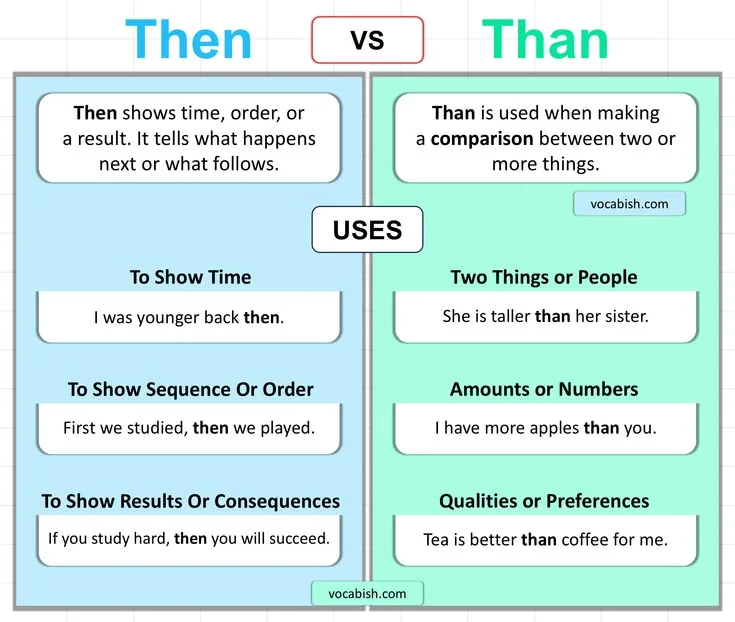
"Than" and "then" are spelled almost the same and sound almost the same, but they do completely different jobs in a sentence. "Than" is used for comparisons. Bigger than, better than, more expensive than. "Then" is used for time or sequence. First we met, then we talked. The confusion between them is one of the most common writing mistakes in English, and it is also one of the easiest to fix once you learn the rule. This guide explains Than vs with clear rules and worked examples.
The reason the mistake persists is that spell-checkers do not catch it. Both "than" and "then" are valid English words, so no software will flag the error for you. The only defense is understanding the distinction well enough that the right word comes automatically while you draft.
This guide walks through the rule, the logic behind it, more than twenty concrete examples, the memory trick that sticks, and the four mistake patterns that cause most errors. By the end, the distinction should feel natural.
The Kalenux Team maintains this reference as part of a broader grammar library for writers who want to move past common stumbles and produce cleaner drafts. Because "than" and "then" appear in almost every piece of writing, the investment in mastering them pays back many times over.
The Core Rule
"Than" is used for comparisons. It sets up a contrast between two items.
"Then" is used for time, sequence, or consequence. It tells you when something happens or what happens next.
Examples:
"She is taller than her brother." Comparison. Use "than."
"We finished dinner, then we went for a walk." Sequence. Use "then."
"This version is easier to read than the last one." Comparison. Use "than."
"Back then, we used paper forms for everything." Time. Use "then."
"The test that never fails is this: if you are putting two items side by side and comparing them, use than. If you are putting events in order along a timeline, use then. That is the full rule." Kalenux Team expert-written grammar reference
The Mnemonic That Sticks
The letter inside each word matches its job.
"Than" has an A. It is used for comparisons or contrasts, which both start with A-related words: apples and oranges, above and below, alike and different.
"Then" has an E. It is used for time or events in a sequence, and both "time" and "event" contain an E.
Another angle: "then" and "when" rhyme and both relate to time. If the sentence answers the question "when," use "then."
"Than" and "compare" are both about comparison. If the sentence answers the question "compared to what," use "than."
Most writers find one of these angles sticks for them. Pick the one that clicks and let it do the work.
Twenty-Plus Correct Examples
Than (comparison):
- "The project took longer than expected."
- "She speaks more clearly than most of the other candidates."
- "The new office is closer to the station than the old one."
- "This report is more detailed than last quarter's."
- "He arrived earlier than the rest of the team."
- "The second draft is stronger than the first."
- "My coffee is hotter than yours."
- "Their apartment is cheaper than ours."
- "The revised budget is tighter than before."
- "She knows more about accounting than anyone on the team."
- "The meeting ran longer than planned."
- "The weather today is worse than yesterday."
- "Fewer people attended than registered."
- "The route through downtown is faster than the highway."
- "This camera produces better images than the previous model."
Then (time or sequence):
- "First we review the agenda, then we discuss the proposal."
- "Back then, email was still a new technology."
- "She walked in, sat down, and then began the presentation."
- "If the invoice is late, then we apply the penalty."
- "He studied for an hour, then took a break."
- "Open the file, then scroll to the bottom."
- "I was much younger then."
- "We went to the meeting, and then we had lunch."
- "If you press that key, then the window closes."
- "Turn left at the corner, then take the second right."
- "She finished the draft, then sent it for review."
- "By then, the deadline had already passed."
- "We will confirm the details, then send the contract."
- "Just then, the alarm went off."
- "Load the data, then run the analysis."
Common Mistakes to Avoid
Mistake 1: Using then in a comparison.
Wrong: "This option is better then the other one."
Correct: "This option is better than the other one."
The word "better" signals a comparison. The second item in the comparison always takes "than."
Mistake 2: Using than in a sequence.
Wrong: "We finished the report, than we sent it to the client."
Correct: "We finished the report, then we sent it to the client."
The sentence describes two events in time order. "Then" is the sequence word.
Mistake 3: Mixing them in the same document.
Some writers use "than" in one sentence and "then" in a similar construction two paragraphs later. Consistency matters. A single document should apply the rule uniformly.
Mistake 4: Trusting spell-check.
Both words are valid English, so spell-checkers do not flag the wrong one. Proofread specifically for "than" and "then" if you know you struggle with the distinction.
Quick Reference Cheat Sheet
| If the Sentence Is About | Correct Word | Sample Construction |
|---|---|---|
| Comparing two items | than | bigger than, better than, more expensive than |
| Placing an event in time | then | back then, right then, by then |
| Ordering steps or actions | then | first do X, then do Y |
| Expressing a consequence | then | if this, then that |
| Setting up a contrast | than | smarter than, different than, rather than |
This single table covers more than ninety-nine percent of real writing situations.
The Special Case of Rather Than
"Rather than" is a common compound phrase that confuses some writers because it feels like a sequence ("rather" followed by what comes next) but is actually a comparison. Stick with "than."
Correct:
- "We decided to meet on Tuesday rather than Wednesday."
- "She chose the direct route rather than the scenic one."
- "The firm invested in training rather than new hires."
The phrase "rather than" always takes "than," never "then." It is a comparison signaling preference between two options.
Many writers hesitate over "rather than" because "rather" can feel like it signals a sequence. It does not. The phrase is a long-established comparison construction and always takes "than."
The Special Case of If Then
"If this, then that" is a conditional construction that uses "then" even though no time is literally involved. The construction comes from logic and programming, but it is standard in English writing.
Correct:
- "If the contract expires, then we renegotiate the rate."
- "If the server goes down, then the alert system triggers."
- "If the student passes both tests, then the certificate is awarded."
Here "then" signals consequence or result, which is close enough to sequence that the same word handles both.
Self-Check Exercise
Fill in the blank with "than" or "then." Answers at the end.
- Sarah is faster ___ everyone else on the team.
- We reviewed the numbers, ___ decided to proceed.
- The new version is more reliable ___ the old one.
- Back ___, we did everything on paper.
- If the rain stops, ___ we will start the outdoor event.
- I would rather stay in ___ go out tonight.
- The commute takes longer ___ it used to.
Answers: 1. than (comparison). 2. then (sequence). 3. than (comparison). 4. then (time). 5. then (conditional consequence). 6. than (rather than comparison). 7. than (comparison).
If you got all seven, the rule has stuck.
Why the Mistake Matters in Professional Writing
Editors, hiring managers, and senior writers notice "than" and "then" mistakes immediately because the words are so basic that mixing them suggests the writer did not proofread. A single occurrence in a long document is forgivable. Two or more in the same document starts to affect the reader's trust in the rest of the writing.
In corporate communication, marketing copy, and academic writing, the standard is zero errors of this type. In casual blog posts and social content, the error may go unnoticed by many readers but will still catch the eye of the small fraction who read carefully.
"Two-letter spelling differences are the cracks through which otherwise strong writing leaks credibility. Than and then is the most visible of those cracks in English." Kalenux Team expert-written editorial guidance
Building a Proofreading Habit
Writers who struggle with "than" and "then" can build a quick habit to catch the errors during editing.
Step 1: Search the document for the word "then" and verify each instance.
Step 2: Search the document for the word "than" and verify each instance.
Step 3: For any instance of "then," ask whether the sentence is about time or sequence. If not, change to "than."
Step 4: For any instance of "than," ask whether the sentence is about a comparison. If not, change to "then."
A two-minute search and review catches almost every error of this type, even in long documents. Word processors, email clients, and text editors all have find functions that make this habit fast.
Conclusion
"Than" and "then" are not hard to keep straight once the rule is clear. Comparison takes "than." Time and sequence take "then." The A in "than" matches "apples and oranges" and "compare." The E in "then" matches "time" and "event" and "when." Two short mnemonic cues are enough to make the right word automatic.
The Kalenux Team maintains a broader set of grammar guides, and this article pairs naturally with the companion pieces on "fewer" versus "less," "who" versus "whom," and other commonly confused word pairs. Writers who build mastery of these low-cost distinctions gain steady credibility across every draft they produce.
Frequently Asked Questions
What is the difference between than and then?
Than is used for comparison. Bigger than, stronger than, later than. Then is used for time or sequence. First this, then that, back then, right then. The two words have nothing in common grammatically. Than is a conjunction or preposition that introduces the second item in a comparison.
Then is an adverb that places something in time or in a list of steps.
The confusion is almost entirely visual because the words look nearly identical. The quick rule is that than answers the question compared to what, and then answers the question when.
Why do people mix up than and then?
Two reasons. First, the words are spelled almost the same, with only one letter different. Second, they sound similar enough in casual speech that writers who learn English by ear rather than by reading can blur them together. Children and ESL learners often mix them up because the visual difference is small and the audio difference is small. Correct usage requires a clear mental rule rather than relying on how the sentence sounds.
Is it better than or better then?
Better than. The phrase is always a comparison, so the correct word is than. She is better than her brother at chess. The new version is better than the old one. Better then is never correct. If you see it in writing, it is a mistake. The phrase is one of the most commonly misspelled in casual online writing, which is why it is worth memorizing as a fixed unit.
Better than, stronger than, faster than, smarter than, higher than, lower than, older than, younger than. All of these use than.
Is it no later than or no later then?
No later than. This is a comparison, so the word is than. The report is due no later than Friday. The flight arrives no later than ten. Writers sometimes use then in this phrase because it involves a time reference, but time references in comparison constructions still take than. The reason is that the word after the comparative later must be than, no matter what kind of noun follows. Later than Friday, later than noon, later than I expected.
What is a good mnemonic for than vs then?
Than has an A and is used for comparisons or contrasts like apples and oranges. Then has an E and is used for events in a sequence. If the sentence is about comparing two things, write than. If the sentence is about what happens next, write then. Another trick is to remember that then and time both have an E. When a sentence is about time, use then.
Comparison and contrast both have an A, matching than. These small tricks make the choice automatic after a few days of practice.
Does than vs then matter in professional writing?
Yes. Mixing than and then is one of the most visible typos in professional communication because the mistake is semantic, not mechanical. Spell-checkers do not catch it because both words are valid. Readers catch it immediately. Repeated errors suggest weak editing.
A single error in a long document is forgivable but still worth avoiding. Careful writers internalize the distinction so deeply that the correct word comes automatically, even under pressure. This is one of the lowest-cost editing wins available.