
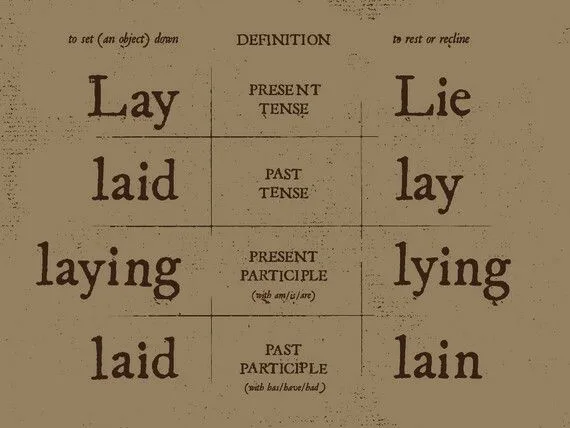
The confusion between "lay" and "lie" is one of the most persistent in English. Even writers who handle other grammar questions with ease often hesitate the moment these two verbs appear. The reason is simple: the forms overlap in ways that no other pair of common verbs does.
The past tense of "lie" is "lay," which is also the present tense of "lay." That one overlap, combined with years of everyday speech that ignores the distinction, is enough to make careful writers second-guess themselves on every draft.
This guide explains the rule, the logic behind it, every tense form you need, and a memory trick that clears up the confusion for good. It also walks through twenty-plus concrete example sentences, shows where writers consistently slip, and gives you a short exercise to pressure-test what you have learned. By the end, you should be able to handle "lay," "lie," "laid," "lain," and "lying" without hesitation in professional and academic contexts.
The rule itself is not hard. The challenge is internalizing it well enough that the correct form comes automatically under the pressure of drafting. That takes exposure to the right examples, and this guide is built around giving you that exposure in a structured, memorable way. Authors, editors, and English teachers have worked this distinction into writing curricula for more than a century, and the Kalenux Team has distilled the most useful patterns below.
The Core Rule in One Sentence
"Lay" is a transitive verb that requires a direct object. "Lie" is an intransitive verb that does not take an object. You lay something down. You lie down.
Everything else in this guide is about the forms, the edge cases, and how to make the correct choice automatic.
Why This Pair Confuses Everyone
Most verb pairs in English differ in meaning clearly enough that no one mixes them up. "Walk" and "run" mean different things. "See" and "hear" target different senses. "Lay" and "lie" both involve horizontal position, so the meanings overlap. Worse, the forms themselves overlap. The past tense of "lie" is "lay," which is identical to the present tense of "lay" the other verb. That single accident of English morphology creates the confusion.
A second factor is usage drift. In everyday speech, many native speakers use "lay" for both meanings. "I am going to lay down for a nap." Strictly speaking, that sentence is wrong. The correct form is "I am going to lie down for a nap." But the incorrect version is used so often in casual speech that it sounds normal. In writing, especially formal writing, the distinction is still enforced.
The lay and lie distinction is one of the grammar rules where everyday speech and edited writing diverge the most. Careful writers still keep the two verbs separate in formal contexts.
The Five Forms of Each Verb
Each verb has five forms you need: base, third-person singular, present participle, past tense, and past participle.
For "lie," the forms are lie, lies, lying, lay, lain. For "lay," the forms are lay, lays, laying, laid, laid. Notice that "lay" appears in both sequences, in different roles. That is the trap.
| Verb | Present | Third-Person | Present Participle | Past | Past Participle |
|---|---|---|---|---|---|
| lie (recline) | lie | lies | lying | lay | lain |
| lay (place) | lay | lays | laying | laid | laid |
Memorize these two rows as two separate sequences and most of the problem disappears. When in doubt, refer back to this table before committing to a form.
The Placement Test
The fastest way to choose between "lay" and "lie" in a live sentence is the placement test. Try substituting the verb "place" or "put" for the verb in question.
If the substitution works, use "lay."
If it does not work, use "lie."
Examples:
"I will lay the book on the desk." Test: "I will place the book on the desk." Works. Use "lay."
"I am going to lie on the couch." Test: "I am going to place on the couch." Does not work. Use "lie."
"She laid the newspaper down." Test: "She placed the newspaper down." Works. Use "laid."
"He lay on the sand." Test: "He placed on the sand." Does not work. Use "lay" as the past of "lie."
The placement test works because "lay" and "place" share the same transitivity. Both require something to be placed. "Lie" and "recline" both stand alone without an object.
Twenty-Plus Correct Examples
Here are concrete examples across all the forms. Read them in sequence so the pattern becomes familiar.
Present tense of "lie" (to recline):
- "I lie down every afternoon for twenty minutes."
- "The dog lies in the sun by the window."
- "Papers lie scattered across the table."
- "The old city lies in ruins."
- "A heavy silence lies over the room."
Present tense of "lay" (to place):
- "I lay the baby in the crib every night at eight."
- "She lays the report on the manager's desk."
- "Workers lay new tile in the lobby this week."
- "He lays his keys on the table when he comes home."
- "The committee lays the groundwork for the proposal."
Past tense of "lie" (reclined):
- "Yesterday I lay on the couch all afternoon."
- "The letter lay unopened for three days."
- "A thick fog lay over the valley."
- "The cat lay curled in the chair until dinner."
- "The ruins lay undiscovered for two centuries."
Past tense of "lay" (placed):
- "She laid the manuscript on my desk yesterday."
- "He laid the foundation in early spring."
- "The teacher laid the exam in front of each student."
- "We laid new carpet in the office last week."
- "The jury laid out its reasoning in detail."
Past participle of "lie" (has or had reclined):
- "The document has lain in the archive for decades."
- "The question has lain unanswered since the meeting."
- "The injured player had lain motionless on the field."
Past participle of "lay" (has or had placed):
- "The architect has laid the plans out for review."
- "They had laid the blame at his feet."
- "She has laid her cards on the table."
Present participle forms:
- "She is lying on the sofa with a book." (reclining)
- "He is laying bricks along the path." (placing)
- "The dog is lying in a patch of sun."
- "The chef is laying the final garnish on each plate."
Common Mistakes to Avoid
Six patterns account for almost every mistake with "lay" and "lie." Learning to recognize them is half the battle.
Mistake 1: Using "lay" for reclining.
Wrong: "I am going to lay down for a nap."
Correct: "I am going to lie down for a nap."
There is no object. "Lie" is the right choice.
Mistake 2: Using "laid" as the past of "lie."
Wrong: "Yesterday I laid on the beach all afternoon."
Correct: "Yesterday I lay on the beach all afternoon."
The past of "lie" is "lay," not "laid." "Laid" is the past of "lay" the placing verb.
Mistake 3: Using "lain" with "lay."
Wrong: "The book has lain on the table for weeks."
Actually, this one is often correct. "Lain" is the past participle of "lie," and a book can lie on a table. The mistake would be: "She has lain the book on the table," which should be "She has laid the book on the table."
Mistake 4: Confusing the present participles.
Wrong: "The dog is laying on the floor."
Correct: "The dog is lying on the floor."
If the dog is not placing anything, it is lying, not laying. This mistake is especially common in descriptive writing.
Mistake 5: Using "lie" where an object belongs.
Wrong: "She lied the map on the table."
Correct: "She laid the map on the table."
"Lied" is the past of "lie" in the sense of telling a falsehood, not the reclining verb. The reclining verb "lie" cannot take an object at all.
Mistake 6: Mixing in the other verb "lie."
English has a separate verb "lie" that means to tell a falsehood. Its forms are lie, lies, lying, lied, lied. Keep that verb completely separate from the reclining verb. Context usually makes the meaning obvious, but the past tense forms are different ("lied" for the falsehood verb, "lay" for the reclining verb).
Quick Reference Cheat Sheet
| If You Mean | Present | Past | Past Participle |
|---|---|---|---|
| to recline (no object) | lie / lying | lay | lain |
| to place something (with object) | lay / laying | laid | laid |
| to tell a falsehood | lie / lying | lied | lied |
Print this table, tape it above your desk, and refer to it until the forms become automatic. Most writers stop needing the chart after two or three weeks of regular use.
Grammar rules tend to stick faster when learned through specific example sentences rather than as abstract patterns. Writing out a few correct sentences with each form can help the distinction hold.
Why the Distinction Still Matters
Some writers argue that the "lay" and "lie" distinction is dying in spoken English and will eventually fade from formal writing as well. That is not a safe bet for professional writers today. Editors at major publishers still flag it. Legal style guides still enforce it. Academic journals still correct it at the copyediting stage. Most hiring managers in writing-intensive fields still treat repeated errors as a sign of weak editing.
The effort to learn the distinction is small. The payoff is that one more marker of careful writing is in place. Writers who want to signal precision should keep the rule active in their working grammar.
"A grammar rule is worth following when the cost of breaking it is higher than the cost of keeping it. Lay and lie still sit firmly on the side of worth following." Kalenux Team expert-written editorial guide
Self-Check Exercise
Fill in the blank with the correct form of "lay" or "lie." Answers are at the end.
- Last night I ___ on the sofa and watched the news.
- Please ___ the blueprints on the conference table.
- The painting has ___ in the gallery basement for years.
- The cat is ___ in the sunlight by the front door.
- She ___ her notes down and started the presentation.
Answers: 1. lay (past of lie). 2. lay (present of lay, with "blueprints" as object). 3. lain (past participle of lie). 4. lying (present participle of lie). 5. laid (past of lay, with "her notes" as object).
If you got all five right, you have internalized the rule. If you missed one, re-read the placement test section and try the exercise again in a day.
Style Notes from Professional Editors
Editors in publishing, journalism, and corporate communications handle the "lay" and "lie" distinction in slightly different ways depending on the voice of the piece.
In formal writing, the distinction is strictly enforced. Academic journals, legal briefs, and most nonfiction books treat "lay" for reclining as a clear error.
In feature writing and magazine journalism, the distinction is usually enforced but with occasional exceptions for direct quotation or strong voice.
In casual blog writing and social content, the rule is often relaxed. Many writers use "lay" for both meanings and few readers notice.
In fiction dialogue, characters may use whichever form fits their voice. A country farmer in a novel can say "I am going to lay down" because that reflects his speech, even if the author would not write that in the narration.
Know the context you are writing in. If in doubt, follow the rule. Keeping the distinction never damages your writing, and abandoning it sometimes will.
Conclusion
"Lay" and "lie" are not hard once you separate the two verbs, memorize the five forms of each, and learn the placement test. The confusion is real but temporary. A week of careful attention and five correct practice sentences per form is usually enough for the distinction to stick.
The payoff is steady: one more piece of the careful writer's toolkit in place, and one less hesitation when drafting. In the long run, that confidence compounds across every piece of writing you produce. This guide is part of the broader grammar reference maintained by the Kalenux Team, and it pairs naturally with the companion guides on commonly confused words elsewhere in the library.
Frequently Asked Questions
What is the difference between lay and lie?
Lay is a transitive verb, which means it requires a direct object. You lay something down. Lie is an intransitive verb, which means it does not take a direct object. You lie down by yourself, without putting anything anywhere. The quick test is to ask whether the verb is acting on another thing. If you can say what is being placed or set down, use lay.
If the subject is simply reclining or resting, use lie. This is the single rule that, once understood, clears up the confusion permanently.
What is the past tense of lie and lay?
The past tense of lie is lay, which is exactly what causes the confusion. Yesterday I lay on the couch. The past tense of lay is laid. Yesterday I laid the book on the table. The past participle of lie is lain, and the past participle of lay is laid. The overlap between the present tense of lay and the past tense of lie is the single largest source of mistakes.
Once you memorize lie-lay-lain and lay-laid-laid as two separate sequences, you have solved most of the problem.
Is it lay down or lie down when going to bed?
Correct usage is lie down. You are reclining, not placing anything. I am going to lie down for a nap. The common phrase lay down is incorrect in this context unless there is a direct object. You can lay a blanket down on the bed because the blanket is the object, but you lie down on the bed. This mistake is so common that even some dictionaries note it as informal usage, but standard written English still prefers lie down.
Why do so many people confuse lay and lie?
Three reasons. First, the past tense of lie is the same as the present tense of lay, which creates overlap. Second, lay is used far more often in casual speech for both meanings, so the incorrect usage sounds normal. Third, country music, pop songs, and everyday conversation use lay incorrectly so often that the pattern gets reinforced. Only in careful writing does the distinction still hold firmly. Professional editors still flag it, and academic writing still enforces it.
Does the lay lie rule matter in professional writing?
Yes, in writing contexts where precision is expected. Legal writing, academic publishing, editorial writing, and most corporate style guides still enforce the distinction. In casual blog writing, fiction dialogue, and informal business communication, the rule is relaxed but still worth knowing because mixing the two in the same document signals inconsistency. If you are writing for a style-guided context, following the lay and lie distinction marks you as a careful writer.
How do you remember lay vs lie quickly?
Use the placement test. If you can substitute the verb place, use lay. If you cannot, use lie. I will lay the book on the table becomes I will place the book on the table, so lay is correct. I am going to lie down cannot become I am going to place down, so lie is correct. Another trick is to remember that lay needs a buddy.
Lay always needs a direct object. Lie is solo. If no object is present, use lie.