
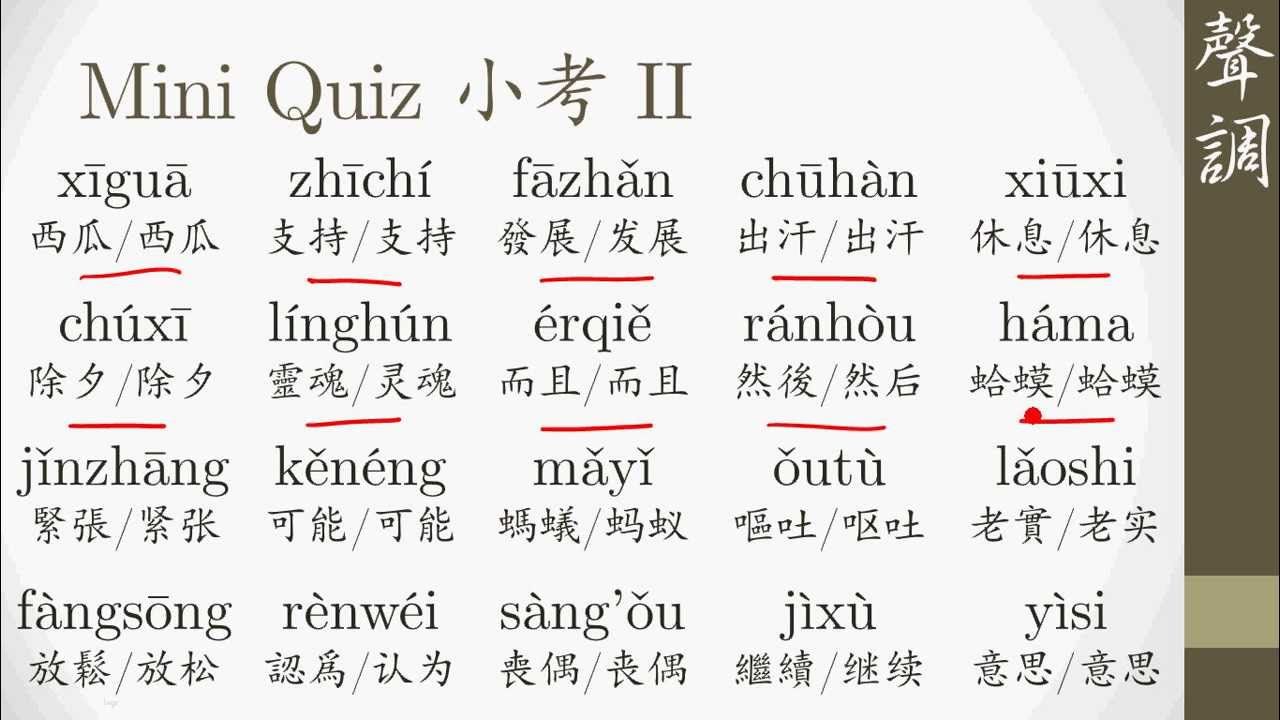
Mandarin Chinese is a tonal language. Every syllable carries a tone, and the tone is as essential to the word as any vowel or consonant. The syllable "ma" can mean "mother" (mā, first tone), "hemp" (má, second tone), "horse" (mǎ, third tone), or "to scold" (mà, fourth tone), depending solely on the melodic contour placed on it. Swap the tone and you swap the word. A fifth tone - the neutral tone - has no pitch of its own and simply rides on the tones around it. Learning to hear, produce, and read the four-plus-one tone system is the foundational task of any Mandarin learner.
This reference describes each tone with its pitch contour, notation, common mistakes, and the tone sandhi rules that modify tones in certain combinations. For the broader pinyin phonetic system, see the pinyin complete guide. For the character-writing system, see the Chinese characters and radicals guide. For basic grammar in which these syllables live, see the Chinese grammar rules guide.
The Four Basic Tones
Table 1. The four Mandarin tones.
| Tone | Name | Contour (5-scale) | Pinyin mark | Description |
|---|---|---|---|---|
| 1 | High level | 55 | ā | High, flat, sustained |
| 2 | Rising | 35 | á | Mid rising to high |
| 3 | Dipping (falling-rising) | 214 | ǎ | Falls then rises |
| 4 | Falling | 51 | à | High falling to low |
| Neutral | (no fixed pitch) | - | a | Short, unstressed |
The Chao numerical system describes pitch on a 1-5 scale (1 lowest, 5 highest). Tone 1 stays at 5; tone 2 starts at 3 and rises to 5; tone 3 dips from 2 to 1 to 4; tone 4 falls from 5 to 1.
Detailed Description of Each Tone
Tone 1 (高平, gāo píng)
A level, high-pitched sustain. Imagine saying "aaa" for a doctor examining your throat, or an operatic "ah" held at a steady note. The pitch does not rise, fall, or waver.
- mā 妈 (mother)
- shū 书 (book)
- gāo 高 (tall)
Common mistake: letting the tone sag at the end. Keep it flat throughout.
Tone 2 (阳平, yáng píng)
A rising tone, like the intonation of a question in English ("What?"). Starts at mid-pitch and climbs to high.
- má 麻 (hemp)
- míng 明 (bright)
- rén 人 (person)
Common mistake: starting too high and failing to rise enough. The motion upward is essential.
Tone 3 (上声, shǎng shēng)
A dipping tone: it starts mid-low, drops, then rises. In citation form (the tone said alone) the rise is prominent. In running speech the rise is often reduced, and the tone sounds mostly low ("half third tone").
- mǎ 马 (horse)
- wǒ 我 (I)
- nǐ 好 (... you good, 你好 nǐ hǎo)
Common mistake: overemphasizing the rise in running speech. Most full third tones in sentences sound "low and flat"; the rise appears only at the very end of a phrase or when said alone.
Tone 4 (去声, qù shēng)
A sharp fall from high to low. Short, emphatic. Similar to an English exclamation "No!" said curtly.
- mà 骂 (to scold)
- bù 不 (not)
- dà 大 (big)
Common mistake: making it sound angry. It is merely steep, not aggressive.
Neutral Tone (轻声, qīng shēng)
A short, unstressed syllable with no fixed pitch. Its actual pitch depends on the tone of the preceding syllable:
- After tone 1: mid pitch (mā ma 妈妈 has second ma mid)
- After tone 2: middle-high (yé ye 爷爷)
- After tone 3: half-high (jiě jie 姐姐)
- After tone 4: low (dì di 弟弟)
The neutral tone appears in:
- Grammatical particles: 的 de, 了 le, 吗 ma, 呢 ne
- Family terms repeated: 妈妈 māma (mama), 爸爸 bàba (papa)
- Some compound words: 东西 dōngxi (thing), 朋友 péngyou (friend)
Tone Sandhi Rules
Tones do not always keep their citation form in connected speech. Several systematic changes, called tone sandhi, occur.
Rule 1: Third-Tone Sandhi
When two third tones appear together, the first changes to second tone:
- 你好 nǐ hǎo (hello) is actually pronounced ní hǎo.
- 很好 hěn hǎo (very good) is pronounced hén hǎo.
- 我很好 wǒ hěn hǎo (I'm fine) - actually: wó hén hǎo (first 3 becomes 2, second 3 becomes 2, third stays 3).
The original tone marks are written as though unchanged; the change is a pronunciation rule.
Rule 2: Half Third Tone
A third tone followed by any non-third tone is pronounced as a low, flat half-third, losing its rising portion.
- 北京 Běijīng - the first syllable is a low flat "Bei," not the full dip.
- 好吃 hǎo chī (delicious) - "hao" is low-flat before the first tone.
Rule 3: The bu (不) Tone Change
不 bù (not) is normally fourth tone. Before another fourth tone, it changes to second tone: bú.
- 不是 bù shì (is not) stays bù (shì is fourth). Wait: shì is fourth. So actually bú shì.
- 不对 bù duì (not right) - bú duì.
- 不来 bù lái - stays bù (lái is second tone).
- 不喝 bù hē - stays bù (hē is first tone).
Only before a fourth tone does bu change to bú.
Rule 4: The yi (一) Tone Change
一 yī (one) has three forms depending on environment:
- Before pause (counting): yī (first tone).
- Before fourth tone: yí (second tone). Example: 一个 yí ge, 一样 yíyàng.
- Before first, second, third tones: yì (fourth tone). Example: 一张 yì zhāng, 一年 yì nián, 一本 yì běn.
Rule 5: Half-Fourth Tone
A sequence of two fourth tones sometimes lightens the first fourth, pronouncing it from high to mid rather than high to low. This is subtle and not always marked.
Tone Pairs Practice
Learning tone pairs (two syllables together) is usually more productive than single tones. Here are the 20 productive pairs with examples:
Table 2. Two-syllable tone combinations with examples.
| 1st tone | Combined | Pinyin | Example | Meaning |
|---|---|---|---|---|
| 1+1 | high level twice | zhōng guó | 中国 | China |
| 1+2 | level then rising | zhōng wén | 中文 | Chinese (language) |
| 1+3 | level then dipping | jīng lǐ | 经理 | manager |
| 1+4 | level then falling | gāo xìng | 高兴 | happy |
| 1+0 | level + neutral | māma | 妈妈 | mother |
| 2+1 | rising + level | míng tiān | 明天 | tomorrow |
| 2+2 | rising + rising | yóu yǒng | 游泳 | swim (wait: 泳 is 3) - use 时候 shí hòu (3rd wrong too). Use 银行 yín háng (bank) |
| 2+3 | rising + dipping | míng bǎi | n/a; better example 学好 xué hǎo (to learn well) | |
| 2+4 | rising + falling | xué xiào | 学校 | school |
| 2+0 | rising + neutral | péng you | 朋友 | friend |
| 3+1 | dipping + level | lǎo shī | 老师 | teacher |
| 3+2 | dipping + rising | měi guó | 美国 | America (meǐ rises; but 3+2 is pronounced as half-3 + 2) |
| 3+3 | 2+3 (sandhi) | nǐ hǎo (ní hǎo) | 你好 | hello |
| 3+4 | dipping + falling | xiǎng yào | 想要 | want |
| 3+0 | dipping + neutral | jiě jie | 姐姐 | older sister |
| 4+1 | falling + level | zài jiā | 在家 | at home |
| 4+2 | falling + rising | zài lái | 再来 | come again |
| 4+3 | falling + dipping | fù wǔ | n/a; better 电脑 diàn nǎo (computer) | |
| 4+4 | falling + falling | zài jiàn | 再见 | goodbye |
| 4+0 | falling + neutral | bào gào | 报告 | report (second is 4, so not neutral) - use 爸爸 bà ba |
Common Mistakes English Speakers Make
- Treating tones as optional. A word without a tone is not the word; it is a different word or no word at all.
- Confusing tone 2 and tone 3. Tone 2 rises steadily; tone 3 dips then rises. In running speech the dip can be the key distinction.
- Over-exaggerating tone 4. It should be sharp and short, not shouted.
- Ignoring tone sandhi. Writing nǐ hǎo but not saying ní hǎo marks a non-native speaker.
- Applying English intonation. English sentence-level pitch (rising for questions, falling for statements) conflicts with Chinese word-tone pitch.
- Over-stressing the neutral tone. The second syllable of 妈妈 should be light and short, not as strong as the first.
- Forgetting bu and yi tone changes. Writing bù shì but pronouncing bù shì (instead of bú shì) is a tone error.
- Skipping tone practice in multisyllable words. Always practice words, not just single syllables.
Quick Reference
- Tone 1: high, flat, sustained (55)
- Tone 2: rising (35)
- Tone 3: dipping (214) in isolation, low (21) before non-3
- Tone 4: falling (51)
- Neutral: short, unstressed, pitch determined by preceding tone
Sandhi rules:
- 3+3 → 2+3
- bù (4) before 4 → bú (2)
- yī (1) before 4 → yí (2); before 1/2/3 → yì (4)
FAQ
Can I speak Chinese without tones?
No. You will be incomprehensible or misunderstood. Tones are phonemic, just like vowels. "Ma" without a tone is not a word.
Is it easier to sing Chinese than speak it?
Some learners find it helpful because singing is already melodic. But Chinese songs actually abandon tones in favor of the song's melody; this means karaoke helps less than it might seem.
How long until my tones sound natural?
Typically 1-2 years of immersion or dedicated practice. Individual tones can be learned in weeks; tone sandhi in connected speech takes much longer.
Why are tones marked over vowels in pinyin?
They ride on the vowel (the syllabic peak). The mark goes over the main vowel of the syllable, typically a, o, or e; then i, u, or u if no main vowel.
Does Cantonese have the same tones?
No. Cantonese has six tones (or nine, counting allophones). Mandarin tones do not transfer.
Does every syllable need a tone?
Every content syllable, yes. Grammatical particles (le, ma, de, ba) are in the neutral tone, with no fixed pitch.
Is the third tone always dipping?
Only in isolation or at the end of a phrase. In running speech, third tones usually stay low without the rise (half third tone).
See Also
- Pinyin complete guide
- Chinese tones complete guide
- Chinese characters and radicals guide
- Chinese grammar rules complete beginners guide
- Chinese measure words guide
- Chinese measure words classifiers reference
- Chinese sentence particles reference
- Chinese radicals 214 Kangxi reference
Frequently Asked Questions
Can I speak Chinese without tones?
No. Tones are phonemic. ‘Ma’ without a tone is not a recognizable word, and tonal errors cause misunderstanding or no understanding at all.
Is it easier to sing Chinese than speak it?
Not really. Chinese songs follow the song’s melody rather than word tones, so tones often disappear in singing. Speaking tones must be learned separately.
How long until my tones sound natural?
Individual tones can be produced in weeks. Tone sandhi in connected speech usually takes 1-2 years of immersion or dedicated practice.
Why are tones marked over vowels in pinyin?
Because tones ride on the syllabic peak (the vowel). The mark goes over a, o, or e when present, otherwise i, u, or u.
Does Cantonese have the same tones?
No. Cantonese has six tones (nine counting allophonic variations). Mandarin tones do not transfer.
Does every syllable need a tone?
Every content syllable does. Grammatical particles like le, ma, de, ba are neutral-tone and have no fixed pitch.
Is the third tone always dipping?
Only in citation form or at the end of a phrase. In running speech, most third tones are pronounced as a low half-third without the rising portion.