
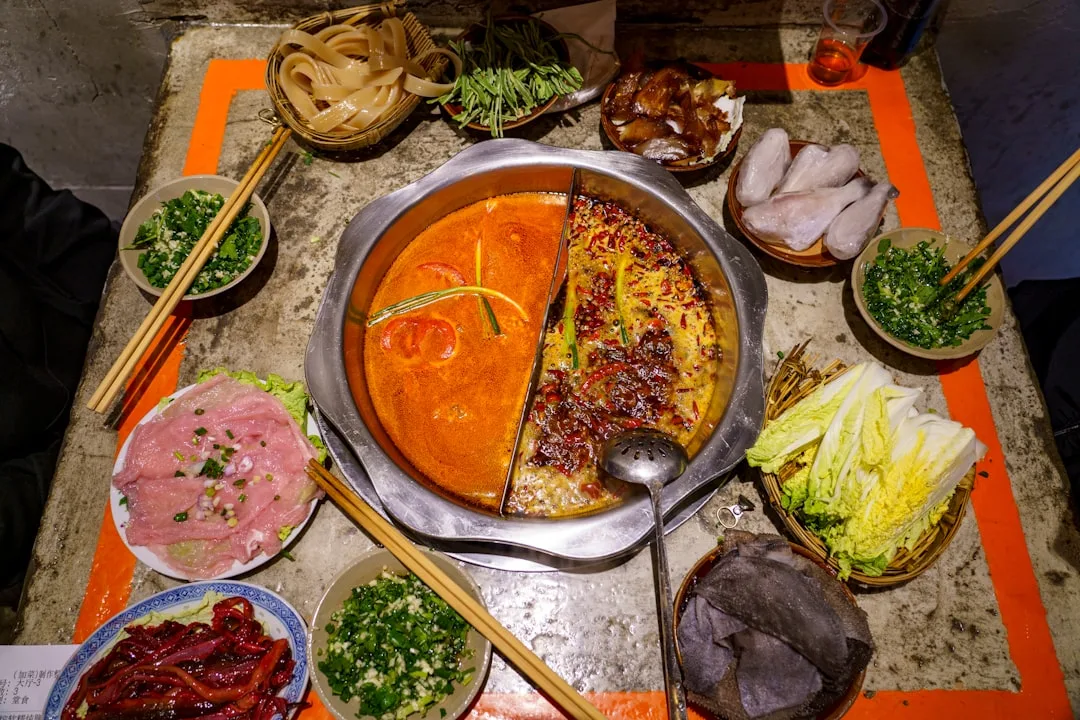
Chinese cuisine (中国菜, zhōngguó cài) is not a single cooking tradition but a constellation of regional styles developed across twenty-three provinces and five autonomous regions, each with distinctive ingredients, flavors, and techniques. This reference collects Chinese food vocabulary across those traditions, covering ingredients, dishes, cooking methods, and the language of ordering in a restaurant.
The most widely recognized grouping is the "Eight Great Cuisines" (八大菜系, bā dà càixì): Sichuan, Cantonese, Shandong, Jiangsu, Zhejiang, Fujian, Hunan, and Anhui. Food vocabulary is therefore not merely practical survival language; it is a window into regional identity, festival tradition, and centuries of culinary innovation.
This reference to Chinese Food Vocabulary covers the vocabulary a learner needs to read menus, order in restaurants, shop at markets, and understand recipes: staple ingredients, cooking methods, flavors, regional cuisines, dining etiquette, and restaurant phrases. Each entry pairs simplified characters with pinyin and a short gloss or cultural note.
For pronunciation of every term, see the pinyin complete guide and the Chinese tones complete guide. For sentence patterns used in ordering and asking, see the Chinese grammar rules guide, and for classifier particles used with food items, see the Chinese measure words classifiers reference.
Staple Foods and Grains
The traditional division between northern wheat-based cuisine and southern rice-based cuisine remains culturally important. Northern Chinese (北方人, běifāng rén) staples feature noodles, dumplings, and steamed buns; southern Chinese (南方人, nánfāng rén) staples feature steamed rice and congee.
Table 1. Staple foods.
| Chinese | Pinyin | English | Notes |
|---|---|---|---|
| 米饭 | mǐfàn | Cooked rice | Southern staple |
| 稀饭 | xīfàn | Rice porridge, congee | Breakfast |
| 粥 | zhōu | Congee | General term |
| 面条 | miàntiáo | Noodles | Northern staple |
| 拉面 | lāmiàn | Hand-pulled noodles | Lanzhou origin |
| 刀削面 | dāoxiāo miàn | Knife-shaved noodles | Shanxi origin |
| 饺子 | jiǎozi | Dumplings | Northern New Year food |
| 包子 | bāozi | Steamed buns (filled) | Breakfast staple |
| 馒头 | mántou | Steamed bun (plain) | Northern bread |
| 烙饼 | làobǐng | Pan-fried flatbread | |
| 煎饼 | jiānbing | Savory crepe | Street food |
| 油条 | yóutiáo | Fried dough stick | Breakfast |
| 粽子 | zòngzi | Sticky rice in bamboo leaf | Dragon Boat Festival |
| 年糕 | niángāo | Sticky rice cake | Spring Festival |
| 月饼 | yuèbǐng | Mooncake | Mid-Autumn Festival |
Meats, Seafood, and Proteins
Pork is the default unspecified meat (猪肉, zhūròu); menus often list just 肉 (ròu) implying pork. Beef (牛肉) and lamb (羊肉) are common in northwestern and Muslim cuisine. Seafood dominates coastal cuisines.
Table 2. Meats and seafood.
| Chinese | Pinyin | English |
|---|---|---|
| 肉 | ròu | Meat (usually pork) |
| 猪肉 | zhūròu | Pork |
| 牛肉 | niúròu | Beef |
| 羊肉 | yángròu | Lamb, mutton |
| 鸡肉 | jīròu | Chicken |
| 鸭肉 | yāròu | Duck |
| 鱼 | yú | Fish |
| 虾 | xiā | Shrimp |
| 螃蟹 | pángxiè | Crab |
| 龙虾 | lóngxiā | Lobster |
| 海鲜 | hǎixiān | Seafood |
| 鸡蛋 | jīdàn | Chicken egg |
| 鸭蛋 | yādàn | Duck egg |
| 皮蛋 | pídàn | Century egg |
| 豆腐 | dòufu | Tofu |
| 豆浆 | dòujiāng | Soy milk |
Vegetables, Fruits, and Herbs
Table 3. Vegetables.
| Chinese | Pinyin | English |
|---|---|---|
| 蔬菜 | shūcài | Vegetables (generic) |
| 青菜 | qīngcài | Leafy greens |
| 白菜 | báicài | Napa cabbage |
| 卷心菜 | juǎnxīncài | Regular cabbage |
| 菠菜 | bōcài | Spinach |
| 土豆 | tǔdòu | Potato |
| 西红柿 | xīhóngshì | Tomato |
| 黄瓜 | huángguā | Cucumber |
| 茄子 | qiézi | Eggplant |
| 胡萝卜 | húluóbo | Carrot |
| 洋葱 | yángcōng | Onion |
| 蒜 | suàn | Garlic |
| 姜 | jiāng | Ginger |
| 葱 | cōng | Green onion, scallion |
| 辣椒 | làjiāo | Chili pepper |
| 香菜 | xiāngcài | Cilantro |
Table 4. Fruits.
| Chinese | Pinyin | English |
|---|---|---|
| 水果 | shuǐguǒ | Fruit (generic) |
| 苹果 | píngguǒ | Apple |
| 香蕉 | xiāngjiāo | Banana |
| 橙子 | chéngzi | Orange |
| 橘子 | júzi | Tangerine |
| 葡萄 | pútao | Grape |
| 西瓜 | xīguā | Watermelon |
| 草莓 | cǎoméi | Strawberry |
| 梨 | lí | Pear |
| 桃子 | táozi | Peach |
| 芒果 | mángguǒ | Mango |
| 荔枝 | lìzhī | Lychee |
| 龙眼 | lóngyǎn | Longan |
| 榴莲 | liúlián | Durian |
Cooking Methods
Chinese cuisine distinguishes more than twenty cooking verbs. Five dominate: 炒 (chǎo, stir-fry), 蒸 (zhēng, steam), 煮 (zhǔ, boil), 炸 (zhá, deep-fry), and 烤 (kǎo, roast/bake).
Table 5. Cooking methods.
| Chinese | Pinyin | English | Description |
|---|---|---|---|
| 炒 | chǎo | Stir-fry | Most common; high heat in a wok |
| 爆 | bào | Quick-fry | Very high heat, seconds only |
| 煎 | jiān | Pan-fry | Low oil, moderate heat |
| 炸 | zhá | Deep-fry | Full submersion |
| 蒸 | zhēng | Steam | Bamboo or metal steamer |
| 煮 | zhǔ | Boil | Full water immersion |
| 炖 | dùn | Stew, braise | Long slow simmer |
| 焖 | mèn | Slow-braise, covered | Low liquid |
| 烧 | shāo | Red-cook, braise | Soy-based braise |
| 烤 | kǎo | Roast, bake | Oven or grill |
| 熏 | xūn | Smoke | Tea or wood |
| 腌 | yān | Pickle, cure | Salt or vinegar |
| 凉拌 | liángbàn | Cold-mix | Salad-style |
| 涮 | shuàn | Blanch at table | Hot pot |
The distinction between 炒 (stir-fry) and 爆 (quick-fry) is not mere degree but technique: 爆 uses oil heated until smoking and cooks ingredients in ten to twenty seconds, preserving crunch. Cantonese kitchens call this the 锅气 (guō qì, "breath of the wok") that distinguishes a master's stir-fry from a novice's.
Flavors and Seasonings
Classical Chinese culinary theory recognizes five flavors: 酸 (suān, sour), 甜 (tián, sweet), 苦 (kǔ, bitter), 辣 (là, spicy), 咸 (xián, salty). Some traditions add 鲜 (xiān, umami) and 麻 (má, numbing), the latter being essential to Sichuan cuisine.
Table 6. Flavors.
| Chinese | Pinyin | English |
|---|---|---|
| 味道 | wèidào | Flavor, taste |
| 酸 | suān | Sour |
| 甜 | tián | Sweet |
| 苦 | kǔ | Bitter |
| 辣 | là | Spicy |
| 咸 | xián | Salty |
| 鲜 | xiān | Umami, fresh |
| 麻 | má | Numbing (Sichuan pepper) |
| 淡 | dàn | Bland, mild |
| 香 | xiāng | Fragrant, aromatic |
| 油 | yóu | Oily |
| 腻 | nì | Greasy, cloying |
Table 7. Seasonings and sauces.
| Chinese | Pinyin | English |
|---|---|---|
| 盐 | yán | Salt |
| 糖 | táng | Sugar |
| 酱油 | jiàngyóu | Soy sauce |
| 醋 | cù | Vinegar |
| 料酒 | liàojiǔ | Cooking wine |
| 芝麻油 | zhīmayóu | Sesame oil |
| 辣椒油 | làjiāoyóu | Chili oil |
| 豆瓣酱 | dòubànjiàng | Fermented broad bean paste |
| 花椒 | huājiāo | Sichuan peppercorn |
| 五香粉 | wǔxiāng fěn | Five-spice powder |
| 八角 | bājiǎo | Star anise |
| 桂皮 | guìpí | Cinnamon bark |
Regional Cuisines
Table 8. The Eight Great Cuisines.
| Chinese | Pinyin | Region | Characteristic |
|---|---|---|---|
| 川菜 | Chuān cài | Sichuan | Numbing-spicy, peppercorns, bold |
| 粤菜 | Yuè cài | Guangdong, Cantonese | Light, fresh, steamed seafood |
| 鲁菜 | Lǔ cài | Shandong | Salty, soupy, seafood |
| 苏菜 | Sū cài | Jiangsu | Sweet, delicate, refined |
| 浙菜 | Zhè cài | Zhejiang | Fresh, light, tender |
| 闽菜 | Mǐn cài | Fujian | Soups, umami, seafood |
| 湘菜 | Xiāng cài | Hunan | Dry-spicy, smoky |
| 徽菜 | Huī cài | Anhui | Wild ingredients, braised |
Other notable traditions include 京菜 (Jīng cài, Beijing), famous for 北京烤鸭 (Peking duck); 东北菜 (Dōngběi cài, Northeastern), featuring hearty stews and dumplings; and 新疆菜 (Xīnjiāng cài, Xinjiang), centered on lamb, cumin, and flatbreads.
Sichuan cuisine is built on the 麻辣 (má là, "numbing-spicy") sensation produced by Sichuan peppercorns paired with dried chilies. Outside China, many "Sichuan" restaurants deliver only 辣 without the 麻, missing what Chinese gastronomes consider the signature sensation. Dishes like 麻婆豆腐 (Mapo tofu), 水煮鱼 (water-boiled fish), and 夫妻肺片 (husband-and-wife lung slices) showcase the full 麻辣 effect.
Restaurant Dining
Table 9. Restaurant phrases.
| Chinese | Pinyin | English |
|---|---|---|
| 饭馆 | fànguǎn | Restaurant (casual) |
| 餐厅 | cāntīng | Restaurant (formal) |
| 饭店 | fàndiàn | Restaurant or hotel |
| 食堂 | shítáng | Cafeteria, canteen |
| 小吃店 | xiǎochī diàn | Snack shop |
| 火锅店 | huǒguō diàn | Hot pot restaurant |
| 服务员 | fúwùyuán | Waiter, waitress |
| 菜单 | càidān | Menu |
| 点菜 | diǎn cài | Order dishes |
| 招牌菜 | zhāopái cài | Signature dish |
| 特色菜 | tèsè cài | Specialty |
| 推荐 | tuījiàn | Recommend |
| 买单 | mǎi dān | Pay the bill |
| 结账 | jié zhàng | Settle the bill |
| 打包 | dǎbāo | Take away, wrap up |
| 小费 | xiǎofèi | Tip (rarely expected) |
| 位子 | wèizi | Seat, table |
| 预订 | yùdìng | Reserve |
Meals of the Day and Dining Etiquette
Table 10. Meals.
| Chinese | Pinyin | English |
|---|---|---|
| 早饭 | zǎofàn | Breakfast |
| 早餐 | zǎocān | Breakfast (formal) |
| 午饭 | wǔfàn | Lunch |
| 晚饭 | wǎnfàn | Dinner |
| 宵夜 | xiāoyè | Late-night snack |
| 点心 | diǎnxin | Dim sum, snacks |
| 零食 | língshí | Snacks |
Chinese dining etiquette favors family-style sharing. Dishes are placed in the center; each diner eats from a personal rice bowl. The host orders for the table, and courses arrive as ready. Chopsticks (筷子, kuàizi) should never be stood upright in rice (resembles incense at funerals) and should not be used to point. Toasting (干杯, gānbēi, "dry glass") involves lowering your glass below an elder's as a sign of respect.
The phrase 干杯 (gānbēi) literally means "empty the glass" and historically required finishing the drink. Modern etiquette in business settings is more lenient, but in traditional gatherings, especially with baijiu (白酒), failing to drain on 干杯 can be read as insincerity. A polite alternative is 随意 (suíyì, "as you please"), meaning drink as much as you want.
Drinks
Table 11. Drinks.
| Chinese | Pinyin | English |
|---|---|---|
| 水 | shuǐ | Water |
| 开水 | kāishuǐ | Boiled water (hot) |
| 冰水 | bīngshuǐ | Ice water (uncommon) |
| 茶 | chá | Tea |
| 绿茶 | lǜchá | Green tea |
| 红茶 | hóngchá | Black tea |
| 乌龙茶 | wūlóng chá | Oolong |
| 普洱 | pǔ'ěr | Pu'er tea |
| 咖啡 | kāfēi | Coffee |
| 牛奶 | niúnǎi | Milk |
| 果汁 | guǒzhī | Juice |
| 可乐 | kělè | Cola |
| 啤酒 | píjiǔ | Beer |
| 白酒 | báijiǔ | Baijiu (sorghum liquor) |
| 红酒 | hóngjiǔ | Red wine |
Common Mistakes Learners Make
- Confusing 饭 and 饭馆. 饭 (fàn) is cooked rice/meal, 饭馆 (fànguǎn) is a restaurant. "Let's eat" is 吃饭, not 吃饭馆.
- Asking for ice water. Cold drinks with meals are uncommon in traditional Chinese dining; 开水 (boiled water) is the default. Specify 冰 (bīng) only if you want cold.
- Tipping. Not customary in mainland China. Tipping waiters may cause confusion. Tourist hotels and Western restaurants sometimes include service charge (服务费).
- Using 辣 for "hot temperature." 辣 means spicy-hot. For temperature use 热 (rè).
- Mistranslating 面. 面 (miàn) means noodles in context but also "flour" or "face." 面条 (miàntiáo) is unambiguous.
- Pointing with chopsticks. Considered rude. So is sticking them vertically in rice.
- Assuming "chicken" means boneless. Chinese chicken dishes typically include bones; cleaver cuts are through-bone. Specify 无骨 (wú gǔ, boneless) if needed.
- Ordering too little. Meals are communal; order roughly one dish per person plus one extra, rather than individual plates.
Quick Reference
- Five core flavors: 酸 sour, 甜 sweet, 苦 bitter, 辣 spicy, 咸 salty.
- Five core cooking methods: 炒 stir-fry, 蒸 steam, 煮 boil, 炸 deep-fry, 烤 roast.
- Eight Great Cuisines: 川 Sichuan, 粤 Cantonese, 鲁 Shandong, 苏 Jiangsu, 浙 Zhejiang, 闽 Fujian, 湘 Hunan, 徽 Anhui.
- Call the waiter: 服务员!
- Ask for the bill: 买单 or 结账.
- Specify no spice: 不要辣 (bú yào là).
FAQ
What's the difference between 饭店, 餐厅, and 饭馆?
饭店 historically meant restaurant and increasingly means hotel; 餐厅 is a dining hall or restaurant (formal); 饭馆 is an informal restaurant or eatery. Signs use all three interchangeably in practice.
Is Chinese food always oily?
Restaurant Chinese food tends to use more oil than home cooking. To request less oil say 少油 (shǎo yóu, "less oil"). Steamed and boiled dishes are naturally light.
How do I order vegetarian?
Say 我吃素 (wǒ chī sù, "I eat vegetarian") or 我不吃肉 (wǒ bù chī ròu, "I don't eat meat"). Be aware that many "vegetable" dishes include small amounts of pork or lard. For strict vegan, specify 全素 (quán sù) and mention 不吃鸡蛋 (no eggs) and 不吃奶 (no dairy).
What is 麻 in 麻辣?
麻 (má) is a numbing, tingling sensation caused by 花椒 (huājiāo, Sichuan peppercorn). Combined with 辣 (chili heat), it creates Sichuan cuisine's signature 麻辣 dual sensation.
Are chopsticks required?
Forks and spoons are usually available on request but chopsticks are the default. Rice is often eaten by lifting the bowl close to the mouth and pushing rice in with chopsticks.
What is 小吃?
小吃 (xiǎochī, "small eats") refers to street food, snacks, and regional specialties eaten outside formal meals: dumplings, skewers, noodles, pancakes. Night markets (夜市) are famous for 小吃.
How spicy is "微辣"?
微辣 (wēi là) is "slightly spicy" and safe for most Western palates. 中辣 (zhōng là) is medium; 特辣 (tè là) is extra spicy; 变态辣 (biàntài là, "abnormal spicy") is as hot as the kitchen makes it. Sichuan scale is always one level higher than elsewhere.
See Also
- Chinese common phrases daily conversation reference
- Chinese HSK 1 vocabulary 150 essential words
- Pinyin complete guide
- Chinese tones complete guide with examples
- Chinese measure words classifiers reference
- Chinese characters and radicals guide for beginners
- Chinese grammar rules complete beginners guide
Author: Kalenux Team
Frequently Asked Questions
What's the difference between 饭店, 餐厅, and 饭馆?
饭店 historically meant restaurant but now often means hotel. 餐厅 is a formal restaurant or dining hall. 饭馆 is an informal eatery. In practice signs use all three interchangeably.
Is Chinese food always oily?
Restaurant Chinese food uses more oil than home cooking. Ask for 少油 (shǎo yóu, ‘less oil’). Steamed and boiled dishes are naturally light.
How do I order vegetarian in Chinese?
Say 我吃素 (wǒ chī sù) or 我不吃肉 (wǒ bù chī ròu). For strict vegan, specify 全素 (quán sù) and mention no eggs (不吃鸡蛋) and no dairy (不吃奶).
What is 麻 in 麻辣?
麻 (má) is the numbing, tingling sensation caused by Sichuan peppercorn (花椒). Paired with 辣 (chili heat) it creates Sichuan’s signature 麻辣 dual sensation.
Are chopsticks required?
Forks and spoons are available on request but chopsticks are default. Rice is often eaten by lifting the bowl close to the mouth. Never stick chopsticks vertically in rice.
What is 小吃?
小吃 (xiǎochī, ‘small eats’) is street food, snacks, and regional specialties eaten outside formal meals. Night markets are famous for 小吃.
How spicy is 微辣?
微辣 (wēi là) is slightly spicy and safe for most Western palates. 中辣 is medium, 特辣 is extra spicy, 变态辣 is as hot as the kitchen makes it. Sichuan’s scale runs one level higher than elsewhere.