
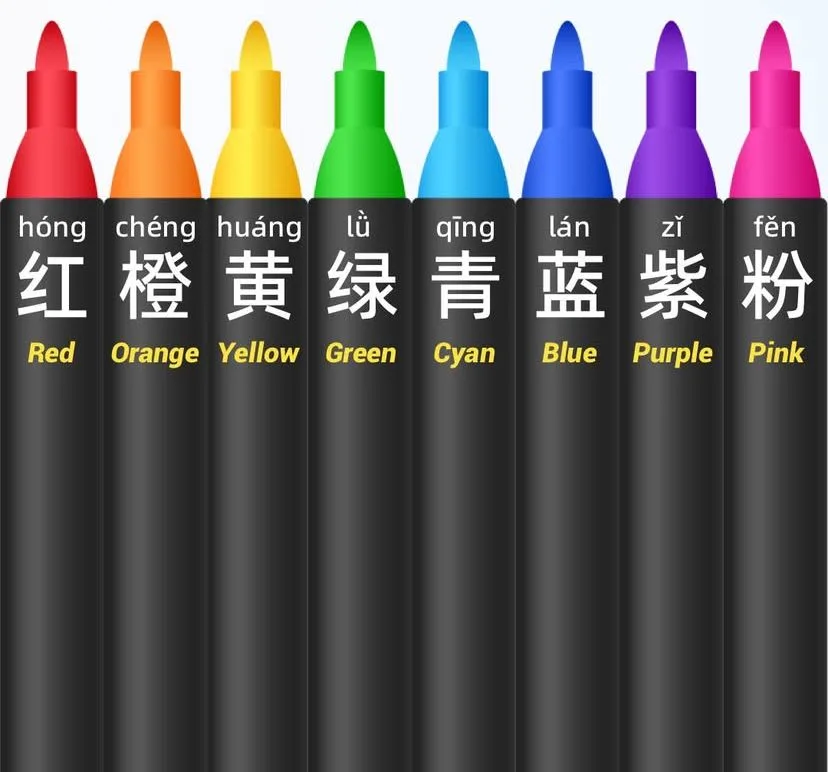
Chinese color terminology is both smaller and larger than English: smaller in the sense that several distinct English colors cluster under one Chinese word (青 covers blue, green, and black-blue in different contexts), and larger in that Chinese color words carry powerful cultural connotations that have guided poetry, politics, weddings, funerals, and opera costumes for thousands of years. This reference covers Chinese colors and adjectives together, since the two are inseparable: the grammar of description in Mandarin runs through the same patterns as the color words themselves.
Understanding Chinese color and adjective vocabulary is therefore not just about choosing the right word for a crayon; it is about knowing that red (红, hóng) signifies luck, celebration, and marriage, while white (白, bái) can mean purity in Western-influenced contexts but traditionally signals mourning.
This reference to Chinese Colors and Adjectives covers basic colors, their cultural meanings, the 色 suffix, descriptive adjectives for size, shape, temperature, texture, and character, and the 的 structure that turns adjectives into modifiers. Each entry pairs simplified characters with pinyin and meaning.
For pronunciation, see the Chinese tones complete guide and pinyin complete guide. For sentence patterns using adjectives (often called "adjectival verbs" in Chinese), see the Chinese grammar rules guide. For classifiers used when describing quantities of colored objects, see the Chinese measure words classifiers reference.
Basic Colors
Chinese color words can appear alone or with the suffix 色 (sè, "color"). 红色 (hóngsè) and 红 (hóng) both mean "red"; the disyllabic form is slightly more formal or unambiguous.
Table 1. Basic colors.
| Chinese | Pinyin | English | Notes |
|---|---|---|---|
| 红色 | hóngsè | Red | Luck, celebration |
| 黄色 | huángsè | Yellow | Imperial, also "porno" colloquially |
| 蓝色 | lánsè | Blue | Modern neutral |
| 绿色 | lǜsè | Green | Nature, also "cuckold" idiom |
| 黑色 | hēisè | Black | Formal, mystery |
| 白色 | báisè | White | Purity, mourning |
| 灰色 | huīsè | Gray | Neutral |
| 粉色 | fěnsè | Pink | |
| 橙色 | chéngsè | Orange | |
| 紫色 | zǐsè | Purple | Nobility |
| 棕色 | zōngsè | Brown | |
| 褐色 | hèsè | Brown (darker) | |
| 金色 | jīnsè | Gold | Wealth, prestige |
| 银色 | yínsè | Silver |
Cultural Meanings of Colors
Chinese color symbolism draws on thousands of years of Confucian, Daoist, and imperial tradition. The Five Phases (五行, wǔxíng) map colors onto elements and cardinal directions: east-green-wood, south-red-fire, center-yellow-earth, west-white-metal, north-black-water.
Table 2. Traditional color symbolism.
| Color | Symbolism | Typical Uses |
|---|---|---|
| 红 Red | Luck, joy, celebration | Weddings, New Year, envelopes |
| 黄 Yellow | Imperial, earth, center | Historical royal dress |
| 白 White | Mourning, purity | Funerals, medical, Western weddings |
| 黑 Black | Formal, darkness, mystery | Formal suits, contemporary fashion |
| 绿 Green | Vitality, nature | Plants, Islamic culture |
| 金 Gold | Wealth, divinity | Temples, luxury goods |
| 紫 Purple | Nobility, rarity | Historical aristocracy |
Green is a color of caution in one specific Chinese context: a man whose wife is unfaithful is said to 戴绿帽子 (dài lǜ màozi, "wear a green hat"). The idiom dates to the Yuan Dynasty when certain low-status professions were required to wear green headgear. A gift of a green hat to a male friend can therefore cause unintended offense.
Red envelopes (红包, hóngbāo) given during Spring Festival, weddings, and birthdays contain monetary gifts. Amounts avoid the number 4 (四, sì, "death") and favor 8 (八, bā, phonetically similar to 发, "fortune"). Digital red packets on WeChat and Alipay have become ubiquitous.
Color Intensity and Variants
Chinese forms color variants by combining a color word with modifiers such as 深 (shēn, "deep"), 浅 (qiǎn, "light"), 鲜 (xiān, "bright"), 暗 (àn, "dark"), or another color word.
Table 3. Color variants.
| Chinese | Pinyin | English |
|---|---|---|
| 深红色 | shēn hóngsè | Deep red |
| 浅蓝色 | qiǎn lánsè | Light blue |
| 鲜红色 | xiān hóngsè | Bright red |
| 暗绿色 | àn lǜsè | Dark green |
| 淡黄色 | dàn huángsè | Pale yellow |
| 鲜艳 | xiānyàn | Bright, vivid |
| 透明 | tòumíng | Transparent |
| 彩色 | cǎisè | Colorful |
| 单色 | dānsè | Monochromatic |
The 的 Structure for Color Modification
To say "red car" in Chinese, use adjective + 的 + noun: 红色的车 (hóngsè de chē). The 的 particle links the modifier to the noun. With one-syllable colors, 的 can sometimes drop: 红车 works, though 红色的车 is more common. For longer modifiers 的 is obligatory.
Table 4. Color + 的 + noun examples.
| Chinese | Pinyin | English |
|---|---|---|
| 红色的车 | hóngsè de chē | Red car |
| 蓝色的衣服 | lánsè de yīfu | Blue clothes |
| 黑色的头发 | hēisè de tóufa | Black hair |
| 白色的房子 | báisè de fángzi | White house |
| 绿色的树 | lǜsè de shù | Green tree |
| 黄色的花 | huángsè de huā | Yellow flower |
Common Descriptive Adjectives
Chinese adjectives function much like verbs (they are sometimes called "stative verbs"). "This is big" is 这个大 (zhège dà) or more commonly 这个很大 (zhège hěn dà), where 很 fills the predicate slot without adding "very" intensity.
Table 5. Size and shape.
| Chinese | Pinyin | English |
|---|---|---|
| 大 | dà | Big |
| 小 | xiǎo | Small |
| 长 | cháng | Long |
| 短 | duǎn | Short |
| 高 | gāo | Tall, high |
| 矮 | ǎi | Short (height) |
| 低 | dī | Low |
| 宽 | kuān | Wide |
| 窄 | zhǎi | Narrow |
| 厚 | hòu | Thick |
| 薄 | báo | Thin |
| 圆 | yuán | Round |
| 方 | fāng | Square |
Table 6. Temperature and weather feel.
| Chinese | Pinyin | English |
|---|---|---|
| 热 | rè | Hot |
| 冷 | lěng | Cold |
| 暖 | nuǎn | Warm |
| 凉 | liáng | Cool |
| 烫 | tàng | Burning hot |
| 冰 | bīng | Icy |
Table 7. Texture and material.
| Chinese | Pinyin | English |
|---|---|---|
| 软 | ruǎn | Soft |
| 硬 | yìng | Hard |
| 光滑 | guānghuá | Smooth |
| 粗糙 | cūcāo | Rough |
| 湿 | shī | Wet |
| 干 | gān | Dry |
| 重 | zhòng | Heavy |
| 轻 | qīng | Light (weight) |
| 新 | xīn | New |
| 旧 | jiù | Old (objects) |
Table 8. Taste.
| Chinese | Pinyin | English |
|---|---|---|
| 好吃 | hǎochī | Delicious (food) |
| 难吃 | nánchī | Bad-tasting |
| 好喝 | hǎohē | Delicious (drink) |
| 难喝 | nánhē | Bad-tasting drink |
| 酸 | suān | Sour |
| 甜 | tián | Sweet |
| 辣 | là | Spicy |
| 咸 | xián | Salty |
| 苦 | kǔ | Bitter |
| 香 | xiāng | Fragrant |
| 臭 | chòu | Smelly |
Table 9. Quality and value.
| Chinese | Pinyin | English |
|---|---|---|
| 好 | hǎo | Good |
| 不好 | bùhǎo | Not good |
| 坏 | huài | Bad, broken |
| 对 | duì | Correct |
| 错 | cuò | Wrong |
| 贵 | guì | Expensive |
| 便宜 | piányi | Cheap, inexpensive |
| 漂亮 | piàoliang | Pretty |
| 好看 | hǎokàn | Nice-looking |
| 丑 | chǒu | Ugly |
| 可爱 | kě'ài | Cute |
Adjectives for People
Table 10. Personality and character.
| Chinese | Pinyin | English |
|---|---|---|
| 聪明 | cōngming | Smart, clever |
| 笨 | bèn | Dumb |
| 善良 | shànliáng | Kind-hearted |
| 友好 | yǒuhǎo | Friendly |
| 热情 | rèqíng | Warm, enthusiastic |
| 冷淡 | lěngdàn | Cold, indifferent |
| 勤奋 | qínfèn | Diligent |
| 懒 | lǎn | Lazy |
| 诚实 | chéngshí | Honest |
| 勇敢 | yǒnggǎn | Brave |
| 内向 | nèixiàng | Introverted |
| 外向 | wàixiàng | Extroverted |
| 幽默 | yōumò | Humorous |
| 谦虚 | qiānxū | Modest, humble |
| 骄傲 | jiāo'ào | Proud, arrogant |
Table 11. Appearance.
| Chinese | Pinyin | English |
|---|---|---|
| 年轻 | niánqīng | Young |
| 老 | lǎo | Old (people, respectful) |
| 高 | gāo | Tall |
| 矮 | ǎi | Short |
| 胖 | pàng | Fat, chubby |
| 瘦 | shòu | Thin |
| 壮 | zhuàng | Strong, sturdy |
| 弱 | ruò | Weak |
The 很 Requirement and Comparatives
In Chinese predicative adjective sentences, 很 (hěn) is usually obligatory even without the English meaning "very." 我高兴 sounds contrastive or incomplete; 我很高兴 is the standard "I'm happy."
Table 12. Intensity and comparison.
| Chinese | Pinyin | English |
|---|---|---|
| 很 | hěn | Very (default filler) |
| 非常 | fēicháng | Extremely |
| 特别 | tèbié | Especially |
| 真 | zhēn | Really, truly |
| 太 | tài | Too (often with 了) |
| 有点儿 | yǒudiǎnr | A little (unwanted) |
| 一点儿 | yìdiǎnr | A little (wanted) |
| 更 | gèng | More, even more |
| 最 | zuì | Most |
| 比 | bǐ | Compared to |
Examples:
- 他比我高 (tā bǐ wǒ gāo) "He is taller than me."
- 这个更贵 (zhège gèng guì) "This is more expensive."
- 那个最好 (nàge zuì hǎo) "That one is the best."
Common Mistakes Learners Make
- Dropping 很 from adjective predicates. 我高兴 sounds wrong or contrastive. Use 我很高兴 as the default "I'm happy."
- Adding 是 before adjectives. 他是高 is wrong; 他很高 is correct. Chinese adjectives are verbs.
- Misusing 老. 老 before a person's age sounds neutral or respectful (老先生), but calling someone 老 to their face can be rude. Prefer 年长 or just avoid.
- Green hat gift faux pas. Never gift a green hat or cap to a male friend.
- Confusing 黑 and 暗. 黑 is black (color); 暗 is dark (not bright). 房间很暗 (the room is dark); 头发是黑色的 (the hair is black).
- Saying 白菜 for white cabbage. 白菜 (báicài) is Napa cabbage, the specific vegetable. Plain white cabbage is 卷心菜 or 圆白菜.
- Literal translation of "blue movie" or "yellow book." 黄色 in contemporary slang also means pornographic. 黄色电影 and 黄色书刊 mean adult films and adult magazines.
- Forgetting 的. With two-syllable color words, 的 is needed: 红色的车 preferred over 红色车. With one-syllable: 红车 may work, 红色车 is odd.
Quick Reference
- Color structure: color + 色 + 的 + noun.
- Red: luck, weddings, New Year.
- White: mourning traditionally; modern Western weddings also white.
- Default adjective predicate: subject + 很 + adjective.
- Comparative: A 比 B + adjective (他比我高).
- Superlative: 最 + adjective (最好).
- Avoid: green hats, yellow connotations, counting mourning flowers.
FAQ
Do I need 色 after every color word?
No. 红 and 红色 both mean "red." The disyllabic form 红色 is slightly more formal and unambiguous, especially in writing or with modifier structures. Spoken Chinese frequently omits 色 in fixed phrases such as 红灯 (red light) and 白头发 (white hair).
Why is 黄色 sometimes translated as "pornographic"?
In modern Chinese slang, 黄色 took on the meaning "obscene" in the 20th century. 黄色电影 (yellow movie) means X-rated film. Context distinguishes the color from the slang.
Is 红 always lucky?
In celebration, business openings, weddings, and New Year, yes. In financial contexts, 红 can mean "surplus" or "gain" (股票飘红, stock price up), whereas 绿 marks losses. Stock tickers in Western markets are opposite (red down, green up), which confuses international traders initially.
What does the 很 in 我很高兴 really mean?
Grammatically it fills the predicate slot required with bare adjectives; semantically it is unstressed and carries little meaning. Only when emphasized ("hěn") does it intensify to "very." Without 很, 我高兴 sounds like the start of a contrast: "I'm happy (but he's not)."
How do I say "X is taller than Y"?
X 比 Y 高 (X bǐ Y gāo). Example: 他比我高 (he is taller than me). For degree, add after: 他比我高两厘米 (he is two centimeters taller than me).
Are there "untranslatable" Chinese colors?
青 (qīng) covers a range from deep blue to green to black depending on context: 青山 (blue-green mountains), 青菜 (green vegetables), 青发 (raven hair). No single English word captures 青.
What's the difference between 很 and 非常?
很 is the default predicate filler with minimal emphasis. 非常 (extremely) and 特别 (especially) add real intensity. 真 (really) can express surprise.
See Also
- Chinese HSK 1 vocabulary 150 essential words
- Chinese grammar rules complete beginners guide
- Chinese common phrases daily conversation reference
- Chinese food vocabulary restaurant cooking reference
- Chinese measure words classifiers reference
- Chinese characters and radicals guide for beginners
- Chinese tones complete guide with examples
Author: Kalenux Team
Frequently Asked Questions
Do I need 色 after every color word?
No. 红 and 红色 both mean ‘red.’ The disyllabic form is slightly more formal, especially in writing or with modifier structures. Spoken Chinese frequently omits 色 in fixed phrases like 红灯 and 白头发.
Why is 黄色 sometimes translated as 'pornographic'?
In modern slang, 黄色 took on the meaning ‘obscene’ in the 20th century. 黄色电影 means X-rated film. Context distinguishes color from slang.
Is 红 always lucky?
In celebration, business openings, weddings, and New Year, yes. In finance, 红 means surplus/gain (stock up) while 绿 marks losses. Western stock tickers reverse this, which confuses international traders.
What does the 很 in 我很高兴 really mean?
Grammatically it fills the predicate slot required with bare adjectives; semantically it is unstressed and carries little meaning. Only when stressed does it intensify to ‘very.’ Without 很, 我高兴 sounds contrastive.
How do I say 'X is taller than Y'?
X 比 Y 高 (X bǐ Y gāo). Example: 他比我高 (he is taller than me). For degree, add after: 他比我高两厘米 (two centimeters taller).
Are there 'untranslatable' Chinese colors?
青 (qīng) covers deep blue to green to black depending on context: 青山 (blue-green mountains), 青菜 (green vegetables), 青发 (raven hair). No single English word captures 青.
What's the difference between 很 and 非常?
很 is the default predicate filler with minimal emphasis. 非常 (extremely) and 特别 (especially) add real intensity. 真 (really) can express surprise.