
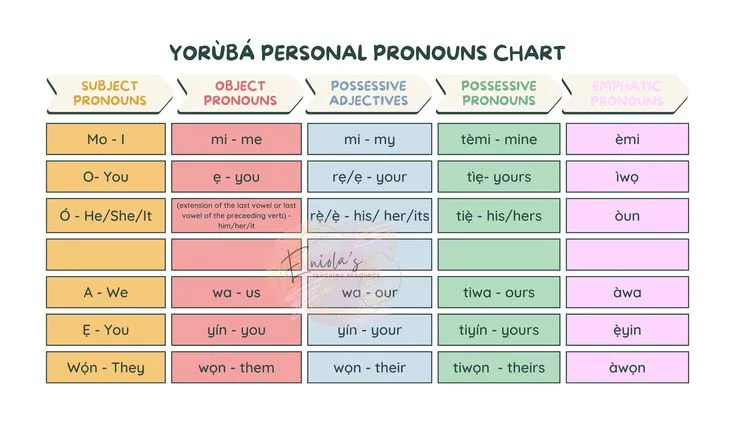
Pronouns are a small closed class of words in any language, but they are used so constantly that getting them right is essential to even basic communication. Yoruba pronouns organize the speech situation the way all human languages do, distinguishing first person from second from third, singular from plural, and usually separating subject from object position.
Yoruba, however, adds two features that English speakers must learn explicitly. First, tone distinguishes several pronoun pairs, so that the same consonant and vowel can be two different pronouns depending on the pitch. Second, Yoruba has an entire parallel system of emphatic or focus pronouns, morphologically distinct from the ordinary pronouns and used whenever a pronoun is stressed, contrasted, or stands alone.
This reference lays out the full pronoun system of Standard Yoruba. It covers the short (non-emphatic) subject and object pronouns, the emphatic pronouns used for focus and standalone contexts, the possessive constructions, and the demonstrative system. The goal is to give learners a complete picture in one place, with enough examples to see the forms in natural sentences.
The Two Pronoun Systems
Yoruba has two sets of personal pronouns used in different syntactic environments. Most of the time a learner uses the short set. The emphatic set appears when the pronoun is the answer to a question ("Who did it?" "I did."), when the pronoun is the subject of a clause without a verb, when the pronoun is introduced by certain prepositions, or when the speaker wishes to emphasize contrast ("I know, but you don't").
The short pronouns are clitics, meaning they are prosodically bound to the verb. They cannot appear alone or bear stress. The emphatic pronouns are full phonological words that can stand on their own and carry their own stress or tone.
Subject Pronouns: The Short Forms
Short subject pronouns appear immediately before the verb. They are part of the verb phrase and carry the tone of their lexical class.
| Person | Subject Pronoun | English | Example |
|---|---|---|---|
| 1 singular | mo (mid), ń (before continuous ń) | I | Mo rí ọ. (I see you.) |
| 2 singular | o (mid) | you | O fẹ́ jẹun. (You want to eat.) |
| 3 singular | ó (high) | he, she, it | Ó ń lọ. (He/she is going.) |
| 1 plural | a (mid) | we | A jẹ iyán. (We ate pounded yam.) |
| 2 plural / polite | ẹ (mid) | you (plural) or respectful you | Ẹ káàárọ̀. (Good morning.) |
| 3 plural | wọ́n (high) | they | Wọ́n wá nibí. (They came here.) |
Note the tone contrasts. The second person singular o is mid while the third person singular ó is high. They would look identical without tone marking, and this is one of the clearest examples of why tone marks matter in writing.
The Plural Second Person as Polite Singular
Yoruba, like French and German, uses the plural second person pronoun to show respect in singular contexts. When addressing an elder, a superior, or a stranger, a Yoruba speaker uses ẹ rather than o even when speaking to one person. Using o to an older person is perceived as rude; using ẹ is neutral to respectful.
Object Pronouns
Object pronouns appear after the verb, often with a short vowel change or tone change compared to subjects.
| Person | Object Pronoun | English | Example |
|---|---|---|---|
| 1 singular | mi (mid) | me | Wọ́n rí mi. (They saw me.) |
| 2 singular | ẹ or ọ (depending on verb vowel) | you | Mo rí ẹ. (I saw you.) |
| 3 singular | ... (tone copy) | him, her, it | See below |
| 1 plural | wa (mid) | us | Wọ́n gbà wa. (They accepted us.) |
| 2 plural | yín (high) | you (plural) | Mo rí yín. (I saw you all.) |
| 3 plural | wọ́n (high) | them | Mo rí wọn. (I saw them.) |
The third person singular object in Yoruba is unusual. Rather than a fixed pronoun, it is realized as a lengthening of the final vowel of the verb with a specific tone, typically mid or a copy of the verb's tone. For example, Mo rí (I saw) plus a third person singular object becomes Mo rí i with a short i added, meaning I saw him or her or it. Learners can treat i in this position as the third person singular object pronoun for practical purposes.
Emphatic Pronouns
The emphatic pronouns are used for focus, contrast, and standalone contexts. They are morphologically distinct from the short forms.
| Person | Emphatic | English | Typical Use |
|---|---|---|---|
| 1 singular | èmi | I (emphatic) | Èmi ni. (It is I.) |
| 2 singular | ìwọ | you (emphatic) | Ìwọ ni ó ṣe é. (You did it.) |
| 3 singular | òun | he, she, it (emphatic) | Òun wá. (He himself came.) |
| 1 plural | àwa | we (emphatic) | Àwa mọ̀. (We know.) |
| 2 plural | ẹ̀yin | you all (emphatic) | Ẹ̀yin ni mo fẹ́. (It is you I want.) |
| 3 plural | àwọn | they (emphatic) | Àwọn ní. (It is they who said so.) |
Uses of the emphatic forms include:
Answering a question. "Ta ni?" (Who?) is answered with "Èmi ni" (It is I), not with a short mo.
Focus constructions with ni. The focus particle ni follows the constituent being focused. "Èmi ni ó rí i" means "It is I who saw it," emphasizing the I.
Coordination. When pronouns are joined by "and," emphatic forms are used: àti èmi àti ìwọ (both I and you).
After prepositions. "With me" in Yoruba is pẹ̀lú mi in informal casual speech but can be pẹ̀lú èmi in emphatic or formal style.
Possessive Constructions
Yoruba possessives are formed by placing the possessor directly after the possessed noun, with no linking word. The possessor may be a pronoun, a noun, or a full phrase.
| Possessed + Possessor | Translation |
|---|---|
| ilé mi | my house |
| ilé rẹ | your (singular) house |
| ilé rẹ̀ | his, her, its house |
| ilé wa | our house |
| ilé yín | your (plural) house |
| ilé wọn | their house |
Note that these possessor pronouns are mostly shared with the object pronouns (mi, wa, yín) but with some specialization. The third person singular possessive rẹ̀ (with low tone) is distinct from the second person possessive rẹ (with mid tone). This is another case where tone marking is essential.
For noun possessors, the structure is simply noun plus noun: ilé Adé (Ade's house), ọmọ baba (the father's child). No apostrophe or particle is needed.
The Associative Marker with Proper Nouns
For clearer emphasis on possession between nouns, particularly with names or titles, the particle ti (that, of) can optionally appear: ilé ti Adé (the house of Ade). This is common in formal writing and in cases where the bare noun-plus-noun construction might be ambiguous.
Demonstratives
Demonstratives point out specific referents. Yoruba has three demonstratives based on relative distance from the speaker.
| Demonstrative | Distance | Example |
|---|---|---|
| yìí | this (close to speaker) | ilé yìí (this house) |
| yẹn | that (away from speaker) | ọkọ̀ yẹn (that car) |
| ọ̀hún | that over there, distant | òkè ọ̀hún (that mountain over there) |
Demonstratives follow the noun they modify, consistent with the adjective-after-noun pattern of Yoruba.
For plurals, àwọn appears before the noun to mark plural, and the demonstrative follows: àwọn ilé yìí (these houses), àwọn ọmọ yẹn (those children).
The proximal and distal system is three-way rather than the two-way English this/that. Yoruba speakers routinely distinguish near-speaker, mid-distance, and far-distance reference.
Example Sentences
| Yoruba | Translation |
|---|---|
| Mo mọ̀ ẹ́. | I know you. |
| Ó fẹ́ wa. | He/she likes us. |
| Ẹ ṣé fún ẹbùn yín. | Thank you all for your gift. |
| Èmi ni baba wọn. | I am their father. |
| Ilé rẹ̀ jìn ju tèmi lọ. | His/her house is farther than mine. |
| Wọ́n ti rí àwọn ọmọ yẹn. | They have seen those children. |
| Ìwọ ni mo fẹ́. | It is you that I want. |
| Àwa ń lọ sí ọjà. | We are going to the market. |
| Ẹ̀yin yóò jẹun, àbí? | You all will eat, right? |
| Òun tí kò wá. | He is the one who did not come. |
Negation and Pronouns
Negation interacts with pronouns in subtle ways. The negator kò (not) follows the subject pronoun and precedes the verb. With some pronouns it contracts:
| Affirmative | Negative | English |
|---|---|---|
| Mo mọ̀. | Mi ò mọ̀. or N kò mọ̀. | I do not know. |
| O mọ̀. | Ìwọ kò mọ̀. or O kò mọ̀. | You do not know. |
| Ó mọ̀. | Kò mọ̀. | He/she does not know. |
| A mọ̀. | A kò mọ̀. | We do not know. |
| Ẹ mọ̀. | Ẹ kò mọ̀. | You all do not know. |
| Wọ́n mọ̀. | Wọn kò mọ̀. | They do not know. |
Note that in the first person singular negative, mo often changes to mi or is elided entirely, with the sentence starting N kò. These alternations are memorized with exposure rather than derived from a single rule.
Common Mistakes
Mixing up o and ó. This is the single most common pronoun error for English-speaking learners. The second person singular subject is o with mid tone; the third person singular subject is ó with high tone. Always mark the tone.
Using a short pronoun where emphasis is required. If you are answering a question like "Who did it?" the answer is "Èmi ni," not just "Mo." Using the short form in this position sounds ungrammatical.
Forgetting the o-to-ẹ change for respect. Addressing an elder with o rather than ẹ is perceived as impolite. When in doubt with a Yoruba speaker older than you, use ẹ.
Assuming pronouns distinguish gender. Ó covers he, she, and it. English speakers sometimes invent separate words trying to mirror English distinctions, but Yoruba has only the one form.
Wrong word order in possessives. English possessives come before the noun (my house); Yoruba possessives come after (ilé mi). Reversing this is one of the earliest grammatical errors.
Ignoring rẹ versus rẹ̀. The mid-tone rẹ is your possessive singular; the low-tone rẹ̀ is his/her/its. Mixing these changes who owns what.
Confusing the demonstratives. English has only two distance degrees (this/that). Yoruba has three. Learners often collapse yẹn and ọ̀hún, which works but flattens a real distinction native speakers make.
Quick Reference
Short subject pronouns: mo, o, ó, a, ẹ, wọ́n. Short object pronouns: mi, ẹ/ọ, (vowel lengthening), wa, yín, wọn. Emphatic pronouns: èmi, ìwọ, òun, àwa, ẹ̀yin, àwọn. Possessive structure: noun + pronoun (ilé mi = my house). Demonstratives: yìí (near), yẹn (mid), ọ̀hún (far). Ẹ is plural/respectful; o is singular/familiar. Tone distinguishes o (you) from ó (he/she/it) and rẹ (your) from rẹ̀ (his/her/its).
FAQ
Do I always need to say the pronoun?
Yoruba is not a pro-drop language for most sentences. The subject pronoun is normally required even when the referent is obvious. Dropping it is unusual and only happens in specific imperative or elliptical contexts.
What is the difference between ẹ and ẹyin?
Ẹ is the short form used as an ordinary subject pronoun. Ẹ̀yin is the emphatic form used for focus, standalone use, and after prepositions. They refer to the same people in the same roles; the difference is pragmatic.
Why does my textbook sometimes write mi and sometimes mí?
The form mí with high tone is the first person singular possessive in some analyses, while mi with mid tone is the first person singular object. In practice many textbooks merge these because the distinction is subtle in modern usage. Copy whichever form the textbook uses and be consistent.
How do I say my own?
The phrase for my own uses tèmi (mine): ilé tèmi (a house of mine, my own house). For yours, tìrẹ; for his/hers, tirẹ̀; for ours, tiwa; for theirs, tiwọn. These substantivized possessives function as pronouns meaning "mine, yours, his/hers."
Can I just leave off tone marks on pronouns?
In handwritten notes to yourself, technically yes. In anything that will be read by others, no. A line like "o ri mi" without tones could mean "you saw me" or "he saw me" depending on which o is meant.
Why are there no gender-marked pronouns?
Many languages of the world have no gender in pronouns, including Mandarin (in speech, though writing distinguishes 他, 她, 它), Finnish, and most Niger-Congo languages. This is a common pattern, not a gap in Yoruba.
How do I show politeness if the pronoun system does not distinguish formal from informal clearly?
By using ẹ instead of o in the second person, by adding honorific titles (ẹ̀gbọ́n for senior, bàbá for father figure), and by employing traditional greetings with prostration or kneeling gestures. The pronoun is only one signal in a larger system of respect.
See Also
- Yoruba Alphabet and Pronunciation Complete Guide
- Yoruba Three Tones: High, Mid, Low Complete Reference
- Yoruba Verb Tense and Aspect Markers Reference
- Yoruba Noun System: No Plurals, No Gender Reference
- Yoruba Greetings and Cultural Salutations Reference
- Yoruba Numbers and Counting: Vigesimal System Reference
- Language Difficulty for English Speakers Reference
- Pronunciation and Phonology Comparison for English Native Speakers
Frequently Asked Questions
Why does Yoruba have two forms for each pronoun?
Yoruba distinguishes short pronouns used in ordinary subject and object position from emphatic pronouns used for focus, contrast, or standalone answers. The short forms are unstressed clitics; the emphatic forms are stressed full words like emi, iwo, oun.
Does Yoruba have grammatical gender in pronouns?
No. The third person singular pronoun ó covers he, she, and it without distinction. Gender, when needed, is signaled by nouns such as akọ for male and abo for female, not by pronouns.
What is the difference between ẹ and yín?
Ẹ is the plural second person subject pronoun meaning you all or formal you, and yín is the plural second person object pronoun. They refer to the same people in the same role; the distinction is syntactic position, not meaning.
How do I say my, your, his in Yoruba?
Possessives are formed by placing the possessor pronoun after the noun: ilé mi (my house), ilé rẹ (your house), ilé rẹ̀ (his, her, or its house). The word order is noun plus possessor, opposite of English.
Are tone marks important on pronouns?
Extremely. The pronoun o with mid tone is second person singular, while ó with high tone is third person singular. Without the tone mark the sentence is ambiguous or wrong.
What are demonstratives in Yoruba?
Yoruba has three levels of demonstrative: yìí (this, close to speaker), yẹn (that, away from speaker), and ọ̀hún or ọ̀run (that over there, distant). They follow the noun and agree in number with àwọn when plural.
Is the plural we inclusive or exclusive?
Yoruba a and wá do not distinguish inclusive from exclusive we. The single form covers both we including you and we excluding you. Context clarifies which is meant.