
The Yoruba number system is one of the most distinctive and intellectually interesting in world languages. While English, French, Spanish, and most Indo-European languages use a base-ten (decimal) system with small irregularities, Yoruba uses a base-twenty (vigesimal) system with systematic subtraction.
A Yoruba speaker does not simply stack units and tens the way English does (twenty-one, twenty-two, twenty-three). Instead, Yoruba names numbers by anchoring them to multiples of 20 and expressing the intervening quantities as additions to or subtractions from those anchors.
This reference walks through the Yoruba number system from one through one thousand and beyond, explaining the structural logic, offering practice tables, and addressing the very real question learners ask: why count this way?
The answer is partly historical (base-twenty counting is widespread in West Africa and in many pre-colonial cultures worldwide), partly bodily (twenty is the total of fingers and toes), and partly mathematical (subtraction-based construction compresses the number of distinct base names needed). The Yoruba system is not a curiosity but a fully functional counting system used daily by tens of millions of speakers.
Numbers 1 Through 10: The Foundation
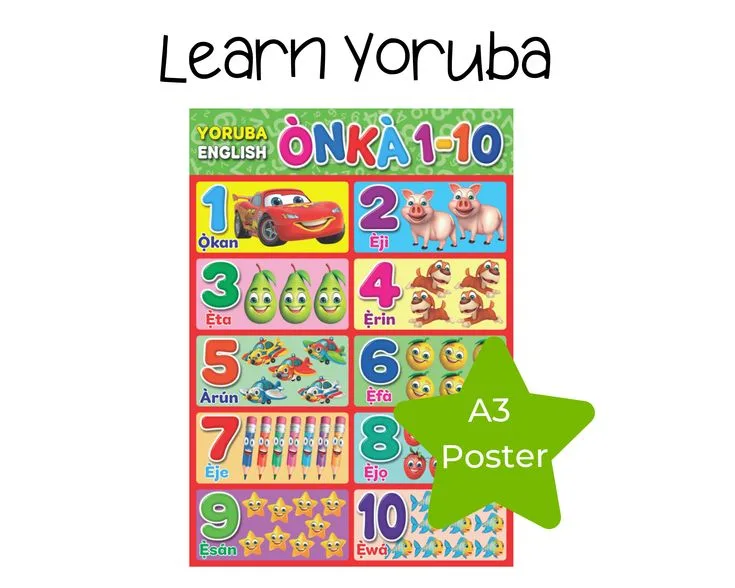
The smallest numbers are single lexical items with no internal structure.
| Number | Yoruba | Pronunciation Notes |
|---|---|---|
| 1 | ẹni, ọ̀kan | ẹni is the counting form; ọ̀kan is attributive |
| 2 | èjì | Mid-low followed by low |
| 3 | ẹ̀ta | Low on first syllable |
| 4 | ẹ̀rin | Low-mid |
| 5 | àrún | Low-high |
| 6 | ẹ̀fà | Low-low |
| 7 | èje | Mid-mid |
| 8 | ẹ̀jọ | Low-low |
| 9 | ẹ̀sán | Low-high |
| 10 | ẹ̀wá | Low-high |
Yoruba numbers typically appear in two forms: a counting form used when listing or counting objects (ẹni, èjì, ẹ̀ta ...) and an attributive form used when modifying a noun (ọ̀kan, méjì, mẹ́ta ...). The attributive form is more common in ordinary sentences: mo ní ọmọ mẹ́ta (I have three children).
The attributive forms use the prefix m- (for méjì, mẹ́ta, mẹ́rin, márùn-ún, mẹ́fà, méje, mẹ́jọ, mẹ́sàn-án, mẹ́wàá).
Numbers 11 Through 19: Addition to Ten
Numbers 11 through 14 are formed by adding small units to ten. Numbers 15 through 19 pivot to a new pattern: subtraction from twenty.
| Number | Yoruba | Literal Meaning |
|---|---|---|
| 11 | ọ̀kànlá | one plus ten (1 + 10) |
| 12 | èjìlá | two plus ten |
| 13 | ẹ̀talá | three plus ten |
| 14 | ẹ̀rìnlá | four plus ten |
| 15 | ẹ̀ẹ́dógún | five from twenty (20 - 5) |
| 16 | ẹ̀rìndínlógún | four from twenty (20 - 4) |
| 17 | ẹ̀tàdínlógún | three from twenty (20 - 3) |
| 18 | èjìdínlógún | two from twenty (20 - 2) |
| 19 | ọ̀kàndínlógún | one from twenty (20 - 1) |
The shift at 15 is the distinctive feature. Rather than saying "ten plus five," Yoruba says "twenty minus five." The word ẹ̀ẹ́dógún literally breaks down as ẹ̀ẹ́d- (subtracted from) plus ogún (twenty). Similarly for 16 through 19, each number is expressed as "n subtracted from 20."
This is the first appearance of the subtraction pattern that runs through the entire Yoruba number system. Once the subtraction pattern is internalized, many apparent irregularities become regular.
Twenties and Multiples of Twenty
The number 20 is a fundamental anchor in Yoruba counting.
| Number | Yoruba | Literal |
|---|---|---|
| 20 | ogún | twenty (basic unit) |
| 30 | ọgbọ̀n | thirty (20 + 10) |
| 40 | ogójì | two twenties (2 x 20) |
| 50 | àádọ́ta | ten subtracted from sixty (60 - 10) |
| 60 | ọgọ́ta | three twenties (3 x 20) |
| 80 | ọgọ́rin | four twenties (4 x 20) |
| 100 | ọgọ́rùn-ún | five twenties (5 x 20) |
| 120 | ọgọ́fà | six twenties (6 x 20) |
| 140 | ọgọ́je | seven twenties (7 x 20) |
| 160 | ọgọ́jọ | eight twenties (8 x 20) |
| 180 | ọgọ́sàn | nine twenties (9 x 20) |
| 200 | igba | two hundred (basic unit) |
Note that ọgọ́- (derived from ogún, twenty) combines with a number to form multiples of twenty. Ọgọ́ta is 3 x 20 = 60. Ọgọ́rin is 4 x 20 = 80. Ọgọ́rùn-ún is 5 x 20 = 100.
The number 30 (ọgbọ̀n) is a single lexical item rather than a compound. Similarly 50 is àádọ́ta rather than a transparent compound. These small irregularities are vestiges of older naming patterns.
Numbers Between Multiples of Ten
Numbers that fall between the "tens" anchors (20, 30, 40, 50, 60 ...) follow the subtraction-from-above pattern or the addition-to-below pattern depending on the value.
Numbers 21 Through 25: Addition to Twenty
| Number | Yoruba | Literal |
|---|---|---|
| 21 | mọ́kànlélógún | one plus twenty |
| 22 | méjìlélógún | two plus twenty |
| 23 | mẹ́talélógún | three plus twenty |
| 24 | mẹ́rìnlélógún | four plus twenty |
| 25 | mẹ́ẹ̀ẹ́dọ́gbọ̀n | five from thirty (30 - 5) |
The pattern changes again at 25. From 25 onwards, numbers are expressed as subtractions from 30.
| Number | Yoruba | Literal |
|---|---|---|
| 25 | mẹ́ẹ̀ẹ́dọ́gbọ̀n | five from thirty |
| 26 | mẹ́rìndínlọ́gbọ̀n | four from thirty |
| 27 | mẹ́tàdínlọ́gbọ̀n | three from thirty |
| 28 | méjìdínlọ́gbọ̀n | two from thirty |
| 29 | ọ̀kàndínlọ́gbọ̀n | one from thirty |
So 25 through 29 count down toward 30 just as 15 through 19 counted down toward 20.
The Five-Subtraction Rule
Generalizing: any number ending in 5, 6, 7, 8, or 9 uses the subtraction pattern from the next-higher multiple of ten. Numbers ending in 1, 2, 3, or 4 use the addition pattern to the current multiple.
This is mathematically elegant. To name 47, you think "three from fifty" (mẹ́tàdínláàádọ́ta or a similar construction depending on the speaker). To name 43, you think "three plus forty" (mẹ́talélógójì).
Numbers 30 Through 100
| Number | Yoruba |
|---|---|
| 30 | ọgbọ̀n |
| 31 | mọ́kànlélọ́gbọ̀n |
| 35 | aárùndínlógójì (5 from 40) |
| 40 | ogójì |
| 45 | márùn-úndínláàádọ́ta |
| 50 | àádọ́ta |
| 55 | márùn-úndínlọ́gọ́ta |
| 60 | ọgọ́ta |
| 65 | márùn-úndínláàádọ́rin |
| 70 | àádọ́rin |
| 75 | márùn-úndínlọ́gọ́rin |
| 80 | ọgọ́rin |
| 90 | àádọ́rùn-ún |
| 100 | ọgọ́rùn-ún |
The numbers 50, 70, and 90 use the àádọ́- prefix ("ten less") combined with the next higher multiple of twenty. For example, àádọ́ta is literally "ten less than sixty" (60 - 10 = 50). Similarly àádọ́rin is "ten less than eighty" (80 - 10 = 70). Yes, 50 is named as ten less than sixty because of the vigesimal framing. This takes getting used to but becomes natural with practice.
Hundreds and Thousands
| Number | Yoruba | Literal |
|---|---|---|
| 100 | ọgọ́rùn-ún | five twenties |
| 200 | igba | two hundred (simple word) |
| 300 | ọ̀ọ́dúnrún | three hundred |
| 400 | irínwó | four hundred |
| 500 | ẹ̀ẹ́dẹ́gbẹ̀ta | five hundred |
| 600 | ẹgbẹ̀ta | three two-hundreds |
| 1000 | ẹgbẹ̀rún | thousand (basic) |
| 2000 | ẹgbẹ̀wá | ten two-hundreds |
| 20000 | ọkẹ́ | twenty thousand (basic unit) |
The higher number system uses igba (200) as a secondary anchor, and multiplies of igba produce the hundreds. Very large numbers like ọkẹ́ (20,000) and ẹgbẹ̀rún (1,000) are used for ceremonial and traditional counts.
In modern everyday speech, Yoruba speakers often use English number words for specific numeric values, especially in commerce, technology, and formal writing, while using Yoruba number words for counting objects and in cultural contexts.
Ordinal Numbers
Ordinal numbers (first, second, third) use the prefix èk- or ọ̀k- combined with the cardinal.
| Ordinal | Yoruba |
|---|---|
| first | èkínní, àkọ́kọ́ |
| second | èkejì |
| third | ẹ̀kẹta |
| fourth | ẹ̀kẹrin |
| fifth | ẹ̀karún |
| sixth | ẹ̀kẹfà |
| seventh | ẹ̀keje |
| eighth | ẹ̀kẹjọ |
| ninth | ẹ̀kẹsàn |
| tenth | ẹ̀kẹwàá |
The word àkọ́kọ́ (first, firstborn) is often used instead of èkínní in contexts referring to the first child, first in line, etc. Both forms are accepted.
Ordinal Number Examples
| Yoruba | Translation |
|---|---|
| Ọmọ èkínní mi | My first child |
| Ọjọ́ ẹ̀keje | The seventh day |
| Ilé ẹ̀kẹrin | The fourth house |
| Ìdíje àkọ́kọ́ | The first competition |
Counting Objects: Numeral + Noun
Yoruba numerals follow the noun they modify, like adjectives.
| Yoruba | Translation |
|---|---|
| ọmọ mẹ́ta | three children |
| ilé méjì | two houses |
| ẹyẹ márùn-ún | five birds |
| ìwé kan | one book |
| eniyan mẹ́wàá | ten people |
Note that ìwé kan uses kan (the attributive form of "one") rather than ọ̀kan or ẹni, and it directly follows the noun. This pattern is reliable: noun first, then the numeral in its attributive form.
For plural without a specific number, àwọn is used before the noun: àwọn ọmọ (children, multiple).
Telling Time
Yoruba time expressions use the numeric system in combination with aago (clock).
| Yoruba | Translation |
|---|---|
| Aago kan | One o'clock |
| Aago méjì | Two o'clock |
| Aago mẹ́rin | Four o'clock |
| Aago mẹ́fà | Six o'clock |
| Aago mẹ́fà kọjá ìṣẹ́jú mẹ́wàá | Ten minutes past six |
| Aago mẹ́fà ààbọ̀ | Half past six (literally six and a half) |
Because of the complexity of traditional Yoruba numbers beyond 12, clock times use the basic numerals 1 through 12 for hours. Most modern Nigerian speakers also switch to English for time in formal contexts.
Prices and Money
| Yoruba | Translation |
|---|---|
| Igba náírà | Two hundred naira |
| Ẹgbẹ̀rún náírà | One thousand naira |
| Ẹgbẹ̀wá náírà | Two thousand naira |
| Ọkẹ́ náírà kan | Twenty thousand naira |
For commercial transactions above several thousand naira, most speakers use English number words for precision: "Forty thousand naira" rather than navigating the complex traditional names.
Common Mistakes
Treating Yoruba like decimal. English speakers naturally think in tens and multiples of ten. Trying to construct Yoruba numbers by counting "twenty-one, twenty-two, twenty-three" with an additive pattern all the way to 30 is wrong; the subtraction pattern kicks in at 25.
Memorizing numbers without the structure. Learning 100 Yoruba numbers as separate items is overwhelming. Learning the construction rules (add to lower anchor, subtract from higher anchor, multiples of 20 with ọgọ́-) is much more efficient.
Forgetting the attributive form. Saying "ọmọ èjì" for "two children" is wrong; the attributive méjì is required: ọmọ méjì.
Misplacing the numeral. English says "three children"; Yoruba says "ọmọ mẹ́ta." Putting the numeral first is ungrammatical.
Confusing ordinals with cardinals. Saying ẹni dípò èkínní for "first" is a beginner error. The ordinal with the ẹk- prefix is required.
Dropping tone marks on numbers. The numbers have fixed tone patterns that distinguish them from similar-sounding words. Márùn-ún (five) without tones could be misread.
Using igba versus ogún incorrectly. Igba is 200, ogún is 20. They sound related but differ in meaning by a factor of ten.
Ignoring modern usage. While traditional numbers are culturally important, modern Nigerian speakers often code-switch to English number words for dates, prices above a few hundred, and technical contexts. Being aware of the mixed register helps interpret real speech.
Quick Reference
Base 20 (vigesimal) system. 1 to 10: basic lexical items (ẹni, èjì, ẹ̀ta, ẹ̀rin, àrún, ẹ̀fà, èje, ẹ̀jọ, ẹ̀sán, ẹ̀wá). Attributive m- prefix: méjì, mẹ́ta, mẹ́rin, márùn-ún, mẹ́fà, méje, mẹ́jọ, mẹ́sàn-án, mẹ́wàá. 11 to 14: add to 10 (ọ̀kànlá, èjìlá, ẹ̀talá, ẹ̀rìnlá). 15 to 19: subtract from 20 (ẹ̀ẹ́dógún = 20 - 5). 20 = ogún. 30 = ọgbọ̀n.
Multiples of 20 use ọgọ́- prefix. Hundreds: ọgọ́rùn-ún (100) = 5 x 20, igba (200), ẹgbẹ̀ta (600) = 3 x 200. Ordinals: ẹk- prefix (èkínní, èkejì, ẹ̀kẹta). Numeral follows noun: ọmọ mẹ́ta (three children). Modern usage often mixes English for dates, prices, and large numbers.
FAQ
Why does Yoruba use base 20 instead of base 10?
Base 20 reflects the total count of fingers and toes. Many pre-colonial cultures used base 20: the Maya of Mesoamerica, many West African languages, and even French retains vestiges of base 20 in quatre-vingts (four twenties = 80). It is a natural human counting system that predates base-10 standardization.
Is the subtraction system harder to learn than decimal?
At first, yes. Yoruba children learn both systems in school. For second-language learners, the pattern requires memorization effort, but once the structure is internalized it becomes second nature.
Do Yoruba speakers do arithmetic in base 20?
Formal arithmetic is done in base 10 using Arabic numerals, taught in schools worldwide. The base-20 system is linguistic: it affects how numbers are named and counted, not how calculations are performed on paper.
Can I just use English numbers when speaking Yoruba?
In modern practical contexts, many Nigerians do exactly this, especially for prices, phone numbers, and times. However, for counting small numbers of objects and for cultural or ceremonial contexts, Yoruba numbers are expected. Learners should know both systems.
What about decimals and fractions?
Traditional Yoruba has limited fraction vocabulary (ààbọ̀ = half, ìdámẹ́ta = one-third, literally "one from three"). Modern fractions and decimals are typically expressed with English loanwords.
Why are some numbers like 30 and 200 single words instead of compounds?
These are considered "anchor" numbers in the system, comparable to how English has single-word names for 10, 100, 1000 rather than compounds like "ten tens" for 100. Yoruba anchors include ẹ̀wá (10), ogún (20), ọgbọ̀n (30), igba (200), ẹgbẹ̀rún (1000), ọkẹ́ (20000).
Are the high numbers like ọkẹ́ still used?
In ceremonial and traditional contexts yes. In everyday modern speech, numbers above a few thousand are often given in English. Both registers coexist.
See Also
- Yoruba Alphabet and Pronunciation Complete Guide
- Yoruba Three Tones: High, Mid, Low Complete Reference
- Yoruba Noun System: No Plurals, No Gender Reference
- Yoruba Pronouns: Subject, Object, and Possessive Reference
- Yoruba Greetings and Cultural Salutations Reference
- Yoruba Verb Tense and Aspect Markers Reference
- Language Difficulty for English Speakers Reference
- Yoruba Proverbs and Wisdom Sayings Cultural Reference
Frequently Asked Questions
What is a vigesimal number system?
A vigesimal system uses base 20 rather than base 10. Yoruba counts in multiples of 20, with subtraction used to express numbers between multiples. The system is linguistic, not a separate notation; Yoruba speakers use Arabic numerals for writing numbers today.
Why does Yoruba use subtraction to count?
Historically, Yoruba number formation uses subtraction from higher anchor points such as 20, 200, and 20000. For example, 15 is eedogun, literally meaning twenty minus five. This produces a pattern where 16 to 19 are subtracted from 20, 45 is fifty minus five, and so on.
Is the Yoruba number system still used in everyday life?
Yes for speaking, though most arithmetic and written numbers use Arabic numerals and English number words in formal commerce. The traditional Yoruba names are used when counting in Yoruba conversation, for cultural contexts, and for exact ceremonial numbers.
How do I say ordinal numbers like first, second, third in Yoruba?
Add the prefix ike- or use the construction with kan (one) for first: èkínní (first), èkejì (second), èketa (third), ẹkẹrin (fourth). These use the ek- prefix plus the cardinal number.
Why is counting in twenties instead of tens useful?
Base 20 counts the digits of both hands and feet together. Many West African and Mesoamerican cultures use base-20 systems reflecting this bodily origin. French still shows vestiges with quatre-vingts (four twenties) for 80.
What is the largest named number in traditional Yoruba?
Traditional Yoruba has names up to very large quantities including ọgọ́rùn-ún (one hundred, but literally 5 twenties), ẹgbẹ̀wá (two thousand), and ọkẹ́ (twenty thousand). Modern usage extends this with loanwords for millions and billions.