
Yoruba nouns present an agreeable simplicity to learners coming from languages with rich nominal morphology. Unlike Spanish or French nouns, which inflect for gender and number and must agree with articles and adjectives. Unlike German nouns, which inflect for four grammatical cases in addition to gender and number. This reference explains Yoruba Noun System with clear rules and worked examples.
Unlike Russian nouns, which combine gender, number, and six cases. Yoruba nouns do none of this. A Yoruba noun has a single form, and whether it refers to one or many, male or female, subject or object, is signaled by other elements of the sentence or is left for context to determine.
This simplicity is typologically interesting. Yoruba does not lack the concepts of number and gender; it simply does not grammaticalize them on the noun itself. To express "three children" Yoruba uses the same word ọmọ (child) plus a numeral. To specify that a goat is male, Yoruba adds akọ (male): ewúrẹ́ akọ. The noun never changes shape; modifiers carry the specifying information.
This reference explores the complete Yoruba noun system: how plurality is expressed through quantifiers and the plural marker àwọn, how biological sex is marked with akọ and abo, how compound nouns are formed, how possession between nouns works, and how Yoruba places itself within the broader Niger-Congo family. Understanding these structural features clarifies why Yoruba is considered morphologically simple at the nominal level despite being fully expressive.
The Invariable Noun
A Yoruba noun has one form. It does not change to indicate singular versus plural, nominative versus accusative, or masculine versus feminine. Some examples to make the point:
| Yoruba | Singular Context | Plural Context |
|---|---|---|
| ọmọ | ọmọ kan (one child) | ọmọ mẹ́ta (three children), àwọn ọmọ (children) |
| ilé | ilé mi (my house) | àwọn ilé (houses), ilé márùn-ún (five houses) |
| ọkọ̀ | ọkọ̀ tuntun (new car) | àwọn ọkọ̀ (cars), ọkọ̀ kan (a car) |
| aja | aja yẹn (that dog) | àwọn aja (dogs) |
| iwé | iwé mi (my book) | iwé méjì (two books) |
The word ọmọ does not become plural by any internal change. English "child" becomes "children" (suppletion) or "cat" becomes "cats" (suffix). Yoruba ọmọ stays ọmọ.
Indefinite Specification
To specify "a" or "one" in Yoruba, the word kan appears after the noun. This is how you say "one X" or "a certain X":
| Yoruba | Translation |
|---|---|
| ọmọ kan | a child / one child |
| ilé kan | a house |
| ọkọ̀ kan | a car |
| iwé kan | a book |
Note that kan comes after the noun, consistent with the general Yoruba pattern that modifiers follow the noun.
Marking Plurality
Since Yoruba nouns do not inflect for plural, the language uses three main strategies to signal that more than one entity is meant.
The Plural Marker àwọn
The word àwọn placed before a noun marks it as plural. This is the most explicit way to signal plurality when no other cue is present.
| Yoruba | Translation |
|---|---|
| àwọn ọmọ | children |
| àwọn ọkùnrin | men |
| àwọn obìnrin | women |
| àwọn aja | dogs |
| àwọn iwé | books |
Àwọn historically derives from the emphatic third person plural pronoun meaning "they," and in its plural-marker role it functions as a definite plural article similar to English "the" with a plural noun.
Numerals
A noun followed by a numeral is automatically plural (for numerals greater than one):
| Yoruba | Translation |
|---|---|
| ọmọ méjì | two children |
| ilé mẹ́ta | three houses |
| aja márùn-ún | five dogs |
| iwé mẹ́wàá | ten books |
With a numeral in the sentence, àwọn is redundant and usually omitted.
Quantifiers
Words meaning "many," "some," "all," "few" function as quantifiers and imply plurality:
| Yoruba | Translation |
|---|---|
| púpọ̀ | many, much |
| díẹ̀ | a few, a little |
| gbogbo | all |
| kọ̀ọ̀kan | each |
| méjì-méjì | by twos |
| Yoruba | Translation |
|---|---|
| ọmọ púpọ̀ | many children |
| ilé díẹ̀ | a few houses |
| gbogbo ènìyàn | all people |
| ọmọ kọ̀ọ̀kan | each child |
Context
Sometimes plurality is simply clear from context and no explicit marker is used. A speaker saying "I saw ọmọ in the market" might mean children, but in context listeners understand. This reliance on context is characteristic of Yoruba and of many languages that lack obligatory number marking.
Expressing Gender and Biological Sex
Yoruba has no grammatical gender. Nouns are not masculine or feminine as a grammatical category, and no agreement occurs on adjectives or verbs for gender. However, biological sex can be specified when needed.
The Adjectives akọ and abo
To mark a noun as referring to a male or female being, Yoruba uses akọ (male) or abo (female) following the noun.
| Yoruba | Translation |
|---|---|
| ẹṣin akọ | male horse (stallion) |
| ẹṣin abo | female horse (mare) |
| adìẹ akọ | rooster |
| adìẹ abo | hen |
| ewúrẹ́ akọ | male goat (billy) |
| ewúrẹ́ abo | female goat (nanny) |
| aja akọ | male dog |
| aja abo | female dog |
For humans, Yoruba has specific gendered terms for many roles (ọkùnrin = man, obìnrin = woman, ọmọkùnrin = boy, ọmọbìnrin = girl), so akọ and abo are not typically used with human nouns in everyday speech.
Family Terms
Family relationships use dedicated gendered nouns:
| Yoruba | Translation |
|---|---|
| bàbá | father |
| ìyá / màmá | mother |
| ọmọkùnrin | son |
| ọmọbìnrin | daughter |
| ẹ̀gbọ́n ọkùnrin | older brother |
| ẹ̀gbọ́n obìnrin | older sister |
| àbúrò ọkùnrin | younger brother |
| àbúrò obìnrin | younger sister |
| bàbá àgbà | grandfather |
| ìyá àgbà | grandmother |
| ọkọ | husband |
| ìyàwó | wife |
| ọmọ ọkọ | husband's relative |
| ẹ̀gbọ́n | older sibling (unmarked for gender) |
| àbúrò | younger sibling (unmarked for gender) |
Note that ẹ̀gbọ́n (older sibling) and àbúrò (younger sibling) are not gendered unless specified. This is common in West African languages: birth order matters more than gender for naming sibling relationships.
Compound Nouns
Yoruba forms compound nouns productively by placing two or more nouns in sequence. The head noun (the main referent) comes first, and the modifying noun follows.
| Compound | Components | Translation |
|---|---|---|
| ọkọ̀-ọ̀gba | ọkọ̀ (vehicle) + ọ̀gba (ground, plot) | tractor |
| ọkọ̀ òfúrufú | ọkọ̀ (vehicle) + òfúrufú (air) | aircraft |
| ọkọ̀ ojú omi | ọkọ̀ (vehicle) + ojú omi (on water) | ship |
| ilé-ìwé | ilé (house) + ìwé (book) | school |
| ilé-ìwòsàn | ilé (house) + ìwòsàn (healing) | hospital |
| ilé ìjọsìn | ilé (house) + ìjọsìn (worship) | church |
| ilé ọba | ilé (house) + ọba (king) | palace |
| ọmọ ilé-ìwé | ọmọ + ilé-ìwé | student (child of school) |
| ọmọ ẹ̀gbẹ́ | ọmọ + ẹ̀gbẹ́ (association) | member |
| ẹbí nlá | ẹbí (family) + nlá (big) | extended family |
Compound nouns are often written with hyphens (ilé-ìwé) or as separate words (ilé ìwé) depending on orthographic preference. They function as single nouns that can take their own modifiers, numerals, and tone adjustments.
Tone in Compounds
When two nouns combine, the tone of the second noun may shift. For example, ilé + ìwé combines as ilé-ìwé with the original tones preserved on both morphemes. In some compounds, however, tonal adjustments occur to create smoother pronunciation. Dictionaries and reference texts document these specific tonal patterns.
Possession Between Nouns
Yoruba expresses possession between nouns by simple juxtaposition, with the possessor following the possessed:
| Yoruba | Translation |
|---|---|
| ilé baba | father's house |
| ọmọ ìyá mi | my mother's child |
| ìwé olùkọ́ | the teacher's book |
| ọkọ̀ ọrẹ́ mi | my friend's car |
| ẹ̀kọ́ Ọlọ́run | God's teaching |
For added emphasis or clarity, especially with personal names, the associative marker ti can be inserted between the possessed and the possessor:
| Yoruba | Translation |
|---|---|
| ilé ti Adé | Ade's house |
| ìwé ti olùkọ́ náà | the book of that teacher |
| àlá ti ọmọ yìí | this child's dream |
In ordinary speech, the particle ti is often omitted when context is clear.
Nominalizing Verbs
Many Yoruba nouns are derived from verbs by adding a prefix (typically a vowel), a process called nominalization. This is productive and generates a wealth of abstract and concrete nouns.
| Verb | Nominalized Noun | Meaning |
|---|---|---|
| kọ́ (to teach) | ẹ̀kọ́ (teaching, lesson) | |
| jẹ (to eat) | ounjẹ (food) | |
| lọ (to go) | ìlọ (going, departure) | |
| wá (to come) | àbọ̀ (coming, arrival, via a different stem) | |
| ṣiṣẹ́ (to work) | iṣẹ́ (work) | |
| mọ̀ (to know) | ìmọ̀ (knowledge) | |
| mí (to breathe) | ìmí (breath) | |
| rìn (to walk) | ìrìn (walking, journey) | |
| kọ (to write) | ìkọ (writing) |
The prefixes ẹ̀-, ì-, à-, ọ̀-, a- appear on various nominalizations. Learning the pattern allows a learner to guess at related word forms and to expand vocabulary efficiently.
Adjectives and Noun Modification
Adjectives follow the noun they modify, and like nouns they do not inflect for number or gender.
| Yoruba | Translation |
|---|---|
| ilé nlá | a big house |
| ọmọ kékeré | a small child |
| ọkọ̀ tuntun | a new car |
| iwé dídá | a beautiful book |
| ọkùnrin gígùn | a tall man |
| aja dúdú | a black dog |
For plurals with adjectives, the adjective stays the same:
| Yoruba | Translation |
|---|---|
| àwọn ilé nlá | big houses |
| ọmọ kékeré méjì | two small children |
Some Yoruba "adjectives" are actually stative verbs. Tóbi (to be big) is a verb, and Ó tóbi means "It is big." In attributive position (modifying a noun), the same root appears with tonal or morphological adjustments: ilé tóbi or ilé nlá depending on the specific word.
Example Sentences
| Yoruba | Translation |
|---|---|
| Mo rí àwọn ọmọ méjì. | I saw two children. |
| Ó ní ọkọ̀ tuntun kan. | He/she has a new car. |
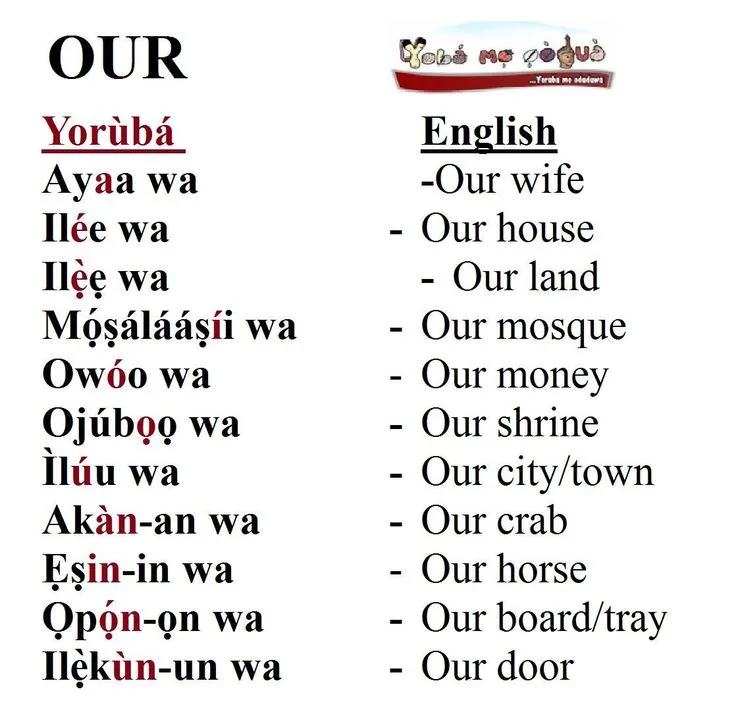
| Ilé wa kò tóbi tó tiwọn. | Our house is not as big as theirs. |
| Àwọn obìnrin ń ta oúnjẹ. | The women are selling food. |
| Ewúrẹ́ abo náà ń jẹ eléra. | That female goat is eating grass. |
| Ọmọ ilé-ìwé yìí mọ̀ ọ̀pọ̀lọpọ̀ ohun. | This student knows many things. |
| Mo fẹ́ ra ìwé Ọlọ́run. | I want to buy God's book (the Bible). |
| Gbogbo ẹbí wa ń lọ sí Èkó. | All our family is going to Lagos. |
Common Mistakes
Forcing plural endings onto nouns. English speakers often want to add -s or a similar marker to ọmọ when meaning children. Yoruba does not. Use àwọn or a numeral instead.
Adding gender marking where none is needed. In most Yoruba sentences, gender is not specified and does not need to be. Learners sometimes insert akọ or abo unnecessarily, making the sentence awkward.
Wrong order in possession. English says "father's house"; Yoruba says "ilé baba" (house father). Reversing to "baba ilé" would mean something different (a father figure of a house, or be ungrammatical).
Using àwọn with numerals. Saying àwọn ọmọ mẹ́ta (those three children) is grammatical but redundant if you just mean "three children." The numeral alone suffices.
Misplacing adjectives. English puts adjectives before the noun (big house); Yoruba puts them after (ilé nlá). The English order is a beginner error.
Translating English articles directly. English has "the" and "a"; Yoruba has neither as obligatory markers. "Ọmọ kan" is "a child" (kan = one/a), and "ọmọ náà" or "ọmọ yìí" is "the child / this child."
Assuming every noun has a plural. Some nouns (mass nouns like omi "water" or abstract nouns like ìfẹ́ "love") are not typically pluralized. This matches English intuitions in many cases.
Confusing compound nouns with possessives. Ilé ọba can mean "palace" (the king's house, a compound) or "the king's house" (specific, possessive). Context usually disambiguates.
Quick Reference
Nouns do not inflect for number or gender. Plural marker: àwọn (before noun). Alternatives for plural: numeral after noun, quantifier after noun, or context. Gender marking: akọ (male), abo (female) after the noun. Possessor follows possessed: ilé baba (father's house). Compound nouns formed by juxtaposition: ilé-ìwé (school). Adjectives follow the noun: ilé nlá (big house). Indefinite: kan after the noun (ilé kan = a house). No grammatical gender; pronouns (ó, wọ́n) are gender-neutral.
FAQ
Are there any irregular plurals in Yoruba?
No. Since Yoruba has no plural morphology, there are no irregular plural forms. Every noun uses the same strategies (àwọn, numerals, quantifiers, context) to signal plural.
What if I need to specify "he" versus "she"?
Yoruba pronouns do not distinguish he, she, or it. Ó covers all three. If you need to specify, rephrase with the person's name or role: "Ade [male], Ade came" instead of "he came."
Does every noun have a version with akọ or abo?
In principle any noun referring to a sexed entity can be modified with akọ or abo. In practice, these adjectives are mostly used with animals (goats, horses, chickens). For humans, dedicated gendered words (ọkùnrin, obìnrin) are used.
Is àwọn considered a separate word or a prefix?
It is a separate word. In writing it is written with a space after it: àwọn ọmọ.
How do I make a noun definite, like "the child"?
Yoruba does not have a dedicated definite article like English "the." Definiteness is signaled by demonstratives (ọmọ yìí = this child, ọmọ yẹn = that child), by possessives (ọmọ mi = my child), by the particle náà (ọmọ náà = the aforementioned child), or by context.
Are compound nouns still productive, or are they all lexicalized?
Both. Many compound nouns are fixed lexical items (ilé-ìwé = school). But speakers freely coin new compounds when needed, especially for modern technology: ẹ̀rọ-amúlùmálà (mixer, "machine for mixing").
Do Yoruba speakers feel the lack of gender as a limitation?
Not at all. Just as English speakers do not feel limited by the lack of case endings (compared to Russian speakers), Yoruba speakers do not experience their language as impoverished. All necessary distinctions are expressible; they are simply made through different mechanisms.
See Also
- Yoruba Alphabet and Pronunciation Complete Guide
- Yoruba Three Tones: High, Mid, Low Complete Reference
- Yoruba Pronouns: Subject, Object, and Possessive Reference
- Yoruba Verb Tense and Aspect Markers Reference
- Yoruba Numbers and Counting: Vigesimal System Reference
- Yoruba Loanwords from English, Hausa, and Portuguese Reference
- Language Difficulty for English Speakers Reference
- Pronunciation and Phonology Comparison for English Native Speakers
Frequently Asked Questions
Does Yoruba really have no grammatical gender?
Yes. Yoruba nouns do not inflect for masculine or feminine grammatical gender, and pronouns do not distinguish he, she, or it. When biological sex needs to be specified, adjectives akọ (male) and abo (female) are added to the noun.
How do I say plural in Yoruba?
The most common way is to place the plural marker àwọn before the noun: àwọn ọmọ (children). Numerals and quantifiers can also signal plurality: ọmọ mẹ́ta (three children), ọmọ púpọ̀ (many children).
Is àwọn always required for plurals?
No. When plurality is clear from context, from a numeral, or from a quantifier, àwọn can be omitted. Ọmọ mẹ́ta is already plural by virtue of the numeral. Use àwọn when there is no other plural signal.
How are compound nouns formed?
Yoruba forms compound nouns by simply placing two nouns together, with the modifying noun following the head noun: ọmọ ilé (student, literally child of house), ọkọ̀ òfúrufú (aircraft, literally vehicle of air). Tonal changes may occur at the boundary.
How do I show possession between nouns?
Possession between nouns uses simple juxtaposition with the possessor following the possessed: ilé baba (father’s house). Optionally, the associative particle ti can be inserted for emphasis or clarity: ilé ti Adé (Ade’s house).
What is the difference between ọmọ and ọmọdé?
Ọmọ means child (offspring) with no specific age. Ọmọdé means young child or youth, with the suffix -dé suggesting youthfulness. Ọmọ is more general and includes adult children of a family.
Do Yoruba nouns have classes like Bantu languages?
No. Unlike Bantu languages such as Swahili which have an elaborate noun class system with agreement prefixes, Yoruba nouns are not organized into classes with grammatical agreement. Yoruba is in the Niger-Congo family but not in the Bantu branch.