
Yoruba is a tonal Niger-Congo language spoken by approximately forty-five million people across southwestern Nigeria, Benin, and Togo, with substantial diaspora communities in the United Kingdom, United States, Brazil, and Cuba. For learners approaching the language, mastering a working set of daily phrases is the single most practical step toward functional communication.
Unlike grammar study, which unfolds gradually, phrasebook vocabulary produces immediate social rewards because Yoruba culture places extraordinary weight on verbal etiquette. A greeting exchanged correctly, a thank-you offered with the right honorific, a polite request framed with jọ̀wọ́ all signal that the speaker has absorbed the culture rather than merely acquired the lexicon.
This reference compiles more than one hundred phrases commonly used in ordinary Yoruba interaction, organized by context. Each phrase appears with its standard Yoruba orthography, including the full set of tone marks and subdot letters, followed by a close English translation and a brief usage note where necessary.
The collection emphasizes formal register and the second-person plural form ẹ, which is the default for addressing adults, strangers, and anyone deserving of respect. Learners should consider this the safe choice in nearly all contexts, reserving the singular o and intimate address only for close peers, children, and younger family members.
Yoruba greeting culture is genuinely elaborate. Where English speakers typically exchange one or two lines before proceeding to business, Yoruba speakers often devote several minutes to ritualized inquiries about health, family, work, and rest. Skipping these exchanges can read as cold or hurried. Learners should resist the urge to rush through greetings and instead treat them as a meaningful part of the conversation itself.
Core Greetings by Time of Day
Yoruba marks the time of day in greetings with specific compound forms. The opening ẹ káà- is itself a reverent formula derived from an archaic verb of greeting.
| Time | Yoruba | Literal Sense | Use |
|---|---|---|---|
| Morning | Ẹ káàárọ̀ | Good morning (plural respect) | From dawn until roughly 11 am |
| Midday | Ẹ káàsán | Good afternoon | From late morning through early afternoon |
| Late afternoon | Ẹ kú ìròlẹ́ | Good late afternoon | Roughly 4 pm until dusk |
| Evening | Ẹ káalẹ́ | Good evening | After dusk until night |
| Night | Ó dàárọ̀ | Until morning (goodbye at night) | Farewell said at the close of day |
The response to each of these is typically the same phrase echoed back, often followed by a further inquiry. Omitting the ẹ prefix (as in káàárọ̀ alone) marks the greeting as singular and informal; use the full ẹ forms when uncertain.
The Greeting-Response Sequence
A full Yoruba greeting develops through several exchanges. A typical opening between adults might proceed as follows.
Speaker A: Ẹ káàárọ̀, sir. (Good morning, sir.) Speaker B: Ẹ káàárọ̀. Ṣé dáadáa ni? (Good morning. Is all well?) Speaker A: Dáadáa ni, ọpẹ́ l'Ọlọ́run. (All is well, thanks be to God.) Speaker B: Báwo ni ilé? (How is the house?) Speaker A: Wọ́n wà. (They are well.) Speaker B: Ẹ ṣeun. (Thank you.)
Each of these segments is independently useful and can be deployed as a standalone phrase. The table below lists the core question-and-response pairs.
| Question | Yoruba | Response | Yoruba |
|---|---|---|---|
| How are you? | Báwo ni? | I am fine | Dáadáa ni |
| How are things? | Ṣé dáadáa ni? | All is well | Ó wà dáadáa |
| How is the family? | Báwo ni ìdílé? | They are well | Wọ́n wà |
| How is work? | Báwo ni iṣẹ́? | Work continues | Ó ń lọ |
| How was your rest? | Báwo ni ìsinmi? | It was good | Ó dáa |
| How is your health? | Báwo ni àlàáfíà? | I am healthy | Mo wà ní àlàáfíà |
Basic Courtesy Phrases
| English | Yoruba | Literal Notes |
|---|---|---|
| Please | Jọ̀wọ́ | Used to soften requests, essential in any polite exchange |
| Thank you | Ẹ ṣeun | Plural respect form; singular is ó ṣeun |
| Thank you very much | Ẹ ṣeun púpọ̀ | Adds intensifier púpọ̀ (much) |
| Thank you so kindly | Ẹ ṣeun gan an | Strong emphatic thanks |
| You are welcome | Kò tọ́pẹ́ | Literally "it is not worth thanking" |
| Excuse me | Ẹ má bínú | Literally "do not be annoyed" |
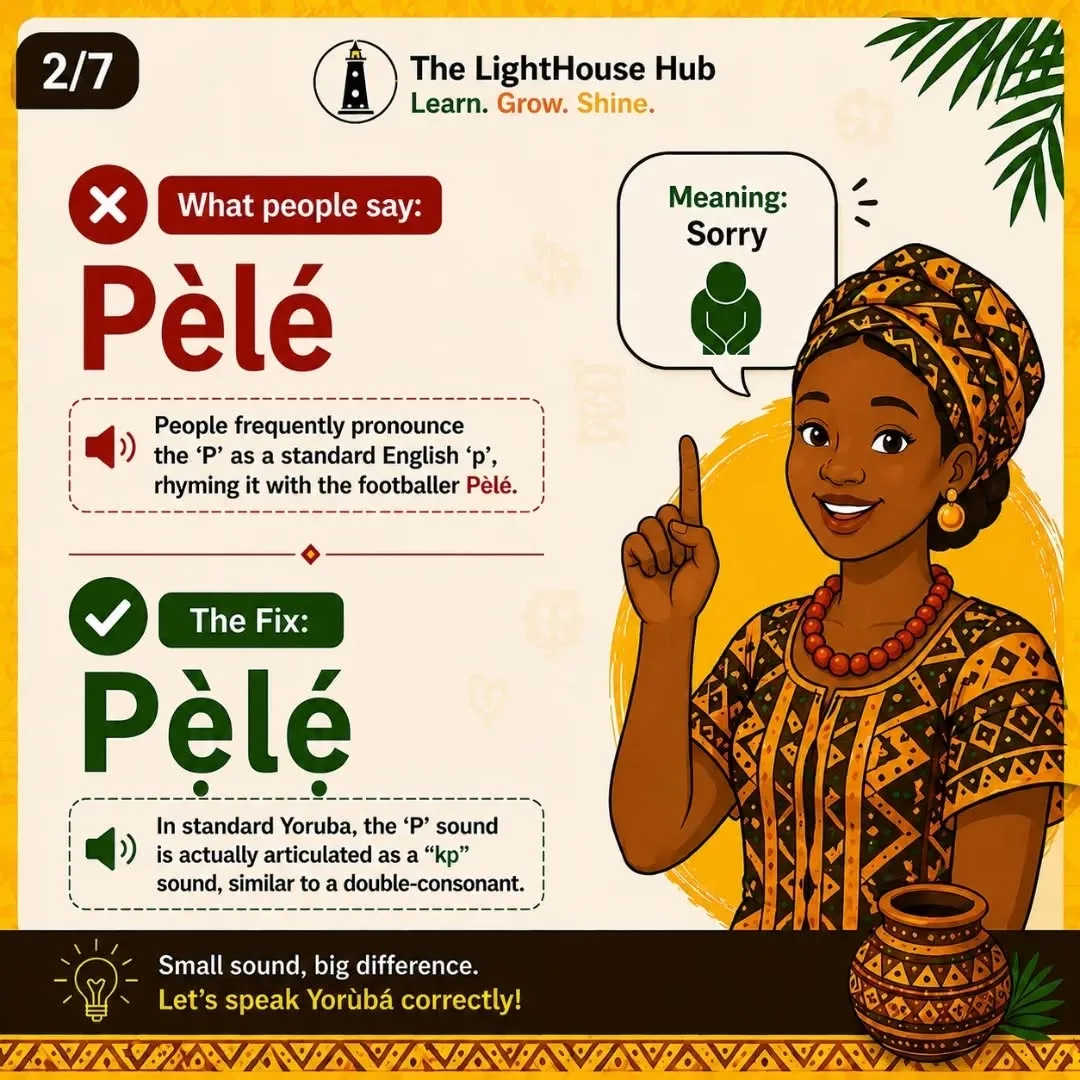
| I am sorry | Mo bẹ̀ ẹ́ | Used for small social errors |
| Pardon (I did not hear) | Kí ni? | Literally "what?", used to request repetition |
| Yes | Bẹ́ẹ̀ni | Formal affirmative |
| No | Rárá | Formal negative |
| Maybe | Bóyá | Expresses uncertainty |
| Of course | Dájúdájú | Literally "truly truly" |
The phrase ẹ má bínú (do not be annoyed) is the standard Yoruba apology for minor inconveniences: stepping in front of someone, interrupting, asking for help. It is not heavy; learners should use it freely.
Self-Introduction
| English | Yoruba |
|---|---|
| My name is Adé | Orúkọ mi ni Adé |
| What is your name? | Kí ni orúkọ rẹ? |
| I am from America | Mo wá láti Amẹ́ríkà |
| I live in Lagos | Mo ń gbé ní Èkó |
| I am learning Yoruba | Mo ń kẹ́kọ̀ọ́ Yorùbá |
| I speak a little Yoruba | Mo ń sọ Yorùbá díẹ̀ |
| I do not understand | N kò yé mi |
| Please speak slowly | Jọ̀wọ́ sọ̀rọ̀ pẹ́lẹ́pẹ́lẹ́ |
| Do you speak English? | Ṣé o ń sọ Gẹ̀ẹ́sì? |
| I am a student | Akẹ́kọ̀ọ́ ni mí |
| I am a visitor here | Àlejò ni mí níbí |
| Pleased to meet you | Inú mi dùn láti rí ẹ |
Shopping and Market Phrases
Yoruba markets, called ọjà, are traditional centers of commerce where bargaining is expected. The classic and ancient market of Ọjà Ọba in Ọ̀yọ́ and the vast Balogun market in Lagos both operate on negotiation. The following phrases cover basic transactions.
| English | Yoruba |
|---|---|
| How much is this? | Ẹ̀ló ni èyí? |
| That is too expensive | Ó wọ́n jù |
| Can you reduce the price? | Ṣé ẹ lè dín iye rẹ̀ kù? |
| I will pay this much | Mo máa san iye yìí |
| Good, I will take it | Ó dáa, mo máa gbà á |
| I am just looking | Mò ń wò lásán |
| Where is the market? | Níbo ni ọjà wà? |
| I want to buy food | Mo fẹ́ ra oúnjẹ |
| Do you have change? | Ṣé ẹ ní ìyè owó? |
| Please give me a bag | Jọ̀wọ́ fún mi ní àpò |
| Where do I pay? | Níbo ni mo ti máa san? |
| This is very nice | Ó dára gan |
A Yoruba market negotiation often begins with a purposely high offer from the seller and a purposely low counter from the buyer; the final price settles somewhere in between. Phrases like ó wọ́n jù (it is too expensive) and ẹ dín in fún mi (reduce it for me) are part of the routine, not rude.
Food and Restaurant Phrases
| English | Yoruba |
|---|---|
| I am hungry | Ebi ń pa mí |
| I am thirsty | Òùngbẹ ń gbẹ mí |
| I want to eat | Mo fẹ́ jẹun |
| Let us eat | Ẹ jẹ́ kí a jẹun |
| What do you want to eat? | Kí ni o fẹ́ jẹ? |
| Please bring water | Jọ̀wọ́ mú omi wá |
| The food is delicious | Oúnjẹ yìí dùn |
| I have had enough | Mo ti jẹ tó |
| How much is the food? | Ẹ̀ló ni oúnjẹ? |
| Do you have jollof rice? | Ṣé ẹ ní ìrẹsì jollof? |
| I would like pounded yam | Mo fẹ́ ìyán |
| May I have the bill? | Ṣé mo lè rí iye owó? |
The phrase ebi ń pa mí literally says "hunger is killing me," a vivid idiom that is not considered dramatic in Yoruba; it is the standard way to announce hunger.
Travel and Transportation
Nigerian urban transport runs on two iconic vehicles: the danfo (yellow minibus) and the ọ̀kàdà (motorcycle taxi). Both require vocabulary. In Lagos, the danfo system is the principal daytime transport; the name itself is of disputed origin but possibly derives from the Hausa term for a small vehicle.
| English | Yoruba |
|---|---|
| Where is the bus station? | Níbo ni gáréeji? |
| I want to go to Ibadan | Mo fẹ́ lọ sí Ìbàdàn |
| How much is the fare? | Ẹ̀ló ni owó ọkọ̀? |
| Please stop here | Jọ̀wọ́ dúró níbí |
| Where is the airport? | Níbo ni pápá ọkọ̀ òfúrufú? |
| Where is the hotel? | Níbo ni hótẹ̀lì? |
| Please call a taxi | Jọ̀wọ́ pe tákì |
| I am lost | Mo ṣi ọ̀nà |
| Please help me | Jọ̀wọ́ ràn mí lọ́wọ́ |
| Where is the toilet? | Níbo ni ilé ìgbọ̀nsẹ̀? |
| Is it far? | Ṣé ó jìnnà? |
| It is close by | Ó súnmọ́ |
Directions
| English | Yoruba |
|---|---|
| Turn right | Yípadà sí ọ̀tún |
| Turn left | Yípadà sí òsì |
| Go straight | Lọ tààràtà |
| Stop | Dúró |
| Here | Níbí |
| There | Níbẹ̀ |
| North | Àríwá |
| South | Gúúsù |
| East | Ìlà-oòrùn |
| West | Ìwọ̀-oòrùn |
| Near | Súnmọ́ |
| Far | Jìnnà |
Family and Social Phrases
| English | Yoruba |
|---|---|
| This is my friend | Èyí ni ọ̀rẹ́ mi |
| This is my family | Èyí ni ìdílé mi |
| How is your mother? | Báwo ni ìyá rẹ? |
| Please greet them for me | Jọ̀wọ́ kí wọn fún mi |
| I miss you | Ọkàn mi ń fà sí ọ |
| Welcome | Ẹ káàbọ̀ |
| Safe journey | Ọ̀nà ààbò |
| Have a good day | Ẹ jẹ́ kí ọjọ́ dáa |
| Congratulations | Ẹ kú orí ire |
| Condolences | Ẹ kú àánú |
The greeting ẹ káàbọ̀ (welcome) is essential: it is offered to any arrival, whether a long-awaited family member or an unexpected stranger. Its response is typically ẹ ṣeun (thank you) or à dúpẹ́ (we thank).
Emergencies and Urgent Situations
| English | Yoruba |
|---|---|
| Help! | Ẹ gbà mí! |
| Fire! | Iná! |
| Thief! | Olè! |
| Call the police | Pe ọlọ́pàá |
| Call an ambulance | Pe ọkọ̀ àìsàn |
| I am sick | Mò ń ṣàìsàn |
| I need a doctor | Mo nílò dókítà |
| Where is the hospital? | Níbo ni ilé ìwòsàn? |
| I am hurt | Ara mi ń dùn mí |
| Please be careful | Jọ̀wọ́ ṣọ́ra |
| It is an emergency | Ìṣòro ni |
Farewells
| English | Yoruba |
|---|---|
| Goodbye | Ó dìgbà |
| Until tomorrow | Ó dọ̀la |
| Until later | Ó di ìgbà ẹ̀yìn |
| Safe journey | Ọ̀nà ààbò |
| Take care | Ṣe àánú ara rẹ |
| See you soon | À má a rí ara wa láìpẹ́ |
| God bless you | Ọlọ́run bùkún fún ẹ |
Time Expressions in Conversation
| English | Yoruba |
|---|---|
| Today | Òní |
| Yesterday | Àná |
| Tomorrow | Ọ̀la |
| Now | Nísinsìnyí |
| Later | Ní àkókò mìíràn |
| Soon | Láìpẹ́ |
| Never | Láéláé |
| Always | Nígbà gbogbo |
| Sometimes | Nígbà míì |
| Quickly | Kíákíá |
| Slowly | Pẹ́lẹ́pẹ́lẹ́ |
These basic temporal markers combine freely with the main verb phrases above. A learner who commands ten greetings, twenty courtesy phrases, and a dozen time markers can already handle most short Yoruba interactions.
Common Questions
Kí ni èyí? (What is this?) Níbo ni ẹ ń lọ? (Where are you going?) Kí ni ẹ ń ṣe? (What are you doing?) Ṣé ẹ fẹ́ jẹun? (Would you like to eat?)
The question particle ṣé introduces yes-or-no questions and is used very widely. The interrogative kí ni (what is) opens most content questions. The word níbo (where) marks location questions, and nígbà wo (when) marks temporal questions.
Cultural Notes on Respect
Yoruba encodes social hierarchy in grammar itself. The second-person plural ẹ is the respect form used for elders, strangers, and anyone deserving of courtesy. The singular o is reserved for close peers, subordinates, and children. When addressing an older person, a learner should always use ẹ forms even if speaking to a single individual. Crucial respectful gestures include:
- Prostration or deep bow from men (dọbálẹ̀)
- Kneeling greeting from women (kúnlẹ̀)
- Removal of hats or head coverings for men in formal greetings
- Using the full phrase ẹ káàárọ̀ máàmì or ẹ káàárọ̀ dádì with parents
For traditional rulers and chiefs, elaborate formulas replace ordinary greetings. For the Ọba (king) of a Yoruba town, subjects use káàbíyèsí or the extended form ẹ káàbíyèsí o.
Common Mistakes
Using singular forms with elders. English has no singular-plural distinction in you, so English speakers default to the singular Yoruba o when they should use the plural ẹ. The result reads as disrespectful even if unintentional.
Skipping the greeting sequence. Moving too quickly from Báwo ni to substantive conversation feels hurried in Yoruba culture. Slow down; ask about family, work, rest.
Dropping tone marks in writing. In casual online Yoruba, people often omit diacritics. Learners should still practice writing with the correct marks, because misplaced tones change meaning entirely: ọkọ́ (hoe) versus ọkọ (husband/vehicle) versus ọ̀kọ̀ (spear) are distinguished only by tone.
Confusing ẹ ṣeun and à dúpẹ́. Both mean "thank you," but ẹ ṣeun is direct second-person thanks while à dúpẹ́ is a communal "we give thanks." Use the first for someone who served you; the second for divine or general gratitude.
Saying mo ti jẹ instead of mo ti jẹ tó. Mo ti jẹ means simply "I have eaten"; to politely refuse more food you must add tó (enough).
Quick Reference
Top Ten Daily Phrases
- Ẹ káàárọ̀ (Good morning)
- Báwo ni? (How are you?)
- Dáadáa ni (I am fine)
- Ẹ ṣeun (Thank you)
- Jọ̀wọ́ (Please)
- Ẹ má bínú (Excuse me / sorry)
- Kí ni orúkọ rẹ? (What is your name?)
- Ẹ̀ló ni? (How much?)
- Ó dìgbà (Goodbye)
- Ẹ káàbọ̀ (Welcome)
FAQ
How long does it take to learn enough Yoruba for basic tourist conversation? A motivated learner can master the core greetings, numbers, and phrases in this reference within two to three weeks of daily practice. Full conversational fluency is a longer project because tones require ear training.
Is it acceptable to speak English in Yoruba areas? In cities like Lagos and Ìbàdàn, English and Pidgin function as lingua francas; most people will switch readily. However, opening in Yoruba, even imperfectly, earns genuine goodwill and often unlocks more patient conversations.
What is the single most important phrase to learn? Ẹ ṣeun (thank you). It is deployed more frequently than any other phrase and covers many social functions. Mastery of its tones signals that a learner takes the language seriously.
Should I use a phrasebook or learn grammar first? Both, but phrases produce faster social rewards. A working set of fifty phrases will carry a learner through most ordinary encounters while grammar study continues in parallel.
Are Yoruba phrases the same in Benin and Togo? Broadly yes, though there are regional differences in vocabulary and intonation. The Ifẹ̀, Ìjẹ̀bú, Ìjẹ̀ṣà, and Ọ̀yọ́ dialects have distinctive features, and Yoruba in Benin has incorporated some French loanwords. Standard Yoruba (Yorùbá Ìwé) is understood everywhere.
See Also
- Yoruba Alphabet and Pronunciation Complete Guide
- Yoruba Three Tones High Mid Low Complete Reference
- Yoruba Greetings and Cultural Salutations Reference
- Yoruba Pronouns Subject Object Possessive Reference
- Yoruba Numbers Counting Vigesimal System Reference
- Yoruba Proverbs Wisdom Sayings Cultural Reference
- Language Difficulty for English Speakers Reference
Author: Kalenux Team
Frequently Asked Questions
How long does it take to learn enough Yoruba for basic tourist conversation?
A motivated learner can master the core greetings, numbers, and phrases in this reference within two to three weeks of daily practice. Full conversational fluency is a longer project because tones require ear training and idiomatic use requires cultural exposure, but a working phrasebook set supports short interactions quickly.
Is it acceptable to speak English in Yoruba areas?
In cities like Lagos and Ibadan, English and Nigerian Pidgin function as lingua francas, and most people will switch readily. However, opening in Yoruba, even imperfectly, earns genuine goodwill and often unlocks warmer, more patient conversations. Locals especially appreciate when learners use proper greeting forms.
What is the single most important phrase to learn?
E seun (thank you) is the most practically valuable phrase because it is deployed constantly and covers a wide range of social functions. Mastery of its tonal contour signals that a learner takes the language seriously, and combining it with the respect plural form makes it usable in nearly any setting.
Should I use a phrasebook or learn grammar first?
Both, but phrases produce faster social rewards. A working set of fifty phrases will carry a learner through most ordinary encounters while grammar study continues in parallel. Phrasebook learning also builds the ear for Yoruba tonal patterns which formal grammar study alone cannot achieve.
Are Yoruba phrases the same in Benin and Togo?
Broadly yes, though there are regional differences in vocabulary and intonation. The Ife, Ijebu, Ijesa, and Oyo dialects have distinctive features, and Yoruba in Benin has incorporated some French loanwords. Standard Yoruba (Yoruba Iwe) taught in schools is understood across the entire Yoruba-speaking region.
Why are greetings so long in Yoruba culture?
Yoruba greeting practice reflects a cultural value that relationships deserve explicit verbal recognition. A sequence of inquiries about health, family, work, and rest affirms social bonds and demonstrates that neither party is rushing past the other. Skipping this sequence can read as cold or disrespectful.
How do I know when to use e rather than o for you?
The plural form e is the respectful default: use it with elders, strangers, shopkeepers, teachers, and anyone in a position of respect. The singular o is reserved for close peers, close family members younger than the speaker, and children. When in doubt, choose e, which is never wrong though sometimes more formal than necessary.