
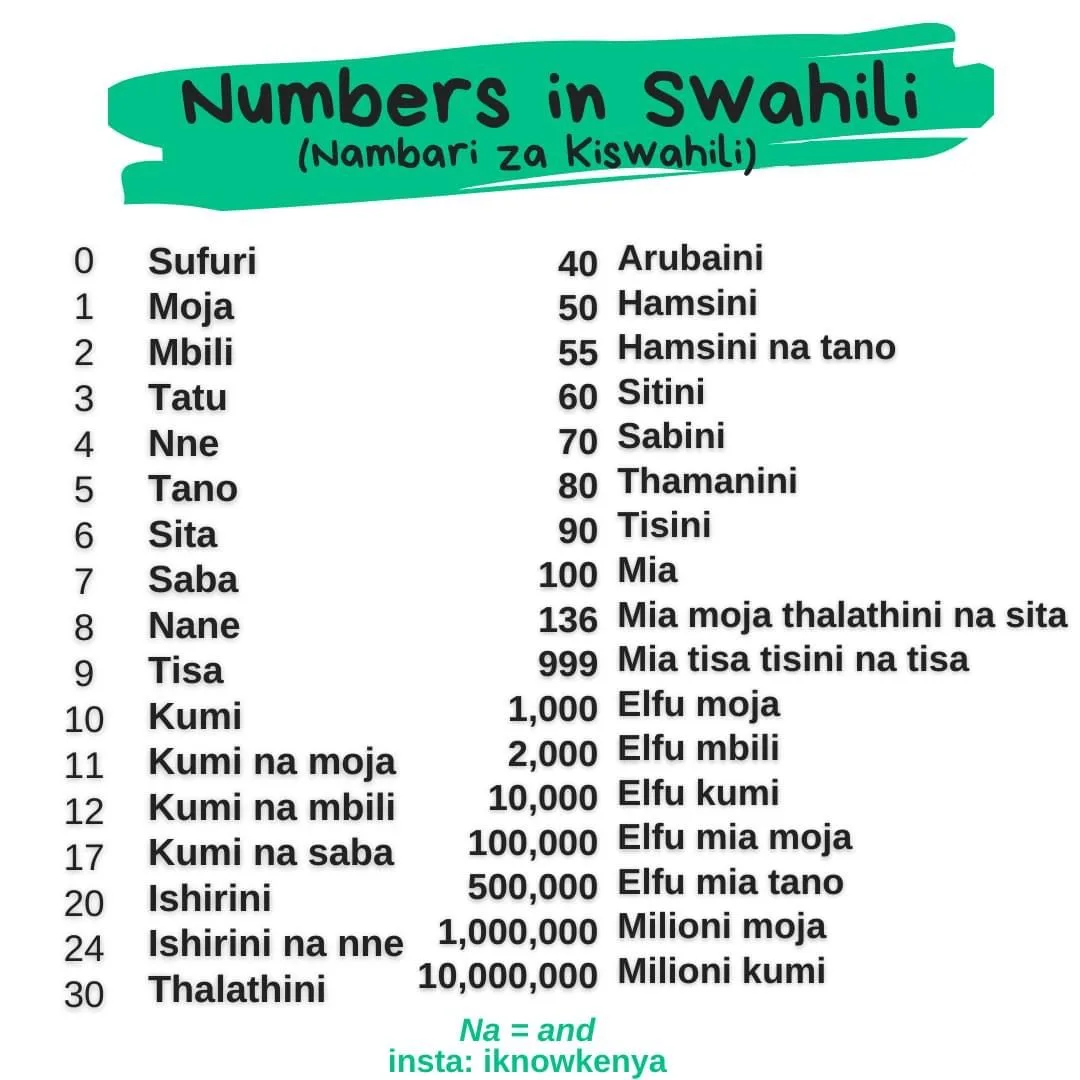
Swahili numbers offer one of the most striking examples of the mixed linguistic heritage of the language. Small numbers come from Bantu roots and behave like adjectives - they agree with the noun class of the thing being counted. Larger numbers, from six upward, are predominantly Arabic loanwords and do not inflect. This split is visible in every counting exercise, and it is a gentle introduction to the interaction of native and loan vocabulary that runs throughout Swahili.
This reference page covers the full number system: cardinal numbers from one to one thousand, the rules for number agreement with noun classes, ordinal numbers (first, second, third), very large numbers (thousand, million, billion), the Swahili system of telling time (which uniquely offsets by six hours from Western conventions), common counting constructions, and prices and money. All examples use standard Kiswahili sanifu as used in Tanzania and taught in schools.
Numbers are among the first things a visitor to East Africa needs in practice - for prices at markets, for telling time, for dates and addresses. The cardinal numbers are used so frequently that they become automatic quickly. The grammatical complications arise when you try to say "one person" versus "two people," since these require the native Bantu numbers to agree with the noun class of the human subject.
Cardinal Numbers 1 to 10
The first ten numbers show the split between Bantu roots (numbers 1-5) and Arabic loans (6 and 8), with two native numbers (7 and 9) mixed in.
| Number | Swahili | Origin | Notes |
|---|---|---|---|
| 1 | moja | Bantu | takes class agreement |
| 2 | mbili | Bantu | takes class agreement |
| 3 | tatu | Bantu | takes class agreement |
| 4 | nne | Bantu | takes class agreement |
| 5 | tano | Bantu | takes class agreement |
| 6 | sita | Arabic | invariable |
| 7 | saba | Arabic | invariable |
| 8 | nane | Bantu | invariable in practice |
| 9 | tisa | Arabic | invariable |
| 10 | kumi | Bantu | invariable |
The Bantu numbers from 1 to 5 inflect for noun class when used to count specific items. The others - including 8 and 10, which happen to be Bantu-origin but do not agree - stay the same regardless of what they count.
Numbers 11 to 99
Eleven through nineteen are formed as "ten and X" using the connector "na" (and):
- 11: kumi na moja
- 12: kumi na mbili
- 13: kumi na tatu
- 14: kumi na nne
- 15: kumi na tano
- 16: kumi na sita
- 17: kumi na saba
- 18: kumi na nane
- 19: kumi na tisa
Twenty and the other multiples of ten are individual words, mostly Arabic loans with native "makumi" (tens) forms also possible but dated.
| Number | Swahili |
|---|---|
| 20 | ishirini |
| 30 | thelathini |
| 40 | arobaini |
| 50 | hamsini |
| 60 | sitini |
| 70 | sabini |
| 80 | themanini |
| 90 | tisini |
Compound numbers use na:
- 21: ishirini na moja
- 35: thelathini na tano
- 47: arobaini na saba
- 68: sitini na nane
- 99: tisini na tisa
Hundreds, Thousands, Millions
These are all Arabic loans and do not inflect.
| Number | Swahili |
|---|---|
| 100 | mia |
| 200 | mia mbili |
| 300 | mia tatu |
| 1,000 | elfu |
| 2,000 | elfu mbili |
| 10,000 | elfu kumi |
| 100,000 | laki (in Kenya and coastal Tanzania) / elfu mia |
| 1,000,000 | milioni |
| 1,000,000,000 | bilioni |
Note that while the hundred word is invariable, the Bantu 1-5 numbers following mia do agree, but with class 10 of the noun they describe (mia mbili = two hundreds, literally). "Mia mbili" uses mbili rather than wawili because "mia" itself is class 9/10.
Constructing long numbers:
- 125: mia moja na ishirini na tano (literally one hundred and twenty and five)
- 1,234: elfu moja, mia mbili thelathini na nne
- 2024: elfu mbili na ishirini na nne
In ordinary speech, "na" is often dropped in the middle of long numbers but kept before the last component.
Number Agreement with Noun Classes
The critical complication: when counting people or specific items, Bantu numbers 1-5 must agree with the noun class. Here is the full agreement table for "one" through "five" across major classes.
| Class | 1 | 2 | 3 | 4 | 5 |
|---|---|---|---|---|---|
| 1 (m-) | mmoja | - | - | - | - |
| 2 (wa-) | - | wawili | watatu | wanne | watano |
| 3 (m-) | mmoja | - | - | - | - |
| 4 (mi-) | - | miwili | mitatu | minne | mitano |
| 5 (ji-/0) | moja | - | - | - | - |
| 6 (ma-) | - | mawili | matatu | manne | matano |
| 7 (ki-) | kimoja | - | - | - | - |
| 8 (vi-) | - | viwili | vitatu | vinne | vitano |
| 9 (n-) | moja | - | - | - | - |
| 10 (n-) | - | mbili | tatu | nne | tano |
| 11 (u-) | mmoja | - | - | - | - |
| 14 | mmoja | - | - | - | - |
Examples:
- mtu mmoja (one person) - class 1
- watu wawili (two people) - class 2
- kitabu kimoja (one book) - class 7
- vitabu vitatu (three books) - class 8
- nyumba moja (one house) - class 9
- nyumba tatu (three houses) - class 10
- miti minne (four trees) - class 4
Numbers 6 and higher stay the same regardless of noun class:
- watu sita (six people)
- vitabu sita (six books)
- nyumba sita (six houses)
This asymmetry - agreement for 1-5 but not 6+ - is one of Swahili's most distinctive features.
Memory aid: "One" through "five" are old Bantu numbers that inflect. "Six," "seven," "nine" are Arabic loans that never inflect. Eight (nane) and ten (kumi) are Bantu but stopped inflecting long ago. You don't need to know the origin - just memorize that numbers above five are invariable.
Ordinal Numbers
Ordinals (first, second, third) are formed with the connector -a plus the number. The connector agrees with the noun class, just like the possessive.
For class 7 (kitabu, book):
- kitabu cha kwanza (the first book)
- kitabu cha pili (the second book)
- kitabu cha tatu (the third book)
- kitabu cha nne (the fourth book)
- kitabu cha tano (the fifth book)
Note that "first" uses the special word "kwanza" (from the verb kuanza, to begin), and "second" uses "pili" (not mbili). From third onward, the regular number stem is used after the connector.
Full ordinal paradigm:
| Ordinal | Stem | Class 1 | Class 7 | Class 9 |
|---|---|---|---|---|
| 1st | kwanza | wa kwanza | cha kwanza | ya kwanza |
| 2nd | pili | wa pili | cha pili | ya pili |
| 3rd | tatu | wa tatu | cha tatu | ya tatu |
| 4th | nne | wa nne | cha nne | ya nne |
| 5th | tano | wa tano | cha tano | ya tano |
| 6th | sita | wa sita | cha sita | ya sita |
| 7th | saba | wa saba | cha saba | ya saba |
| 10th | kumi | wa kumi | cha kumi | ya kumi |
Examples:
- mtoto wa kwanza (the first child)
- siku ya tatu (the third day)
- mwaka wa pili (the second year)
Telling Time
Swahili time is unique among world languages for being offset from Western convention by six hours. The Swahili system treats sunrise, around 6 a.m., as the start of the first hour - logical in an equatorial region where the sun rises and sets at roughly the same time every day.
To convert:
- Western 7 a.m. = Swahili saa moja asubuhi (hour one of the morning)
- Western 12 noon = Swahili saa sita (hour six, i.e. six hours after 6 a.m.)
- Western 1 p.m. = Swahili saa saba mchana (hour seven of the day)
- Western 6 p.m. = Swahili saa kumi na mbili jioni (hour twelve of the evening)
- Western 7 p.m. = Swahili saa moja usiku (hour one of the night)
The word "saa" means both hour and watch/clock. Period words attach to clarify which half of the 24-hour cycle:
- asubuhi (morning, roughly dawn to mid-morning)
- mchana (day / afternoon)
- jioni (evening)
- usiku (night)
- alfajiri (pre-dawn)
Half and quarter hours:
- saa tatu kasorobo (quarter to nine = 9 a.m. less 15 minutes = 8:45 a.m.) - literally hour three less a quarter
- saa tatu na nusu (half past nine = 9:30 a.m.)
- saa tatu na robo (quarter past nine = 9:15 a.m.)
Here "nusu" means half and "robo" means quarter - both Arabic loans.
Example sentences:
- Ni saa ngapi? (What time is it?)
- Ni saa nne asubuhi. (It is 10 a.m. - hour four of the morning.)
- Tutakutana saa sita mchana. (We will meet at noon.)
Money and Prices
The Swahili currency word is "shilingi" (shilling) in Kenya, Tanzania, and Uganda. Prices use cardinal numbers followed by "shilingi":
- shilingi mia tatu (300 shillings)
- shilingi elfu mbili (2,000 shillings)
- shilingi elfu tano mia mbili (5,200 shillings)
"Senti" (cents) is used for sub-shilling amounts, though in practice inflation has made cents largely irrelevant in daily transactions.
Shopping vocabulary:
- Bei gani? (What price? / How much?)
- Ni bei gani? (What is the price?)
- Shilingi ngapi? (How many shillings?)
- Ghali sana (very expensive)
- Punguza kidogo (reduce a little, i.e. bring the price down)
- Bei ya mwisho (final price)
Common Mistakes English Speakers Make
1. Forgetting to inflect numbers 1-5. Saying "mtu mbili" instead of "watu wawili" for "two people" is a classic error. The number must agree with the noun class.
2. Attempting to inflect numbers 6 and up. "Watu wasita" is wrong - it should be "watu sita." Once past five, the number is frozen.
3. Miscounting time. A common mistake is assuming "saa moja" is 1 a.m. or 1 p.m., when it actually means 7 a.m. or 7 p.m. in Western reckoning. Always subtract or add six hours when converting.
4. Using "mbili" for "second" in ordinals. "Kitabu cha mbili" is non-standard. The correct form is "kitabu cha pili." "Pili" is a special ordinal form for second.
5. Leaving out the connector "na" in long numbers. "Ishirini moja" is not quite right for 21; the correct form is "ishirini na moja." The na is obligatory.
Quick Reference
| Category | Key Forms |
|---|---|
| 1-5 (inflect) | moja, mbili, tatu, nne, tano |
| 6-10 (invariable) | sita, saba, nane, tisa, kumi |
| Tens | ishirini, thelathini, arobaini, hamsini, sitini, sabini, themanini, tisini |
| 100 / 1000 / million | mia, elfu, milioni |
| Ordinals | cha/wa/ya + kwanza, pili, tatu... |
| Time | saa + number + period (asubuhi, mchana, jioni, usiku) |
| Time offset | Swahili hour = Western hour minus 6 |
FAQ
Why do small numbers agree with noun class but large numbers do not?
Numbers 1-5 are inherited from Proto-Bantu, where numerals behaved like adjectives and took concord prefixes. Numbers 6 and above were largely borrowed from Arabic during the long history of coastal trade, and they entered Swahili as invariable words. The mixed system reflects the language's history.
Is Swahili time really different from Western time?
Yes. In traditional Swahili reckoning, the day begins at sunrise (around 6 a.m. at the equator), so saa moja is the first hour after sunrise - 7 a.m. To avoid confusion, media, schools, and international contexts increasingly use Western time. But in everyday conversation, Swahili time is still the norm.
What is "laki" and is it always used?
Laki means 100,000 and is used commonly in Kenya and Tanzanian coastal regions. In more formal or inland speech, elfu mia (one hundred thousand) may be used instead. Both are understood.
Why does "six people" not use a class prefix on "sita"?
Because sita, from Arabic, entered Swahili as an invariable word and never acquired the class concord system. All numbers from six upward are similarly invariable, regardless of what they count.
How do I say "zero"?
"Sifuri" is the standard word for zero, another Arabic loan (from the same root that gave English "cipher" and "zero"). "Bila" (without) or "hakuna" (there is not) are used for "none" in many contexts.
How do Swahili phone numbers work?
Phone numbers are typically read in pairs of digits: "07-23-45-67-89" becomes "sifuri saba, ishirini na tatu, arobaini na tano..." Longer numbers are broken into pronounceable chunks.
What's the difference between "pili" and "mbili"?
Both mean "two" in some sense. "Mbili" is the cardinal number two. "Pili" is the ordinal (second) and also appears in a few fixed expressions like "mara ya pili" (the second time).
See Also
- Swahili Noun Classes
- Swahili Adjectives and Agreement
- Swahili Arabic Loanwords
- Swahili Greetings and Daily Phrases
- Swahili Alphabet and Pronunciation
- Arabic Numbers System Guide
- Grammatical Cases Compared
- Language Difficulty for English Speakers
Frequently Asked Questions
Why do small numbers agree with noun class but large numbers do not?
Numbers 1-5 are inherited from Proto-Bantu, where numerals took concord prefixes like adjectives. Numbers 6 and above were largely borrowed from Arabic during centuries of coastal trade and entered Swahili as invariable words. The mixed system reflects the language’s history.
Is Swahili time really different from Western time?
Yes. In traditional Swahili reckoning, the day begins at sunrise (around 6 a.m. at the equator), so saa moja is the first hour after sunrise - 7 a.m. Media and international contexts increasingly use Western time, but everyday conversation still uses Swahili time.
What is laki and is it always used?
Laki means 100,000 and is common in Kenya and Tanzanian coastal regions. In more formal or inland speech, elfu mia may be used. Both are understood.
Why does six people not use a class prefix on sita?
Because sita, from Arabic, entered Swahili as an invariable word and never acquired the class concord system. All numbers from six upward are similarly invariable regardless of what they count.
How do I say zero in Swahili?
Sifuri is the standard word for zero, another Arabic loan from the same root that gave English cipher and zero. Bila (without) or hakuna (there is not) are used for ‘none’ in many contexts.
What is the difference between pili and mbili?
Mbili is the cardinal number two. Pili is the ordinal ‘second’ and appears in fixed expressions like mara ya pili (the second time). You cannot substitute one for the other.
How do Swahili speakers read phone numbers?
Phone numbers are typically read in pairs of digits: 07-23-45-67 becomes sifuri saba, ishirini na tatu, arobaini na tano, sitini na saba. Longer numbers are broken into pronounceable chunks.