
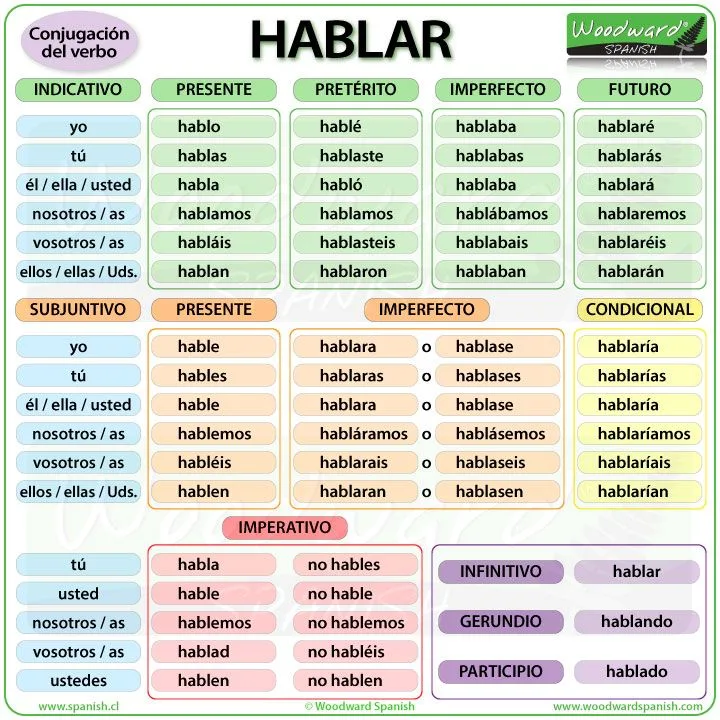
Spanish verbs are organized into three conjugation classes based on the ending of the infinitive: -ar (first conjugation), -er (second conjugation), and -ir (third conjugation). Roughly 80 percent of Spanish verbs are -ar; a smaller but important group of high-frequency verbs is -er; -ir is the smallest class but contains essential verbs like vivir, salir, and dormir. This reference explains Spanish Verb Conjugation System with clear rules and worked examples.
Each class has its own set of endings that vary across person (yo, tu, el/ella/usted, nosotros, vosotros, ellos/ustedes), tense, mood, and aspect. Spanish recognizes roughly 14 distinct simple and compound tense/mood combinations in active voice.
This reference lays out the full conjugation of one regular verb from each class across all 14 tense-mood combinations, explains the core stem-change patterns, and provides memory tables for the most frequent irregularities.
For a beginner-friendly introduction to the present tense alone, see the Spanish verb conjugation guide: present tense. For the crucial past-tense choice between preterite and imperfect, see the Spanish past tense: preterite vs imperfect guide. For a general orientation, see the Spanish grammar rules guide for beginners.
The Three Conjugation Classes
Table 1. Sample regular verbs from each class.
| Class | Infinitive | Meaning |
|---|---|---|
| -ar | hablar | to speak |
| -er | comer | to eat |
| -ir | vivir | to live |
Every regular verb in Spanish conjugates exactly like its class model. Irregular verbs (ser, estar, ir, tener, hacer, etc.) require separate memorization; see below for the frequency rankings.
Present Indicative (Presente de indicativo)
Table 2. Present indicative endings.
| Pronoun | -ar (hablar) | -er (comer) | -ir (vivir) |
|---|---|---|---|
| yo | hablo | como | vivo |
| tu | hablas | comes | vives |
| el/ella/usted | habla | come | vive |
| nosotros/-as | hablamos | comemos | vivimos |
| vosotros/-as | hablais | comeis | vivis |
| ellos/ellas/ustedes | hablan | comen | viven |
Notice that -er and -ir verbs differ only in the nosotros and vosotros forms. In spoken Latin American Spanish, ustedes replaces vosotros for plural "you."
Preterite (Preterito indefinido)
Completed past action with a definite endpoint.
Table 3. Preterite endings.
| Pronoun | -ar (hablar) | -er (comer) | -ir (vivir) |
|---|---|---|---|
| yo | hable | comi | vivi |
| tu | hablaste | comiste | viviste |
| el/ella/usted | hablo | comio | vivio |
| nosotros | hablamos | comimos | vivimos |
| vosotros | hablasteis | comisteis | vivisteis |
| ellos/ustedes | hablaron | comieron | vivieron |
Note: -er and -ir verbs share the same preterite endings exactly. The hablamos form is identical for present and preterite; only context disambiguates.
Imperfect (Preterito imperfecto)
Past action as habitual, ongoing, or descriptive.
Table 4. Imperfect endings.
| Pronoun | -ar (hablar) | -er (comer) | -ir (vivir) |
|---|---|---|---|
| yo | hablaba | comia | vivia |
| tu | hablabas | comias | vivias |
| el/ella/usted | hablaba | comia | vivia |
| nosotros | hablabamos | comiamos | viviamos |
| vosotros | hablabais | comiais | viviais |
| ellos/ustedes | hablaban | comian | vivian |
Only three verbs are irregular in the imperfect: ir (iba), ser (era), ver (veia).
Future and Conditional
Both built from the infinitive plus endings derived from haber.
Table 5. Future simple.
| Pronoun | hablar | comer | vivir |
|---|---|---|---|
| yo | hablare | comere | vivire |
| tu | hablaras | comeras | viviras |
| el | hablara | comera | vivira |
| nosotros | hablaremos | comeremos | viviremos |
| vosotros | hablareis | comereis | vivireis |
| ellos | hablaran | comeran | viviran |
Table 6. Conditional simple.
| Pronoun | hablar | comer | vivir |
|---|---|---|---|
| yo | hablaria | comeria | viviria |
| tu | hablarias | comerias | vivirias |
| el | hablaria | comeria | viviria |
| nosotros | hablariamos | comeriamos | viviriamos |
| vosotros | hablariais | comeriais | viviriais |
| ellos | hablarian | comerian | vivirian |
Twelve common verbs have irregular future/conditional stems: tener (tendr-), poner (pondr-), salir (saldr-), venir (vendr-), poder (podr-), saber (sabr-), caber (cabr-), querer (querr-), haber (habr-), hacer (har-), decir (dir-), and compounds of these.
Present Subjunctive
Formed from the yo-form of the present indicative (minus -o) plus "opposite-vowel" endings: -ar verbs take -e endings, -er/-ir verbs take -a endings.
Table 7. Present subjunctive endings.
| Pronoun | -ar (hablar) | -er (comer) | -ir (vivir) |
|---|---|---|---|
| yo | hable | coma | viva |
| tu | hables | comas | vivas |
| el | hable | coma | viva |
| nosotros | hablemos | comamos | vivamos |
| vosotros | hableis | comais | vivais |
| ellos | hablen | coman | vivan |
The subjunctive is central to Spanish. See the Spanish subjunctive mood reference for when to use it.
Imperfect Subjunctive
Two accepted forms, -ra and -se. The -ra form is more common in speech; -se is somewhat more literary. Both are formed from the third-person plural preterite stem.
Table 8. Imperfect subjunctive, -ra form.
| Pronoun | hablar | comer | vivir |
|---|---|---|---|
| yo | hablara | comiera | viviera |
| tu | hablaras | comieras | vivieras |
| el | hablara | comiera | viviera |
| nosotros | hablaramos | comieramos | vivieramos |
| vosotros | hablarais | comierais | vivierais |
| ellos | hablaran | comieran | vivieran |
Compound Tenses
Compound tenses pair a conjugated form of haber with the past participle (-ado for -ar verbs; -ido for -er/-ir verbs).
Table 9. The six compound tenses (yo-form shown, hablar).
| Tense | Formation | Example | English |
|---|---|---|---|
| Present perfect | he + hablado | he hablado | I have spoken |
| Pluperfect | habia + hablado | habia hablado | I had spoken |
| Preterite perfect (rare) | hube + hablado | hube hablado | I had spoken |
| Future perfect | habre + hablado | habre hablado | I will have spoken |
| Conditional perfect | habria + hablado | habria hablado | I would have spoken |
| Present perfect subj. | haya + hablado | haya hablado | I have spoken (subj) |
| Pluperfect subj. | hubiera + hablado | hubiera hablado | I had spoken (subj) |
The past participle does not change for person or gender in compound tenses; it always stays -ado/-ido.
Stem-Changing Verbs
Many common verbs change their stem vowel in stressed syllables. The change affects all present forms except nosotros and vosotros (the "boot" pattern).
Table 10. Main stem-change patterns in the present.
| Pattern | Example verb | Change | Present yo, tu, el, nosotros, vosotros, ellos |
|---|---|---|---|
| e - ie | pensar | penso - pienso | pienso, piensas, piensa, pensamos, pensais, piensan |
| o - ue | poder | podo - puedo | puedo, puedes, puede, podemos, podeis, pueden |
| e - i (-ir only) | pedir | pedo - pido | pido, pides, pide, pedimos, pedis, piden |
| u - ue | jugar | jugo - juego | juego, juegas, juega, jugamos, jugais, juegan |
-ir stem-changers also change in the preterite (3rd-person only): pedir preterite = pidio/pidieron; dormir preterite = durmio/durmieron. -ar and -er stem-changers do not change in the preterite.
Irregular Verbs: The Top Twelve
Table 11. Top 12 most-used irregular Spanish verbs.
| Verb | Meaning | Notable irregularities |
|---|---|---|
| ser | to be (essential) | soy/eres/es, fui/fuiste/fue, era/eras/era |
| estar | to be (temporary) | estoy/estas/esta, estuve |
| ir | to go | voy/vas/va, fui/fuiste/fue, iba |
| tener | to have | tengo, tuve, tendre |
| hacer | to do/make | hago, hice, hare, hecho |
| decir | to say | digo, dije, dire, dicho |
| poder | to be able | puedo, pude, podre |
| ver | to see | veo, vi, veia, visto |
| dar | to give | doy, di, dado |
| saber | to know | se, supe, sabre |
| querer | to want | quiero, quise, querre |
| venir | to come | vengo, vine, vendre |
For the perennial confusion between ser and estar, see ser vs estar complete guide.
Common Mistakes Learners Make
- Mixing -er and -ir endings. They differ only in nosotros/vosotros forms - but they do differ.
- Forgetting the yo-form stem in the subjunctive. Subjunctive is built from present yo minus -o, preserving the irregularities (tener - yo tengo - tenga).
- Using infinitive forms after sentence triggers. "Quiero que tu vas" is wrong; must be subjunctive "vayas."
- Getting conditional endings mixed with imperfect. Conditional uses the infinitive as stem (hablaria); imperfect uses -aba/-ia endings (hablaba/comia).
- Over-applying stem changes in nosotros. Stressed vowels change; nosotros is unstressed. "Nos pensamos" wrong, "nosotros pensamos" right.
- Forgetting accent marks. Missing accents change tense: hablo (I speak) vs hablo (he spoke) - both written hablo without diacritics but different words.
- Mixing present perfect with preterite for recent events. "He visto" (have seen) vs "vi" (saw) - regional preferences differ sharply between Spain and Latin America.
- Treating past participles as variable. In compound tenses the participle is invariable (-ado/-ido).
Quick Reference: 14 Tense-Mood Combinations
- Present indicative (hablo)
- Imperfect indicative (hablaba)
- Preterite (hable)
- Future simple (hablare)
- Conditional simple (hablaria)
- Present subjunctive (hable)
- Imperfect subjunctive (hablara / hablase)
- Present perfect (he hablado)
- Pluperfect (habia hablado)
- Future perfect (habre hablado)
- Conditional perfect (habria hablado)
- Present perfect subjunctive (haya hablado)
- Pluperfect subjunctive (hubiera hablado)
- Imperative (habla/hable/hablen)
FAQ
How long does it take to learn all Spanish tenses?
Most learners need 6-12 months to reliably produce the present, preterite, imperfect, and present perfect in speech. The subjunctive and compound tenses often take an additional year.
Is vosotros really needed?
For Spain, yes. For Latin America, rarely - ustedes covers plural "you." Passive recognition of vosotros is helpful everywhere because of Spanish literature and film.
Why are there two forms of the imperfect subjunctive?
Both -ra and -se forms are correct and mean the same thing. The -se form is slightly more literary; the -ra form dominates spoken usage.
When do I use preterite vs imperfect?
Preterite for completed, bounded actions; imperfect for descriptions, habits, and ongoing background. See the dedicated preterite vs imperfect guide.
How do I know if a verb is stem-changing?
Dictionaries mark it: pensar (ie), poder (ue), pedir (i). A handful of patterns (e-ie, o-ue, e-i) cover almost all stem changes.
Why are -er and -ir endings so similar?
Because they share a common Latin origin. The third conjugation (-ir) split off from the second (-er) but retained almost all endings except nosotros/vosotros.
Is the subjunctive ever optional?
In some constructions yes (especially after expressions like "quiza" and "tal vez"), but after most triggers (querer que, dudar que, es importante que) it is obligatory.
See Also
- Spanish verb conjugation guide: present tense
- Spanish past tense: preterite vs imperfect guide
- Spanish subjunctive mood reference
- Spanish grammar rules guide for beginners
- Spanish alphabet pronunciation guide
- Ser vs estar complete guide
- Spanish pronouns: direct, indirect, reflexive
- Spanish por vs para usage reference
Frequently Asked Questions
How long does it take to learn all Spanish tenses?
Most learners need 6-12 months to reliably produce present, preterite, imperfect, and present perfect. The subjunctive and compound tenses often take another year of practice.
Is vosotros really needed?
For Spain, yes. For Latin America, ustedes covers plural ‘you’ in all situations. Passive recognition of vosotros still helps for Spanish media and literature.
Why are there two forms of the imperfect subjunctive?
Both -ra and -se forms are historically valid and mean the same thing. The -ra form dominates spoken usage; -se is slightly more literary.
When do I use preterite vs imperfect?
Preterite for completed bounded actions; imperfect for descriptions, habits, and ongoing background. See the preterite vs imperfect guide.
How do I know if a verb is stem-changing?
Dictionaries mark it in parentheses: pensar (ie), poder (ue), pedir (i). The patterns e-ie, o-ue, e-i, and u-ue cover most cases.
Why are -er and -ir endings so similar?
They share a Latin origin. The third conjugation split off from the second but retained nearly all endings except in the nosotros and vosotros forms.
Is the subjunctive ever optional?
After some expressions (quiza, tal vez) the subjunctive is optional. After standard triggers (querer que, dudar que, es importante que) it is required.