
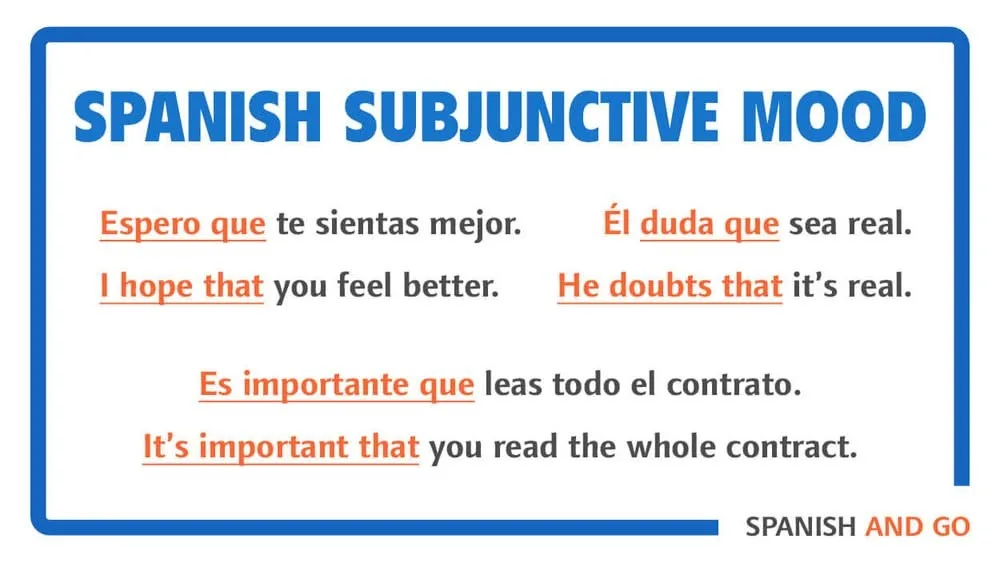
The subjunctive (subjuntivo) is a mood, not a tense. It marks how a speaker views the reality of an action - whether it is a fact (indicative) or something subjective: wished for, doubted, feared, denied, commanded, or hypothetical. This Spanish Subjunctive Mood reference collects the forms, examples, and usage notes in one place.
English has a nearly extinct subjunctive ("I suggest he be on time"); Spanish uses it constantly, in nearly every complex sentence. Learning to recognize subjunctive triggers, then to produce the right forms, is the key grammatical milestone between intermediate and advanced Spanish.
This page covers the two main tenses of the subjunctive - present and imperfect - their formation rules, the categories of triggers that require them, and the most common specific expressions. For the full tense-mood conjugation chart, see the Spanish verb conjugation system reference. For the preterite vs imperfect choice in the indicative, see the Spanish past tense guide. For broader orientation, see the Spanish grammar rules guide.
Formation
Present Subjunctive
- Start with the yo-form of the present indicative.
- Drop the final -o.
- Add the "opposite-vowel" endings: -ar verbs take -e endings; -er/-ir verbs take -a endings.
Table 1. Present subjunctive endings.
| Pronoun | -ar (hablar) | -er (comer) | -ir (vivir) |
|---|---|---|---|
| yo | hable | coma | viva |
| tu | hables | comas | vivas |
| el/ella/usted | hable | coma | viva |
| nosotros | hablemos | comamos | vivamos |
| vosotros | hableis | comais | vivais |
| ellos/ustedes | hablen | coman | vivan |
This rule automatically handles most irregular verbs because the yo-form carries the irregularity into the subjunctive:
- tener - yo tengo - tenga, tengas, tenga, tengamos, tengais, tengan
- hacer - yo hago - haga, hagas, haga, ...
- decir - yo digo - diga, digas, diga, ...
Six verbs have special subjunctive stems that do not follow the yo-form rule: ser (sea), estar (este), ir (vaya), haber (haya), saber (sepa), dar (de).
Imperfect Subjunctive
- Start with the ellos-form of the preterite.
- Drop the final -ron.
- Add -ra/-ras/-ra/-ramos/-rais/-ran or -se/-ses/-se/-semos/-seis/-sen.
Both sets of endings are correct and interchangeable in meaning. The -ra forms dominate conversation; the -se forms appear more in literary prose.
Table 2. Imperfect subjunctive -ra endings.
| Pronoun | hablar (hablaron) | comer (comieron) | vivir (vivieron) |
|---|---|---|---|
| yo | hablara | comiera | viviera |
| tu | hablaras | comieras | vivieras |
| el | hablara | comiera | viviera |
| nosotros | hablaramos | comieramos | vivieramos |
| vosotros | hablarais | comierais | vivierais |
| ellos | hablaran | comieran | vivieran |
Compound Subjunctive Tenses
- Present perfect subjunctive: haya + past participle. Espero que hayas llegado. (I hope you've arrived.)
- Pluperfect subjunctive: hubiera + past participle. Si hubiera sabido, habria venido. (If I had known, I would have come.)
When to Use the Subjunctive: WEIRDO and ESCAPA
Spanish grammar tradition uses two acronyms to group subjunctive triggers.
WEIRDO
Wish, Emotion, Impersonal expressions, Recommendations, Doubt/Denial, Ojala / unrealized hopes.
- Wish: querer que, desear que, esperar que.
- Quiero que vengas. (I want you to come.)
- Emotion: alegrarse de que, sentir que, temer que, gustar que.
- Me alegro de que estes aqui. (I'm glad you're here.)
- Impersonal expressions: es importante que, es posible que, es necesario que, es bueno que.
- Es necesario que estudies. (It's necessary that you study.)
- Recommendations/Requests: recomendar que, pedir que, sugerir que, aconsejar que.
- Te recomiendo que vayas. (I recommend you go.)
- Doubt/Denial: dudar que, no creer que, negar que, no es cierto que.
- Dudo que venga. (I doubt he will come.)
- Ojala / hope: ojala (+ present subj for future hope, imperfect subj for wish).
- Ojala llueva. (I hope it rains.) / Ojala lloviera. (I wish it would rain.)
ESCAPA
Less famous but useful: conjunctions that require subjunctive for future, hypothetical, or uncertain events.
- En caso de que (in case)
- Sin que (without)
- Con tal de que (provided that)
- Antes de que (before)
- Para que (so that)
- A menos que (unless)
All of these require subjunctive when they refer to an unrealized future event: Ven temprano para que podamos hablar. (Come early so that we can talk.)
Indicative vs Subjunctive: Side-by-Side
Table 3. Same trigger, different mood.
| Verb/trigger | Indicative (fact) | Subjunctive (doubt/wish) |
|---|---|---|
| Creer que | Creo que viene. | No creo que venga. |
| Ser cierto que | Es cierto que esta aqui. | No es cierto que este aqui. |
| Pensar que | Piensa que es facil. | No piensa que sea facil. |
| Saber que | Se que trabaja. | No se si trabaje. |
The indicative asserts reality. The subjunctive marks the action as outside the speaker's confirmed reality.
The Subjunctive in Relative Clauses
When the antecedent is indefinite or unknown, the relative clause takes subjunctive:
- Busco una casa que tenga jardin. (I'm looking for a house that has a garden - any house.) Subjunctive - hypothetical.
- Tengo una casa que tiene jardin. (I have a house that has a garden - a specific one.) Indicative - definite.
Similarly:
- No hay nadie que sepa la respuesta. (There's no one who knows the answer.) Subjunctive - negated antecedent.
- Hay alguien que sabe la respuesta. (There's someone who knows the answer.) Indicative - affirmative antecedent.
Sequence of Tenses
Table 4. Subjunctive tense matching the main clause.
| Main clause tense | Subordinate clause subjunctive |
|---|---|
| Present / future / present perfect | Present subjunctive |
| Preterite / imperfect / conditional | Imperfect subjunctive |
| Present + perfect aspect | Present perfect subjunctive |
| Past + perfect aspect | Pluperfect subjunctive |
Examples:
- Quiero que vengas. (Present + present subj.)
- Queria que vinieras. (Imperfect + imperfect subj.)
- Habia querido que vinieras. (Pluperfect + imperfect subj.)
- Si vinieras, te veria. (Imperfect subj + conditional - contrary-to-fact.)
- Si hubieras venido, te habria visto. (Pluperfect subj + conditional perfect - contrary-to-past.)
Common Fixed Expressions
Table 5. Subjunctive in frozen phrases.
| Expression | Meaning | Example |
|---|---|---|
| Que tengas un buen dia | Have a good day | - |
| Que te vaya bien | May it go well | - |
| Que Dios te bendiga | May God bless you | - |
| Quiza / Tal vez | Maybe (subj or ind, speaker's choice) | Tal vez venga / Tal vez viene. |
| Aunque (followed by subj = concession of hypothetical; ind = conceded fact) | Although / even if | Aunque llueva, vamos. / Aunque llueve, vamos. |
| Como si | As if (always imperfect subj) | Habla como si fuera rico. |
Common Mistakes Learners Make
- Using the indicative after querer que, dudar que, etc. These are hard triggers; subjunctive is obligatory.
- Using subjunctive after verbs of thought in the affirmative. Creo que viene (not venga). Only negated forms take subj: No creo que venga.
- Dropping the que. Spanish subjunctive in subordinate clauses always needs que: Quiero que vengas, not *Quiero vengas.
- Using present subjunctive after past-tense main clause. Sequence of tenses demands imperfect subj: Queria que vinieras, not Queria que vengas.
- Using indicative after ojala. Ojala always takes subjunctive.
- Confusing present and preterite with subjunctive. -ar verbs: yo hablo (pres ind), hablo (pret), hable (pres subj). Accents matter.
- Forgetting the yo-stem carries over. Tener yo tengo - tenga. Not *tena.
- Using indicative in hypothetical si-clauses. "Si + imperfect subj + conditional" for unreal present; "si + pluperfect subj + conditional perfect" for unreal past.
Quick Reference Cheat Sheet
Use subjunctive when you have a main clause + que + new subject expressing:
- A wish: quiero que, deseo que
- An emotion: me alegra que, siento que
- A request: te pido que, te digo que + command meaning
- A doubt: dudo que, no creo que
- An impersonal judgment: es importante que, es bueno que
- A purpose: para que, a fin de que
- A condition: con tal de que, a menos que
- An unrealized time: antes de que, hasta que (future reference)
- An indefinite or negated antecedent in relative clauses
Form by:
- Taking yo-form of present indicative
- Dropping -o
- Adding opposite-vowel endings
FAQ
What's the difference between querer + inf and querer que + subj?
Use querer + infinitive when the subject of both verbs is the same: Quiero ir (I want to go). Use querer que + subjunctive when subjects differ: Quiero que vayas (I want you to go).
Is the subjunctive used in Latin America less than in Spain?
The forms are the same; frequency is similar. Some constructions (future subjunctive, for instance) are virtually extinct everywhere in everyday speech.
Why do "creer que" and "no creer que" take different moods?
Affirmative belief asserts reality (indicative); negated belief marks doubt (subjunctive).
Is the imperfect subjunctive used in real life?
Yes, constantly. It is essential for hypothetical si-clauses, polite requests (Quisiera un cafe), and sequence-of-tenses contexts.
Can I avoid the subjunctive by rephrasing?
Sometimes, with infinitive constructions: Te recomiendo estudiar instead of Te recomiendo que estudies. But only when the subject is implicit or the same across both clauses.
What's the future subjunctive?
A very rare form (hablare, comiere, viviere) surviving only in legal and literary contexts. Learners can safely ignore it in speech.
Does ojala need que?
No. Ojala llueva, not ojala que llueva (though the latter is heard in some regions). The word ojala comes from Arabic law sha'a Allah "if God wills."
See Also
- Spanish verb conjugation system -AR -ER -IR reference
- Spanish verb conjugation guide: present tense
- Spanish past tense: preterite vs imperfect
- Spanish grammar rules complete beginners guide
- Ser vs estar complete guide
- Spanish alphabet and pronunciation
- Spanish pronouns: direct, indirect, reflexive
- Spanish por vs para usage reference
Frequently Asked Questions
What's the difference between querer + infinitive and querer que + subjunctive?
Use querer + infinitive when both verbs share the same subject (Quiero ir = I want to go). Use querer que + subjunctive when subjects differ (Quiero que vayas = I want you to go).
Is the subjunctive used less in Latin America than in Spain?
Forms and frequency are similar. Some specific constructions like the future subjunctive are essentially extinct in both regions outside legal or archaic contexts.
Why do creer que and no creer que use different moods?
Affirmative belief asserts reality (indicative). Negated belief expresses doubt, which triggers the subjunctive.
Is the imperfect subjunctive used in daily speech?
Yes. It is required in hypothetical si-clauses, polite requests (Quisiera un cafe), and the sequence of tenses with past-tense main clauses.
Can I avoid the subjunctive by rephrasing?
Sometimes. With verbs like recomendar, pedir, decir you can use an infinitive if the subject is the same or implicit (Te recomiendo estudiar). With que + new subject the subjunctive is needed.
What is the future subjunctive?
A very rare form (hablare, comiere, viviere) surviving only in legal and archaic literary contexts. Modern learners can safely ignore it.
Does ojala need que?
No. Standard form is ojala + subjunctive without que, though in some regions ojala que is heard.